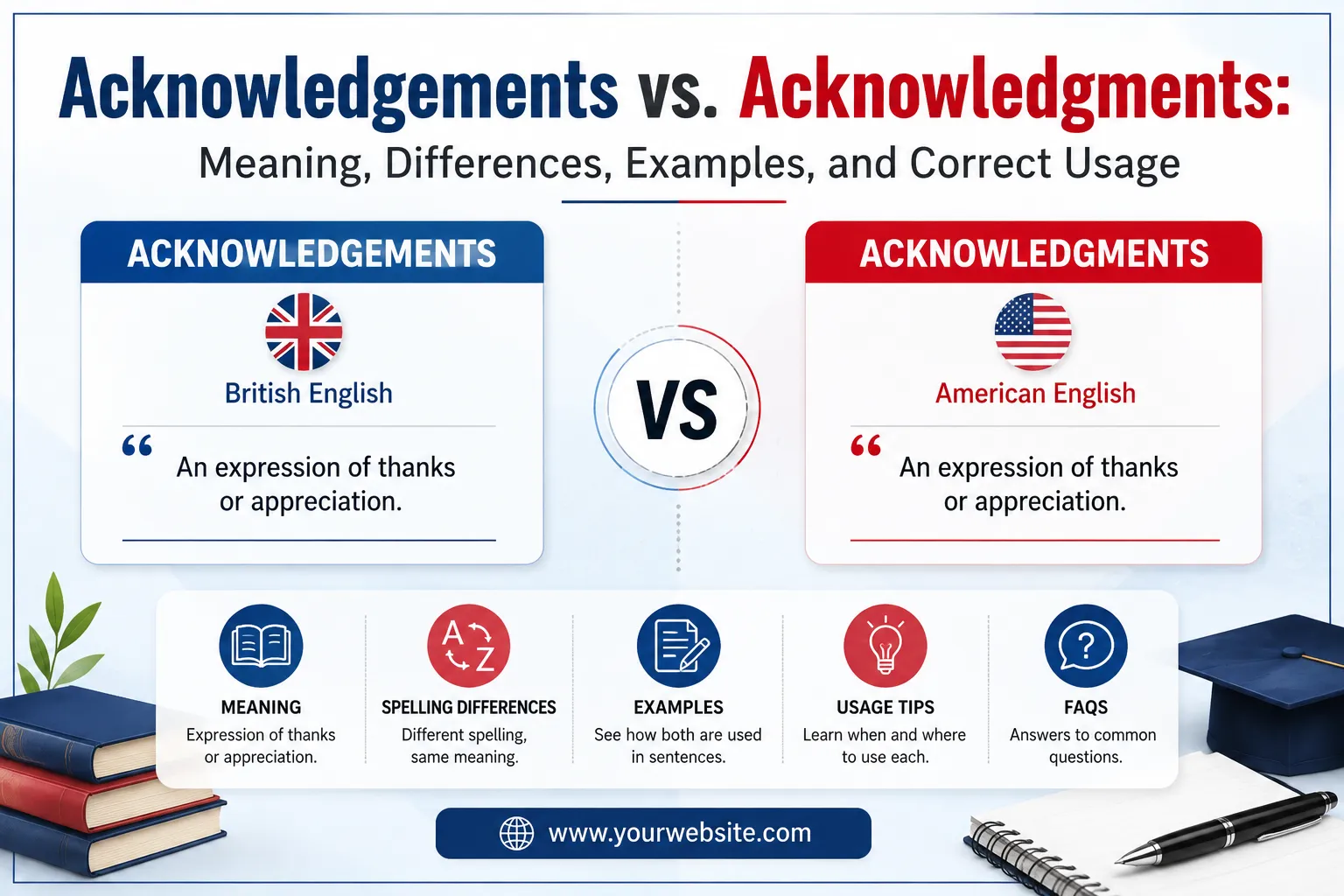
Both acknowledgements and acknowledgments are correct. Acknowledgments is American English, and acknowledgements is British English.
Have you ever wondered whether to write acknowledgements or acknowledgments? Many people ask this question because both spellings are correct. At first glance, the words seem different, but they have the same meaning. The confusion comes from regional spelling preferences rather than grammar.
Many people search for acknowledgements vs acknowledgments to choose the correct spelling. Both are correct, but each is used in a different variety of English.
This guide explains the difference between acknowledgements and acknowledgments, with their meanings, examples, and correct usage. By the end, you’ll know which spelling to use.
Acknowledgements vs Acknowledgments – Quick Answer
Quick Answer: Both acknowledgements and acknowledgments are correct.
- Acknowledgments is the preferred spelling in American English.
- Acknowledgements is the preferred spelling in British English and most Commonwealth countries.
Examples
- American English: The book includes a page of acknowledgments.
- British English: The thesis begins with acknowledgements.
Both words have the same meaning. The only difference is regional spelling.
The Origin of Acknowledgements vs Acknowledgments
The word acknowledge comes from Middle English and means to admit, recognize, or show thanks. The noun was later formed by adding the suffix -ment.
Over time, two spellings became accepted:
- Acknowledgments (without the extra e) became the standard in American English.
- Acknowledgements (with the extra e) remained more common in British English.
Both spellings are recognized by major dictionaries.
British English vs American English Spelling
This is one of the few English words with accepted regional spelling differences.
Meaning
British English
American English
Section thanking contributors

Acknowledgements
Acknowledgments
Recognition or thanks
Acknowledgements
Acknowledgments
Examples
British English
American English
Please read the acknowledgements.
Please read the acknowledgments.
The acknowledgements appear before Chapter 1.
The acknowledgments appear before Chapter 1.
Which Spelling Should You Use?
Choose the spelling based on your audience.
Audience
Recommended Spelling
United States
Acknowledgments
United Kingdom
Acknowledgements
Canada
Either (follow your style guide)
Australia
Acknowledgements
New Zealand
Acknowledgements
Global audience
Match your chosen English style consistently
If you are writing a university thesis, always follow your institution’s formatting guide.
Common Mistakes with Acknowledgements vs Acknowledgments
Many writers switch between both spellings in the same document. This creates inconsistency.
Incorrect
Correct

Acknowledgements on one page and acknowledgments on another
Use one spelling consistently
Mixing British and American spelling
Choose one English style
Assuming one spelling is wrong
Both spellings are correct
Tip: Stay consistent throughout your document.
Acknowledgements vs Acknowledgments in Everyday Examples
Emails
- I would like to include special acknowledgments in the report.
- Please review the acknowledgements section before submission.
News
- The author’s acknowledgments thanked medical staff.
- The report ended with acknowledgements for volunteers.
Social Media
- Huge acknowledgments to everyone who supported us!
- Special acknowledgements to our amazing team.
Formal Writing
- The dissertation includes detailed acknowledgements.
- The research paper begins with acknowledgments.
Acknowledgements vs Acknowledgments – Google Trends & Usage Data
Many students and writers search for acknowledgements vs acknowledgments to choose the correct spelling.
General usage patterns show:
- Acknowledgments is more common in the United States.
- Acknowledgements is more common in British English and most Commonwealth countries.
- Students often search for the correct spelling for their thesis.
Comparison Table
Feature
Acknowledgements
Acknowledgments
Meaning
Expression of thanks
Expression of thanks
British English
Preferred
Less common
American English
Less common
Preferred
Correct?
Yes
Yes
Academic Use
Common in UK
Common in US
Frequently Asked Questions
1. Is acknowledgements or acknowledgments correct?
Both are correct. The preferred spelling depends on whether you use British or American English.

2. Which spelling should I use in my thesis?
Follow your university’s style guide. UK universities often prefer acknowledgements, while US universities usually prefer acknowledgments.
3. Is acknowledgments American English?
Yes. Acknowledgments is the standard spelling in American English.
4. Is acknowledgements British English?
Yes. Acknowledgements is the preferred British English spelling.
5. Do both words have the same meaning?
Yes. They both refer to giving thanks or recognizing contributions.
6. Can I use both spellings in one document?
No. Choose one spelling and use it consistently.
7. Which spelling is better for international readers?
Either is acceptable, but consistency with your chosen English style is most important.
Conclusion
The difference between acknowledgements and acknowledgments is based on regional spelling, not meaning. Both words refer to expressing gratitude or recognizing the contributions of others.
American English: Acknowledgments
British English: Acknowledgements
Choose the spelling that matches your audience or style guide. Most importantly, remain consistent throughout your document. Mixing both spellings can make your writing appear unprofessional.
Use acknowledgments in American English and acknowledgements in British English.
Related articles: Bolder or Boulder: Rock or Comparative Word?, Boney or Bony: Which Spelling Is Correct?, Scarred or Scared: Past Tense and Adjectives.
See the dictionary definitions for acknowledgements and acknowledgments.

Daniel R. Foster is an experienced English language writer and editor who specializes in explaining commonly confused words and grammar nuances. With a strong passion for clarity in communication, he creates easy-to-understand comparisons that help learners, students, and professionals use English more confidently. His articles focus on accuracy, real-world examples, and practical usage.