Words that sound the same but have different meanings often create confusion in English. By vs Buy vs Bye is one of the most common spelling questions searched by English learners, writers, and students. These three words have identical pronunciation, but their meanings and uses are completely different. Using the wrong word can change the meaning of a sentence and make writing look unprofessional.
Many people confuse these words because English has many homophones if words that sound alike but have different spellings and meanings. For example, “I will buy a book,” “The book was written by an author,” and “Bye, see you tomorrow” all contain words that sound similar but serve different purposes.
By vs Buy vs Bye:Quick Answer
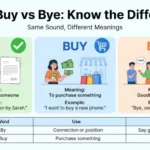
| Word | Meaning | Example |
| By | A preposition used to show location, method, time, or the person who does something | The book was written by Sarah. |
| Buy | A verb meaning to purchase something | I want to buy a new phone. |
| Bye | A short way to say goodbye | Bye, see you tomorrow. |
Simple Memory Trick:
- By = Near or done by someone
The painting was made by an artist. - Buy = Get something with money
I will buy a dress. - Bye = Goodbye
Bye! Have a nice day.
The Origin of By vs Buy vs Bye
The confusion between By, Buy, and Bye comes from their shared pronunciation and different historical roots.
Origin of “Bye”
The word bye comes from the phrase “goodbye,” which was originally shortened from “God be with ye.” Over time, people began using “bye” as a casual farewell.
Examples:
- Bye, see you soon.
- She waved goodbye.
- He said bye before leaving.
British English vs American English Spelling
The words By, Buy, and Bye are spelled the same in both British English and American English. Unlike some words that change spelling between the UK and the US (such as colour/color or honour/honor), these three words have no spelling differences.
The main difference is not spelling but usage and pronunciation style. Both British and American speakers pronounce these words almost the same, and their meanings remain identical.
Examples in British and American English:
British English:
- I will buy a new jacket.
- The letter was written by my teacher.
- Bye, see you next week.
American English:
- I will buy a new jacket.
- The letter was written by my teacher.
- Bye, see you next week.
By vs Buy vs Bye Comparison Table
| Word | Part of Speech | Meaning | British English Example | American English Example |
| By | Preposition | Near, through, or done by someone | The book was written by an author. | The book was written by an author. |
| Buy | Verb | To purchase something | I will buy some groceries. | I will buy some groceries. |
| Bye | Interjection | A way to say goodbye | Bye, see you later. | Bye, see you later. |
Why Do These Words Cause Confusion?
The main reason people confuse these words is because they are homophones. Homophones have:
- The same sound
- Different spellings
- Different meanings
Other examples of homophones include:
- Two / Too / To
- Their / There / They’re
- Sea / See
Learning the meaning behind each word makes it easier to choose the correct spelling.
Which Spelling Should You Use?

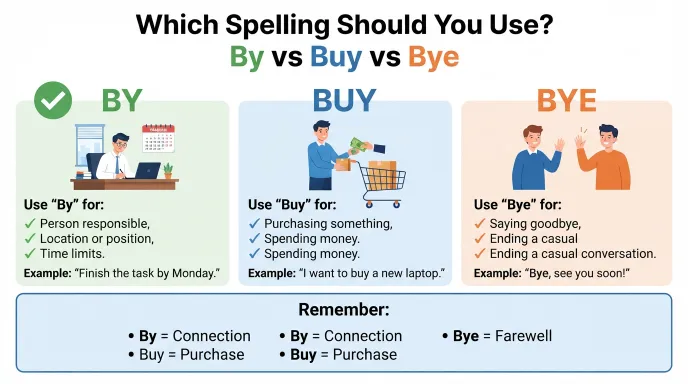
Since By, Buy, and Bye have different meanings, the correct choice depends on what you want to say.
For US English Writers
American English uses all three words in the same way:
- Use by when talking about a person, place, method, or deadline.
- Use buy when talking about purchasing.
- Use bye when leaving or ending a conversation.
Examples:
✅ The report was completed by Tom.
✅ I need to buy a new laptop.
✅ Bye, have a great weekend
For UK and Commonwealth Writers
British English follows the same rules.
Examples:
✅ Please send the email by Friday.
✅ I want to buy a new pair of shoes.
✅ Bye, see you tomorrow.
There is no British spelling alternative for these words.
For Global English Users
English learners worldwide should remember the simple rule:
- By = connection or position
- Buy = purchase
- Bye = farewell
Using the correct word improves clarity in:
- Emails
- Business writing
- School assignments
- Online communication
- Professional documents
Common Mistakes with By vs Buy vs Bye
Even experienced English users sometimes confuse these words because they sound identical.
Mistake 1: Using “Buy” Instead of “By”
❌ The book was written buy Mark.
✅ The book was written by Mark.
Why?
“By” shows who completed an action. “Buy” means to purchase.
Mistake 2: Using “By” Instead of “Buy”
❌ I want to by a new phone.
✅ I want to buy a new phone.
Why?
The sentence means purchasing a phone, so buy is correct.
Mistake 3: Using “Bye” in Formal Writing
❌ Dear Manager, bye for now.
✅ Dear Manager, thank you for your time.
Why?
“Bye” is casual and usually used in conversations.
Mistake 4: Confusing “Bye” with “Buy”
❌ I will say buy before leaving.
✅ I will say bye before leaving.
Why?
“Bye” means goodbye, while “buy” relates to shopping.
By vs Buy vs Bye in Everyday Examples
Understanding By, Buy, and Bye becomes easier when you see how they appear in real-life situations. These words are used in conversations, emails, news reports, social media posts, and formal writing every day.
By in Everyday Examples
By is commonly used to show who did something, where something is located, how something happens, or a deadline.
In Emails:
✅ Please send the document by Friday.
✅ The report was prepared by the marketing team.
In News:
✅ The new bridge was designed by international engineers.
✅ The decision was announced by government officials.
On Social Media:
✅ Photo taken by my best friend.
✅ A great story shared by many users.
In Formal Writing:
✅ The research was completed by a group of scientists.
✅ The project must be finished by the end of the month.
Buy in Everyday Examples
Buy is used when someone purchases something or gets something in exchange for money.
In Emails:
✅ You can buy the software license online.
✅ Customers can buy tickets through our website.
In News:
✅ Consumers are choosing to buy more environmentally friendly products.
✅ People rushed to buy the latest smartphone.
On Social Media:
✅ I just bought a beautiful dress!
✅ Where can I buy this product?
In Formal Writing:
✅ Businesses often buy materials from trusted suppliers.
✅ Customers prefer to buy products with good reviews.
Bye in Everyday Examples
Bye is a casual farewell used when leaving a conversation or ending communication.

In Emails:
✅ Bye for now! (Casual email)
✅ Talk soon, bye!
(For formal emails, use “Regards” or “Sincerely” instead.)
In Conversations:
✅ Bye! See you tomorrow.
✅ She said bye before leaving.
On Social Media:
✅ Bye everyone, see you next week!
✅ Saying bye to an amazing place.
By vs Buy vs Bye:Google Trends & Usage Data
Search interest for By vs Buy vs Bye usually comes from students, English learners, writers, and people checking grammar mistakes.
The popularity of these searches changes depending on:
- Education levels
- English learning trends
- Online writing needs
- Grammar correction searches
Usage Trends by Context
| Word | Search Interest Reason | Common Users |
| By | Grammar meaning and sentence usage | Students, writers, learners |
| Buy | Shopping and purchasing questions | Consumers, online shoppers |
| Bye | Meaning and farewell usage | Language learners, children |
Countries Where This Topic Is Popular
The confusion between By, Buy, and Bye is common in countries where English is widely learned as a second language, including:
- India
- Pakistan
- Philippines
- United States
- United Kingdom
- Canada
- Australia
English learners often search these words because pronunciation alone does not show the correct spelling.
Frequently Asked Questions
1. Are By, Buy, and Bye pronounced the same?
Yes. By, Buy, and Bye are homophones. They have the same pronunciation but different meanings and spellings.
2. Is “buy” a noun or a verb?
Buy is mainly a verb meaning to purchase something.
Example:
✅ I want to buy a new computer.
It can also be used as a noun in informal English:
✅ That phone was a good buy.
3. Can I use “bye” in a formal email?
Usually, no. Bye is casual. In professional emails, use:
- Regards
- Best wishes
- Sincerely
4. How can I remember the difference between by, buy, and bye?
Use this simple trick:
- By = beside or done by someone
- Buy = pay money for something
- Bye = goodbye
5. Is “buyed” the past tense of buy?
No. The correct past tense is bought.
❌ I buyed a book.
✅ I bought a book.
6. Do British and American English use these words differently?
No. Both British and American English use By, Buy, and Bye with the same meanings and spellings.
7. Why are these words confusing?
They are confusing because English has many homophones. Words can sound the same while having different spellings and meanings.
Conclusion
Understanding the difference between By vs Buy vs Bye is important for clear and correct English communication. Although these three words sound exactly the same, they have completely different meanings. By is used for connections, locations, methods, and people who complete actions. Buy means to purchase something with money. Bye is a friendly way to say goodbye.
These words do not change between British and American English, making them easier to learn once their meanings are clear.
Loren more!
Cutesie or Cutesy: Which Is Correct?
Foot or Feet: The Complete Usage Guide
QQQM or QQQ? Which ETF Should You Choose?
Related articles: Employees or Employee’s: Which One Is Correct?.
See the dictionary definitions for by, buy, and bye.