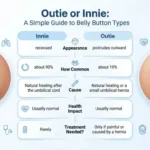
Have you ever wondered if you have an outie or innie belly button? Many people search for this question because they want to understand the difference between the two, learn how belly buttons form, or find out if one type is healthier than the other. The good news is that both are completely normal.
The confusion often comes from myths on social media and online discussions. Some people believe an outie belly button is caused by the doctor cutting the umbilical cord in a certain way, while others think it means there is a health problem.
In reality, that is usually not true. An innie is simply a belly button that curves inward, while an outie sticks outward. Most people have an innie, but millions of healthy people have outies too.
In this guide, you’ll learn the difference between outie or innie, how each type develops, common myths, real life examples, Google Trends insights, and answers to the most frequently asked questions.
Outie or Innie :Quick Answer
An innie belly button goes inward, while an outie sticks outward.
Examples
- ✔ She has an innie belly button.
- ✔ He was born with an outie.
- ✔ Both outies and innies are normal.
There is no “better” type. Most people have innies, but both are healthy unless they cause pain or swelling.
The Origin of Outie or Innie
The terms outie and innie describe the appearance of a person’s belly button after the umbilical cord heals.
Before birth, every baby is connected to the mother through the umbilical cord. After birth, the cord is cut, and the remaining stump dries up and falls off. As the skin heals, the belly button becomes either an innie or an outie.
Contrary to popular belief, doctors do not decide whether a baby will have an outie or an innie by the way they cut the cord
. The final shape depends on how the body heals. In rare cases, an outie may be caused by a small umbilical hernia.
Outie vs Innie Comparison
| Feature | Innie | Outie |
| Appearance | Curves inward | Sticks outward |
| Commonness | Very common | Less common |
| Health | Usually normal | Usually normal |
| Cause | Natural healing | Natural healing or rarely a hernia |
| Medical concern | Usually none | Usually none unless painful |
Are Outies and Innies Healthy?
Yes. Both types are healthy in most cases.
An outie does not automatically mean there is a medical problem. However, you should see a doctor if your belly button:
- Hurts
- Becomes swollen
- Leaks fluid
- Bleeds
- Develops a lump that grows larger
Otherwise, an outie or innie is simply a normal body difference.
Common Myths About Outie or Innie
Myth 1: Doctors create outies.
Fact: Belly button shape depends on healing, not how the cord is cut.
Myth 2: Outies are unhealthy.
Fact: Most outies are completely healthy.
Myth 3: Everyone is born with an innie.
Fact: Belly buttons form after the umbilical cord heals.
Myth 4: An outie always needs surgery.
Fact: Surgery is only needed if there is a medical condition, such as a hernia.
Outie or Innie in Everyday Examples
Here are common ways the terms appear in daily life.
“The school nurse confirmed that both outie and innie belly buttons are normal.”
News
“Doctors explained that belly button shape depends on natural healing.”
Social Media
“Team Outie or Team Innie? Which one do you have?”
Formal Writing
“The study found that most participants had an innie belly button.”
Outie or Innie :Google Trends & Usage Data

Searches for outie or innie increase whenever:
- Parents ask about newborn belly buttons.
- Health websites discuss baby care.
- Social media starts body positive trends.
- TV shows or celebrities mention belly button types.
Popular Countries
- United States
- United Kingdom
- Canada
- Australia
- India
People usually search this keyword to learn:

- Which type is more common
- If an outie is normal
- How belly buttons form
- If surgery is ever needed
Interest also rises after viral TikTok, Instagram, and YouTube discussions about body differences.
Comparison Table
| Outie | Innie |
| Belly button sticks out | Belly button curves inward |
| Less common | More common |
| Usually natural | Usually natural |
| May rarely involve a hernia | Rarely linked to medical issues |
| Healthy in most cases | Healthy in most cases |
Frequently Asked Questions
1. Which is more common, an outie or innie?
An innie is much more common. Around 90% of people have an innie.
2. Can an outie become an innie?
Usually no. The shape stays the same after healing unless surgery changes it.
3. Is an outie a disability since birth defect?
No. Most outies are a normal result of healing.
4. Can adults develop an outie?
Yes. In some cases, pregnancy or an umbilical hernia can make the belly button stick out.
5. Does the doctor decide if a baby has an outie?
No. The way the umbilical cord is cut does not determine the belly button type.
6. Should I worry about my outie belly button?
Only if it becomes painful, swollen, or starts leaking fluid. Otherwise, it is usually normal.
7. Are outies and innies inherited?
Genetics may play a small role, but healing after birth is the biggest factor.
Conclusion
The answer to outie or innie is simple. An innie curves inward, while an outie sticks outward. Both are normal, healthy, and natural for most people
. The shape of your belly button is mainly determined by how your body heals after the umbilical cord falls off not by how the doctor cuts the cord.
Although innies are more common, having an outie is usually nothing to worry about. Understanding the facts helps clear up common myths and gives parents, students, and curious readers the confidence to know that both types are perfectly normal.
If a belly button becomes painful, swollen, or changes suddenly, it is best to seek medical advice. Otherwise, your belly button is simply another unique part of your body.
Read more about!
Related articles: Many or Meny: Which Spelling Is Correct?, Recur or Reoccur: Which Is Correct?, Lilly or Lily: Spelling Rules Explained.
See the dictionary definitions for outie and innie.

Daniel R. Foster is an experienced English language writer and editor who specializes in explaining commonly confused words and grammar nuances. With a strong passion for clarity in communication, he creates easy-to-understand comparisons that help learners, students, and professionals use English more confidently. His articles focus on accuracy, real-world examples, and practical usage.