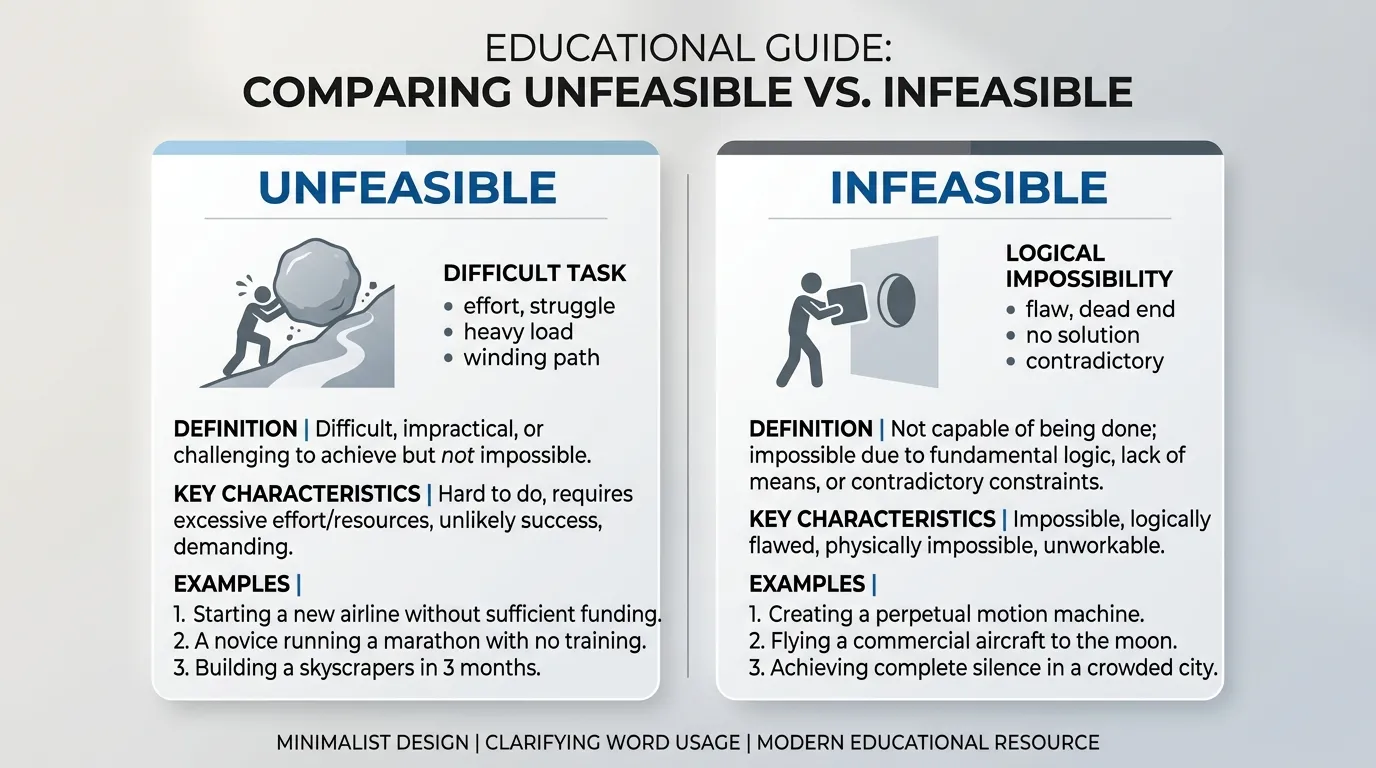
Infeasible is the more common and widely preferred word for something that is not practical, possible, or workable. Unfeasible also exists and can be understood with the same basic meaning, but infeasible is generally the better choice in formal and standard writing.
Unfeasible vs. Infeasible: Quick Comparison
| Word | Meaning | Commonness | Example |
| Infeasible | Not practical or possible | More common | The plan is infeasible. |
| Unfeasible | Not feasible or workable | Less common | The proposal was considered unfeasible. |
| Best general choice | Use infeasible | Widely preferred | The project is financially infeasible. |
Choosing between unfeasible and infeasible can be confusing because both words seem to mean the same thing. They are both formed from feasible, which means possible, practical, or workable.
If something can be done successfully, it is feasible. If it cannot reasonably be done, it is usually described as infeasible.
For example:
The project is feasible.
This means the project is possible or practical.
The project is infeasible.
This means the project is not practical or cannot reasonably be carried out.
You may also come across unfeasible, and the word is understandable and has been used in English. However, infeasible is much more common and is usually the safer choice when you want clear, standard, formal English.
Let’s explore the difference in detail.
What Does Infeasible Mean?
Infeasible is an adjective that means not feasible.
It describes something that is not practical, realistic, possible, or workable under the circumstances.
For example:
The plan is financially infeasible.
This means the plan cannot realistically be carried out because of financial limitations.
Another example:
Building a road through the mountain is infeasible.
This means building the road is not considered practical or realistically achievable.
The word is especially common when discussing:
- Plans
- Projects
- Business ideas
- Engineering
- Construction
- Technology
- Financial decisions
- Research
- Government projects
- Solutions
What Does Unfeasible Mean?
Unfeasible is also used to describe something that is not feasible or practical.
For example:
The proposal was considered unfeasible because of its high cost.
The meaning is clear. The proposal was not considered practical.
However, unfeasible is less common than infeasible. Because of this, many writers prefer infeasible, especially in formal or professional writing.
So, while unfeasible can be encountered in English, infeasible is normally the stronger default choice.
Infeasible vs. Unfeasible: Full Comparison
| Feature | Infeasible | Unfeasible |
| Part of speech | Adjective | Adjective |
| Basic meaning | Not feasible | Not feasible |
| Meaning | Not practical, possible, or workable | Not practical, possible, or workable |
| Usage | Very common | Less common |
| Formal writing | Commonly preferred | Less preferred |
| Business writing | Very common | Less common |
| Technical writing | Common | Less common |
| Example | The plan is infeasible. | The plan is unfeasible. |
The main difference is therefore usage and preference, rather than a major difference in meaning.
What Does Feasible Mean?
To understand these words, it helps to understand feasible.
Feasible means something is possible, practical, or capable of being successfully done.
For example:
The project is feasible.
This means the project can realistically be completed.
The idea sounds feasible.
This means the idea seems practical or possible.
When you add the prefix in-, you get:
feasible → infeasible
The meaning changes to the opposite:
infeasible = not feasible
Examples
The plan is feasible.
The plan is infeasible.
The first says the plan is practical.
The second says the plan is not practical.
Why Is Infeasible More Common?
English often uses prefixes to create words with opposite meanings. In this case, in- creates the negative form of feasible.
This gives us:
feasible → infeasible
The word infeasible has become the established and widely recognized form in many areas of English.
You will often find it in formal discussions about whether something can actually be done.
For example:
The proposed solution is technically infeasible.
The construction plan is financially infeasible.
The deadline makes the project infeasible.
These sentences sound natural in professional English.
Is Unfeasible Wrong?
Not necessarily.
Unfeasible can be found in English and its meaning is understandable. However, it is much less common than infeasible.
If you are deciding which word to use in an essay, report, business document, academic paper, or professional communication, infeasible is generally the better choice.
For example:
Preferred:
The proposed solution is infeasible.
Less common:
The proposed solution is unfeasible.
The first version is more natural for most formal contexts.
Infeasible in Everyday Examples
Let’s look at some common sentences with infeasible.
Plans
The original plan became infeasible after the budget was reduced.
The plan was no longer practical.
Business
Opening another branch is currently financially infeasible.
The business cannot realistically afford it.
Construction
Building the bridge in this location is technically infeasible.
The construction cannot reasonably be completed using the available methods or conditions.
Travel
Driving there in one hour is infeasible because of the distance.
The goal is not realistically possible.
Technology
The design is infeasible with the current technology.
The design cannot currently be achieved in a practical way.
Unfeasible in Sentences
Although infeasible is preferred, you may still encounter unfeasible.
The proposal was described as unfeasible.
The original schedule proved unfeasible.
The plan became unfeasible after costs increased.
These sentences can be understood, but many readers would naturally expect infeasible instead.
A more common version would be:
The proposal was described as infeasible.
The original schedule proved infeasible.
The plan became infeasible after costs increased.
Common Mistakes
Mistake 1: Assuming Both Words Are Equally Common
Both forms can be encountered, but they are not equally common.
Infeasible is the usual choice in modern standard usage.
Mistake 2: Using Unfeasible in Formal Writing
You may not always be wrong if you use unfeasible, but infeasible is generally more natural in formal writing.
Instead of:
The proposed project is unfeasible.
Prefer:
The proposed project is infeasible.
Mistake 3: Confusing Infeasible With Impossible
Infeasible and impossible can be similar, but they are not always identical.
Impossible often means something cannot happen or cannot be done at all.
Infeasible often means something is not practical, realistic, or workable under the current conditions.
For example:
The plan is impossible.
This can suggest that the plan cannot be done.
The plan is infeasible.
This may mean the plan could theoretically be possible, but it is not practical because of cost, time, resources, technology, or other limitations.
Infeasible vs. Impossible
This distinction is important in professional writing.
Imagine a company wants to build a new factory.
The factory may technically be possible to build, but the cost could be extremely high.
In that case, you might say:
The project is financially infeasible.
You would not necessarily say it is absolutely impossible.
This makes infeasible useful when discussing real-world limitations.
Common reasons something may be infeasible
Something can be infeasible because of:
- High costs
- Limited time
- Lack of resources
- Technical limitations
- Safety concerns
- Physical restrictions
- Legal restrictions
- Lack of equipment
- Staffing problems
Infeasible in Formal Writing
Infeasible works well in professional and academic contexts.
Examples:
The proposed solution was found to be economically infeasible.
The construction project is currently financially infeasible.
The researchers concluded that the method was technically infeasible.
The schedule is infeasible given the available resources.
These examples show how the word can describe different types of practical limitations.
How to Remember Infeasible
A simple memory trick is to start with feasible.
Think:
Feasible = possible or practical
Then add in-:
Infeasible = not possible or practical
For example:
Feasible: The plan can work.
Infeasible: The plan cannot reasonably work.
You can also remember that infeasible is the form you are more likely to see in formal writing.
Which One Should You Use?
If you are unsure, choose infeasible.
It is the more common and widely preferred form, especially in:
- Academic writing
- Business writing
- Technical documents
- Reports
- Professional communication
- Formal explanations
Use unfeasible only when there is a specific reason to use that less common form.
For most readers, infeasible will sound more natural.
Feasible, Infeasible, and Unfeasible
Here is a simple way to see the relationship:
| Word | Meaning |
| Feasible | Possible or practical |
| Infeasible | Not possible or practical |
| Unfeasible | Not feasible, less common |
Example
Feasible:
The project can be completed within the budget.
Infeasible:
The project cannot be completed within the budget.
Unfeasible:
The project is not practical within the budget.
The second and third sentences communicate a similar basic idea, but infeasible is the more usual choice.
Frequently Asked Questions
Is infeasible or unfeasible correct?
Both words can be used, but infeasible is the more common and generally preferred form.
Is unfeasible a real word?
Yes, unfeasible is found in English and means not feasible. However, it is less common than infeasible.
Is infeasible the opposite of feasible?
Yes. Feasible means possible or practical, while infeasible means not feasible, practical, or workable.
Which is better for formal writing, infeasible or unfeasible?
Infeasible is generally the better choice for formal, academic, technical, and professional writing.
Does infeasible mean impossible?
Not always. Infeasible often means something is not practical or workable under particular conditions. Impossible can suggest that something cannot be done at all.
Can I use unfeasible in an essay?
You can encounter and use unfeasible, but infeasible is generally the more natural choice for an essay or other formal writing.
What is the easiest way to remember infeasible?
Remember feasible = practical and infeasible = not practical. When in doubt, use infeasible.
Conclusion
Unfeasible and infeasible both express the basic idea of something that is not feasible, practical, or workable. However, they are not equally common.
Infeasible is the standard choice for most modern English writing. It is widely used in business, academic, technical, scientific, and professional contexts.
Unfeasible can also be found and understood, but it is much less common. For that reason, choosing infeasible will usually make your writing sound more natural and familiar to readers.
Remember the simple relationship:
Feasible = practical or possible
Infeasible = not practical or possible
If you are writing a formal sentence and are deciding between the two, infeasible is generally the safer choice.
Fiber or Fibre: Which Spelling Should You Use? 🌾

I’m an experienced article writer who creates clear, engaging, and SEO-friendly content that helps readers find the information they need. I specialize in writing well-researched articles, blog posts, guides, and informative content on a wide range of topics.
My writing focuses on simple language, strong structure, accurate information, and search intent. I aim to make every article easy to read while also helping websites improve their visibility on search engines.
I enjoy turning complex topics into useful, reader-friendly content that informs, answers questions, and keeps readers engaged. Whether you need an SEO article, blog post, educational guide, or website content, I can create content tailored to your audience and goals.