Have you ever paused while writing because you weren’t sure if to use accept or except? You’re not alone. These two words look and sound similar, making them one of the most commonly confused word pairs in English. Even fluent speakers sometimes mix them up because only one letter changes, but their meanings are completely different.
People often search for accept vs except to avoid grammar mistakes in emails, school assignments, business documents, and social media posts. Using the wrong word can change the meaning of an entire sentence and make your writing less professional.
Accept vs Except :Quick Answer
The difference is simple:
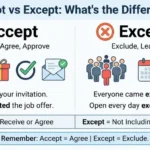
- Accept = to receive, agree to, or approve something.
- Except = not including; excluding someone or something.
Examples
✅ I accept your invitation.
✅ She accepted the job offer.
Quick Memory Trick
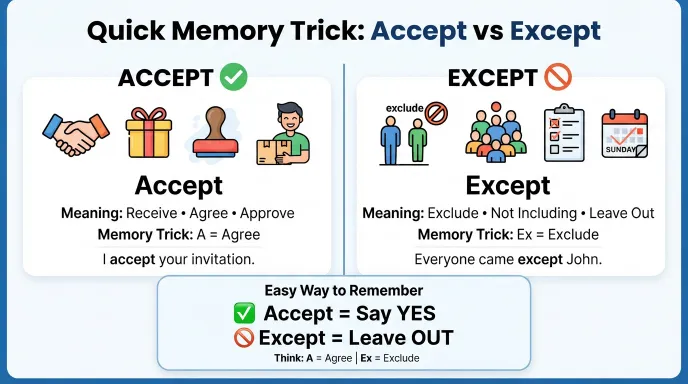
- Accept = Agree or Approve.
- Except = Exclude.
If you mean receive or agree, use accept.
If you mean leave out, use except.
The Origin of Accept vs Except
The words accept and except share similar Latin roots, which explains why they look alike.
Accept
The word accept comes from the Latin word acceptare, meaning “to receive willingly” or “to welcome.”
Over time, English kept this meaning. Today, accept means receiving something, agreeing to something, or saying yes.
Examples:
- Accept a gift
- Accept responsibility
- Accept an invitation
Except
Except comes from the Latin word exceptus, meaning “taken out.”

Its meaning has remained nearly unchanged for centuries.
Today it means:
- excluding
- leaving out
- other than
Examples:
- Everyone except Sam
- Open every day except Monday
Although the spellings are similar, their meanings developed in completely different directions.
British English vs American English Spelling
Unlike many English word pairs, accept and except have exactly the same spelling in both British and American English.
There are no spelling differences.
Only the meaning changes.
Examples
| British English | American English |
| I accept your apology. | I accept your apology. |
| Everyone except James arrived. | Everyone except James arrived. |
| We accepted the proposal. | We accepted the proposal. |
| The office is closed except weekends. | The office is closed except weekends. |
Comparison Table
| Feature | Accept | Except |
| Meaning | Receive or agree | Excluding |
| Part of Speech | Verb | Preposition, conjunction, verb |
| British English | Same | Same |
| American English | Same | Same |
| Pronunciation | /əkˈsept/ | /ɪkˈsept/ |
Key Point: British and American English use the same spelling and meaning.
Which Spelling Should You Use?
Since accept and except are different words, this is not a British vs American spelling issue. Instead, choose the word based on the meaning of your sentence.
Use Accept When You Mean:
- To receive something
- To agree with something
- To approve or say yes
Examples
- I accept your offer.
- She accepted the award.
- They accepted the new rules.
- We accept online payments.
Use Except When You Mean:
- Leaving someone or something out
- Not including
- Other than
Examples
- Everyone came except Tom.
- The museum is open every day except Monday.
- All the files loaded except one.
- I like every fruit except bananas.
AudienceifBased Advice
| Audience | Recommended Usage |
| United States | Use accept for receiving or agreeing; except for excluding. |
| United Kingdom | Same as American English. |
| Canada | Same usage. |
| Australia | Same usage. |
| New Zealand | Same usage. |
| International Audience | Follow the meaning of the sentence. Both words are standard worldwide. |
Tip: Don’t choose based on country. Choose based on meaning.
Common Mistakes with Accept vs Except
Because the words sound similar, writers often replace one with the other. Here are the most common mistakes.
Mistake 1: Using “Except” Instead of “Accept”
❌ I except your apology.
✅ I accept your apology.
Mistake 2: Using “Accept” Instead of “Except”
❌ Everyone came accept Sarah.
✅ Everyone came except Sarah.
Mistake 3: Confusing Similar Pronunciation
Many learners hear the words quickly in conversation and choose the wrong spelling.
❌ We except all credit cards.
✅ We accept all credit cards.
Mistake 4: Forgetting the Meaning
Instead of memorizing spelling alone, remember the purpose.
Mistake 5: Relying Only on Spell Check
Spell check usually won’t catch this mistake because both words are spelled correctly. Always read the sentence for meaning.
Quick Correction Table

| Incorrect | Correct | Why |
| I except your invitation. | I accept your invitation. | Receiving an invitation. |
| Everyone accept Mike came. | Everyone except Mike came. | Mike is excluded. |
| We except online orders. | We accept online orders. | Receiving orders. |
| All students accept Ali passed. | All students except Ali passed. | Ali is left out. |
| She accepted everyone accept John. | She accepted everyone except John. | John is excluded. |
Accept vs Except in Everyday Examples
Understanding these words becomes much easier when you see them in realiflife situations.
In Emails
- We accept your request.
- We accept your payment.
- All applications are complete except yours.
- In News Headlines
- On Social Media
- In Formal Writing
- The committee accepted the recommendation.
- All employees attended except those on leave.
- The organization accepts donations throughout the year.
Everyday Usage Summary
| Situation | Accept | Except |
| Receiving a gift | ✅ | ❌ |
| Agreeing to an offer | ✅ | ❌ |
| Excluding someone | ❌ | ✅ |
| Leaving out information | ❌ | ✅ |
| Approving an application | ✅ | ❌ |
| Saying “not including” | ❌ | ✅ |
Accept vs Except: Google Trends & Usage Data
Although accept and except are both common English words, they are used in different situations. Many people search for “accept vs except” because they sound alike and are often confused in writing.
Google Search Interest
Searches for accept vs except remain steady throughout the year because:
- Students study commonly confused words.
- Writers proofread emails and reports.
- Job seekers want erroriffree applications.
- English learners improve grammar skills.
- Teachers and editors explain the difference.
Popular Countries
The keyword accept vs except is frequently searched in:
| Country | Reason for Interest |
| United States | Grammar learning and education |
| United Kingdom | English writing and proofreading |
| Canada | Academic writing |
| Australia | ESL learning |
| India | Competitive exams and English education |
| Pakistan | School, college, and professional writing |
Usage Context
| Word | Most Common Use |
| Accept | Offers, invitations, payments, apologies, responsibility |
| Except | Exclusions, lists, rules, schedules, instructions |
Popular Search Queries
People also search for:
- accept or except
- accept vs except meaning
- difference between accept and except
- when to use accept
- when to use except
- accept and except examples
- accept vs except grammar
- accept vs except sentences
Accept vs Except Comparison Table
| Feature | Accept | Except |
| Meaning | Receive, agree, approve | Excluding, leaving out |
| Part of Speech | Verb | Preposition, conjunction, verb |
| Used For | Receiving something | Excluding something |
| Opposite Idea | Reject | Include |
| Example | I accept your offer. | Everyone came except Tom. |
| British English | Same spelling | Same spelling |
| American English | Same spelling | Same spelling |
| Common Mistake | Used instead of except | Used instead of accept |
Frequently Asked Questions
1. What is the difference between accept and except?
Accept means to receive, agree, or approve something. Except means leaving someone or something out.
2. Is “accept” a verb?
Yes. Accept is mainly used as a verb.
Example:
- She accepted the invitation.
3. Is “except” a preposition?
Usually, yes. Except is most often used as a preposition meaning “not including.”
Example:
- Everyone passed except Ben.
It can also act as a conjunction or, less commonly, a verb.
4. Do British and American English spell them differently?
No. Both British English and American English use the same spellings: accept and except.
5. How can I remember the difference
Think of this simple trick:
- Accept = Agree (both start with A)
- Except = Exclude (both start with Ex)
6. Can spell check detect mistakes between accept and except?
Not always. Since both are correctly spelled English words, spell check may not notice if you’ve chosen the wrong one. Always check the meaning of your sentence.
7. Which word is more common?
Both words are common, but accept appears more often in everyday communication because people frequently talk about accepting offers, payments, invitations, and responsibilities. Except is common when making exceptions or exclusions.
Conclusion
Understanding the difference between accept and except is easier than it first seems. While the two words look and sound similar, they have completely different meanings. Accept means to receive, agree to, or approve something, whereas except means to leave someone or something out. Remembering this simple distinction will help you avoid one of the most common grammar mistakes in English.
The best way to master these words is through regular practice. Read example sentences, write your own, and always check if your sentence is about receiving something or excluding something. This quick check can prevent embarrassing mistakes in emails, school assignments, business documents, and social media
Learn More!
Ate or Eaten: Which One Is Correct?
Related articles: Delux or Deluxe: Which Spelling Is Correct?, Scarred or Scared: Past Tense and Adjectives, Flavor or Flavour: Which Spelling Is Correct?.
See the dictionary definitions for accept and except.

Miles Thornton is a seasoned author and content specialist with a knack for simplifying complex topics. Passionate about clear, engaging writing, creates articles that inform and inspire readers. With years of experience in digital publishing, Miles combines professionalism with creativity, delivering insightful content for diverse audiences