Many English learners and even native speakers mix up advice vs advise because the words look almost identical. The only visible difference is the last letter if c or s if but that small change creates a completely different part of speech and pronunciation. This common mistake appears in emails, school assignments, business writing, and social media every day.
People search for advice vs advise because they want to know which word is correct in a sentence like “Can you advice me?” or “Thank you for your advise.” These mistakes are easy to make because both words relate to giving guidance. However, one is a noun (a thing) and the other is a verb (an action).
Advice vs Advise :Quick Answer
The difference is simple:
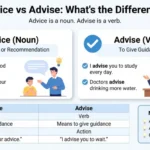
- Advice is a noun. It means guidance or a suggestion.
- Advise is a verb. It means to give guidance or recommend something.
Examples
| Word | Part of Speech | Example |
| Advice | Noun | She gave me good advice. |
| Advise | Verb | I advise you to study every day. |
Quick Memory Trick
- Advice = Thing (the guidance)
- Advise = Action (giving the guidance)
More Examples
✅ I need your advice.
✅ The teacher advised us to revise.
❌ Please advice me.
✔ Please advise me.
❌ Thanks for your advise.
✔ Thanks for your advice.

The Origin of Advice vs Advise
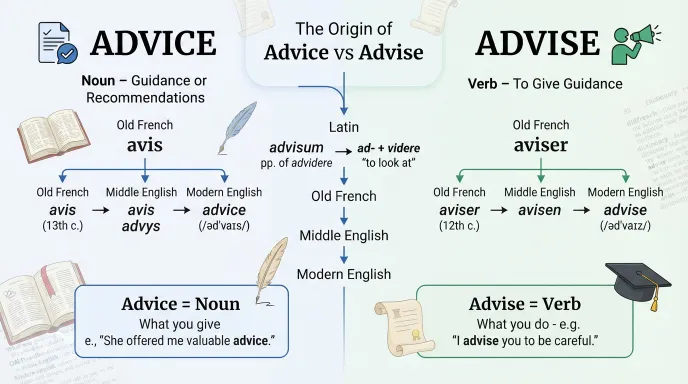
Both advice and advise come from the Old French word aviser, meaning to consider, think about, or give an opinion. This word later entered Middle English, where it gradually developed into two separate forms.
Although both words share the same origin, English gave them different jobs.
- Advice became the noun, referring to the guidance itself.
- Advise became the verb, meaning the act of giving guidance.
This pattern is common in English. Other word pairs follow a similar rule:
| Noun | Verb |
| Advice | Advise |
| Device | Devise |
| Practice (British noun) | Practise (British verb) |
The pronunciation also changed over time.
- Advice ends with the /s/ sound.
- Advise ends with the /z/ sound.
This pronunciation difference helps native speakers tell the words apart even though their spelling is very similar.
Today, both words are standard English and are used worldwide. The only challenge is remembering that advice names the guidance, while advise describes the action of giving it.
British English vs American English Spelling
Unlike many English word pairs, advice and advise are spelled exactly the same in both British English and American English.
There is no spelling difference between the UK and the US.
The only difference is how the words function:
- Advice is always the noun.
- Advise is always the verb.
British English Examples
- My teacher gave me excellent advice.
- I would advise waiting until tomorrow.
American English Examples
- Thanks for your helpful advice.
- Doctors advise drinking plenty of water.
British vs American Comparison Table
| Feature | British English | American English |
| Noun | Advice | Advice |
| Verb | Advise | Advise |
| Meaning | Same | Same |
| Pronunciation | Same | Same |
| Grammar | Same | Same |
| Official Usage | Advice (noun), Advise (verb) | Advice (noun), Advise (verb) |
Key Takeaway
If you write for readers in the UK, the US, Canada, Australia, or anywhere else, the rule never changes:
- Advice = Noun
- Advise = Verb
There are no regional spelling differences for this word pair.
Which Spelling Should You Use?
The answer depends on grammar, not your audience. Unlike many British and American spelling differences, advice and advise are used the same way worldwide.
- Use advice when you mean guidance or a suggestion (noun).
- Use advise when you mean to give guidance (verb).
By Audience
| Audience | Correct Usage |
| United States | Advice (noun), Advise (verb) |
| United Kingdom | Advice (noun), Advise (verb) |
| Canada | Advice (noun), Advise (verb) |
| Australia & New Zealand | Advice (noun), Advise (verb) |
| Global English | Follow the same grammar rule |
Simple Rule to Remember
- Advice = Thing
- Advise = Action
Examples
- My coach gave me useful advice.
- I advise you to save your work often.
- Thank you for your helpful advice.
- Experts advise wearing sunscreen every day.
Common Mistakes with Advice vs Advise
These two words are often confused because they look alike. Here are the most common errors and how to fix them.
| Incorrect | Correct | Why? |
| Please advice me. | Please advise me. | You need a verb. |
| Thanks for your advise. | Thanks for your advice. | You need a noun. |
| She gave good advise. | She gave good advice. | “Gave” takes a noun. |
| I will advice him tomorrow. | I will advise him tomorrow. | After “will,” use a verb. |
| His advise was helpful. | His advice was helpful. | The sentence needs a noun. |
Why These Mistakes Happen
- The words differ by only one letter.
- Both relate to guidance.
- Many learners confuse nouns and verbs.
- Spell check may not catch the error because both are real words.
Easy Memory Trick
- C in Advice = Counsel (a thing you receive).
- S in Advise = Speak (an action you do).
Advice vs Advise in Everyday Examples

Understanding these words in real situations makes them much easier to remember.
In Emails
- Thank you for your valuable advice.
- I would advise scheduling the meeting next week.
In News Articles
- Financial experts advise people to save more.
- The government issued health advice before the storm.
On Social Media
- Can anyone give me travel advice?
- I advise everyone to back up their files.
In Business Writing
- We appreciate your professional advice.
- Our consultants advise clients on investment strategies.
In School
- The teacher gave useful study advice.
- Parents often advise their children to read daily.
Advice vs Advise : Google Trends & Usage Data
Both advice and advise are searched frequently because they are among the most commonly confused English words.
Search Popularity
- Advice receives more searches because it is commonly used in phrases like:
- career advice
- legal advice
- medical advice
- financial advice
- relationship advice
- Advise is searched mostly by learners who want to understand grammar or check correct sentence usage.
Countries Where Searches Are Most Common
- United States
- United Kingdom
- Canada
- Australia
- India
- Pakistan
- Philippines
Common Search Intent
People often search:
- Advice vs advise
- Is it advice or advise?
- How do you use advice?
- Advice meaning
- Advise meaning
- Advice examples
- Advise in a sentence
This shows that users mainly want a quick grammar explanation and real if world examples.
Advice vs Advise Comparison Table
| Feature | Advice | Advise |
| Part of Speech | Noun | Verb |
| Meaning | Guidance or recommendation | To give guidance |
| Function | Thing | Action |
| Example | Thanks for your advice. | I advise you to rest. |
| Pronunciation | Ends with /s/ sound | Ends with /z/ sound |
| British English | Same | Same |
| American English | Same | Same |
| Formal Writing | Yes | Yes |
| Everyday Conversation | Yes | Yes |
Frequently Asked Questions
1. What is the difference between advice and advise?
Advice is a noun that means guidance. Advise is a verb that means to give guidance.
2. Is “Please advice me” correct?
No. The correct sentence is “Please advise me.”
3. Is “Thank you for your advise” correct?
No. The correct sentence is “Thank you for your advice.”
4. Are advice and advise pronounced differently?
Yes.
- Advice ends with an /s/ sound.
- Advise ends with a /z/ sound.
5. Do British and American English spell these words differently?
No. Both use advice as the noun and advise as the verb.
6. Which word is more common?
Advice is generally more common because it appears in many everyday expressions.
7. How can I remember the difference?
Remember:
- Advice = Noun = Thing
- Advise = Verb = Action
Conclusion:
The difference between advice and advise is simple once you know their roles in a sentence. Advice is always a noun, meaning guidance, suggestion, or recommendation. Advise is always a verb, meaning the act of giving guidance. Although they share the same origin and look very similar, they cannot replace each other.
The good news is that there is no British or American spelling difference to remember. Writers around the world follow the same grammar rule. When you need the guidance itself, use advice. When you are talking about giving guidance, use advise. Reading examples, practicing sentences, and remembering “Advice = Thing, Advise = Action” will help you avoid this common mistake. if you’re writing emails, essays, business reports, or social media posts, using these words correctly makes your English clearer and more professional.
See the dictionary definitions for advice and advise.

Hi, I’m Sehrish Iqbal, and I enjoy writing about the English language and the little differences between words that often cause confusion. I create simple and easy-to-understand articles about grammar, spelling, commonly confused words, and correct word usage. My goal is to make English easier to understand and help students, writers, and English learners use the right words with confidence.