Have you ever typed “stationary” when you meant “stationery”? You are not alone. Many English learners and even native speakers confuse these two words because they look almost identical and sound the same. This common spelling confusion often appears in emails, school assignments, business documents, and online writing.
The keyword “Stationary vs Stationery” is searched by people who want to know which spelling is correct and when to use each word. Although these words differ by only one letter, their meanings are completely different. One describes something that does not move, while the other refers to writing materials such as paper, envelopes, and pens.
Understanding the difference helps you avoid grammar mistakes and improve your professional writing
Stationary vs Stationery : Quick Answer
Stationary and stationery are two different words with different meanings.
- Stationary = something that is not moving or staying in one place.
- Stationery = writing materials such as paper, notebooks, envelopes, and pens.
Examples:
✅ Correct:
- The car remained stationary during the traffic jam.
- She bought new stationery for her office.
❌ Incorrect:
- She bought new stationary for writing letters.
- The train was stationery at the station.
Easy Memory Trick:
Remember:
Stationary = Stay still
Both words contain “a” → think “at a standstill.”
Stationery = Envelopes and writing
Both words contain “e” → think “envelope.”
The Origin of Stationary vs Stationery
The confusion between stationary and stationery comes from their similar spelling and shared historical roots.
The word stationary comes from the Latin word “stationarius,” meaning “belonging to a station” or “standing still.” It entered English through Old French and was later used to describe something fixed in one position.
The word stationery has a different history. It comes from the Middle English word “stationer,” which referred to a person who sold books and writing supplies. A stationer was
| Word | Meaning | Example |
| Stationary | Not moving | A stationary bicycle |
| Stationery | Writing supplies | Office stationery |
The spelling difference helps separate these two meanings in modern English.
British English vs American English Spelling
Unlike many English words, Stationary vs Stationery does not have a British and American spelling difference. Both forms are used the same way in the UK, US, Canada, Australia, and other Englishifspeaking countries.
The difference is based on meaning, not regional spelling rules.
Comparison Table
| Word | British English | American English | Meaning |
| Stationary | Stationary | Stationary | Not moving |
| Stationery | Stationery | Stationery | Writing materials |
Examples in Both English Variants:
British English:

- The vehicle remained stationary.
- The company ordered new stationery.
American English:
- The vehicle remained stationary.
- The company ordered new stationery.
Both countries use the same spelling and meaning.
Which Spelling Should You Use?
Choosing between stationary and stationery depends on what you want to say. There is no difference between British and American spelling, so the correct choice is based only on meaning.
Use Stationary When:
Use stationary when you are describing something that is still, fixed, or not moving.
Examples:
- The bus was stationary for ten minutes.
- The machine must remain stationary during the test.
- She watched the stationary bike exercise video.
Use Stationery When:
Use stationery when talking about writing materials.
Examples:
- I bought new stationery for school.
- The company printed its logo on office stationery.
- She keeps beautiful stationery for writing letters.
Audience Advice:
| Audience | Correct Usage |
| Students | Use stationery for notebooks, pens, and paper supplies. |
| Businesses | Use stationery for letterheads and office materials. |
| Drivers/Engineers | Use stationary for objects that are not moving. |
| Online Writers | Check the meaning before choosing the spelling. |
A simple rule:
If it moves → think about “stationary” (still).
If you write on it → think about “stationery” (envelope).
Common Mistakes with Stationary vs Stationery
Many people confuse these words because they look and sound almost identical. Here are the most common mistakes.
Mistake 1: Using “Stationary” for Writing Materials
❌ Incorrect:
- I ordered new office stationary.
✅ Correct:
- I ordered new office stationery.
Why?
Office paper, envelopes, and pens are writing supplies, so the correct word is stationery.
Mistake 2: Using “Stationery” for Something Still
❌ Incorrect:
- The car stayed stationery on the road.
✅ Correct:
- The car stayed stationary on the road.
Why?
The car is not moving, so use stationary.
Mistake 3: Trusting Spell Check
Spellifcheck tools may not catch this error because both words are correctly spelled. They only check spelling, not meaning.
Example:
❌ The company ordered new office stationary.
The spelling is correct, but the word choice is wrong.
Mistake 4: Confusing Similar Sounds
Both words are pronounced almost the same, which makes them difficult to identify in speech.
The best way to avoid mistakes is to remember:
- Stationary = Still
- Stationery = Supplies
Stationary vs Stationery in Everyday Examples
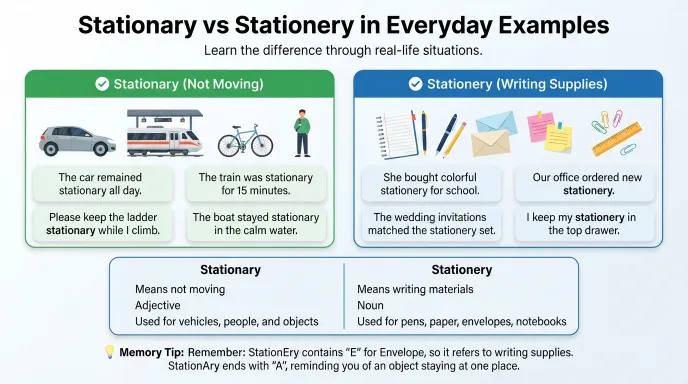
These words appear in many areas of daily communication.
In Emails
Correct Example:
Stationery:
Our company has updated its official stationery with a new logo.
Stationary:
Please keep the equipment stationary while testing.
In News Writing
Stationary:
- The train remained stationary after a technical problem.
Stationery:
- The school received donated stationery for students.
In Social Media Posts
Stationery Example:
New stationery designs can make your study desk more creative.
Stationary Example:
The camera captured a stationary object clearly.

In Formal Writing
Stationery:
- Businesses often use branded stationery for professional communication.
Stationary:
- The laboratory requires all samples to remain stationary during analysis.
Stationary vs Stationery : Google Trends & Usage Data
Search interest for “Stationary vs Stationery” is common because many users want to understand the difference between these two confusing words.
The topic is especially popular among:
- English learners
- Students
- Teachers
- Content writers
- Office professionals
CountryifBased Interest
| Country | Search Interest Reason |
| United States | English writing improvement and grammar learning |
| United Kingdom | Common spelling confusion in education |
| India | High interest among English learners |
| Pakistan | Popular among students and writers |
| Canada & Australia | Grammar and vocabulary searches |
Usage Trends:
- Stationery is frequently searched around school seasons and office supply purchases.
- Stationary appears more often in technical, transportation, and scienceifrelated contexts.
- Grammar websites often explain this pair because it is a common vocabulary mistake.
Understanding the difference improves writing accuracy and helps users communicate more professionally.
Stationary vs Stationery Comparison Table
| Feature | Stationary | Stationery |
| Meaning | Not moving | Writing materials |
| Part of Speech | Adjective | Noun |
| Main Use | Describes position or movement | Describes office and school supplies |
| Example | The car is stationary. | I bought stationery. |
| Memory Trick | “A” = At rest | “E” = Envelope |
About Stationary vs Stationery
1. What is the main difference between stationary and stationery?
The main difference is their meaning.
- Stationary means something that is not moving or stays in one place.
- Stationery means writing materials such as paper, envelopes, notebooks, and pens.
Example:
- The car is stationary.
- She bought new stationery.
2. Is stationery only used for paper?
No. Stationery includes different writing and office supplies.
Examples of stationery:
3. Is stationary a noun or an adjective?
Stationary is usually an adjective.
It describes something that is fixed or not moving.
Examples:
4. Is stationery a noun or an adjective?
Stationery is a noun.
It refers to a collection of writing materials.
Examples:
- School stationery
- Business stationery
- Personalized stationery
5. Are stationary and stationery pronounced the same?
Yes. Both words have the same pronunciation in most English accents.
This makes them homophones if words that sound the same but have different meanings and spellings.
6. Do British and American English use different spellings for stationary and stationery?
No. Both British English and American English use the same spellings.
The difference is based on meaning, not country.
Examples:
British:
- The car remained stationary.
- She purchased new stationery.
American:
- The car remained stationary.
- She purchased new stationery.
7. How can I remember the difference between stationary and stationery?
Use this simple memory trick:
Stationary = Still
- Both contain the letter A
- Think: A = At rest
Stationery = Writing
- Both contain the letter E
- Think: E = Envelope
Conclusion:
Understanding the difference between stationary vs stationery helps you avoid one of the most common English spelling mistakes. Although these two words look almost identical and sound the same, their meanings are completely different.
Stationary describes something that does not move or stays in one place. For example, a parked car, a fixed object, or a machine that is not operating. On the other hand, stationery refers to writing materials such as paper, envelopes, notebooks, and office supplies.
There is no difference between British and American spelling for these words.
See the dictionary definitions for stationary and stationery.

Passionate about language and clear communication, I explore the subtle differences between words and expressions through well-researched, practical content. My goal is to help readers write with greater clarity, confidence, and precision by making complex language concepts easy to understand.