The confusion between piece vs peace is common among students, writers, bloggers, and professionals. A small spelling mistake can change the entire meaning of a sentence. For example, “I want a piece of advice” means you want a part or portion of advice, while “I want peace” means you want calmness or freedom from conflict.
People search for this keyword to understand when to use each word correctly in writing, conversations, emails, and formal documents. Learning the difference helps improve grammar skills and prevents common mistakes. This article explains the meaning, history, spelling differences, examples, and correct usage of piece and peace in a simple way.
Piece vs Peace:Quick Answer
Piece and peace sound the same, but they have different meanings.
Examples:
- I ate a piece of chocolate.
- She found a piece of the puzzle.
- He wrote a beautiful piece of music.
Peace (with “a”)
Peace means calmness, harmony, or the absence of fighting or conflict.
Examples:
- The two countries signed a peace agreement.
- I need some peace and quiet.
- Everyone hopes for world peace.
Easy Memory Trick
Remember:
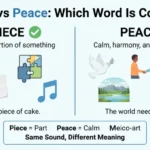
Piece = Part
Both start with P and have the idea of a portion.
Peace = Calm
Think of peaceful moments when there is no conflict.
| Word | Meaning | Example |
| Piece | A part or portion of something | I want a piece of cake. |
| Peace | Calm, harmony, no conflict | The world needs peace. |
The Origin of Piece
The word piece comes from the Old French word “piece”, meaning a part, portion, or fragment. It entered English during the Middle English period around the 13th century.
The Old French term came from the Vulgar Latin word “pettia”, which also meant a piece or portion of something.
Over time, piece developed many meanings, including:
- A part of an object
- A single item
- A work of art or writing
- A chess figure
- A firearm (informal usage)
Examples:
- a piece of furniture
- a piece of information
- a piece of artwork
- a chess piece
The spelling piece remained different from peace because the two words came from different historical roots, even though their pronunciation became similar over time.
Piece vs Peace: What’s the Difference?
The Origin of Peace
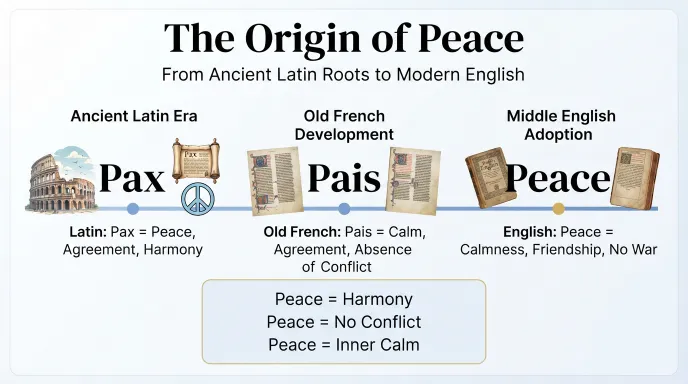
The word peace comes from the Old French word “pais”, meaning calm, agreement, or absence of conflict. It developed from the Latin word “pax”, which also meant peace, agreement, and harmony.
The word entered English during the Middle English period and became widely used to describe a state where people or nations live without fighting.
Over time, peace gained several meanings, including:

- Freedom from war or violence
- A calm and quiet state of mind
- Friendly relationships between people
- Agreement or harmony
Examples:
- The leaders worked together to create peace.
- She enjoys the peace of the countryside.
- They made peace after their disagreement.
Although piece and peace look different, their pronunciation became the same because English pronunciation changed over many centuries. Their different origins explain why they have different meanings and spellings today.
British English vs American English Spelling
The words piece and peace are spelled the same in both British English and American English. Unlike many spelling differences between the UK and US, these two words do not change based on region.
Both British and American speakers use:
- Piece = a part or portion
- Peace = calmness or absence of conflict
Examples in British English:
- I would like a piece of cake.
- The country is searching for peace.
Examples in American English:
- Can I have a piece of pizza?
- Everyone wants peace in the world.
The main difference is not spelling but understanding the meaning and context.
Piece vs Peace Comparison Table
| Feature | Piece | Peace |
| Pronunciation | Same as “peace” | Same as “piece” |
| Meaning | A part, portion, or item | Calmness, harmony, no conflict |
| Word Type | Noun | Noun |
| Origin | Old French “piece” from Latin roots | Old French “pais” from Latin “pax” |
| British Spelling | Piece | Peace |
| American Spelling | Piece | Peace |
| Example | She broke a piece of glass. | The nations signed a peace treaty. |
Why Are Piece and Peace Confusing?
The main reason people confuse these words is that English has many homophones. These are words that sound identical but have different meanings.
Other examples include:
- Right / Write
- Sea / See
- Flower / Flour
- Two / Too / To
Because piece and peace sound the same, writers must use the meaning of the sentence to choose the correct spelling.
Quick Tip:
Ask yourself:
Am I talking about a part of something?
➡ Use piece
Am I talking about calm or no fighting?
➡ Use peace
Piece vs Peace: What’s the Difference?
Which Spelling Should You Use?
When choosing between piece and peace, the correct spelling depends on the meaning of your sentence, not the country or type of English you use. Both words are accepted in British English, American English, and global English.
Use Piece When You Mean:
A part, portion, or single item of something.
Examples:
- I ate a piece of bread.
- She gave me a piece of useful advice.
- He bought a new piece of furniture.
Common phrases with piece:
- a piece of cake
- a piece of information
- a piece of art
- a piece of paper
- a piece of equipment
A state of calm, friendship, or no conflict.
Examples:
- The countries finally reached peace.
- I enjoy the peace and quiet of my home.
- They want to live in peace.
Common phrases with peace:
- world peace
- peace agreement
- peace of mind
- keep the peace
- make peace
Advice for Different Audiences
| Audience | Correct Usage |
| United States readers | Use piece for a part and peace for calmness |
| United Kingdom readers | Use piece for a part and peace for calmness |
| International readers | Follow the meaning of the sentence |
| Academic writing | Check the context carefully |
| Business writing | Use the correct word to avoid confusion |
The spelling does not change between countries. The only thing that matters is the meaning.
Common Mistakes with Piece vs Peace
Many people confuse piece and peace because they sound identical. Here are some common mistakes and corrections.
Mistake 1: Using Peace for a Part of Something
❌ Incorrect:
- I want a peace of cake.
✅ Correct:
- I want a piece of cake.
Why?
Cake can be divided into parts, so the correct word is piece.
Mistake 2: Using Piece for Calmness
❌ Incorrect:
- The world needs piece.
✅ Correct:
- The world needs peace.
Why?
The sentence talks about harmony and no conflict, so use peace.
Mistake 3: Confusing “Piece of Mind” and “Peace of Mind”
❌ Incorrect:
- This insurance gives me a piece of mind.
✅ Correct:
- This insurance gives me peace of mind.
Why?
“Peace of mind” means a feeling of calm and security.
Mistake 4: Trusting Pronunciation Alone
Because both words sound the same, some writers choose the wrong spelling.
Tip:
Do not decide by sound. Look at the meaning.
Piece vs Peace in Everyday Examples
In Emails
Could you send me the missing piece of information for the report?
Meaning: a part of information.
Peace Example:
I hope everyone can work together in peace.

Meaning: harmony and cooperation.
Meaning: a helpful part or suggestion.
Choose kindness and spread peace.
Meaning: calmness and harmony.
In Formal Writin
Piece:
- The researcher added another piece of evidence.
Peace:
- The organization works to promote peace around the world.
Piece vs Peace: What’s the Difference? Meaning, Examples, and Correct Usage
Piece vs Peace: Google Trends & Usage Data
The search term “piece vs peace” is popular because many English learners and writers want to understand the difference between these two homophones. People often search for this phrase when writing school assignments, emails, articles, and professional documents.
Usage Trends by Country
| Country | Common Search Reason |
| United States | Students and writers checking spelling differences |
| United Kingdom | English learners improving grammar skills |
| Canada | Understanding correct word usage |
| Australia | Improving writing accuracy |
| India & Pakistan | English learning and vocabulary improvement |
Why People Search for Piece vs Peace
The confusion happens because:
- Both words have the same pronunciation.
- They have completely different meanings.
- Spellifcheck tools may not detect the mistake.
- Many learners depend on sound instead of context.
Usage Popularity
Piece is commonly used in everyday conversations because people often talk about parts, objects, food, information, and work.
Examples:
- a piece of paper
- a piece of advice
- a piece of furniture
Peace is often used in discussions about society, relationships, politics, and personal emotions.
Examples:
- peace talks
- peace treaty
- peace of mind
Both words remain highly common in English because they describe important ideas used in daily communication.
Piece vs Peace: Side:by Side Comparison
| Word | Meaning | Usage Area | Example |
| Piece | A part or portion of something | Objects, writing, food, information | She gave me a piece of chocolate. |
| Piece | A single item or work | Art, music, journalism | He created a beautiful piece of art. |
| Peace | A state without conflict | Countries, society, relationships | The nations worked for peace. |
| Peace | Calmness of mind | Personal feelings | Meditation brings peace of mind. |
About Piece vs Peace
1. What is the difference between piece and peace?
Piece means a part, portion, or item of something. Peace means calmness, harmony, or the absence of conflict.
Example:
- A piece of cake = a portion of cake.
- World peace = no war or conflict.
2. Are piece and peace pronounced the same?
Yes. Both words have the same pronunciation, but their meanings and spellings are different.
3. Is “a peace of cake” correct?
No. The correct phrase is “a piece of cake.”
Example:
- This task is a piece of cake.
It means something is very easy.
4. Is “peace of mind” or “piece of mind” correct?
The correct phrase is “peace of mind.”
It means a feeling of calmness and security.
Example:
- The warranty gives customers peace of mind.
5. Do British and American English use piece and peace differently?
No. Both British and American English use the same spellings and meanings.
6. How can I remember the difference between piece and peace?
Use this memory trick:
Piece = Part
A piece is a part of something.
Peace = Calm
Peace means a calm and quiet state.
7. Can piece and peace be used as verbs?
Usually, both words are nouns. However, piece can also appear in verbs like “piece together,” meaning to join parts.
Example:
- She pieced together the information.
Peace is rarely used as a verb in modern English.
Conclusion
Understanding the difference between piece vs peace is important for clear and accurate English writing. Although these two words sound exactly the same, their meanings are completely different. Piece refers to a part, portion, or individual item, while peace refers to calmness, harmony, and freedom from conflict.
The key to choosing the correct word is not pronunciation but context. If you are talking about a part of something, use piece. If you are describing calmness or the end of conflict, use peace.
difference more !
Grey or Gray: Which Spelling Should Yose
Payer or Payor: Which Term Should You Use?
Myself or Me: Which One Is Correct?
Related articles: Cueing or Cuing? Which Spelling Is Correct in English?.
See the dictionary definitions for piece and peace.

Passionate about language and clear communication, I explore the subtle differences between words and expressions through well-researched, practical content. My goal is to help readers write with greater clarity, confidence, and precision by making complex language concepts easy to understand.