Have you ever stopped while writing and wondered if you should use to, too, or two? You’re not alone. These three words sound exactly the same, but they have completely different meanings. Because they are homophones if words that share the same pronunciation but different spellings and meanings if they are one of the most common grammar mistakes in English.
People search for “To vs Too vs Two” because using the wrong word can make emails, school assignments, business documents, and social media posts look unprofessional. Even native English speakers sometimes mix them up when typing quickly.
The good news is that the difference is easy to remember
.
To vs Too vs Two: Quick Answer
Here’s the simple difference:
- To = Shows direction, destination, or is part of an infinitive verb.
- Too = Means also or more than enough.
- Two = The number 2.
Examples
| Word | Meaning | Example |
| To | Direction or infinitive | I am going to school. |
| Too | Also / excessively | I want to come too. |
| Too | More than enough | The coffee is too hot. |
| Two | Number 2 | I have two dogs. |
Quick Memory Trick
- To → Think of going to somewhere.
- Too → Has an extra “o”, meaning extra or also.
- Two → Starts with Tw-, just like twins, meaning 2.
The Origin of To vs Too vs Two
Although to, too, and two sound identical today, they come from different historical roots.
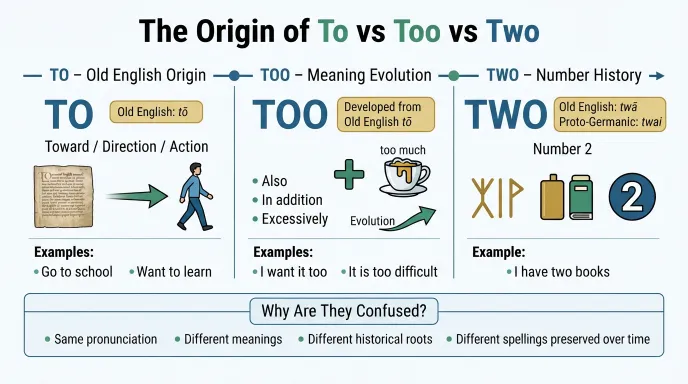
Origin of “To”
The word to comes from the Old English word tō, which meant toward, until, or in the direction of. It has been used in English for over a thousand years as a preposition and later became an important part of infinitive verbs, such as to read, to write, and to learn.
Why Are They Confused?
The confusion exists because:
- They sound exactly alike.
- English pronunciation changed over time.
- Their spellings stayed different to preserve their meanings.
- Fast typing and autocorrect often cause mistakes.
Despite sharing the same pronunciation, to, too, and two have different jobs in English grammar. Learning those jobs is the easiest way to avoid errors.
British English vs American English Spelling
When comparing To vs Too vs Two, there is no spelling difference between British English and American English. Unlike words such as colour/color or honour/honor, these three words are written the same way in both English varieties.
Both British and American speakers use:
- To for direction or infinitive verbs.
- Too for “also” or “excessively.”
- Two for the number 2.
The main difference is not spelling but how people use them in sentences. Grammar rules remain the same across countries.
Examples in British English
- I am going to London tomorrow.
- Would you like to come too?
- I bought two books.
Examples in American English
- I am going to New York tomorrow.
- I want to join too.
- She has two brothers.
The spelling and meaning remain unchanged in both versions of English.
To vs Too vs Two Comparison Table
| Word | Type | Meaning | Correct Example | Incorrect Example |
| To | Preposition / Infinitive marker | Direction, destination, or action | She went to the market. | She went too the market. |
| Too | Adverb | Also / as well | I want pizza too. | I want pizza two. |
| Too | Adverb | Excessively | This bag is too heavy. | This bag is to heavy. |
| Two | Number | The number 2 | He has two cars. | He has too cars. |
Which Spelling Should You Use?
Since to, too, and two have the same spelling worldwide, the choice depends on meaning, not audience.
For US English Readers
American readers expect the same standard usage:
✅ I need to finish my work.
✅ I like this idea too.
✅ I have two options.
Using the wrong form can make writing appear careless
For British English Readers
British English follows the same rule:
✅ She travelled to France.
✅ Can I come too?
✅ They bought two tickets.
There is no British spelling variation for these words
For Global English Writing
For international communication:
- Always check the meaning before choosing the word.
- Use two when talking about the number 2.
- Use too when meaning “also” or “very much.”
- Use to for movement or verb forms.
Correct use improves clarity in:
- Emails
- Reports
- Academic writing
- Websites
- Social media posts
Easy Rule to Remember
Use TO when:
You are talking about movement or an action.
Examples:
- I want to learn English.
- She went to school.
Use TOO when:
You mean “also” or “more than enough.”
Examples:
- I want coffee too.
- This exam is too difficult.
Use TWO when:
You mean the number 2.
Examples:
- I have two sisters.
- They bought two tickets.
Common Mistakes with To vs Too vs Two
Even though the rules are simple, many people confuse to, too, and two in everyday writing. Here are the most common mistakes and corrections.
Mistake 1: Using “Too” Instead of “To”
❌ Incorrect: I want too learn English.
✅ Correct: I want to learn English.
Why?
Use to before a verb to show an action.
More examples:
❌ She needs too study.
✅ She needs to study.
Mistake 2: Using “To” Instead of “Too”
❌ Incorrect: I like this movie to.
✅ Correct: I like this movie too.
Why?
Use too when you mean also or as well.
More examples:
❌ Can I come to?
✅ Can I come too?
Mistake 3: Using “Two” for “Too”
❌ Incorrect: I want two join the meeting.
✅ Correct: I want to join the meeting.
Why?
Two is only used for the number 2.
Mistake 4: Forgetting the Extra “O” in Too
A simple memory trick:
- Too has an extra o because it can mean something extra.
- Example: I want ice cream too. (extra person)
- Example: The water is too cold. (extra amount)
To vs Too vs Two in Everyday Examples
Understanding real-life examples makes these words easier to remember.
In Emails
Correct:
To:
I would like to request more information about your service.

Too:
I would like to attend the meeting too.
Two:
Please send the report within two days.
In News Writing
Examples:
- The company plans to open a new office.
- The event attracted two thousand visitors.
- Many experts agreed too.
In Social Media Posts
Examples:
- I want to travel this year.
- Happy birthday to my best friend!
- I loved this show too!
- I have two new photos to share.
In Formal Writing
Correct use is important in:
- Academic papers
- Business documents
- Professional emails
- Articles and blogs
Example:
❌ Incorrect:
There are too reasons why this method works.
✅ Correct:
There are two reasons why this method works.
To vs Too vs Two :Google Trends & Usage Data
The phrase “To vs Too vs Two” is commonly searched by students, English learners, teachers, and writers who want to improve grammar skills.
Search Interest Patterns
- United States: High searches because English learners and students often study homophones.
- United Kingdom: Frequently searched by students and teachers.
- India, Pakistan, and other English-learning countries: Popular among learners improving writing skills.
- Global searches: Increase during school terms, exams, and English learning courses.
Why People Search This Topic
People usually search for:
- Grammar explanations
- Correct spelling checks
- Writing improvement
- School assignments
- English language learning
The topic remains popular because to, too, and two are among the first confusing words learners encounter in English.
Frequently Asked Questions
1. What is the difference between to, too, and two?
To shows direction or introduces a verb.
Too means also or excessively.
Two is the number 2.
2. Is “too” the same as “also”?
Yes. In many sentences, too means also.
Example:
- I like tea too.
- I also like tea.
3. When should I use “two”?
Use two when talking about the number 2.
Examples:
4. Why do to, too, and two sound the same?
They are homophones. English pronunciation changed over time, but their different spellings remained
5. Is “to” ever used for numbers?
No. The correct word for the number 2 is always two
6. Do British and American English use these words differently?
No. Both British and American English use to, too, and two in the same way
7. How can I remember the difference?
Remember:
- To = going or doing something
- Too = extra or also
- Two = number 2
Conclusion
Understanding To vs Too vs Two is an important step toward improving English writing. Although these words sound exactly the same, their meanings are completely different. To is used for direction, destinations, and verb forms. Too means “also” or “more than enough.” Two represents the number 2.
The good news is that there is no difference between British and American spelling for these words. Writers around the world use the same forms. The key is not remembering spelling differences but understanding the purpose of each word.
Using the correct word helps your writing look clearer and more professional.
Keep Learning!
Related articles: Nook vs Kindle: What’s the Difference?.
See the dictionary definitions for to and too.

Daniel R. Foster is an experienced English language writer and editor who specializes in explaining commonly confused words and grammar nuances. With a strong passion for clarity in communication, he creates easy-to-understand comparisons that help learners, students, and professionals use English more confidently. His articles focus on accuracy, real-world examples, and practical usage.