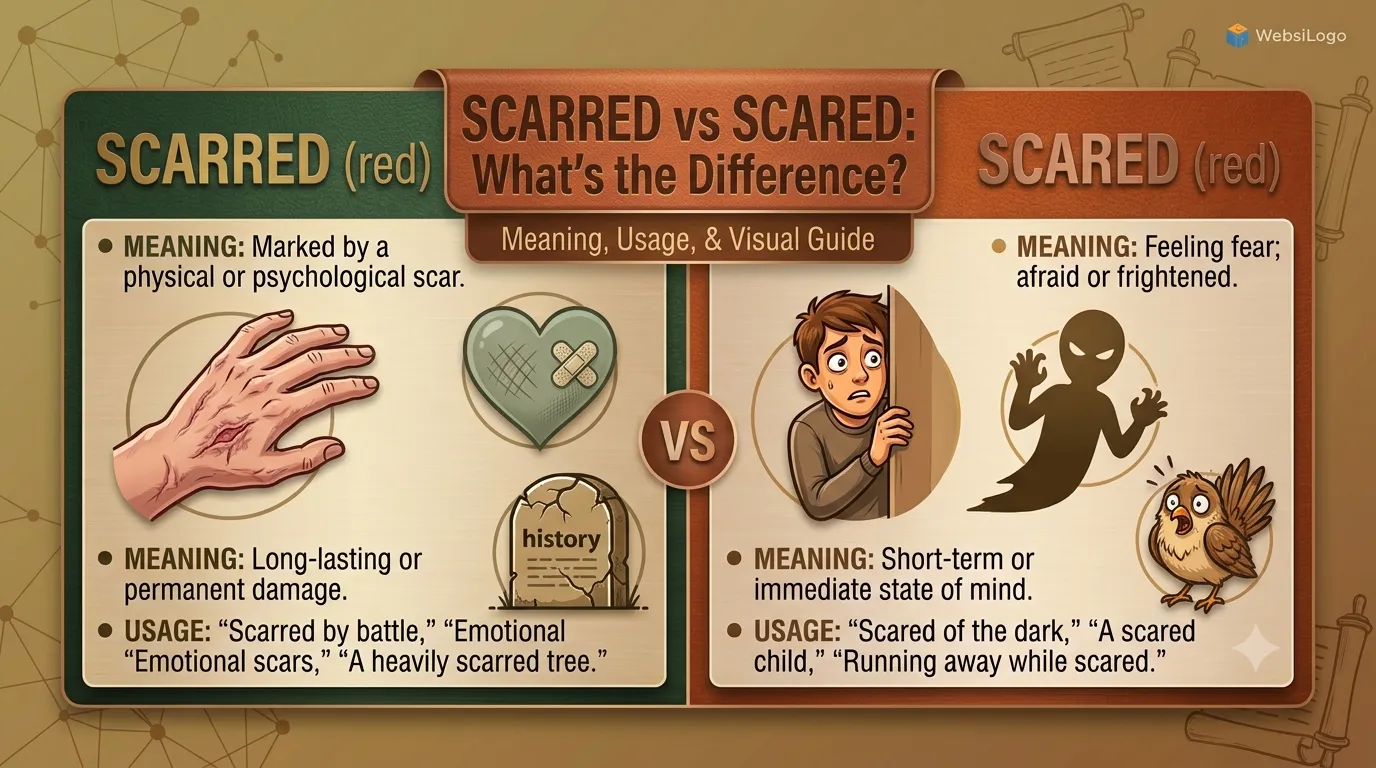
Scarred or Scared: Quick Answer
| Form | Use in this guide | Example |
| Scarred or Scared | Past-tense and adjective angle | She was scared by the loud noise. |
| Standard form | General writing | The surface was scarred after years of use. |
In short, scared means afraid, scarred means marked by a scar. This guide focuses only on past-tense and adjective angle, so it does not repeat the general guide word for word.
How to use this in past-tense and adjective angle
This guide narrows the question to past-tense and adjective angle. That narrower focus matters, because a general guide has to cover every context at once, while this guide can give advice that fits one situation well. Start by checking which form your audience expects, then check the examples below, then apply the same form in your own sentences.

The meaning does not change in this context: scared means afraid, scarred means marked by a scar. What changes is which examples are most useful, which mistakes are most likely, and which style choice is most natural for readers in this situation.
Examples in this context
- She was scared by the loud noise.
- The surface was scarred after years of use.
- Scared describes feeling, scarred describes a lasting mark.
Read each example aloud and check whether the form fits the sentence. If the sentence sounds formal, informal, technical or everyday, the choice should match that tone, not just the dictionary entry.

Mistakes to avoid in this context
- Using both forms in the same document without a reason.
- Copying a form from a different context, such as a US example into a UK document, without checking the style guide.
- Choosing a form because it looks familiar, rather than because it matches the audience.
- Repeating the same example in every paragraph, instead of testing the form in new sentences.
Frequently asked questions
Which form should I use here? Use the form that matches past-tense and adjective angle, and keep it consistent in the document.
Is the other form wrong? No. The other form is correct in its own context. This guide does not claim that the other form is always wrong, it only explains the choice for this angle.
What if my style guide differs? Follow your style guide first. A style guide for a school, journal or employer overrides a general rule.
Conclusion
For past-tense and adjective angle, the safest approach is to pick one form, use it consistently, and test it in real sentences from that context. That approach keeps your writing clear, and it keeps this guide distinct from the general guide, which covers the wider question.
Related in this set: Scared or Scarred: What Is the Real Difference? (Main guide: emotion vs injury angle). Each guide in this set covers a different angle, so use the one that matches your question.

Hi, I’m Sehrish Iqbal, and I enjoy writing about the English language and the little differences between words that often cause confusion. I create simple and easy-to-understand articles about grammar, spelling, commonly confused words, and correct word usage. My goal is to make English easier to understand and help students, writers, and English learners use the right words with confidence.


3 thoughts on “Scarred or Scared: Past Tense and Adjectives”