Have you ever typed “your welcome” instead of “you’re welcome”? If yes, you are not alone. Your vs You’re is one of the most common English grammar mistakes. Even native English speakers mix them up because they sound exactly the same.
People search for “Your vs You’re” to learn the correct spelling and avoid embarrassing writing mistakes. Using the wrong word in emails, school assignments, social media posts, or business messages can make your writing look careless. The good news is that the difference is very simple once you understand it.
Your vs You’re :Quick Answer
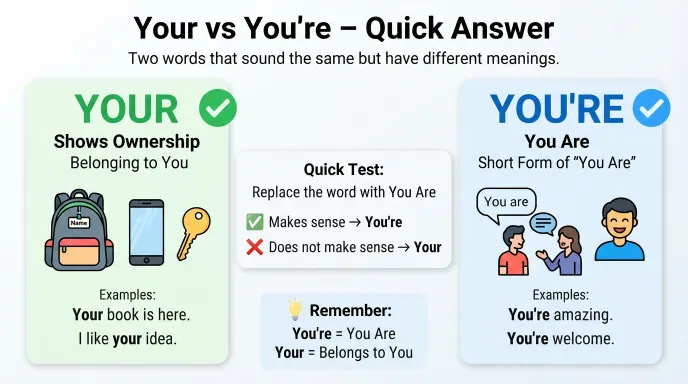
The difference is simple:
- Your shows ownership.
- You’re is short for you are.
Examples
✅ Your book is on the table.
✅ Is this your phone?
Easy Memory Trick
Replace you’re with you are.
If the sentence still makes sense, use you’re.
Example:
✔ You’re happy.
✔ You are happy.
Both are correct.
If replacing it with you are does not work, use your.
Example:
✔ Your backpack is heavy.
✘ You are backpack is heavy.
That sentence is incorrect, so your is the right choice.
The Origin of Your vs You’re

Although these words sound the same, they have different histories and different jobs in English.
The Origin of Your
The word your comes from Old English ēower, which meant belonging to you. Over time, the spelling changed into the modern word your. It has always been a possessive word that shows ownership.
Examples
- Your house
- Your family
- Your computer
The Origin of You’re
You’re is a contraction of you are.
English contractions became popular hundreds of years ago because they made speaking and writing faster and more natural. The apostrophe replaces the missing letter a in are.
Examples
- You’re welcome.
- You’re doing great.
- You’re my best friend.
Why the Confusion Exists
The confusion happens because:
- Both words sound exactly the same.
- Spell check may not catch the mistake.
- People often type quickly.
- Many learners forget that you’re always means you are.
Even though they sound alike, they have completely different meanings and cannot replace each other.
British English vs American English Spelling
Unlike many English words, your and you’re are spelled the same in both British and American English. There is no spelling difference between the two.
The only difference is how you use them.
- Your shows ownership.
- You’re means you are.
Examples
| British English | American English |
| Your bag is here. | Your bag is here. |
| You’re late today. | You’re late today. |
| Is this your seat? | Is this your seat? |
| You’re doing well. | You’re doing well. |
Comparison Table
| Feature | Your | You’re |
| Word Type | Possessive adjective | Contraction |
| Meaning | Belonging to you | You are |
| Shows Ownership | ✅ Yes | ❌ No |
| Can Replace “You Are” | ❌ No | ✅ Yes |
| Used in UK English | ✅ Yes | ✅ Yes |
| Used in US English | ✅ Yes | ✅ Yes |
Key Takeaway
if you write for readers in the United States, the United Kingdom, Canada, Australia, or anywhere else, the spelling stays the same.
The only thing that changes is how you use each word.
Which Spelling Should You Use?
The answer depends on what you want to say if not where your readers live.
Use your when you talk about something that belongs to someone.
Examples
- Your phone is ringing.
- Your idea is excellent.
- Your homework is finished.
Use you’re when you mean you are.
Examples
- You’re very helpful.
- You’re ready to start.
- You’re my best friend.
Quick Test
Replace you’re with you are.
If the sentence still sounds correct, use you’re.
✔ You’re amazing.
✔ You are amazing.
If it does not make sense, use your.
✔ Your jacket looks nice.
✘ You are jacket looks nice.
Best Choice by Audience
| Audience | Recommended Usage |
| United States | Your / You’re |
| United Kingdom | Your / You’re |
| Canada | Your / You’re |
| Australia | Your / You’re |
| International English | Your / You’re |
Writing Tip
Before you publish an email, blog post, or social media update:
- Check if the word shows ownership.
- If yes, use your.
- If it means you are, use you’re.
This simple check will help you avoid one of the most common grammar mistakes in English.
Common Mistakes with Your vs You’re
Many people confuse your and you’re because they sound the same. Here are the most common mistakes and how to fix them.
| Incorrect | Correct | Why? |
| Your welcome. | You’re welcome. | “You’re” means “you are.” |
| I like you’re shoes. | I like your shoes. | “Your” shows ownership. |
| Your the best. | You’re the best. | It means “You are the best.” |
| Is this you’re bag? | Is this your bag? | The bag belongs to you. |
| Your going to love it. | You’re going to love it. | It means “You are going to love it.” |
Mistake 1: Using Your Instead of You’re
❌ Your amazing.
✅ You’re amazing.
Mistake 2: Using You’re Instead of Your
❌ I love you’re idea.
✅ I love your idea.
Mistake 3: Forgetting the Meaning
Remember:

- Your = belongs to you.
- You’re = you are.
Easy Memory Trick
Ask yourself:
Can I replace the word with “you are”?
- Yes → Use you’re.
- No → Use your.
Your vs You’re in Everyday Examples
In Emails
✅ Your report looks great.
✅ You’re scheduled for tomorrow’s meeting.
In News
✅ Your vote matters.
✅ You’re watching the latest news update.
On Social Media
✅ Your photos are beautiful!
✅ You’re awesome!
In School Writing
✅ Please write your name at the top of the page.
✅ You’re expected to submit the assignment by Friday.
In Business Writing
✅ Your application has been approved.
✅ You’re invited to attend the conference.
In Daily Conversation
- Your coffee is ready.
- You’re late today.
- I like your new haircut.
- You’re always helpful.
- Is this your seat?
- You’re doing a great job.
Your vs You’re : Google Trends & Usage Data
Both your and you’re are among the most frequently used words in English because they appear in everyday speech and writing.
Where Are They Most Popular?
These words are commonly searched in:
- United States
- United Kingdom
- Canada
- Australia
- New Zealand
Most searches come from students, English learners, teachers, writers, and professionals who want to avoid grammar mistakes.
Why Do People Search for “Your vs You’re”?
People often search this keyword because they:
- Want to improve their grammar.
- Need help with school assignments.
- Write professional emails.
- Create blog posts or social media content.
- Want to avoid common writing mistakes.
Usage Comparison
| Word | Meaning | Common Usage |
| Your | Shows ownership | Very High |
| You’re | Means “You are” | Very High |
Both words are used every day, but your appears slightly more often because it is used whenever showing possession.
Your vs You’re Comparison Table
| Feature | Your | You’re |
| Meaning | Belonging to you | You are |
| Word Type | Possessive adjective | Contraction |
| Shows Ownership | ✅ Yes | ❌ No |
| Can Replace “You Are” | ❌ No | ✅ Yes |
| Example | Your phone is new. | You’re very kind. |
| Used in Formal Writing | ✅ Yes | ✅ Yes |
| Used in Informal Writing | ✅ Yes | ✅ Yes |
| British English | Same spelling | Same spelling |
| American English | Same spelling | Same spelling |
Frequently Asked Questions
1. What is the difference between your and you’re?
Your shows ownership, while you’re is the short form of you are.
2. Is you’re always short for you are?
Yes. If you can replace you’re with you are, then you’re is correct
3. Is your a possessive word?
Yes. Your is a possessive adjective that shows something belongs to someone.
Example: Your laptop is on the desk.
4. Are your and you’re different in British and American English?
No. Both spellings are exactly the same in British and American English.
5. Why do people confuse your and you’re?
They are pronounced the same, making them homophones. Many writers type quickly and forget to check the meaning.
6. How can I remember the difference?
Use this simple test:
- Replace the word with you are.
- If the sentence still makes sense, use you’re.
- If not, use your.
7. Does spell check always find this mistake?
No. Both words are correctly spelled, so many spell checkers cannot detect the wrong choice in context.
Conclusion
Understanding Your vs You’re is easier than many people think. Although these two words sound exactly the same, they have different meanings and different grammar rules. Your is used to show ownership, while you’re is simply a contraction of you are.
A quick way to choose the correct word is to replace you’re with you are. If the sentence still sounds correct, you’re is the right choice. If it does not, use your instead. This simple trick helps you avoid one of the most common grammar mistakes in English.
The good news is that there is no difference between British English and American English for these words. The spelling remains the same everywher.
See the dictionary definitions for your and you.