Have you ever stopped while writing and wondered if to use lay or lie? You are not alone. Lay vs Lie is one of the most confusing grammar topics in English because both words relate to putting something down or resting, but they are used in different ways.
People search for “Lay or Lie” because these words appear often in daily conversations, emails, books, and professional writing. A small mistake can change the meaning of a sentence and make your writing sound incorrect. The confusion becomes greater because the past tense forms, laid and lay, also look similar.
Understanding the difference between lay and lie helps you write clearer sentences and communicate ideas correctly. The main question is simple:
Lay or Lie: Quick Answer
The main difference is:
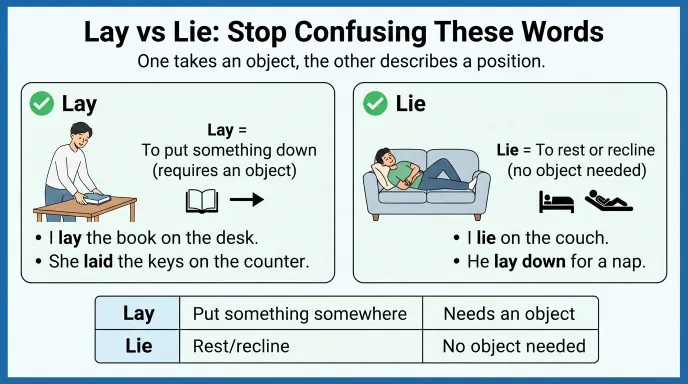
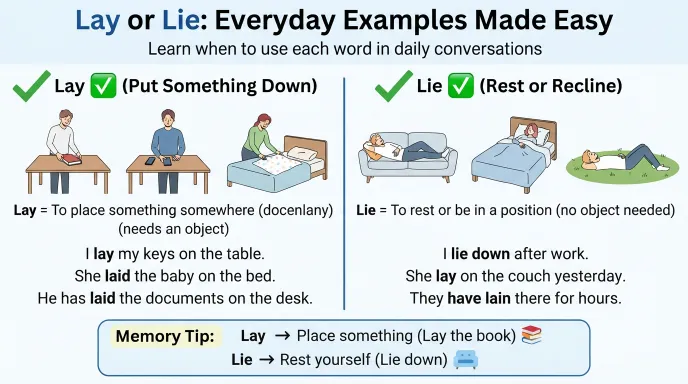
- Lay = to put something down (it needs an object).
- Lie = to rest or be in a position (no object needed).
Lay Examples
Lay means placing something somewhere.
✅ Please lay the book on the table.
✅ She laid the baby in the crib.
Formula:
Someone lays something.
Lie Examples
Lie means to rest or stay in a position.
✅ I need to lie down.
✅ The dog is lying on the f
Formula:
Someone lies down.
Quick Comparison
| Word | Meaning | Needs Object? | Example |
| Lay | Put something down | Yes | Lay the phone on the desk. |
| Lie | Rest or recline | No | Lie on the bed. |
Easy Memory Trick
Remember:
Lay = Place
Lie = Recline
If you are placing an object → use lay.
If you are resting yourself → use lie.
The Origin of Lay or Lie
The words lay and lie have a long history in the English language. Both words come from Old English, but they developed different meanings and grammar roles over time.
The Origin of Lay
The word lay comes from the Old English word lecgan, which meant to place or put something down.

It has always been a word that requires an object because something is being placed somewhere.
Examples:
- Lay the book on the desk.
- Lay the clothes on the bed.
- She laid the baby down gently.
The action moves something from one place to another.
The Origin of Lie
The word lie comes from the Old English word licgan, which meant to rest or remain in a position.
Unlike lay, it does not need an object because the subject itself is resting.
Examples:
- I lie on the sofa.
- The cat lies near the window.
- He lay on the grass.
Why Do People Confuse Lay and Lie?
The confusion happens because:
- Both words describe positions or placement.
- Their past tense forms look similar.
- The past tense of lie is lay, which is also another English word.
Verb Forms Comparison
| Present | Past | Past Participle | Meaning |
| Lay | Laid | Laid | Put something down |
| Lie | Lay | Lain | Rest or recline |
Examples:
Lay:
- Present: I lay the book here.
- Past: I laid the book here yesterday.
- Past Participle: I have laid the book here many times.
Lie:
- Present: I lie on the bed.
- Past: I lay on the bed yesterday.
- Past Participle: I have lain here for an hour.
British English vs American English Spelling
There is no spelling difference between lay and lie in British English and American English.
Both regions use the same words. The difference is only in understanding the grammar and using the correct form.
Comparison Table
| Feature | British English | American English |
| Lay spelling | Lay | Lay |
| Lie spelling | Lie | Lie |
| Past of Lay | Laid | Laid |
| Past of Lie | Lay | Lay |
| Past Participle of Lie | Lain | Lain |
Examples in Both English Varieties
British English:
- Please lay the documents on the table.
- I need to lie down.
American English:
- Please lay the documents on the table.
- I need to lie down.
The spelling remains identical.
Which Spelling Should You Use?
Choosing between lay and lie depends on the meaning of your sentence, not your location. Both words are correct in British English, American English, and international English.
Use Lay When:
You are placing something somewhere.
Examples:
✅ Lay the papers on the desk.
✅ She laid the blanket on the grass.
✅ Please lay your phone beside the laptop.
Question to ask:
“Am I putting something down?”
If yes, use lay.
Use Lie When:
You or something is resting without placing another object.
Examples:
✅ I need to lie down.
✅ The dog is lying on the floor.
✅ She lay in the sun yesterday.
Question to ask:
“Is something resting by itself?”
If yes, use lie.
Audience: Based Advice
| Audience | Recommended Usage |
| United States | Use lay and lie according to meaning |
| United Kingdom | Use lay and lie according to meaning |
| Canada | Use lay and lie according to meaning |
| Australia | Use lay and lie according to meaning |
| Global English | Use the correct grammar form |
Professional Writing Tip
In emails, reports, articles, and formal documents, using lay and lie correctly improves clarity and makes your writing look more professional.
Common Mistakes with Lay or Lie
Many writers confuse these words because their forms overlap. Here are common errors and corrections.
| Incorrect | Correct | Explanation |
| I need to lay down. | I need to lie down. | You are resting, not placing something. |
| Please lie the book here. | Please lay the book here. | A book is being placed. |
| She laid on the bed. | She lay on the bed. | Past tense of lie is lay. |
| He has lay there all day. | He has lain there all day. | Past participle of lie is lain. |
| Lay down and relax. | Lie down and relax. | No object is receiving the action. |
Common Confusion: Lay vs Laid vs Lain
Lay (Present)
Used when placing something.
Example:
- I lay the keys on the table.
Laid (Past)
The past form of lay.
Example:
- She laid the book on the shelf.
Lie (Present)
Used for resting.
Example:
- I lie on the couch.
Lay (Past of Lie)
Used for resting in the past.
Example:
- I lay on the couch yesterday.
Lain (Past Participle of Lie)
Example:

- The dog has lain there for hours.
Lay or Lie in Everyday Examples
In Emails
✅ Please lay the documents on my desk before the meeting.
✅ I need to lie down after finishing this project.
In News Writing
✅ The injured person was asked to lie still.
✅ The report was laid before the committee.
On Social Media
✅ “I just want to lie down and relax.”
✅ “Please lay your phone aside and enjoy the moment.”
In Formal Writing
✅ The company will lay the foundation for future growth.
✅ The evidence was laid before the court.
In Daily Conversation
- Lay your bag on the chair.
- I want to lie in bed longer.
- She laid the baby in the crib.
- The cat is lying near the window.
Lay or Lie : Google Trends & Usage Data
The keyword “Lay or Lie” is searched frequently because many English learners and native speakers find these words confusing. The confusion mainly comes from the similar meanings and overlapping verb forms.
Why Do People Search “Lay or Lie”?
People commonly search this topic because they want help with:
- Grammar improvement
- School assignments
- Professional writing
- Blog and content writing
- Speaking English correctly
- Avoiding common mistakes
Countries Where This Topic Is Popular
Search interest for Lay or Lie is commonly seen in:
- United States
- United Kingdom
- Canada
- Australia
- India
- Other English-learning countries
The topic remains popular because these verbs are used in everyday English but are often misunderstood.
Lay vs Lie Comparison Table
| Feature | Lay | Lie |
| Meaning | To put something down | To rest or recline |
| Needs an object | Yes | No |
| Word Type | Transitive verb | Intransitive verb |
| Present Form | Lay | Lie |
| Past Form | Laid | Lay |
| Past Participle | Laid | Lain |
| Example | Lay the book on the table. | Lie on the sofa. |
Frequently Asked Questions
1. What is the difference between lay and lie?
Lay means to place something somewhere, while lie means to rest or be in a position.
Example:
- Lay the phone on the desk.
- Lie on the bed.
2. Is “I need to lay down” correct?
No, if you mean resting yourself, the correct sentence is:
✅ I need to lie down.
Use lay only when you place something.
3. What is the past tense of lie?
The past tense of lie is lay.
Example:
Present:
- I lie on the couch.
Past:
- I lay on the couch yesterday.
4. What is the past tense of lay?
The past tense of lay is laid.
Example:
Present:
- I lay the book on the table.
Past:
- I laid the book on the table yesterday.
5. Are lay and lie different in British and American English?
No. Both British and American English use the same spelling and grammar rules for these words.
6. How can I remember lay vs lie easily?
Use this trick:
- Lay = Place something
- Lie = Rest yourself
Think:
Lay a book. Lie down.
7. Why are lay and lie so confusing?
They are confusing because:
- They sound similar.
- The past tense of lie is lay.
- Many people use them incorrectly in everyday speech.
Conclusion
Understanding Lay or Lie becomes much easier when you remember one simple rule: lay needs an object, while lie does not. If you are putting something somewhere, use lay. If you are resting yourself or something is already in a position, use lie.
The biggest reason people confuse these words is that their verb forms overlap. The past tense of lie is lay, which looks exactly like the present form of another verb. Learning the forms if lay, laid, laid and lie, lay, lain if will help you choose the correct word every time.
There is no difference between British English and American English spelling for these words. The meaning and grammar rules stay the same worldwide. if you are writing emails, articles, school assignments, or professional documents, using lay and lie correctly makes your writing clearer and more polished.
With practice and the right memory trick, you can confidently use lay and lie in everyday Engli
See the dictionary definitions for lay and lie.

Hi, I’m Sehrish Iqbal, and I enjoy writing about the English language and the little differences between words that often cause confusion. I create simple and easy-to-understand articles about grammar, spelling, commonly confused words, and correct word usage. My goal is to make English easier to understand and help students, writers, and English learners use the right words with confidence.