Have you ever wondered if to write “storys” or “stories”? It is a common question for students, writers, bloggers, and English learners. English spelling rules can be confusing, especially when words change from singular to plural.
Many people type “storys” because they simply add -s to the end of the word. However, English has a special rule for nouns ending in -y.
This guide explains the correct spelling in simple words. You will learn why stories is correct, why storys is wrong, and how the rule works.
We will also compare British and American English, look at the history of the word, provide everyday examples, discuss common mistakes, and answer frequently asked questions
. By the end of this article, you will know exactly which spelling to use in school assignments, business writing, emails, blogs, and social media posts.
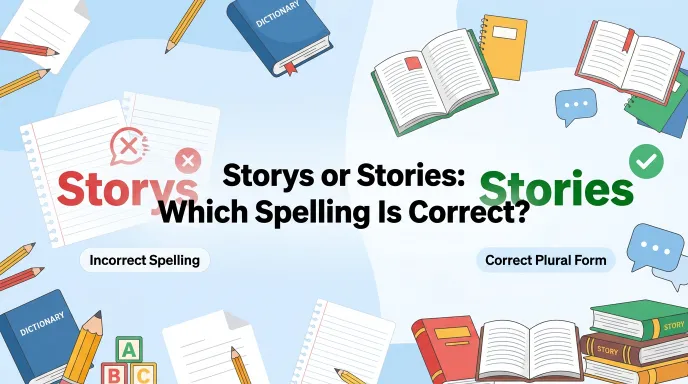
Storys or Stories Quick Answer
The correct spelling is stories.
Storys is incorrect in standard English.
Examples:
- ✅ She told three interesting stories.
- ✅ The book contains many short stories.
- ❌ She told three interesting storys.
Quick Rule
When a noun ends in a consonant + y, change the y to i and add -es.
- Story → Stories
- Baby → Babies
- City → Cities
- Lady → Ladies
The Origin of Storys or Stories
The word story comes from the Old French word estoire, which meant an account of events or history. It later entered Middle English as story and became the word we use today.
English grammar developed a plural rule for many nouns ending in -y. Instead of simply adding -s, the y changes to i, followed by -es. That is why the correct plural is stories.
The spelling storys has never been accepted as standard English.
British English vs American English Spelling
There is no spelling difference between British English and American English.
Both spell the plural as stories.
Comparison Table
| English Version | Correct Spelling | Example |
| American English | Stories | The stories were inspiring. |
| British English | Stories | She enjoys reading stories. |
| Canadian English | Stories | The stories made everyone laugh. |
| Australian English | Stories | Children love bedtime stories. |
| New Zealand English | Stories | These stories are true. |
No major English dictionary recommends storys.
Which Spelling Should You Use?
The answer is the same for every audience.
United States
Use stories.
United Kingdom
Use stories.
Canada, Australia, and New Zealand
Use stories.
Global Audience
Always write stories. It is the accepted spelling everywhere English is used.
Common Mistakes with Storys or Stories

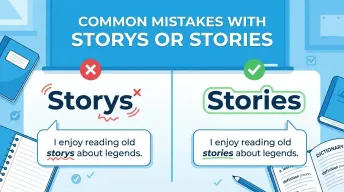
Many learners make mistakes because they forget the -y to -ies rule.
Common Errors
| Incorrect | Correct |
| Storys | Stories |
| Storyes | Stories |
| Story’s (plural) | Stories |
| Storyies | Stories |
Remember
Use story’s only to show possession.
Example:
- The story’s ending surprised everyone.
Use stories when talking about more than one story.
Example:
- I read five stories yesterday.
Storys or Stories in Everyday Examples
“I enjoyed reading your stories about your trip.”
News
“The newspaper published several stories about the event.”
Social Media
“Your travel stories are amazing!”
Formal Writing
“The researcher collected oral stories from local communities.”
School Assignment
“The students wrote creative stories during class.”
Storys or Stories Google Trends & Usage Data
Many people search for “storys or stories” because they are unsure about English plural rules.
Usage patterns show:
- Stories is the standard spelling used in books, schools, newspapers, websites, and professional writing.
- Storys appears mainly as a spelling mistake or search query.
- English learners often search this keyword because nouns ending in -y follow a special plural rule.
Across English-speaking countries, stories is the only accepted plural form.
Keyword Comparison Table
| Word | Correct? | Meaning |
| Story | ✅ Yes | One story |
| Stories | ✅ Yes | More than one story |
| Storys | ❌ No | Incorrect spelling |
| Story’s | ✅ Yes | Possessive form |
| Storytelling | ✅ Yes | The act of telling stories |
FAQs
Is stories the correct spelling?
Yes. Stories is the correct plural of story.
Is storys a real word?
No. Storys is not accepted in standard English.
Why does story become stories?
Because story ends with a consonant followed by y. English changes y to i and adds -es.
Do British and American English spell it differently?
No. Both use stories.
What is the singular form of stories?
The singular form is story.
Is story’s the same as stories?
No. Story’s shows possession, while stories is the plural.
How can I remember the rule?
If a noun ends with consonant + y, change y to i and add -es.
Conclusion
The correct spelling is stories, not storys. This follows one of the most common English grammar rules:
when a noun ends in a consonant and y, change the y to i and add -es to make it plural. This rule applies to many everydayady, and story.
There is no difference between British English and American English for this word. Writers, teachers, publishers, and dictionaries all use stories
. The spelling storys is considered incorrect and should be avoided in schoolwork, professional writing, emails, blogs, and social media.
Whenever you need the plural of story, remember this simple rule: Story → Stories. Following this pattern will help you avoid common spelling mistakes and make your writing clear, accurate, and professional.
Read more about!
Vacuum or Vaccum: Which Spelling Is Correct
Related articles: Whether or Weather: Which Spelling Is Correct?, Excel or Excell: Which Spelling Is Correct?, Waisted vs Wasted: What’s the Real Difference?.
See the dictionary definitions for storys and stories.

Passionate about language and clear communication, I explore the subtle differences between words and expressions through well-researched, practical content. My goal is to help readers write with greater clarity, confidence, and precision by making complex language concepts easy to understand.