Have you ever written “I past the test” or “The passed week” by mistake? You are not alone. Passed and past sound exactly the same, but they do different jobs in a sentence. The fastest way to learn the difference is to practise it, so this guide is built around practice sentences and a short quiz.
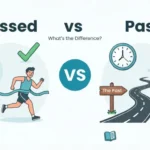
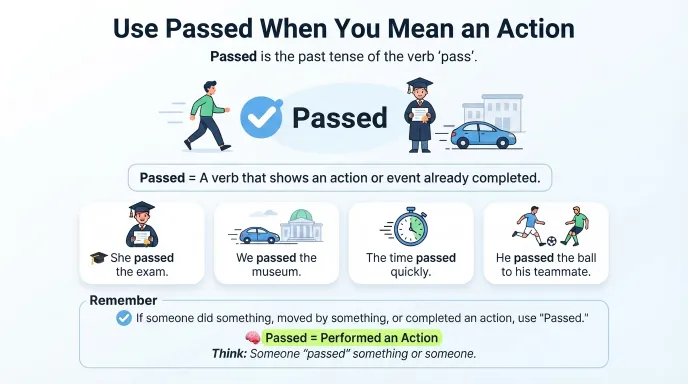
The rule fits in one line: passed is the past tense of the verb pass, so it shows an action. Past talks about earlier time or movement beyond a place, and it works as a noun, adjective, adverb, or preposition.
Work through the 20 practice sentences below, try the verb tense drills, and finish with the 10-question quiz. The answers are given right after each set, so you can check yourself as you go.
Passed vs Past: Quick Answer
The difference is simple:
- Passed is the past tense of the verb “pass.”
- Past is usually a noun, adjective, adverb, or preposition that refers to time or movement beyond something.
Quick Examples
| Word | Meaning | Example |
| Passed | Completed or moved by | She passed the exam. |
| Past | Earlier time or beyond | We walked past the park. |
| Passed | Went by | The bus passed our house. |
| Past | Previous time | Think about the past. |
Easy rule: if you can replace the word with “went by,” “completed,” or “succeeded,” use passed. If you are talking about time, history, or a place beyond something, use past.
Quick memory trick: Passed = Action (Verb). Past = Time or Place. Remember this simple rule: people pass, time is past.
20 Practice Sentences
Fill in each blank with passed or past. The answers are in the table below the list. Try to answer all 20 before you look.
- She ___ her driving test on the first try.
- We walked ___ the old library.
- Three years have ___ since we met.
- Think about the ___ before you decide.
- The bus ___ our house without stopping.
- He ___ me the salt, please.
- In the ___, people wrote letters by hand.
- The deadline has already ___.
- Drive ___ the bank and turn left.
- She ___ away peacefully in her sleep.
- The ___ week was very busy.
- Our team ___ the final inspection.
- He ran ___ the finish line with a smile.
- Time ___ so quickly this year.
- Leave the ___ behind and move on.
- The teacher ___ out the worksheets.
- It is half ___ seven now.
- The bill ___ with only two votes against it.
- She walked ___ me without saying hello.
- The storm ___ over the town by morning.
Answers to the 20 Practice Sentences
| No. | Correct Word | Why |
| 1 | passed | Passing a test is an action, so use the verb passed. |
| 2 | past | Past shows movement beyond a place. |
| 3 | passed | Have passed is the present perfect of pass. |
| 4 | past | Here past is a noun, earlier time. |
| 5 | passed | The bus went by, so passed is the verb. |
| 6 | passed | He handed it over, so passed is the verb. |
| 7 | past | Earlier time, so past is a noun. |
| 8 | passed | Has passed is the present perfect of pass. |
| 9 | past | Past shows the position beyond the bank. |
| 10 | passed | The fixed phrase is passed away. |
| 11 | past | Past works as an adjective before week. |
| 12 | passed | Passing an inspection is an action. |
| 13 | past | Past shows movement beyond the line. |
| 14 | passed | Time does the action, so use passed. |
| 15 | past | Earlier time, so past is a noun. |
| 16 | passed | Handing out is an action, so passed. |
| 17 | past | The fixed time phrase is half past. |
| 18 | passed | A bill passes, so the past tense is passed. |
| 19 | past | Past shows movement beyond a person. |
| 20 | passed | The storm moved by, so passed is the verb. |
How did you do? If you scored 17 or more, you already know the rule well. If you scored less, read the drills below and try the quiz at the end.

Verb Tense Drills: Passed Is the Past Tense of Pass
Passed is a verb form, and it follows the normal pattern of the verb pass: pass (present), passes (he, she, it), passed (past simple), has passed (present perfect), was passing (past continuous). Past is never a verb, so it can never take the place of passed in a verb slot.
Try these five drills. Each one tests a different tense of pass:
- Every day he ___ the shop on his way to work. Answer: passes (present simple, not passed).
- Yesterday he ___ the shop without stopping. Answer: passed (past simple).
- She has ___ all her exams this year. Answer: passed (present perfect).
- They were ___ the ball when the whistle blew. Answer: passing (past continuous).
- The time for registration has ___. Answer: passed (present perfect).
Notice drill 1: because the sentence talks about every day, the verb must be in the present tense, passes. Passed only works when the action is finished in the past.
Past in Four Jobs: Noun, Adjective, Adverb, Preposition
Passed has only one job, the past tense of pass. Past has four jobs, and each one is worth one short drill.
1. Past as a Noun (Earlier Time)
“The past cannot be changed.” “Learn from the past.” Try it: Think about the ___ before you judge. Answer: past.
2. Past as an Adjective (Describing a Noun)
“In past years, prices were lower.” “The past week was very busy.” Try it: The ___ month was the coldest of the year. Answer: past.
3. Past as an Adverb (How Something Moved)
“The train rushed past.” “He walked past without stopping.” Try it: A stranger walked ___ without a word. Answer: past.
4. Past as a Preposition (Beyond Something)
“Walk past the school.” “It is half past six.” Try it: Drive ___ the bank, then turn left. Answer: past.

5 Exam Traps to Watch For
These five mistakes appear again and again in exams and in everyday writing. Learn them once and you will stop making them.
- “Passed away” is correct, “past away” is wrong. The fixed phrase for someone dying is passed away, because pass is the verb.
- “Half past seven” is correct, “half passed seven” is wrong. Time phrases always use past, never passed.
- “We walked passed the bridge” is wrong. Walked is already the verb, so the word after it must be past: “We walked past the bridge.” (Saying “We passed the bridge” is also correct, because there passed is the verb.)
- “The past is behind us” is correct, “the passed is behind us” is wrong. After the, you need the noun past, not the verb passed.
- “Time passed quickly” is correct, “time past quickly” is wrong. Time does the action here, so it needs the verb passed.
Quick Quiz: 10 Questions
Cover the answers, write down your 10 answers, then check them in the table below. A score of 9 or 10 means you have mastered passed vs past.
- I ___ my English exam yesterday.
- We drove ___ the museum on our way home.
- The ___ month was colder than this one.
- Has the deadline ___ yet?
- She ___ the ball to her teammate.
- Forget the ___ and look ahead.
- Time has ___ so fast this year.
- He walked ___ the gate without looking back.
- The new law ___ with a large majority.
- In the ___, letters took weeks to arrive.
Quiz Answers
| No. | Correct Word | Why |
| 1 | passed | Passing an exam is an action. |
| 2 | past | Movement beyond a place. |
| 3 | past | Past works as an adjective before month. |
| 4 | passed | Has passed is the present perfect of pass. |
| 5 | passed | Handing the ball over is an action. |
| 6 | past | Earlier time, so past is a noun. |
| 7 | passed | Time does the action, so use passed. |
| 8 | past | Movement beyond a place. |
| 9 | passed | A law passes, so the past tense is passed. |
| 10 | past | Earlier time, so past is a noun. |
Quick Correction Table
| Incorrect | Correct | Reason |
| I past the exam. | I passed the exam. | Action (verb) |
| Think about the passed. | Think about the past. | Earlier time |
| Drive passed the bank. | Drive past the bank. | Position |
| Time past quickly. | Time passed quickly. | Action |
| We walked passed the store. | We walked past the store. | Movement beyond a place |
Frequently Asked Questions
1. What is the difference between passed and past?
Passed is the past tense of the verb pass and shows an action. Past refers to earlier time or a position beyond something.
2. Is it “passed away” or “past away”?
The correct phrase is passed away. Example: Her grandfather passed away last year.
3. Is it “walked past” or “walked passed”?
The correct expression is walked past, because past shows movement beyond a place. Example: We walked past the park.
4. Can past be a verb?
No. Past is not a verb. It functions as a noun, adjective, adverb, or preposition.
Conclusion
The difference between passed and past is easier than it first appears. Passed is always the past tense of the verb pass, so it describes an action, such as passing an exam or passing a ball. Past refers to an earlier time or a position beyond something, and it can work as a noun, adjective, adverb, or preposition.
If you worked through the 20 practice sentences and the quiz, you have already trained your eye to spot the difference. Keep the one-line rule with you: if there is an action, use passed. If there is a time or a place, use past.
Read more about!
Neighbor or Neighbour: Which Spelling Should You Use?
What or Which: Key Differences Explained With Examples
QQQM or QQQ? Which ETF Should You Choose?
Related articles: Behavioral or Behavioural? The Correct Spelling.
See the dictionary definitions for passed and past.

Miles Thornton is a seasoned author and content specialist with a knack for simplifying complex topics. Passionate about clear, engaging writing, creates articles that inform and inspire readers. With years of experience in digital publishing, Miles combines professionalism with creativity, delivering insightful content for diverse audiences