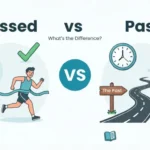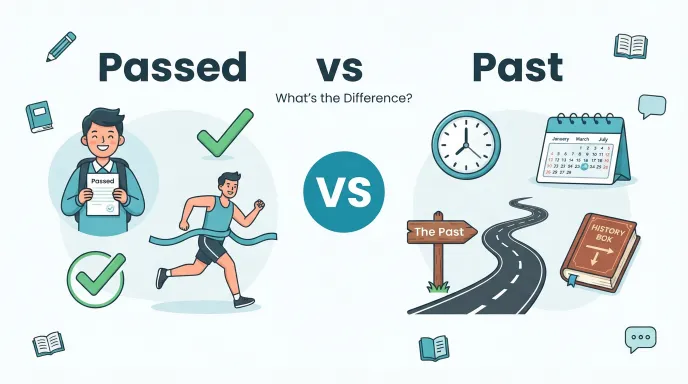
Have you ever stopped while writing and wondered if you should use passed or past? You’re not alone. These two words sound exactly the same, but they have very different meanings and grammar rules. Because they are homophones, many English learners and even native speakers mix them up.
Understanding the difference between passed vs past is important for writing clear emails, school assignments, business documents, and social media posts. Using the wrong word can make a sentence confusing or grammatically incorrect.
The good news is that the difference is easy once you know one simple rule. Passed is usually a verb, while past is most often a noun, adjective, adverb, or preposition. Knowing how each word works in a sentence will help you choose the correct one every time.
In this guide, you’ll learn the meanings, origins, grammar rules, examples, common mistakes, spelling differences, and practical tips for using passed and past correctly.
Passed vs Past: Quick Answer
The quick answer is simple:
- Passed = the past tense or past participle of the verb pass.
- Past = refers to time before now, or something beyond a point or place.
Quick Examples
✅ She passed the driving test..
✅ Learn from the past.
Easy Trick to Remember
If you can replace the word with “went by,” “completed,” or “succeeded,” use passed.
If you’re talking about time, direction, or previous events, use past.
| Word | Part of Speech | Meaning | Example |
| Passed | Verb | Moved by, succeeded, completed | He passed the exam. |
| Past | Noun, adjective, adverb, preposition | Earlier time or beyond | We drove past the park. |
The Origin of Passed vs Past
Although these words sound alike today, they developed differently over centuries.
Origin of “Past”
The word past comes from the same historical root but evolved into a separate word with a different grammatical role.
Instead of acting as a verb, past became a word that describes:
- previous time
- earlier events
- movement beyond a location
Examples:
- In the past
- Past experiences
- Walk past the building
Today, English treats passed and past as completely different words even though they share the same history.
British English vs American English Spelling
Unlike many English words, passed and past are spelled exactly the same in both British and American English.
There is no spelling difference between the two varieties.
The only challenge is choosing the correct word based on grammar and meaning.
Comparison Table
| Usage | British English | American English |
| Passed the exam | ✅ Passed | ✅ Passed |
| Walked past the house | ✅ Past | ✅ Past |
| Past experience | ✅ Past | ✅ Past |
| Time passed quickly | ✅ Passed | ✅ Passed |
Examples in British English
- She passed her GCSE exams.
- We walked past the museum.
Examples in American English
- He passed his driving test.
- They ran past the school.
No matter where you write English, the grammar rule stays exactly the same.
Which Spelling Should You Use?
The answer depends on what you want to say, not where you live. Both passed and past are correct English words, but they have different jobs in a sentence.
- Use passed when talking about an action. It is the past tense of the verb pass.
- Use past when talking about time, position, or something beyond a place.
Audience if Based Advice
| Audience | Recommended Usage |
| United States | Follow the grammar rule: passed for actions, past for time or position. |
| United Kingdom | Same grammar rule. |
| Canada | Same grammar rule. |
| Australia | Same grammar rule. |
| New Zealand | Same grammar rule. |
| Global English | Use the word that matches the sentence meaning. |
Quick Rule
Ask yourself:
Is this an action?
- Yes → Passed
- No → Past
Examples
✅ The teacher passed the papers around the room.
✅ The car drove past the school.
Common Mistakes with Passed vs Past
Because the two words sound exactly alike, writers often choose the wrong one. Here are the most common mistakes and the correct versions.
Mistake 1: Using “Past” Instead of “Passed”
❌ I past my exam.
✅ I passed my exam.
Why?
Passing an exam is an action, so use the verb passed
Mistake 2: Using “Passed” for Direction
❌ We walked passed the park.
✅ We walked past the park.
Why?
The sentence describes moving beyond a place, so past is correct
Mistake 3: Talking About Time
❌ In the passed, people wrote letters.
✅ In the past, people wrote letters.
Why?

The sentence refers to earlier time, not an action
Mistake 4: Confusing the Verb and Preposition
❌ She past the finish line first.
✅ She passed the finish line first.
Why?
Crossing the finish line is an action
Mistake 5: Using “Passed” as a Noun
❌ The passed teaches valuable lessons.
✅ The past teaches valuable lessons.
Why?
Here, past is a noun meaning earlier times
Quick Correction Table
| Incorrect | Correct | Reason |
| I past the test. | I passed the test. | Action (verb). |
| We walked passed the store. | We walked past the store. | Direction. |
| The passed is gone. | The past is gone. | Earlier time. |
| Time past quickly. | Time passed quickly. | Verb. |
| She drove passed me. | She drove past me. | Position or movement |
Easy Memory Trick
Remember this simple sentence:
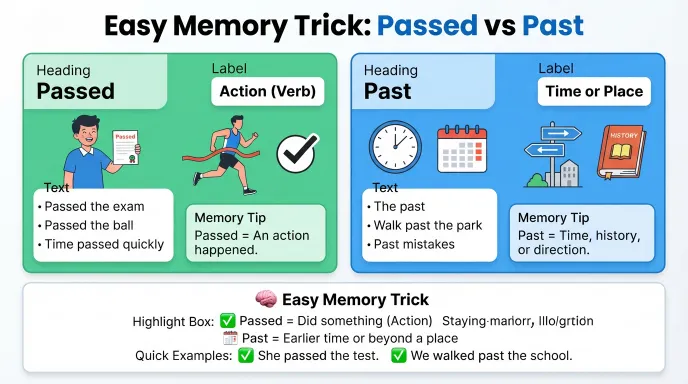
Passed = Did something.
Past = Time or Place.
Another trick:
- If you can replace the word with completed, went by, or succeeded, choose passed.
- If you can replace it with earlier, before, or beyond, choose past.
Practice
Choose the correct word:
- We walked ifififif the library. ✅ Past
- She ifififif the interview. ✅ Passed
- The ifififif cannot be changed. ✅ Past
- Several months have ifififif since then. ✅ Passed
These simple checks will help you avoid one of the most common English grammar mistakes.
Passed vs Past in Everyday Examples
Understanding grammar is easier when you see it in real-life situations. Here are examples of passed and past in emails, news, social media, and formal writing.
In Emails
Passed
- I passed the final review yesterday.
- Your request has passed all quality checks.
Past
In News Articles
Passed

- The city council passed a new law.
- The athlete passed the finish line in first place.
Past
On Social Media
Passed
- I finally passed my driving test! 🎉
- We passed 10,000 followers today!
Past
In Formal Writing
Passed
- The proposal passed after careful review.
- All candidates passed the examination.
Past
- Researchers analyzed past performance data.
- The building is just past the bridge.
Everyday Conversation
| Situation | Correct Sentence |
| School | I passed my math test. |
| Driving | We drove past the hospital. |
| History | The past shapes our future. |
| Sports | He passed the ball to his teammate. |
| Time | Several weeks have passed already. |
Passed vs Past :Google Trends & Usage Data
Both passed and past are searched thousands of times each month because they sound identical but have different meanings.
Why People Search “Passed vs Past”
Common reasons include:
Where the Confusion Is Most Common
The search term “Passed vs Past” is popular in countries where English is widely spoken or studied, including:
- United States
- United Kingdom
- Canada
- Australia
- India
- Pakistan
- Philippines
Students, teachers, bloggers, and professionals frequently search for this topic because it appears in everyday writing
Usage in Modern English
Although both words are common, they appear in different contexts.
Passed is most common when discussing:
- Exams
- Laws
- Time passing
- Sports
- Moving by something
Examples:
- Passed the test
- Passed away
- Time passed
- Passed the bill
Past is most common when discussing:
- History
- Previous experiences
- Directions
- Time
- Memories
Examples:
- The past
- Past mistakes
- Past midnight
- Walk past
Comparison Table: Passed vs Past
| Feature | Passed | Past |
| Part of Speech | Verb | Noun, adjective, adverb, preposition |
| Meaning | Moved by, succeeded, completed | Earlier time or beyond a place |
| Indicates Action | ✅ Yes | ❌ No |
| Refers to Time | Sometimes (time passed) | ✅ Yes |
| Refers to Position | ❌ No | ✅ Yes |
| Used After “Walked” | ❌ Walked passed | ✅ Walked past |
| Used With Exams | ✅ Passed the exam | ❌ Past the exam |
| Used With History | ❌ | ✅ The past |
| British English | Same | Same |
| American English | Same | Sam |
Quick Summary
| Use Passed When… | Use Past When… |
| An action happened | Talking about earlier time |
| Someone succeeded | Referring to history |
| Something moved by | Showing direction |
| Time went by | Meaning “beyond” |
With these examples and comparisons, choosing the correct word becomes much easier.
Frequently Asked Questions
1. What is the difference between passed and past?
Passed is the past tense of the verb pass, meaning to move by, succeed, or complete something. Past refers to earlier time, a position beyond something, or previous events
2. Is it “passed away” or “past away”?
The correct phrase is passed away.
Example:
3. Do you say “walked past” or “walked passed”?
The correct expression is walked past because past shows direction or position.
Example:
4. Which word is used with exams?
Use passed.
Examples:
5. Is “the past” a noun?
Yes. Past can be a noun that means the time before the present.
Example:
6. Are “passed” and “past” spelled differently in British and American English?
No. Both British and American English use the same spellings and grammar rules for passed and past
7. How can I remember the difference?
Use this simple memory trick:
- Passed = Action (verb).
- Past = Time or place.
If something happened or someone completed an action, choose passed. If you’re talking about history, earlier time, or direction, choose past.
Conclusion
The difference between passed vs past is one of the most common grammar challenges in English, but it’s easy to master once you understand each word’s role. Remember that passed is always a verb if the past tense of pass if used when someone or something moves by, succeeds, or completes an action. Past, on the other hand, usually refers to time, position, or events that happened before now and can function as a noun, adjective, adverb, or preposition.
A simple way to choose the correct word is to ask yourself if the sentence describes an action or refers to time or location. If it’s an action, use passed. If it’s about earlier times or movement beyond a place, use past.
By practicing with real-life examples and remembering this easy rule, you’ll avoid common mistakes and write with greater confidence. if you’re writing emails, academic papers, blog posts, or social media updates, using passed and past correctly will make your English clearer, more accurate, and more professional.
Related Guide!
Shinning or Shining: Which One is Correct?
See the dictionary definitions for passed and past.

Hi, I’m Sehrish Iqbal, and I enjoy writing about the English language and the little differences between words that often cause confusion. I create simple and easy-to-understand articles about grammar, spelling, commonly confused words, and correct word usage. My goal is to make English easier to understand and help students, writers, and English learners use the right words with confidence.