Many English learners and even native speakers confuse Accept and Except because they look and sound similar. However, these two words have completely different meanings. Using the wrong one can change the meaning of your sentence and make your writing unclear.
If you’ve ever wondered if to write accept or except, you’re not alone. This is one of the most commonly searched grammar questions online. if you’re writing an email, school assignment, business document, or social media post, knowing the difference helps you communicate with confidence.
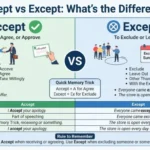
The good news is that the rule is simple. Accept means to receive, agree to, or say yes to something. Except means excluding someone or something. Once you understand this key difference, you’ll rarely confuse them again.
In this guide, you’ll learn the meaning, origin, examples, common mistakes, comparison tables, and practical tips to remember the difference between Accept vs Except. By the end, you’ll know exactly when to use each word.
Accept vs Except: Quick Answer
| Word | Meaning | Part of Speech | Example |
| Accept | To receive, agree to, or approve | Verb | I accept your invitation. |
| Except | Excluding or leaving out | Preposition/Conjunction | Everyone came except Sarah. |
Quick Rule
- Accept = Receive or Agree
- Except = Excluding
Examples
✅ I accept your apology.
✅ She accepted the job offer.
Easy Memory Trick
- Accept starts with A, just like Agree.
- Except starts with Ex, just like Exclude.
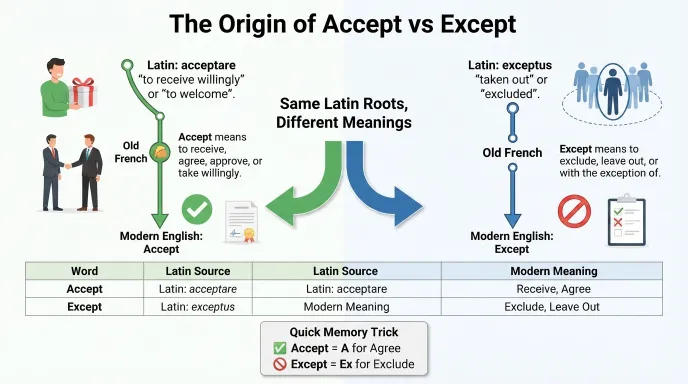
The Origin of Accept vs Except
Although Accept and Except look alike, they have different origins and meanings.
Origin of Accept
The word accept comes from the Latin word acceptare, meaning to receive willingly or to take gladly. It entered English through Old French and has kept nearly the same meaning for centuries.
Examples:
- Accept an invitation
- Accept responsibility
- Accept payment
Origin of Except
The word except comes from the Latin word exceptus, meaning taken out or excluded. It also entered English through Old French but developed a different meaning from accept.
Examples:
- Everyone except me
- Open daily except Monday
- No pets except service animals
Why People Confuse Them
People often mix these words because:
- They look similar.
- They sound similar.
- Both come from Latin.
- Only one letter is different.
- They often appear in formal writing.
However, remembering their meanings is easy:
- Accept = Receive
- Except = Exclude
British English vs American English Spelling
Unlike many English words, Accept and Except are spelled the same in both British English and American English. There are no regional spelling differences. The only challenge is choosing the correct word based on its meaning.
British vs American Comparison
| Feature | British English | American English |
| Accept | ✅ Accept | ✅ Accept |
| Except | ✅ Except | ✅ Except |
| Meaning Changes? | ❌ No | ❌ No |
| Spelling Changes? | ❌ No | ❌ No |
| Pronunciation | Nearly the same | Nearly the same |
Examples in British English
- I accept your invitation.
- Everyone came except James.
- The museum is open every day except Monday.
Examples in American English
- She accepted the new position.
- Everyone except Tom finished the project.
- We accept all major credit cards.
Key Takeaway
if you’re writing for readers in the United States, United Kingdom, Canada, Australia, New Zealand, or any other English-speaking country, the spellings remain:
- Accept ✔
- Except ✔
The only thing that changes is how you use them in a sentence, not how you spell them.
Which Spelling Should You Use?
Since there are no British or American spelling variations, your choice depends entirely on the meaning you want to express.
Use Accept When You Mean:
- To receive something
- To agree
- To approve
- To admit something is true
Examples
Use Except When You Mean:
- Excluding someone or something
- Leaving something out
- With the exception of
Examples
Audience :Based Advice
| Audience | Recommended Usage |
| US Readers | Use Accept for receive or agree; Except for excluding. |
| UK Readers | Same usage as American English. |
| Canada | No spelling differences. |
| Australia & New Zealand | Same spelling and meaning. |
| Global Audience | Follow the meaning, not regional spelling. |
Professional Writing Tip
Before using either word, ask yourself:
- Am I receiving or agreeing? → Accept
- Am I excluding something? → Except
This simple question prevents most mistakes.
Accept vs Except Comparison Table
| Feature | Accept | Except |
| Part of Speech | Verb | Preposition, Conjunction |
| Meaning | Receive, agree, approve | Excluding, leaving out |
| Memory Trick | A = Agree | Ex = Exclude |
| Example | I accept your apology. | Everyone came except Sam. |
| Opposite Idea | Receive | Leave out |
| Used in Formal Writing | Yes | Yes |
| British Spelling | Accept | Except |
| American Spelling | Accept | Except |
Common Mistakes with Accept vs Except
Because accept and except look and sound similar, people often use one when they mean the other. Here are the most common mistakes and how to avoid them.
Mistake 1: Using Accept Instead of Except
❌ Everyone came accept John.
✅ Everyone came except John.
Why?
You are excluding John, so except is correct
Mistake 2: Using Except Instead of Accept
❌ I except your apology.
✅ I accept your apology.
Why?
You are receiving or agreeing to the apology, so accept is correct
Mistake 3: Confusing Their Meanings
❌ We accepted everyone from the meeting.
✅ We invited everyone except Sarah.
Why?
Accept means to receive or agree. Except means to leave o
Mistake 4: Forgetting the Memory Trick
Remember these simple clues:

Common Error Correction Table
| Incorrect Sentence | Correct Sentence | Reason |
| Everyone came accept Tom. | Everyone came except Tom. | Excluding Tom. |
| I except your invitation. | I accept your invitation. | Receiving the invitation. |
| We except cash payments. | We accept cash payments. | Accept means receive. |
| Every student accept Amy passed. | Every student except Amy passed. | Amy is excluded. |
| She excepted the award. | She accepted the award. | Accepted means received. |
Accept vs Except in Everyday Examples
Knowing the difference becomes easier when you see these words in real-life situations.
In Emails
Accept
Thank you. I accept your meeting invitation.
Except
Everyone will attend the meeting except Michael
In Business Writing
Accept
We accept online payments.
Except
Returns are accepted on all items except clearance products
In News Articles
Accept
The company accepted the government’s proposal.
Except
All roads reopened except the highway
On Social Media
Accept
I finally accepted the challenge!
Except
Everyone joined the trend except me
In School Writing
Accept

The teacher accepted my homework.
Except
Every answer was correct except number five
In Everyday Conversation
- I accept your help.
- She accepted the job offer.
- Everyone came except my brother.
- The shop is open every day except Sunday.
- We accept credit cards.
- All passengers boarded except one.
Accept vs Except: Google Trends & Usage Data
Both accept and except are widely searched because they are commonly confused in English writing.
Where Is This Topic Popular?
Grammar searches for Accept vs Except are especially popular in:
- United States
- United Kingdom
- Canada
- Australia
- India
- Pakistan
- New Zealand
These countries have large numbers of English speakers, students, teachers, and professionals who frequently search for grammar explanations.
Why People Search for This Topic
People often search Accept vs Except because:
- The words have similar pronunciation.
- Their spellings differ by only one letter.
- They have completely different meanings.
- They are common in exams and academic writing.
- They appear frequently in business emails and formal documents.
Usage Context
| Word | Common Usage |
| Accept | Invitations, offers, payments, apologies, responsibility |
| Except | Exclusions, rules, lists, instructions, comparisons |
Search Trend Summary
Interest in Accept vs Except remains steady throughout the year because it is a common grammar topic for:
- Students
- English language learners
- Teachers
- Content writers
- Bloggers
- Professionals
- Job seekers
Understanding the difference helps writers avoid mistakes and produce clearer, more professional English
Frequently Asked Questions
1. What is the difference between accept and except?
Accept means to receive, agree to, or approve something. Except means excluding or leaving something or someone out.
Examples:
2. Is accept a verb?
Yes. Accept is always a verb because it describes an action.
Examples:
3. Is except a preposition?
Usually, yes. Except is most often used as a preposition, but it can also be a conjunction in some sentences.
Example:
4. How can I remember the difference?
Use this simple memory trick:
- Accept = Agree or Receive
- Except = Exclude
Think of A in Accept for Agree, and Ex in Except for Exclude
5. Are accept and except pronounced the same?
No. They sound similar but are pronounced slightly differently.
- Accept: /əkˈsept/
- Except: /ɪkˈsept/
The difference is small, which is why many learners confuse them
6. Are there British and American spelling differences?
No. Both British English and American English use the same spellings:
- Accept
- Except
Only the meaning determines which word you should use
7. Can I use accept and except interchangeably?
No. They have completely different meanings and cannot replace each other.
❌ I except your apology.
✅ I accept your apology.
❌ Everyone came accept Sam.
✅ Everyone came except Sam
Conclusion
Although Accept and Except look and sound alike, their meanings are completely different. Accept means to receive, agree to, approve, or willingly take something, while Except means to exclude or leave someone or something out. Understanding this simple distinction can greatly improve your writing and help you avoid one of the most common grammar mistakes in English.
The easiest way to remember them is with two quick memory tricks: Accept = Agree or Receive, and Except = Exclude. Whenever you’re unsure, ask yourself if you’re talking about receiving something or leaving something out. The answer will guide you to the correct word.
if you’re writing emails, essays, business documents, or social media posts, using Accept and Except correctly makes your communication clearer and more professional. Since there are no spelling differences between British and American English, you only need to focus on the meaning. With regular practice and the examples in this guide, you’ll be able to use Accept and Except confidently in everyday English.
Keep Reading!
Develop or Develope: Which Spelling Is Correct?
Bolder or Boulder: Differences & Correct Usage
Openned or Opened: The Correct Spelling Explained
See the dictionary definitions for accept and except.

Daniel R. Foster is an experienced English language writer and editor who specializes in explaining commonly confused words and grammar nuances. With a strong passion for clarity in communication, he creates easy-to-understand comparisons that help learners, students, and professionals use English more confidently. His articles focus on accuracy, real-world examples, and practical usage.