Have you ever stopped while writing and wondered if to use drank or drunk? You are not alone. Many English learners and even native speakers mix up these two words because both come from the verb drink. At first glance, they look similar, and both refer to drinking something in the past. However, they are not interchangeable.
Understanding the difference between drank and drunk helps you speak and write more naturally. if you are writing an email, posting on social media, completing homework, or preparing for an English test, using the correct form makes your writing clearer and more professional.
This guide explains the difference in simple language. You will learn when to use drank, when to use drunk, where each word came from, how British and American English use them, common mistakes to avoid, and plenty of real life examples. By the end, you will know exactly which word to choose every time.
Drank or Drunk Quick Answer
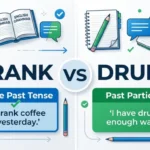
Drank is the simple past tense of drink.
Drunk is the past participle of drink.
Correct Examples
- I drank two glasses of water yesterday.
- She drank coffee this morning.
- I have drunk enough water today.
- They had drunk all the juice before we arrived.
Easy Rule
- Use drank without a helping verb.
- Use drunk after helping verbs like have, has, or had.
| Word | Grammar Role | Example |
| Drank | Simple past | We drank tea. |
| Drunk | Past participle | We have drunk tea. |
The Origin of Drank or Drunk
Both words come from the Old English verb drincan, meaning “to drink.”
Over hundreds of years, English developed different verb forms.
- Drink became the present tense.
- Drank became the simple past tense.
- Drunk became the past participle.
This pattern is common among irregular verbs.
Examples:
- Sing → Sang → Sung
- Begin → Began → Begun
- Drink → Drank → Drunk
These forms changed naturally as English evolved. Today, both British and American English still follow this grammar rule.
British English vs American English Spelling
Unlike words such as color and colour, there is no spelling difference between British English and American English.
Both varieties use:
- Drink
- Drank
- Drunk
The only small difference is style.
British English may use the present perfect more often.
Example:
British English
- I have drunk three cups of tea today.
American English
- I drank three cups of tea today.
Both are correct depending on the situation.
Comparison Table
| Feature | British English | American English |
| Spelling | Drank / Drunk | Drank / Drunk |
| Past tense | Drank | Drank |
| Past participle | Drunk | Drunk |
| Present perfect usage | More common | Slightly less common |
Which Spelling Should You Use?
Since both countries use the same spelling, your choice depends on grammar instead of location.
Use Drank when:
- Talking about a completed action.
- No helping verb is present.
Examples:
- He drank milk before bed.
- We drank coffee after lunch.
Use Drunk when:
- Using have, has, or had.
- Forming perfect tenses.
Examples:
- I have drunk enough water.
- She had drunk the juice already.
Best Advice
- American audience → Follow the same grammar rule.
- British audience → Follow the same grammar rule.
- Global audience → Use drank for simple past and drunk for perfect tenses.
Common Mistakes with Drank or Drunk
Many learners confuse these two verb forms.
Incorrect
❌ I have drank enough water.
✅ I have drunk enough water.
❌ She drunk coffee yesterday.
✅ She drank coffee yesterday.
❌ They had drank everything.
✅ They had drunk everything.
Quick Correction Table
| Incorrect | Correct |
| Have drank | Have drunk |
| Has drank | Has drunk |
| Had drank | Had drunk |
| Drunk yesterday | Drank yesterday |
Drank or Drunk in Everyday Examples
“I drank plenty of water during the meeting.”
News
“The athletes had drunk enough fluids before the race.”
Social Media
“I drank the best coffee today!”
Formal Writing
“The participants had drunk clean water before beginning the experiment.”
Conversation
A: Did you drink the juice?
B: Yes, I drank it this morning.
A: Have you ever drunk coconut water?
B: Yes, I have.
Drank or Drunk Google Trends & Usage Data
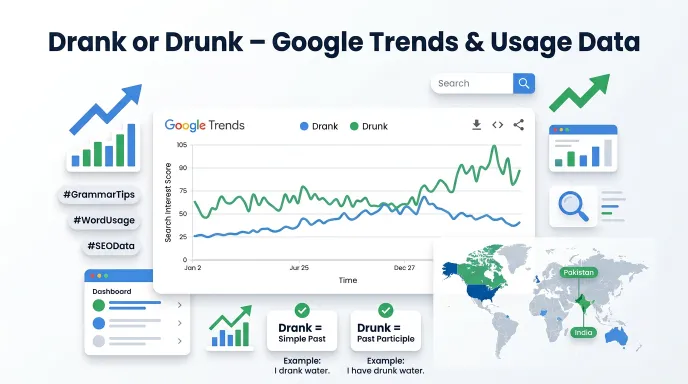
Search interest for drank or drunk stays steady because many English learners want to understand irregular verbs.
The keyword is especially popular in:
- United States
- United Kingdom
- Canada
- Australia
- India
- Pakistan
People usually search this phrase before:
- English exams
- IELTS preparation
- School assignments
- Grammar lessons
- Professional writing
Most users are looking for quick grammar rules and easy examples rather than spelling differences.
Drank vs Drunk Comparison Table
| Feature | Drank | Drunk |
| Verb Form | Simple past | Past participle |
| Needs helping verb | No | Yes |
| Grammar | Past tense | Perfect tenses |
| Example | I drank water. | I have drunk water. |
| Correct after have/has/had | No | Yes |
FAQ’S of Drank or Drunk
Is it drank or drunk yesterday?
Use drank.
Correct: I drank coffee yesterday.
Is “I have drank” correct?
No.
The correct sentence is:
I have drunk coffee.
Is drunk a real word?
Yes.
It is the past participle of drink.
Why do people confuse drank and drunk?
Because both describe actions in the past, but they belong to different grammar forms.
Is drunk only an adjective?
No.
It can be:
- A past participle (“I have drunk water.”)
- An adjective (“He is drunk.”)
Which is more common, drank or drunk?
Both are common.
Drank appears in simple past sentences.
Drunk appears in perfect tenses and as an adjective.
How can I remember the difference?
Think of this rule:
- Yesterday → Drank
- Have/Has/Had → Drunk
Conclusion
The difference between drank and drunk is simple once you know the grammar rule. Drank is the simple past tense and describes an action that happened in the past. Drunk is the past participle and is used with helping verbs such as have, has, and had. Although both words come from the same verb, they cannot replace each other.
The good news is that British English and American English follow the same spelling and grammar rules, so you only need to remember when each form is correct. Practice by reading, writing, and speaking short sentences every day. Over time, using drank and drunk correctly will become natural. Whenever you feel unsure, remember the easy rule: Yesterday equals drank. Have, has, or had equals drunk. This simple trick will help you avoid common grammar mistakes and make your English more accurate and confident.
Descover more about!
Related articles: Leasee or Lessee: Correct Spelling Guide For 2026, Onto or Unto: Which Is Correct and How to Use It?, Flu or Pneumonia: When to Seek Care.
See the dictionary definitions for drank and drunk.

Passionate about language and clear communication, I explore the subtle differences between words and expressions through well-researched, practical content. My goal is to help readers write with greater clarity, confidence, and precision by making complex language concepts easy to understand.