English has many words that sound the same but have different meanings and spellings. These words are called homophones, and one of the most common examples is To vs Too vs Two. Because they all sound alike, many writers, students, and English learners accidentally use the wrong one.
If you’ve ever wondered if to write to, too, or two, you’re not alone. This mistake appears in emails, school assignments, social media posts, and even professional documents. While the pronunciation is identical, each word has a completely different purpose. Using the wrong spelling can make your writing look careless and confuse your readers.
The good news is that learning the difference is easy. Once you understand the meaning and role of each word, you’ll know exactly when to use it. This guide explains the definitions, origins, examples, common mistakes, and practical tips to help you remember the correct spelling every time. if you’re writing for school, work, or everyday conversations, this article will help you use to, too, and two with confidence.
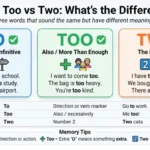
To vs Too vs Two : Quick Answer
Although to, too, and two sound exactly the same, they have different meanings.
| Word | Meaning | Example |
| To | Shows direction, destination, or is part of an infinitive verb | I am going to school. |
| Too | Means also or more than enough | I want to come too. |
| Two | The number 2 | She has two cats. |
Quick Examples
- I walked to the park.
- Emma wants ice cream too.
- We bought two tickets.
Easy Memory Trick
- To = Direction or action.
- Too = Also or extra.
- Two = Number 2.
The Origin of To vs Too vs Two
Although these three words sound the same today, they have different histories.
Origin of Two
The word two comes from the Old English twā, which traces back to the Proto-Germanic language. It has always represented the number 2. The silent “w” remained in the spelling even though it is no longer pronounced.
Why Are They Confused?
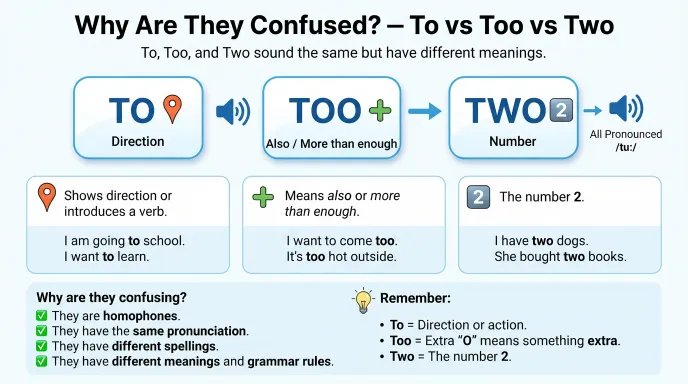
These words are confused because they are homophones—they sound exactly alike but have different spellings and meanings. English pronunciation changed over time, while the spellings stayed mostly the same.
In modern English:
- To = direction or infinitive marker
- Too = also or excessively
- Two = the number 2
Understanding their origins makes it easier to remember why all three spellings exist.
British English vs American English Spelling
Unlike many English words, to, too, and two are spelled exactly the same in both British English and American English. There are no regional spelling differences between these words.
The only challenge is choosing the correct word based on its meaning if not your location or writing style.
Examples in British English
- I walked to the station.
- I’d like a cup of tea too.
- They have two chi.
British English vs American English Comparison Table
| Meaning | Correct Word | British English | American English |
| Shows direction | To | ✅ To | ✅ To |
| Means “also” | Too | ✅ Too | ✅ Too |
| Means “more than enough” | Too | ✅ Too | ✅ Too |
| Number 2 | Two | ✅ Two | ✅ Two |
| Pronunciation | Same | /tuː/ | /tuː/ |
To vs Too vs Two Comparison Table
| Word | Part of Speech | Meaning | Example |
| To | Preposition / Infinitive Marker | Shows direction or introduces a verb | We went to school. |
| Too | Adverb | Also; more than enough | I want to go too. |
| Two | Number | The number 2 | I have two dogs. |
Which Spelling Should You Use?
The correct spelling depends entirely on what you want t
Example
Use Too When:
- You mean also.
- Something is more than enough.
Example
For International Writing
if you’re writing emails, blog posts, business documents, or academic papers, always choose the word based on its meaning. There are no regional spelling preferences for to, too, or two

Quick Memory Tips
- To → Think of traveling to a place.
- Too → Has an extra “O”, meaning something extra (“also” or “more than enough”).
- Two → Starts with Tw-, just like twice and twelve, which relate to numbers.
These simple tricks make it much easier to remember the correct spelling.
Common Mistakes with To vs Too vs Two
Even native English speakers sometimes confuse to, too, and two because they sound exactly the same. Here are the most common mistakes and the correct forms.
| Incorrect | Correct | Why? |
| I want too go home. | I want to go home. | To is used before a verb. |
| Can I come to? | Can I come too? | Too means “also.” |
| I have to sisters. | I have two sisters. | Two is the number 2. |
| The coffee is to hot. | The coffee is too hot. | Too means “more than enough.” |
| We drove two the beach. | We drove to the beach. | To shows direction. |
| She wants two come with us. | She wants to come with us. | To introduces an infinitive verb. |
How to Avoid These Mistakes
Ask yourself these simple questions:
- Am I talking about a place or an action? → Use to.
- Do I mean “also” or “more than enough”? → Use too.
- Am I talking about the number 2? → Use two.
Quick Quiz
Choose the correct word.
- I want ififif learn English.
- ✅ to
- The box is ififif heavy.
- ✅ too
- She has ififif brothers.
- ✅ two
- Are you coming ififif?
- ✅ too
- We walked ififif school.
- ✅ to
To vs Too vs Two in Everyday Examples
These words appear in almost every type of writing. Here are examples from daily life.
In Emails
- Let’s go to the mall.
- Me too!
- I ordered two pizzas.
To vs Too vs Two: Google Trends & Usage Data
The words to, too, and two are among the most frequently searched grammar topics because they are common homophones. Students, writers, and English learners often search for them to improve spelling and grammar.
Search Popularity
- “To vs Too vs Two” is a popular educational search term.
- Interest remains steady throughout the year because it is taught in schools and appears in grammar tests.
- Searches often increase during back-to-school seasons and exam periods.
Where People Search Most
- 🇺🇸 United States
- 🇬🇧 United Kingdom
- 🇨🇦 Canada
- 🇦🇺 Australia
- 🇮🇳 India
- 🌍 Other English-learning countries
Why People Search This Topic
People usually want to know:

- Which word is correct?
- What’s the difference between to, too, and two?
- How can I remember them?
- Are they interchangeable?
- Which one should I use in writing?
Usage Summary
| Word | Most Common Use | Popular Contexts |
| To | Direction and infinitive verbs | Everyday writing, business, education |
| Too | Also; more than enough | Conversations, emails, social media |
| Two | Number 2 | Mathematics, counting, everyday communication |
These three words are essential in English, making them one of the most searched grammar topics online.
Frequently Asked Questions1. What is the difference between to, too, and two?
- To shows direction or introduces a verb.
- Too means also or more than enough.
- Two is the number 2.
Example:
- I want to go.
- I want to go too.
- I have two tickets.
2. Is “too” the same as “to”?
No. Although they sound the same, they have different meanings.
- To = direction or infinitive marker.
- Too = also or excessively.
Correct:
3. When should I use “two”?
Use two whenever you are talking about the number 2.
Examples:
4. Are there British and American spelling differences?
No. To, too, and two are spelled exactly the same in British English, American English, Canadian English, Australian English, and other English varieties
5. Why are to, too, and two confusing?R
They are homophones, which means they sound the same but have different spellings and meanings
6. How can I remember the difference?
A simple memory trick is:
7. Can I use these words interchangeably?
No. Each word has a different purpose. Using the wrong one changes the meaning of your sentence and creates a grammar mistake
Conclusion
The difference between to, too, and two is simple once you understand what each word means. Although they sound exactly alike, they perform completely different jobs in English. To shows direction or introduces a verb, too means alsoor more than enough, and two refers to the number 2. Remembering these meanings will help you avoid one of the most common spelling mistakes in everyday writing.
if you’re writing emails, school assignments, blog posts, business documents, or social media updates, choosing the correct word makes your writing clearer and more professional. Since there are no spelling differences between British and American English, you only need to focus on the meaning of the word you want to use.
A helpful trick is to remember that too has an extra “o”, representing something extra. Two always relates to counting, while to is used for movement and infinitive verbs. With regular practice and careful proofreading, you’ll quickly master to, too, and two, making your English writing more accurate and co
Full or Queen: Which Bed Size
Broke or Broken: Which One Is Correct?
Honourable or Honorable: Which Spelling Is Corr
Related articles: Misspelt or Misspelled: Which Spelling Is Correct? (2026), Mom or Mum: Which Spelling Is Correct? UK vs USA Spelling, Familiarise vs Familiarize: Meaning and Usage.
See the dictionary definitions for to and too.

Passionate about language and clear communication, I explore the subtle differences between words and expressions through well-researched, practical content. My goal is to help readers write with greater clarity, confidence, and precision by making complex language concepts easy to understand.