Many English learners and even native speakers confuse advice and advise because they look almost identical. The only difference is the final letter if c versus s if but they have different meanings and different grammar rules. Using the wrong word can make your writing look unprofessional in emails, school assignments, business documents, and social media posts.
If you’ve ever wondered if to write “Thank you for your advice” or “Thank you for your advise,” you’re not alone. This is one of the most searched grammar questions because both words relate to giving recommendations, yet they cannot be used in the same way.
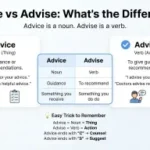
The good news is that the difference is simple once you understand it. Advice is a noun (a thing), while advise is a verb (an action). In this guide, you’ll learn the meaning of each word, their origins, British and American English usage, common mistakes, practical examples, and simple memory tricks to help you use them correctly every time.
Advice vs Advise:Quick Answer
The difference is simple:
- Advice = a noun that means guidance or recommendations.
- Advise = a verb that means to give guidance or recommendations.
Examples
✅ She gave me good advice.
✅ I advise you to save money.
❌ She gave me good advise.
❌ I advice you to save money.
Easy Memory Trick
- Advice = Thing you receive.
- Advise = Action you do.
The Origin of Advice vs Advise
Both words come from the Old French word aviser, meaning “to consider” or “to inform.” They later entered Middle English and gradually developed different grammatical roles.
- Advice became the noun, referring to guidance or recommendations.
- Advise became the verb, meaning to give guidance or recommendations.
Although the words share the same history, English uses them differently today. One names the guidance itself, while the other describes the action of giving it.
Another helpful difference is pronunciation:
- Advice ends with an /s/ sound.
- Advise ends with a /z/ sound.
Listening carefully to the final sound can help you remember which word is being used.
British English vs American English Spelling
Unlike words such as colour/color or behaviour/behavior, there is no spelling difference between British and American English for advice and advise.
| English Version | Noun | Verb |
| American English | Advice | Advise |
| British English | Advice | Advise |
| Australian English | Advice | Advise |
| Canadian English | Advice | Advise |
Examples
American English
- My teacher gave useful advice.
- I advise everyone to wear a seatbelt.
British English
- Her advice was very helpful.
- Doctors advise regular exercise.
Both English varieties follow exactly the same grammar and spelling rules.
Which Spelling Should You Use?
The correct choice depends on how the word is used in your sentence, not if you’re writing for American or British readers.
Use Advice when you need a noun (a thing).
Examples
- Thank you for your advice.
- I need some advice about my career.
- His advice helped me solve the problem.
- She always gives good advice.
Use Advise when you need a verb (an action).
Examples
- I advise you to read the instructions carefully.
- Experts advise saving money for emergencies.
- Doctors advise patients to exercise regularly.
- Teachers advise students before exams.
Audience Guide
| Audience | Correct Usage |
| United States | Advice (noun), Advise (verb) |
| United Kingdom | Advice (noun), Advise (verb) |
| Canada | Advice (noun), Advise (verb) |
| Australia | Advice (noun), Advise (verb) |
| International English | Advice (noun), Advise (verb) |
Key Takeaway:
No matter where your audience is, Advice is always the noun, and Advise is always the verb.
Common Mistakes with Advice vs Advise
Because these words have similar spellings and meanings, many people accidentally use one in place of the other. Here are some of the most common mistakes.
| Incorrect | Correct |
| Please advice me. | Please advise me. |
| Thanks for your advise. | Thanks for your advice. |
| I need an advise. | I need some advice. |
| She adviced me yesterday. | She advised me yesterday. |
| Can you give me an advise? | Can you give me some advice? |
| He gave me many advices. | He gave me a lot of advice. |
Why These Mistakes Happen
Most learners make these mistakes because:
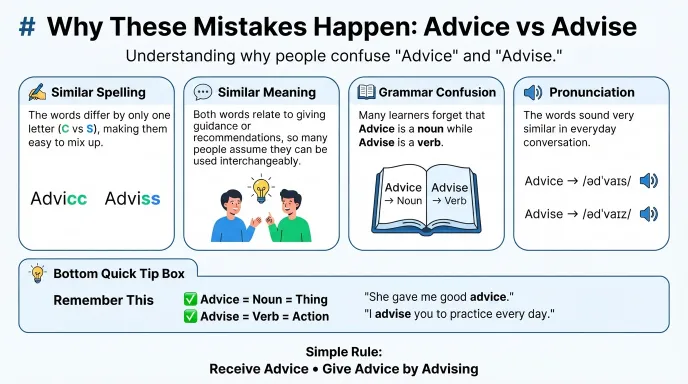
- The words look almost identical.
- Both relate to giving recommendations.
- They are pronounced similarly in fast speech.
- Many people forget that one is a noun and the other is a verb.
Simple Memory Trick
Remember this easy rule:
- Advice = Noun = Something you receive.
- Advise = Verb = Something you do.
Think of these examples:

- ✔ I need your advice.
- ✔ I advise you to stay calm.
Advice vs Advise in Everyday Examples
Understanding these words is easier when you see them in real-life situations.
In Emails
- Thank you for your helpful advice.
- I advise reviewing the report before sending it.
- Your advice was greatly appreciated.
In News Articles
- Financial experts advise people to save for retirement.
- The government issued travel advice for visitors.
- Health officials advise getting vaccinated.
On Social Media
- Best advice I’ve ever received!
- I advise everyone to watch this documentary.
- What’s the best career advice you’ve ever heard?
In Formal Writing
- The lawyer provided legal advice.
- The committee advised the company to update its policy.
- Professional advice should always come from qualified experts.
In Everyday Conversations
- Can you give me some advice?
- I’d advise you to leave early.
- Her advice made a big difference.
- My parents always advise me to work hard.
These examples show that advice refers to the recommendation itself, while advise describes the act of giving that recommendation.
Advice vs Advise : Google Trends & Usage Data
The keywords “Advice vs Advise” receive consistent search traffic throughout the year because they are among the most commonly confused words in English grammar. Students, writers, job seekers, and English learners frequently search for these terms to improve their writing.
Unlike spelling pairs such as color/colour or behavior/behaviour, the confusion is grammatical, not regional. People want to know when to use the noun advice and when to use the verb advise.
Where Is This Keyword Most Popular?
Search interest is highest in countries where English is widely spoken or learned as a second language.
- United States
- United Kingdom
- Canada
- Australia
- India
- Pakistan
- Philippines
- South Africa
Common Search Queries
People often search for:
- Advice vs Advise
- Advice meaning
- Advise meaning
- Difference between Advice and Advise
- Is advice a noun?
- Is advise a verb?
- Advice or Advise examples
- Please advise or please advice
- How to use advice and advise
- Advice vs Advise grammar
Why This Topic Remains Popular
This grammar question continues to trend because:
- The words look almost identical.
- They have similar meanings.
- One is a noun and the other is a verb.
- They are commonly used in emails, business writing, and academic work.
Learning this simple rule helps writers avoid one of the most frequent English grammar mistakes.
Advice vs Advise Comparison Table
| Feature | Advice | Advise |
| Part of Speech | Noun | Verb |
| Meaning | Guidance or recommendation | To give guidance or recommend |
| Pronunciation | /ədˈvaɪs/ | /ədˈvaɪz/ |
| Function | Thing | Action |
| Countable? | No (uncountable) | Not applicable |
| British English | Same spelling | Same spelling |
| American English | Same spelling | Same spelling |
| Example | Thank you for your advice. | I advise you to wait. |
Quick Comparison
| Advice | Advise |
| Noun | Verb |
| Means guidance | Means to recommend |
| Something you receive | Something you do |
| “Good advice” | “I advise you” |
| Cannot be used as a verb | Cannot be used as a noun |
Frequently Asked Questions
1. What is the difference between advice and advise?
Advice is a noun that means guidance or recommendations. Advise is a verb that means to give guidance or recommend something

2. Is “Please advice me” correct?
No. The correct sentence is:
Please advise me.
Because advise is the verb
3. Is advice a noun or a verb?
Advice is always a noun.
Example:
4. Is advise a noun?
No.
Advise is always a verb.
Example:
5. Do British and American English spell advice differently?
No.
Both British and American English use:
- Advice (noun)
- Advise (verb)
The spelling is exactly the same
6. Can I say “an advice”?
Generally, no.
Advice is an uncountable noun.
Correct forms include:
- Some advice
- A piece of advice
- Helpful advice
Incorrect:
7. How can I remember the difference?
Use this easy trick:
- Advice ends in C = Counsel (noun).
- Advise ends in S = Suggest (verb).
Another simple reminder:
- Advice = You receive it.
- Advise = You give it.
Conclusion
Understanding the difference between advice and advise is one of the easiest ways to improve your English grammar and writing. Although these two words look almost identical, they serve different purposes in a sentence. Advice is a noun, meaning guidance, suggestions, or recommendations that someone gives or receives. Advise, on the other hand, is a verb, meaning to offer guidance or recommend a course of action.
A simple way to remember the difference is this: advice is something you receive, while advise is something you do. This rule applies in every form of English, including American, British, Canadian, and Australian English. There is no regional spelling difference, making the choice purely a matter of grammar.
if you’re writing an email, preparing a business report, completing schoolwork, or posting on social media, using the correct word helps your writing appear more accurate and professional. By practicing with real-life examples and remembering that advice = noun and advise = verb, you’ll avoid one of the most common grammar mistakes and communicate with greater confidence in every situation.
Read more !
Sewn or Sewed: Which Is Correct? Easy Grammar Guide?
Full or Queen: Which Bed Size Should You Choose?
Related articles: Scared or Scarred: What Is the Real Difference?.
See the dictionary definitions for advice and advise.

Miles Thornton is a seasoned author and content specialist with a knack for simplifying complex topics. Passionate about clear, engaging writing, creates articles that inform and inspire readers. With years of experience in digital publishing, Miles combines professionalism with creativity, delivering insightful content for diverse audiences