Have you ever typed a sentence, paused, and wondered if to use your or you’re? You’re not alone. This is one of the most common grammar mistakes in English. Even native speakers mix them up because they sound exactly the same when spoken.
People search for “Your vs You’re” because they want to write clearly and avoid embarrassing grammar errors in emails, school assignments, social media posts, and professional documents. While these two words are pronounced alike, they have completely different meanings and uses. Choosing the wrong one can change the meaning of your sentence and make your writing appear less polished.
The good news is that the difference is simple once you understand the basic rule. Your shows ownership, while you’re is a shortened form of you are. Learning this small grammar rule will help you write with greater confidence and accuracy.
In this guide, you’ll discover the meaning of each word, where they came from, common mistakes, practical examples, comparison tables, and expert tips so you’ll never confuse your and you’re again.
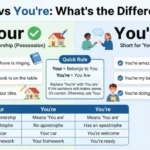
Your vs You’re :Quick Answer
The quick answer is simple:
- Your = shows possession or ownership.
- You’re = a contraction of you are.
Examples
| Word | Meaning | Example |
| Your | Belonging to you | Your phone is ringing. |
| You’re | You are | You’re doing a great job. |
Easy Memory Trick
If you can replace the word with “you are,” then use you’re.
✅ You’re my best friend. → You are my best friend.
If replacing it with “you are” doesn’t make sense, use your.
✅ Your jacket looks nice.
❌ You are jacket looks nice.
The Origin of Your vs You’re
Understanding where these words come from makes them easier to remember.
Origin of Your
The word your comes from Old English ēower, which meant “belonging to you.” Over many centuries, the spelling changed until it became the modern word your.
It has always been a possessive determiner, meaning it shows that something belongs to someone.
Examples:
- Your book
- Your house
- Your idea
Origin of You’re
The word you’re is much newer.
It is simply a contraction made by combining:
- You
- Are
The apostrophe (‘) replaces the missing letter a in are.
You + Are = You’re
Contractions became popular because they make speaking and informal writing sound more natural.
Examples:
- You’re welcome.
- You’re amazing.
- You’re late.
Why People Confuse Them
The confusion exists because:
- They sound exactly the same.
- Spell check may not catch the mistake.
- Both words are extremely common.
- Fast typing often causes errors.
They are homophones iwords that sound alike but have different meanings and spellings.
British English vs American English Spelling
Unlike many English words, your and you’re are spelled exactly the same in both British English and American English.
There is no spelling difference between the two varieties of English.
The only difference is how the words are used, not how they are written.
Examples
American English
- Your car is outside.
- You’re very kind.
British English
- Your holiday starts tomorrow.
- You’re invited to dinner.
The grammar rule never changes.
Comparison Table
| Feature | American English | British English |
| Your | ✅ Same spelling | ✅ Same spelling |
| You’re | ✅ Same spelling | ✅ Same spelling |
| Meaning | Same | Same |
| Grammar Rule | Same | Same |
| Pronunciation | Same | Same |
Both forms follow identical grammar rules worldwide.
Which Spelling Should You Use?
The answer is easy: use the word that matches the meaning of your sentence.
- Use your when you are talking about something that belongs to someone.
- Use you’re when you mean you are.
Since your and you’re have the same spelling in British English and American English, you never need to choose one based on your audience. The only choice is using the correct grammar.
For American English
Follow the same rule:
- Your = possession
- You’re = you are
Examples
For British English
The rule is exactly the same.
Examples
For International or Global Audiences
if you’re writing for readers in Canada, Australia, New Zealand, India, or anywhere else, the grammar never changes.
Always ask yourself:
Can I replace the word with “you are”?
- Yes → You’re
- No → Your
Quick Decision Chart
| If the sentence means… | Use | Example |
| Something belongs to someone | Your | Your bag is on the chair. |
| You are | You’re | You’re my best friend. |
Simple Memory Trick
Think of the apostrophe in you’re as a reminder that letters are missing.
- You’re = You are
- Your = Ownership
If “you are” fits naturally, use you’re.
If it doesn’t, use your.
Common Mistakes with Your vs You’re
Because these words sound the same, many writers accidentally use the wrong one. Here are the most common mistakes and how to fix them.
Mistake 1: Using your Instead of you’re
❌ Your amazing.
✅ You’re amazing.
Reason:
The sentence means You are amazing, so the contraction is needed

Mistake 2: Using you’re Instead of your
❌ I like you’re shoes.
✅ I like your shoes.
Reason:
The shoes belong to you, so use the possessive word
Mistake 3: Forgetting the Apostrophe
❌ Youre my friend.
✅ You’re my friend.
Reason:
The apostrophe replaces the missing a in are
Mistake 4: Trusting Spell Check
Spell check often misses this mistake because both words are correctly spelled.
Example:
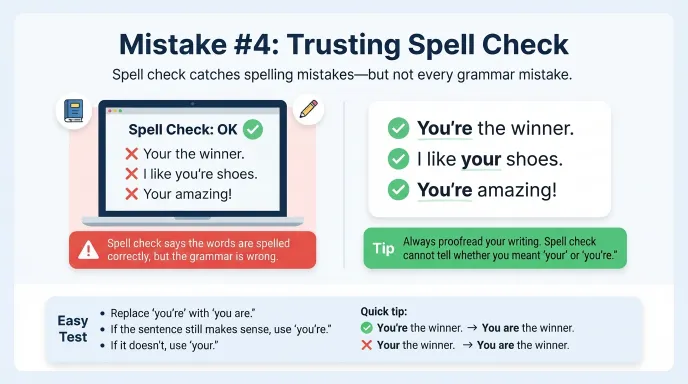
❌ Your the winner.
The spelling is correct, but the grammar is wrong.
✅ You’re the winner.
Always proofread your writing instead of relying only on spell check
Mistake 5: Writing Too Quickly
Many typing mistakes happen because people write fast without checking.
Before submitting an email or assignment, reread every sentence containing your or you’re
Common Error Correction Table
| Incorrect | Correct | Why? |
| Your welcome. | You’re welcome. | Means “You are welcome.” |
| I love you’re smile. | I love your smile. | Smile belongs to you. |
| Your going home. | You’re going home. | Means “You are going home.” |
| You’re phone is ringing. | Your phone is ringing. | Phone belongs to you. |
| Your the best. | You’re the best. | Means “You are the best.” |
| Is this you’re book? | Is this your book? | Book belongs to you. |
Final Tip
Whenever you’re unsure, replace the word with you are:
- You’re happy. → You are happy. ✅
- Your happy dog. → You are happy dog. ❌
If the replacement sounds correct, choose you’re. If it doesn’t, choose your.
Your vs You’re in Everyday Examples
Understanding the rule is one thing, but using it correctly in real life is even more important. Here are examples showing how your and you’re appear in everyday writing.
In Emails
Professional emails should always use the correct word because grammar mistakes can leave a poor impression.
Using Your
- Your application has been approved.
- Thank you for your patience.
- Please confirm your attendance.
Using You’re
- You’re invited to our annual meeting.
- You’re receiving this email because you subscribed.
- We hope you’re enjoying our service.
In News Headlines
News organizations use both words correctly depending on the sentence.
Using Your
- Your Health Matters More Than Ever
- Protect Your Online Privacy
- Your Tax Deadline Is Approaching
Using You’re
On Social Media
Short posts often include these words.
Using Your
- Share your favorite travel photo!
- Your support means everything.
- Tell us your opinion below.
Using You’re
In Formal Writing
Business reports, academic papers, and official documents also follow the same grammar rule.

Using Your
- Your signature is required.
- Your proposal meets our requirements.
- Please submit your report before Friday.
Using You’re
Formal writing usually avoids contractions, so writers often use you are instead.
Instead of:
- You’re responsible for the project.
Formal version:
- You are responsible for the project.
Everyday Conversation Examples
| Situation | Correct Sentence |
| Talking to a friend | You’re always helpful. |
| Giving directions | Your house is easy to find. |
| School | Your homework is excellent. |
| Work | You’re doing great today. |
| Shopping | Your order has arrived. |
| Family | You’re my best brother. |
| Sports | Your team played well. |
| Travel | You’re ready for the trip. |
Your vs You’re :Google Trends & Usage Data
Both your and you’re are among the most frequently used words in English because they appear in everyday speech and writing.
People search for “Your vs You’re” throughout the year because many writers want to improve their grammar and avoid common mistakes.
Why People Search for This Topic
Common search reasons include:
- Learning basic English grammar
- Preparing for school exams
- Improving professional writing
- Avoiding mistakes in emails
- Writing blog posts and articles
- Creating social media content
- Checking homework answers
Popular Search Countries
The keyword “Your vs You’re” is especially popular in countries where English is widely spoken or taught.
| Country | Search Interest |
| United States | Very High |
| United Kingdom | High |
| Canada | High |
| Australia | High |
| India | High |
| Pakistan | Growing |
| Philippines | Growing |
Seasonal Interest
Searches often increase during:
Why This Grammar Topic Stays Popular
Unlike temporary trends, Your vs You’re remains a consistent search because:
- It is taught in schools worldwide.
- It is one of the most common grammar mistakes.
- It appears in nearly every type of writing.
- Many people want to improve their English skills.
- Employers and teachers value accurate grammar.
Your vs You’re Comparison Table
| Feature | Your | You’re |
| Meaning | Shows ownership | Means you are |
| Part of Speech | Possessive determiner | Contraction |
| Indicates Possession | ✅ Yes | ❌ No |
| Can Replace “You Are” | ❌ No | ✅ Yes |
| Uses an Apostrophe | ❌ No | ✅ Yes |
| Common Example | Your phone is ringing. | You’re very kind. |
| Formal Writing | Very common | Often expanded to you are |
| British English | Same spelling | Same spelling |
| American English | Same spelling | Same spelling |
| Easy Memory Tip | Think “belongs to you.” | Think “you are.” |
Frequently Asked Questions
1. What is the difference between your and you’re?
Your shows that something belongs to someone, while you’re is the contraction of you are.
Examples:
2. Is you’re always short for you are?
Yes. You’re is always a contraction of you are. If “you are” does not fit in the sentence, then you’re is incorrect.
Example:
3. How can I remember when to use your?
Think of your as showing ownership.
Ask yourself:
“Does this belong to someone?”
If the answer is yes, use your.
Examples:
4. Why do people confuse your and you’re?
People confuse them because they are homophones. They sound exactly the same but have different meanings and spellings.
Many typing mistakes happen because people write quickly without checking their grammar
5. Is there a spelling difference between British and American English?
No.
Both British English and American English use:
- Your
- You’re
The spelling and grammar rules are identical worldwide
6. Can I use you’re in formal writing?
Yes, but many formal documents prefer the full form you are instead of the contraction.
Informal:
- You’re responsible for the project.
Formal:
7. What is the easiest trick to remember your vs you’re?
Replace you’re with you are.
If the sentence still makes sense, use you’re.
If it does not, use your.
Example:
- You’re my friend. → You are my friend. ✅
- Your friend is here. → You are friend is here. ❌
Conclusion
The difference between your and you’re is simple once you understand their purpose. Your is a possessive word that shows ownership, while you’re is a contraction meaning you are. Although they sound exactly the same, they cannot be used interchangeably.
A quick way to choose the correct word is to replace you’re with you are. If the sentence still makes sense, you’re is correct. If it doesn’t, use your instead. This easy test can help you avoid one of the most common grammar mistakes in English.
if you’re writing emails, school assignments, blog posts, business documents, or social media updates, using the correct form makes your writing clearer and more professional. Since both British English and American English follow the same rule, you only need to focus on the meaning of your sentence.
With regular practice and careful proofreading, you’ll quickly build the habit of choosing the right word every time. Mastering your vs you’re is a small grammar skill that can make a big difference in the quality of your writing.
Learn More About!
Related articles: Repellant or Repellent: Correct Spelling Guide For 2026, Stunk or Stank: Which Is Correct?, Develop or Develope: Tense and Memory Tricks.
See the dictionary definitions for your and you.