Have you ever wondered if you should write piece or peace? You’re not alone. These two words sound exactly the same, making them a common source of confusion for English learners and even native speakers. Because they are homophones if words with the same pronunciation but different meanings if they are often mixed up in writing.
The confusion usually happens when people rely on sound instead of meaning. For example, someone might write, “I want a piece of mind,” when the correct phrase is peace of mind. Small mistakes like this can change the meaning of a sentence and make your writing look less professional.
This guide explains the difference between Piece vs Peace in simple English. You’ll learn what each word means, where it came from, when to use it, common mistakes to avoid, and how these words appear in everyday writing. By the end, you’ll know exactly which word to choose every time.
Piece vs Peace:Quick Answer
The difference is simple:
- Piece = A part, portion, or section of something.
- Peace = Calm, quiet, harmony, or freedom from conflict.
Examples
✅ I ate a piece of cake.
✅ She found a missing piece of the puz
Quick Comparison
| Word | Meaning | Example |
| Piece | A part of something | Please give me a piece of pizza. |
| Peace | Calm or harmony | Everyone wants peace in the world. |
Easy Memory Tip
- Piece contains pie → Think of a piece of pie.
- Peace contains ea → Think of ease, which means calm.
The Origin of Piece vs Peace
Although piece and peace sound the same today, they come from different historical roots.
Origin of Piece
The word piece comes from the Old French word piece, meaning part, portion, or fragment. It entered Middle English during the 13th century and has kept nearly the same meaning ever since.
Examples through history include:
- a piece of land
- a piece of cloth
- a piece of art
Over time, the word expanded to describe anything that forms part of a whole.
Origin of Peace
The word peace comes from the Old French pais and the Latin word pax, meaning peace, agreement, or absence of war.
For centuries, it has been used to describe:
- harmony between people
- freedom from conflict
- inner calm
Today, it appears in expressions such as:
- peace of mind
- world peace
- rest in peace
Why Are They Confused?
The confusion exists because piece and peace are homophones. They have different meanings and spellings but are pronounced the same in modern English.
Their spellings remained different because they developed from completely different historical words.
British English vs American English Spelling
Unlike words such as colour/color or behaviour/behavior, piece and peace are spelled exactly the same in both British English and American English.
There is no spelling difference between the two varieties of English.
Comparison Table
| Feature | British English | American English |
| Piece | ✅ Piece | ✅ Piece |
| Peace | ✅ Peace | ✅ Peace |
| Meaning | Same | Same |
| Pronunciation | Same | Same |
Examples
British English
- We enjoyed a piece of chocolate cake.
- The nation prayed for peace.
American English
- Can I have another piece of pizza?
- They signed a peace agreement.
Both countries follow the same spelling because these are different words—not spelling variants.

Which Spelling Should You Use?
The answer depends on the meaning, not your country. if you write in American English, British English, Canadian English, or Australian English, the spellings piece and peace stay the same.
Use piece when you mean a part of something.
Examples:
- Please cut me a piece of cake.
- I found the last piece of the puzzle.
- She wrote a beautiful piece of music.
- He picked up a piece of broken glass.
Use peace when you mean calm, harmony, or no conflict.
Examples:
- We all hope for peace.
- She finally found peace of mind.
- The countries signed a peace treaty.
- After the argument, there was peace again.
Audience:Based Advice
| Audience | Recommended Usage |
| United States | Use piece for a part; peace for calm or harmony. |
| United Kingdom | Same spelling and meanings. |
| Canada | Follow the standard English meanings. |
| Australia & New Zealand | No spelling differences. |
| Global English | Choose the word based on its meaning, not pronunciation. |
Quick Tip
Ask yourself this simple question:
- Is it a part of something? → Piece
- Does it mean calm or harmony? → Peace
This simple trick helps you choose the correct word every time.
Common Mistakes with Piece vs Peace
Because these words sound exactly alike, many writers accidentally use one instead of the other. Here are some of the most common mistakes.
| ❌ Incorrect | ✅ Correct | Why? |
| I need some peace of cake. | I need a piece of cake. | Cake is divided into pieces. |
| She finally found piece of mind. | She finally found peace of mind. | The expression means mental calm. |
| They signed a piece treaty. | They signed a peace treaty. | Treaties create peace. |
| Can I have another peace of pizza? | Can I have another piece of pizza? | Pizza is cut into pieces. |
| We all want world piece. | We all want world peace. | Peace means harmony. |
Why These Mistakes Happen
- The words are pronounced the same.
- Writers type quickly without checking the meaning.
- Spell-check may not catch the error because both words are correctly spelled.
- Learners often remember the sound but not the definition.
Easy Ways to Remember
- Piece = Part
- Think: piece of cake, piece of pie, piece of paper.
- Peace = Calm
- Think: peace of mind, world peace, inner peace.
If you remember these two ideas, you’ll avoid most mistakes.
Piece vs Peace in Everyday Examples

In Emails
- Please send me a piece of the report before the meeting.
- I hope this solution brings everyone peace of mind.
In News
- The leaders signed a historic peace agreement.
- Archaeologists discovered a rare piece of ancient pottery.
On Social Media
- Enjoy every piece of your journey.
- Wishing everyone love and peace today.
In Formal Writing
- Each piece of evidence supports the conclusion.
- The organization works to promote international peace.
In Everyday Conversation
- Can I have another piece of pizza?
- After a busy week, I finally feel at peace.
- Every piece of advice was helpful.
- They hope for lasting peace in the region.
- Using the correct word makes your writing clearer and more professional.
Piece vs Peace: Google Trends & Usage Data
Although piece and peace sound the same, people search for them online for different reasons. Many searches come from students, English learners, writers, and professionals who want to avoid common spelling mistakes.
Why People Search for “Piece vs Peace”
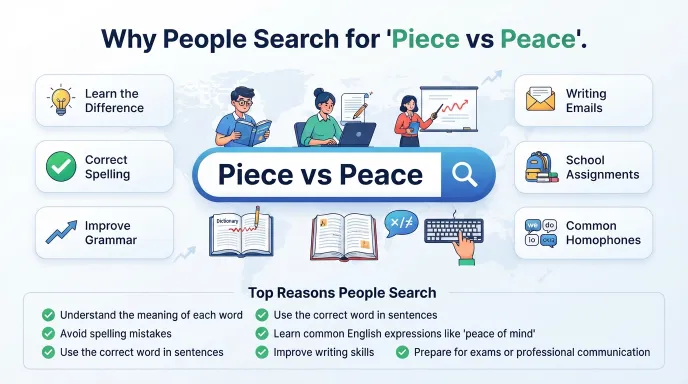
The most common search intentions include:
- Learning the difference between piece and peace.
- Finding the correct word for phrases like peace of mind.
- Checking spelling before writing emails or assignments.
- Understanding examples of each word.
- Improving English grammar and vocabulary.
Search Popularity by Context
| Search Topic | Popularity | Reason |
| Piece vs Peace | Very High | Common grammar confusion |
| Peace of Mind | Very High | Popular English expression |
| Piece of Cake | Very High | Everyday idiom |
| World Peace | High | News, politics, and education |
| Piece Meaning | Medium | Vocabulary learning |
| Peace Meaning | Medium | English learners |
Countries Where This Topic Is Popular
Searches for Piece vs Peace are most common in countries where English is the primary language or widely taught.
| Country | Search Interest | Common Reason |
| United States | ⭐⭐⭐⭐⭐ | Education and everyday writing |
| United Kingdom | ⭐⭐⭐⭐⭐ | Grammar learning |
| Canada | ⭐⭐⭐⭐ | School assignments |
| Australia | ⭐⭐⭐⭐ | English education |
| India | ⭐⭐⭐⭐⭐ | Competitive exams and ESL learning |
| Pakistan | ⭐⭐⭐⭐ | English grammar practice |
| Philippines | ⭐⭐⭐⭐ | English language education |
Search Trends
- Searches increase during school terms and exam seasons.
- English learners often search for piece vs peace examples.
- Writers frequently look up the phrase peace of mind.
- Teachers use this topic in vocabulary and homophone lessons.
- Grammar websites consistently receive traffic for this keyword because it solves a common writing problem.
Note: Search popularity varies over time and by region, but these countries consistently show strong interest in English grammar and commonly confused words.
Piece vs Peace Comparison Table
| Feature | Piece | Peace |
| Part of Speech | Noun | Noun |
| Meaning | A part or portion of something | Calm, harmony, or freedom from conflict |
| Pronunciation | /piːs/ | /piːs/ |
| Spelling | Piece | Peace |
| British English | Same | Same |
| American English | Same | Same |
| Example | A piece of cake | Peace of mind |
| Common Phrase | Piece of the puzzle | World peace |
| Common Mistake | Used instead of peace | Used instead of piece |
Frequently Asked Questions
1. What is the difference between piece and peace?
Piece means a part of something, while peace means calm, harmony, or the absence of conflict.
2. Are piece and peace pronounced the same?
Yes. They are homophones, meaning they have the same pronunciation but different meanings and spellings.
3. Is it “piece of mind” or “peace of mind”?
The correct expression is peace of mind because it refers to feeling calm and free from worry.
4. Is there any spelling difference between British and American English?
No. Both piece and peace are spelled the same in British English and American English.
5. How can I remember the difference?
Think of piece of pie for piece and peace of mind for peace.
6. Can “piece” and “peace” ever be interchangeable?
No. They have completely different meanings and should never replace one another.
7. Why do people confuse these words?
Because they sound exactly alike. Many writers rely on pronunciation instead of meaning, leading to spelling mistakes.
Conclusion
Understanding the difference between piece and peace is easier once you know what each word means. Although they sound exactly the same, they are not interchangeable. Piece refers to a part or portion of something, while peace describes calm, harmony, or freedom from conflict. Remembering this simple distinction will help you avoid one of the most common English spelling mistakes.
There is no difference between British English and American English for these words. Both countries use the same spellings and meanings. The key is to focus on the context of your sentence rather than the pronunciation.
Explore More!
Analysed or Analyzed: Which Spelling is Correct?
Grimey or Grimy : Correct Spelling Explained
While or Whilst: What’s the Real Difference?
See the dictionary definitions for piece and peace.

Miles Thornton is a seasoned author and content specialist with a knack for simplifying complex topics. Passionate about clear, engaging writing, creates articles that inform and inspire readers. With years of experience in digital publishing, Miles combines professionalism with creativity, delivering insightful content for diverse audiences