Have you ever typed “cancelled” and wondered if it should be “canceled” instead? You are not alone. Thousands of people search for “cancelled or canceled” every month because both spellings appear in books, newspapers, websites, and emails. This often leaves writers unsure which version is correct.
The good news is that both spellings are correct. The difference depends on the type of English you are using. In American English, canceled is the preferred spelling.
In British English, cancelled is the standard spelling. Knowing the difference helps you write more clearly and professionally.
if you’re writing a school paper, business email, blog post, social media update, or official document, using the correct spelling for your audience improves readability and credibility
. This guide explains the history behind both spellings, compares British and American English, provides real-world examples, highlights common mistakes, and helps you choose the right version with confidence.
Cancelled or Canceled : Quick Answer
The answer is simple:
- Canceled ✅ = Preferred in American English (US)
- Cancelled ✅ = Preferred in British English (UK), Australia, Canada, and most Commonwealth countries
Examples
American English
- The flight was canceled due to bad weather.
- Our meeting has been canceled.
British English
- The football match was cancelled because of rain.
- My appointment was cancelled yesterday.
Quick Tip: Both are correct. Match your spelling to your audience.
The Origin of Cancelled or Canceled
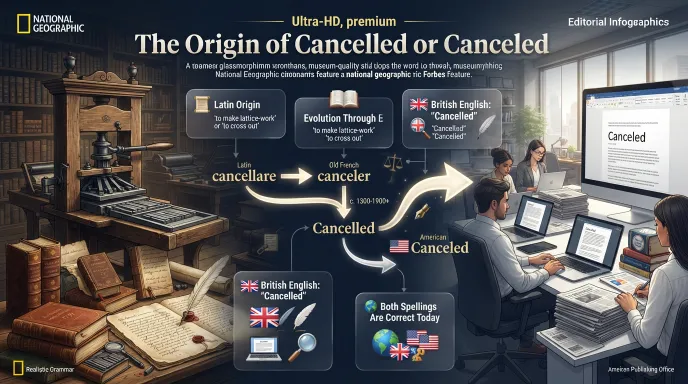
The word cancel comes from the Latin word cancellare, meaning “to cross out.” It entered English through Old French and became common in legal and official writing.
The spelling difference happened because British and American English developed different spelling rules over time.
British English often doubles the final l before adding endings like -ed or -ing.
Example:
- travel → travelled
- cancel → cancelled
American English usually keeps a single l when the stress is not on the last syllable.
Example:
- travel → traveled
- cancel → canceled
Both spellings have been accepted for many years.
British English vs American English Spelling
| Feature | British English | American English |
| Preferred spelling | Cancelled | Canceled |
| Past tense | Cancelled | Canceled |
| Past participle | Cancelled | Canceled |
| Present participle | Cancelling | Canceling |
| Common regions | UK, Australia, New Zealand, Ireland | United States |
Examples
British English
- The concert was cancelled.
- Our booking has been cancelled.
American English
- The game was canceled.
- The event has been canceled.
Which Spelling Should You Use?
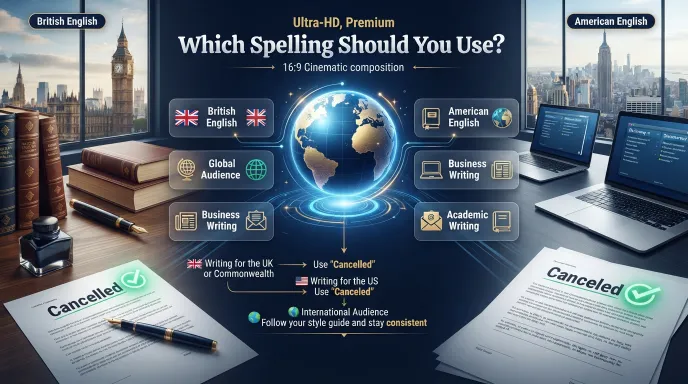
Choose the spelling based on your readers.
Use Canceled if:
- Your audience is in the United States.
- You write for American businesses.
- You follow AP Style.
- Your website targets US readers.
Use Cancelled if:
- Your audience is in the United Kingdom.
- You write for Australia, New Zealand, or Ireland.
- You follow British English rules.
- Your publication uses UK spelling.
For Global Content
Stay consistent. Pick one spelling and use it throughout your article or document.
Common Mistakes with Cancelled or Canceled
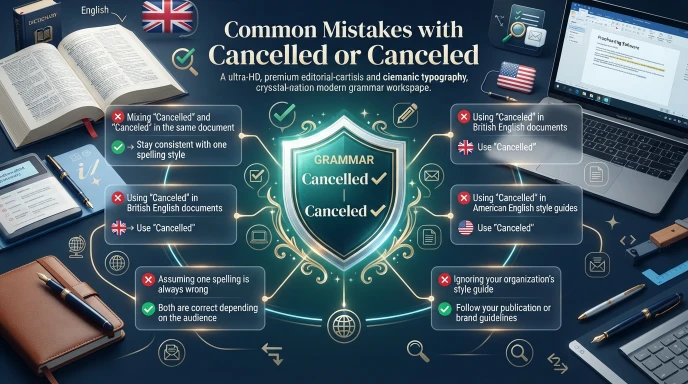
❌ Mixing both spellings
Incorrect:
- The event was cancelled, but the ticket was canceled.
Correct:
- Use one spelling consistently.
❌ Using British spelling for US content
If writing for Americans:
✅ The meeting was canceled.
❌ Using American spelling for UK publications
If writing for British readers:
✅ The meeting was cancelled.
❌ Forgetting “canceling” vs “cancelling”
American:
- canceling
British:
- cancelling
Cancelled or Canceled in Everyday Examples
US:
Your order has been canceled.
UK:
Your order has been cancelled.
News
US:
The airline canceled all flights today.
UK:
The railway company cancelled several services.
Social Media
US:
Our livestream has been canceled.
UK:
Today’s livestream has been cancelled.
Formal Writing
US:
The conference was canceled because of severe weather.
UK:
The conference was cancelled following safety concerns.
Cancelled or Canceled : Google Trends & Usage Data

Search interest for “cancelled or canceled” remains high because people frequently encounter both spellings online.
Popular by Region
| Country | Preferred Spelling |
| United States | Canceled |
| United Kingdom | Cancelled |
| Australia | Cancelled |
| Canada | Cancelled (more common), though both appear |
| New Zealand | Cancelled |
| India | Cancelled (commonly used) |
People usually search this keyword when:
- Writing emails
- Editing academic papers
- Creating business documents
- Publishing blog posts
- Learning English grammar
Comparison Table
| Feature | Cancelled | Canceled |
| Correct? | ✅ Yes | ✅ Yes |
| English Type | British | American |
| Double L | Yes | No |
| Used in UK | ✅ Yes | Rare |
| Used in USA | Rare | ✅ Yes |
| Used in Australia | ✅ Yes | Rare |
| Used in Canada | Common | Sometimes |
| Best for Global Audience | Depends on style guide | Depends on style guide |
FAQs
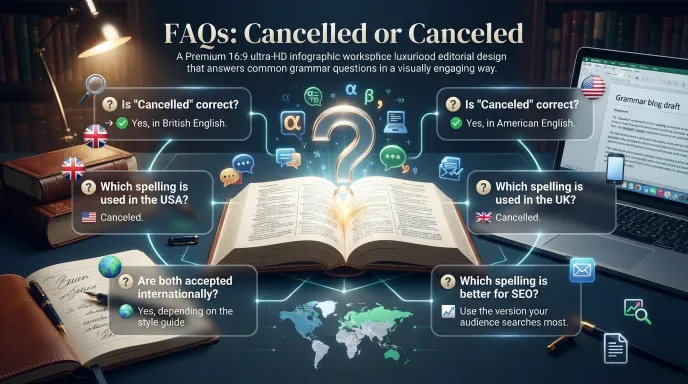
1. Is “cancelled” or “canceled” correct?
Both are correct. Canceled is American English, while cancelled is British English.
2. Which spelling does the United States use?
The United States prefers canceled.
3. Which spelling does the United Kingdom use?
The United Kingdom uses cancelled.
4. Is “cancelling” also different?
Yes. Americans write canceling, while British writers use cancelling.
5. Can I use both spellings in one article?
No. Choose one spelling and stay consistent.
6. Which spelling should international businesses use?
Use the spelling that matches your main audience or your company’s style guide.
7. Does Google accept both spellings?
Yes. Google recognizes both spellings because they are both correct English words.
Conclusion
The debate over cancelled or canceled is not about right versus wrong—it is about choosing the correct style for your audience. Both spellings are accepted by major dictionaries and grammar guides, but they follow different regional conventions.
If you are writing for readers in the United States, canceled is the preferred form. If your audience is in the United Kingdom, Australia, New Zealand, Canada, or other Commonwealth countries, cancelled is generally the better choice.
The most important rule is consistency. Avoid switching between spellings in the same article, email, or report. Consistent spelling makes your writing look more professional and easier to read.
if you are preparing business documents, academic assignments, blog posts, or social media content, selecting the correct version for your readers improves clarity and trust.
By understanding the difference between cancelled and canceled, you can write with confidence and ensure your message matches the expectations of your audience.
DISCOVER MORE ARTICLE CLICK HERE!
Chosen or Choosed: Which One Is Correct?
Broke or Broken: Which One Is Correct? A Simple Grammar Guide
Lay or Lie: Which One Is Correct? The Simple Grammar Guide
Related articles: Delux or Deluxe: Which Spelling Is Correct?, Scarred or Scared: Past Tense and Adjectives, Flavor or Flavour: Which Spelling Is Correct?.
See the dictionary definitions for cancelled and canceled.

Hi, I’m Sehrish Iqbal, and I enjoy writing about the English language and the little differences between words that often cause confusion. I create simple and easy-to-understand articles about grammar, spelling, commonly confused words, and correct word usage. My goal is to make English easier to understand and help students, writers, and English learners use the right words with confidence.