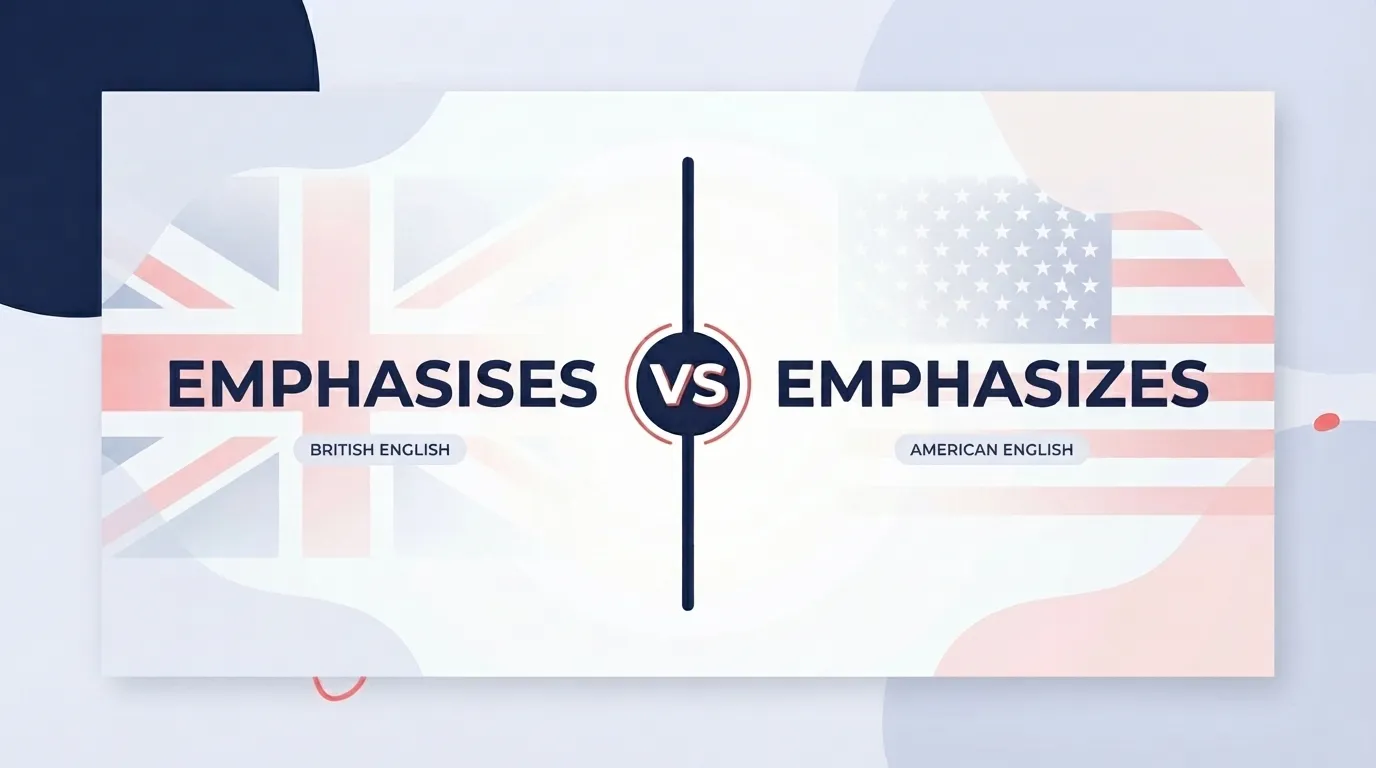
Emphasises and emphasizes are both correct spellings, with emphasises preferred in British English and emphasizes preferred in American English.
Emphasises or Emphasizes: Quick Answer
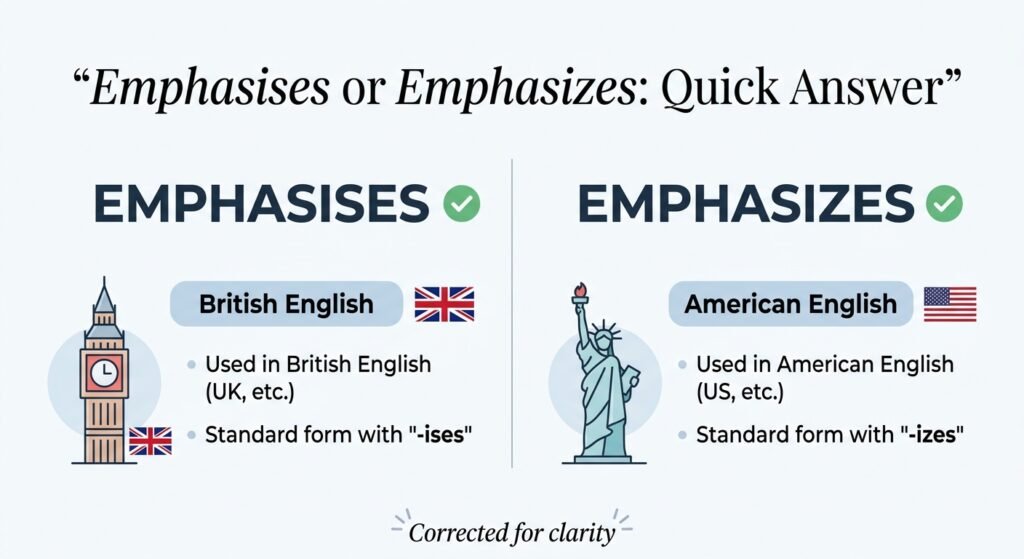
Both emphasises and emphasizes are correct. The difference depends on the type of English you are using.
- Emphasises is the preferred spelling in British English.
- Emphasizes is the preferred spelling in American English.
Examples
- British English: The report emphasises the importance of teamwork.
- American English: The report emphasizes the importance of teamwork.
Both sentences are correct.
The Origin of Emphasises or Emphasizes
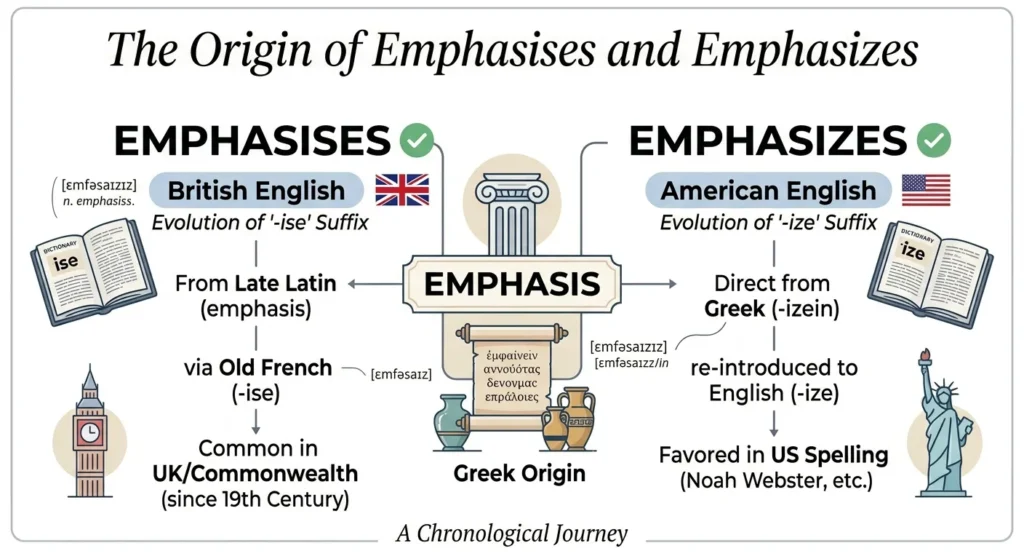
The verb emphasise or emphasize comes from the noun emphasis, which has its roots in the Greek word emphasis, meaning importance or significance.
As English developed, two spelling styles became common.
British English
British English commonly uses emphasise and emphasises with an s.
American English
American English commonly uses emphasize and emphasizes with a z.
Both spelling forms are accepted in their respective varieties of English.
British English vs American English Spelling
The main difference between the two forms is their spelling.
| Meaning | British English | American English |
|---|---|---|
| Present tense | Emphasises | Emphasizes |
| Base verb | Emphasise | Emphasize |
| Past tense | Emphasised | Emphasized |
| Present participle | Emphasising | Emphasizing |
Examples
| British English | American English |
|---|---|
| She emphasises safety. | She emphasizes safety. |
| The teacher emphasises grammar. | The teacher emphasizes grammar. |
| The report emphasises quality. | The report emphasizes quality. |
Which Spelling Should You Use?
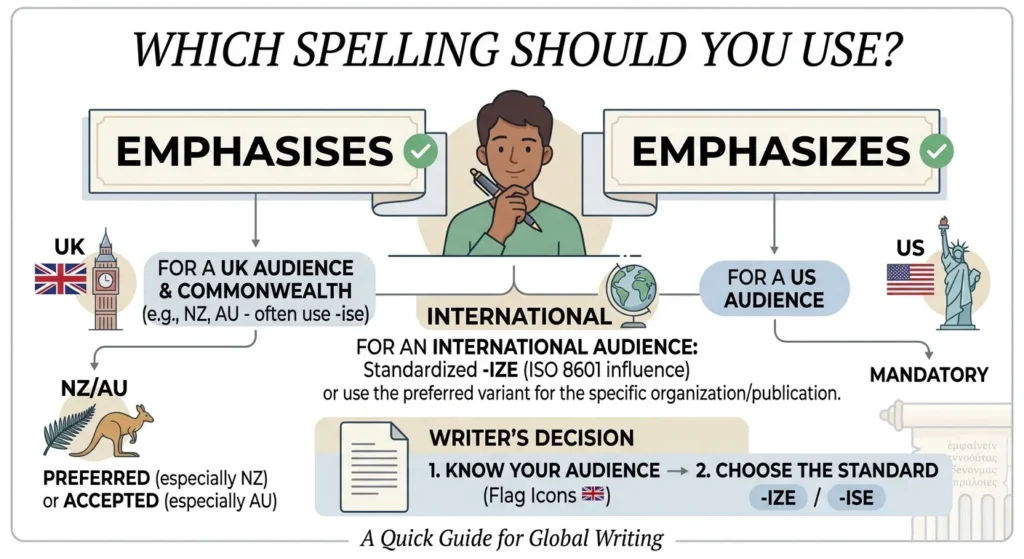
Choose the spelling according to your audience and the English style you are following.
| Audience | Recommended Spelling |
|---|---|
| United States | Emphasizes |
| United Kingdom | Emphasises |
| Canada | Follow your organization’s style guide |
| Australia | Emphasises |
| New Zealand | Emphasises |
| International audience | Stay consistent with one style |
If you write mainly for American readers, use emphasizes. If you write for British or Commonwealth readers, use emphasises.
Common Mistakes with Emphasises or Emphasizes
One common mistake is mixing British and American spelling styles within the same document.
| Incorrect | Correct |
|---|---|
| The report emphasizes teamwork and is organised well. | Keep the spelling style consistent. |
| She emphasises the issue in an American document. | Use emphasizes in American English. |
| He emphasizes the issue in a British document. | Use emphasises in British English. |
Simple Tip
Choose one variety of English before you start writing and follow it consistently throughout your document.
Read more 👉: Scarred vs Scared: Meaning & Difference
Emphasises or Emphasizes in Everyday Examples
Emails
- The manager emphasises clear communication. British English
- The manager emphasizes clear communication. American English
News
- The report emphasises climate action. British English
- The report emphasizes climate action. American English
Social Media
- She always emphasises kindness.
- He emphasizes staying positive.
Formal Writing
- The study emphasises the need for further research.
- The study emphasizes the need for further research.
Emphasises or Emphasizes: Google Trends and Usage Data
Search interest in emphasises or emphasizes remains relevant because writers often want to know which regional spelling is appropriate.
General Usage Patterns
- Emphasizes is more common in the United States.
- Emphasises is more common in the United Kingdom, Australia, New Zealand, and many Commonwealth countries.
- Both forms are widely understood by English speakers.
- Consistency is important in professional and academic writing.
Comparison Table
| Feature | Emphasises | Emphasizes |
|---|---|---|
| Meaning | Gives importance to | Gives importance to |
| Correct? | Yes | Yes |
| British English | Preferred | Less common |
| American English | Less common | Preferred |
| Academic Writing | Common in UK | Common in US |
| Pronunciation | Same | Same |
Frequently Asked Questions
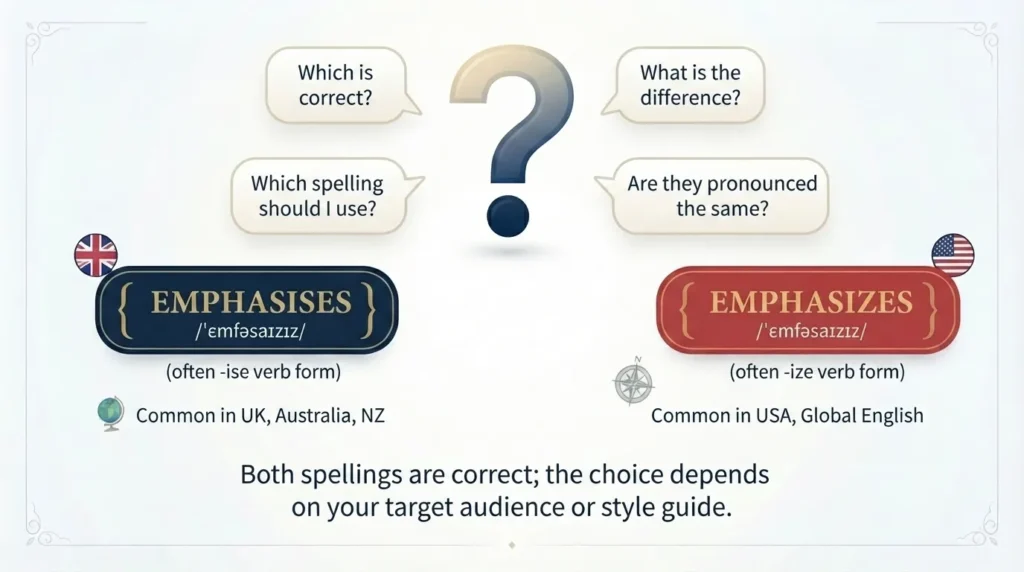
Is emphasises or emphasizes correct?
Both are correct. Emphasises is preferred in British English, while emphasizes is preferred in American English.
What is the difference between emphasises and emphasizes?
The only difference is regional spelling. Both words have the same meaning and pronunciation.
Which spelling should I use in academic writing?
Use the spelling required by your university, institution, journal, or publisher. The most important thing is to follow one English style consistently.
Is emphasizes used in British English?
Yes, emphasizes can be found in British English, but emphasises is generally the preferred British spelling.
Is emphasises wrong in American English?
It is understandable, but emphasizes is the standard spelling in American English.
Do both words have the same pronunciation?
Yes. Emphasises and emphasizes have the same pronunciation.
How can I remember the difference?
A simple way to remember it is:
- S = British English: emphasises
- Z = American English: emphasizes
Conclusion
The choice between emphasises and emphasizes depends on the variety of English you are using. Both forms have the same meaning, pronunciation, and grammatical function. The main difference is their spelling.
British English generally prefers emphasises, while American English prefers emphasizes. When writing for school, work, publishing, or online content, consider your audience and follow the appropriate English style.
For an international audience, either spelling can be understood, but consistency is important. Once you choose British English or American English, use the same spelling style throughout your writing.
A simple rule to remember is that British English uses S in emphasises, while American English uses Z in emphasizes.

Hi, I’m Sehrish Iqbal, and I enjoy writing about the English language and the little differences between words that often cause confusion. I create simple and easy-to-understand articles about grammar, spelling, commonly confused words, and correct word usage. My goal is to make English easier to understand and help students, writers, and English learners use the right words with confidence.