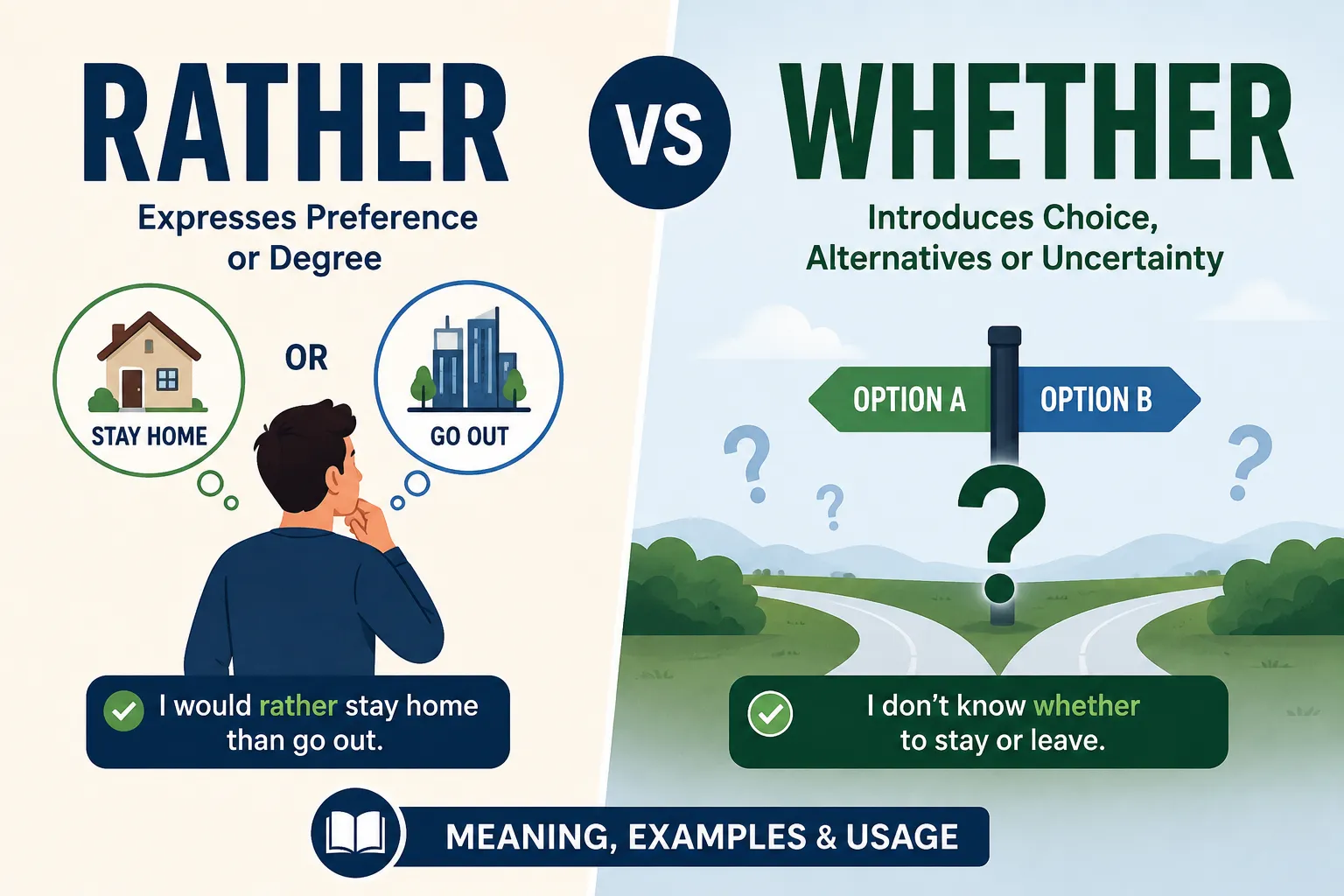
Use rather to express preference or degree, and use whether to talk about choices, alternatives, or uncertainty.
Many English learners confuse rather and whether because they often appear in similar looking sentences. However, these words have completely different meanings and cannot replace each other. Using the wrong one can make a sentence confusing or grammatically incorrect.
People search for rather vs whether because they want to know which word fits their sentence. Should you say I’d rather stay home or I’d whether stay home? Should you write whether it rains or rather it rains? The answer depends on what you want to express.
Rather is used to show preference, degree, or choice. Whether is used when talking about possibilities, alternatives, or uncertainty. This guide explains the meanings, origins, examples, common mistakes, and correct usage of both words. By the end, you will know exactly when to use rather and whether in everyday English.
Rather vs Whether: Quick Answer
Quick Answer: Use rather to express preference or degree. Use whether when talking about alternatives or uncertainty.
Examples
- I would rather walk than drive.
- I don’t know whether she will come.
- He is rather tired today.
- We must decide whether to stay or leave.
Easy Rule
Rather = Preference
Whether = Choice or Uncertainty
The Origin of Rather vs Whether
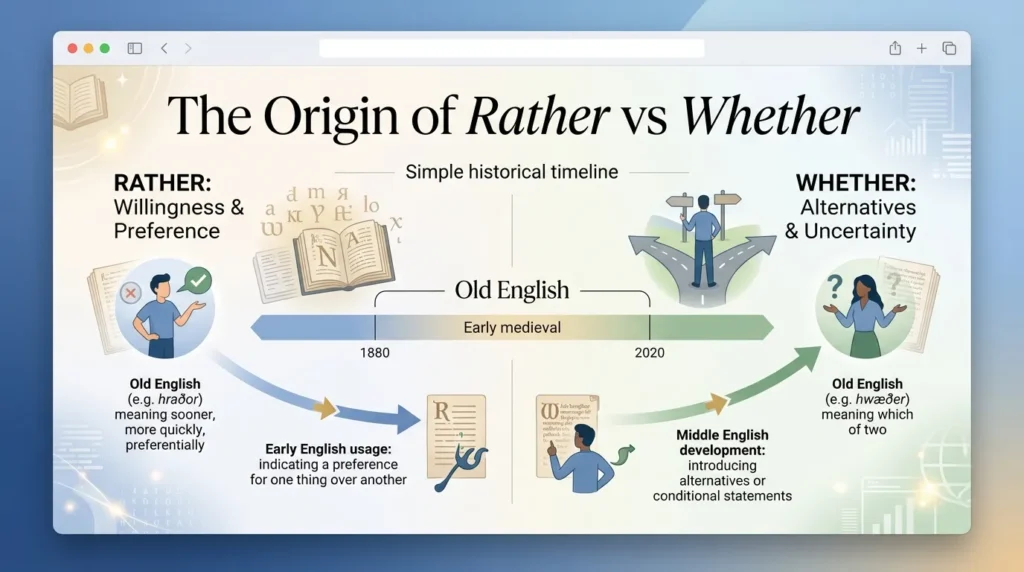
The word rather comes from Old English and originally meant “more quickly” or “more willingly.” Over time, it came to express preference or degree.
The word whether also comes from Old English and has long been used to introduce alternatives or uncertain situations.
Although both words have ancient English roots, they developed different meanings and are never interchangeable.
British English vs American English Spelling
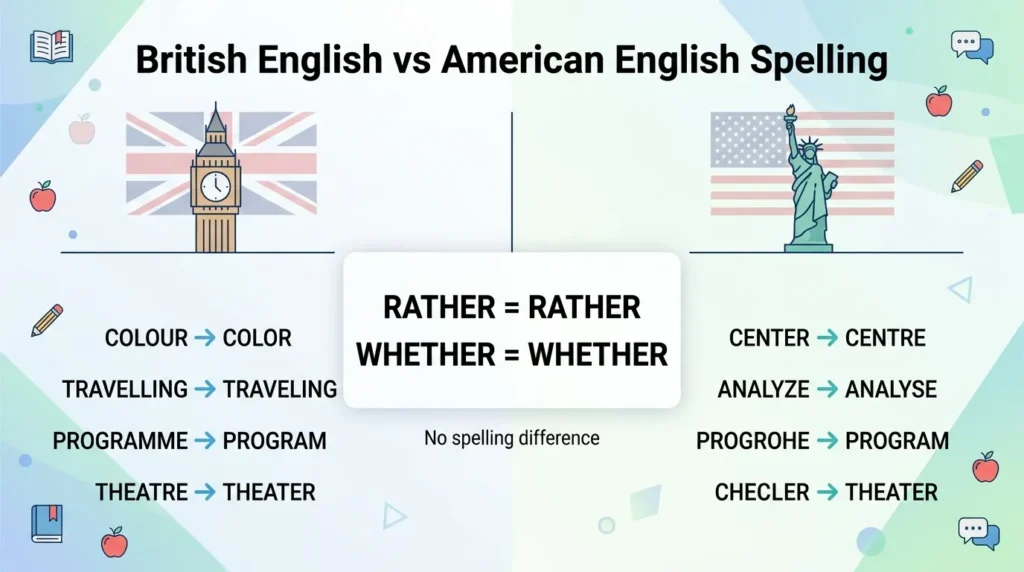
There is no spelling difference between British English and American English.
Both countries use:
Rather for preference or degree.
Whether for alternatives or uncertainty.
| Meaning | British English | American English |
|---|---|---|
| Preference or degree | Rather | Rather |
| Alternatives or uncertainty | Whether | Whether |
Examples
| Sentence | Correct Word |
|---|---|
| I’d _____ stay home. | Rather |
| I don’t know _____ he agrees. | Whether |
| She is _____ busy today. | Rather |
| We must decide _____ to continue. | Whether |
Which Spelling Should You Use?
There is no regional spelling difference.
| Audience | Recommended Usage |
|---|---|
| United States | Rather or Whether based on meaning |
| United Kingdom | Rather or Whether based on meaning |
| Canada | Same rule |
| Australia | Same rule |
| Global audience | Same rule |
Remember
Use rather to express preference.
Use whether to introduce choices or uncertainty.
Read more 👉: Scarred vs Scared: Meaning & Difference
Common Mistakes with Rather vs Whether
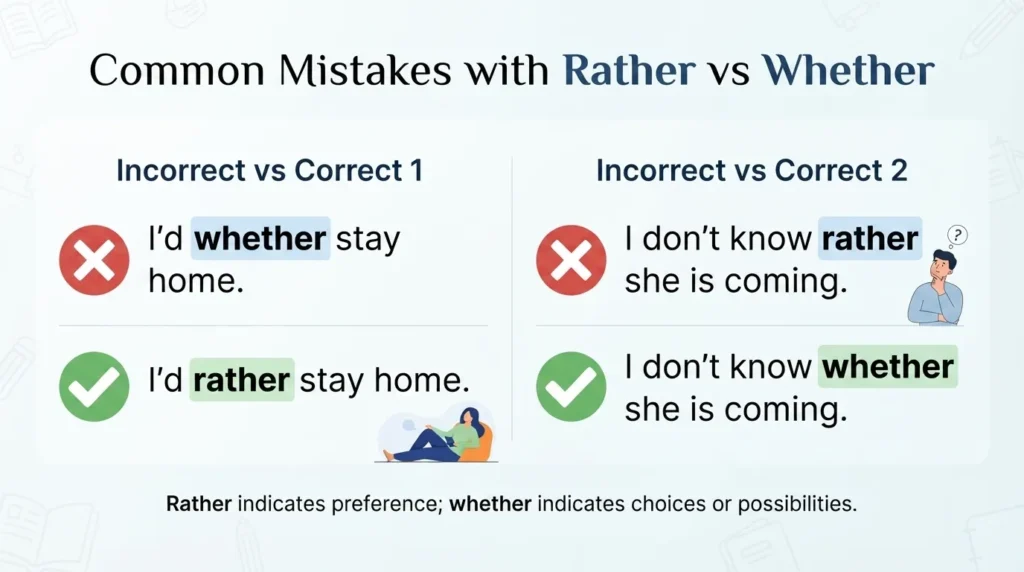
These words cannot replace each other.
| Incorrect | Correct |
|---|---|
| I’d whether stay home. | I’d rather stay home. |
| I don’t know rather she is coming. | I don’t know whether she is coming. |
| Rather to go or stay? | Whether to go or stay? |
| He asked rather I agreed. | He asked whether I agreed. |
Memory Tip
Rather = Prefer
Whether = If there is a choice
Rather vs Whether in Everyday Examples
Emails
I would rather meet tomorrow.
Please let me know whether you can attend.
News
Experts would rather wait for more evidence.
Officials have not decided whether to reopen the road.
Social Media
I’d rather watch a movie tonight.
I can’t decide whether to travel this weekend.
Formal Writing
Participants would rather complete the survey online.
The committee will determine whether the proposal should be approved.
Rather vs Whether: Google Trends and Usage Data
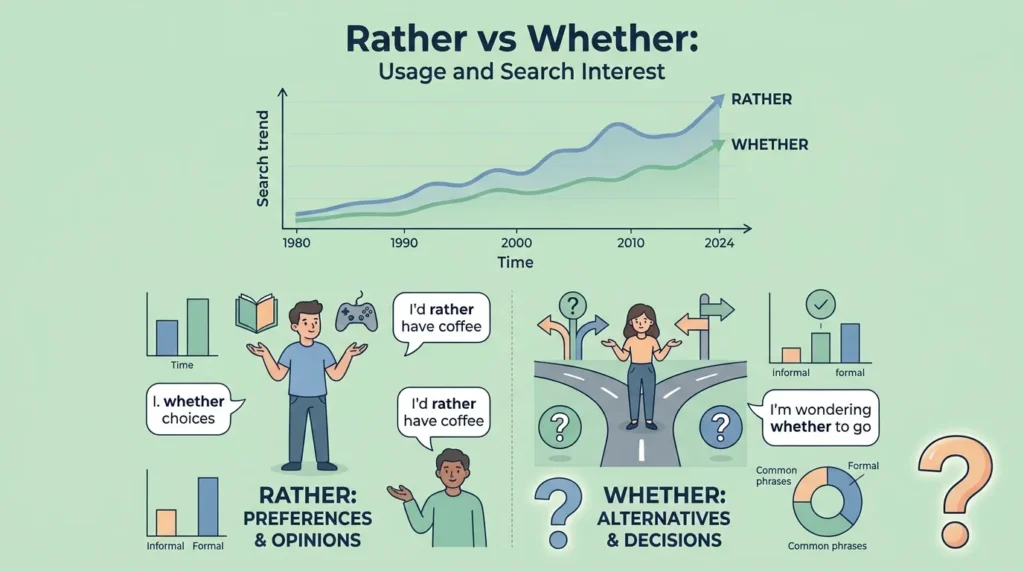
Searches for rather vs whether remain common because English learners often confuse these words in writing and speaking.
Usage patterns show:
Rather is frequently used in conversations, opinions, and expressions of preference.
Whether appears often in academic writing, legal documents, business communication, and formal English because it introduces alternatives or uncertainty.
There is no regional spelling difference between British and American English.
Comparison Table
| Feature | Rather | Whether |
|---|---|---|
| Meaning | Preference or degree | Choice or uncertainty |
| Part of Speech | Adverb | Conjunction |
| Common Context | Opinions and preferences | Decisions and alternatives |
| Example | I’d rather stay. | Whether we stay is your choice. |
| Memory Tip | Prefer | If or choice |
Frequently Asked Questions
1. What is the difference between rather and whether?
Rather shows preference, while whether introduces alternatives or uncertainty.
2. Is it “I’d rather” or “I’d whether”?
The correct expression is I’d rather.
3. Can whether mean if?
Often, yes. Whether is commonly used when presenting two or more possibilities.
4. Is there a spelling difference between British and American English?
No. Both use the same spellings.
5. Can rather replace whether?
No. They have different meanings and grammar.
6. Why are these words confusing?
They appear in similar sentence structures, but they serve different grammatical purposes.
7. How can I remember the difference?
Think rather = preference and whether = choice or uncertainty.
Conclusion
Although rather and whether may seem similar, they have completely different meanings and uses. Rather expresses preference, degree, or opinion, while whether introduces choices, alternatives, or uncertain situations. They are not interchangeable, and choosing the wrong one can make your writing confusing.
There is no spelling difference between British English and American English. The correct word depends only on what you want to say. If you are expressing what you prefer, use rather. If you are talking about options or uncertainty, use whether.
A simple rule to remember is rather means prefer, whether means choice. Keeping this distinction in mind will help you write more clearly and avoid one of the most common English usage mistakes.

Hi, I’m Sehrish Iqbal, and I enjoy writing about the English language and the little differences between words that often cause confusion. I create simple and easy-to-understand articles about grammar, spelling, commonly confused words, and correct word usage. My goal is to make English easier to understand and help students, writers, and English learners use the right words with confidence.