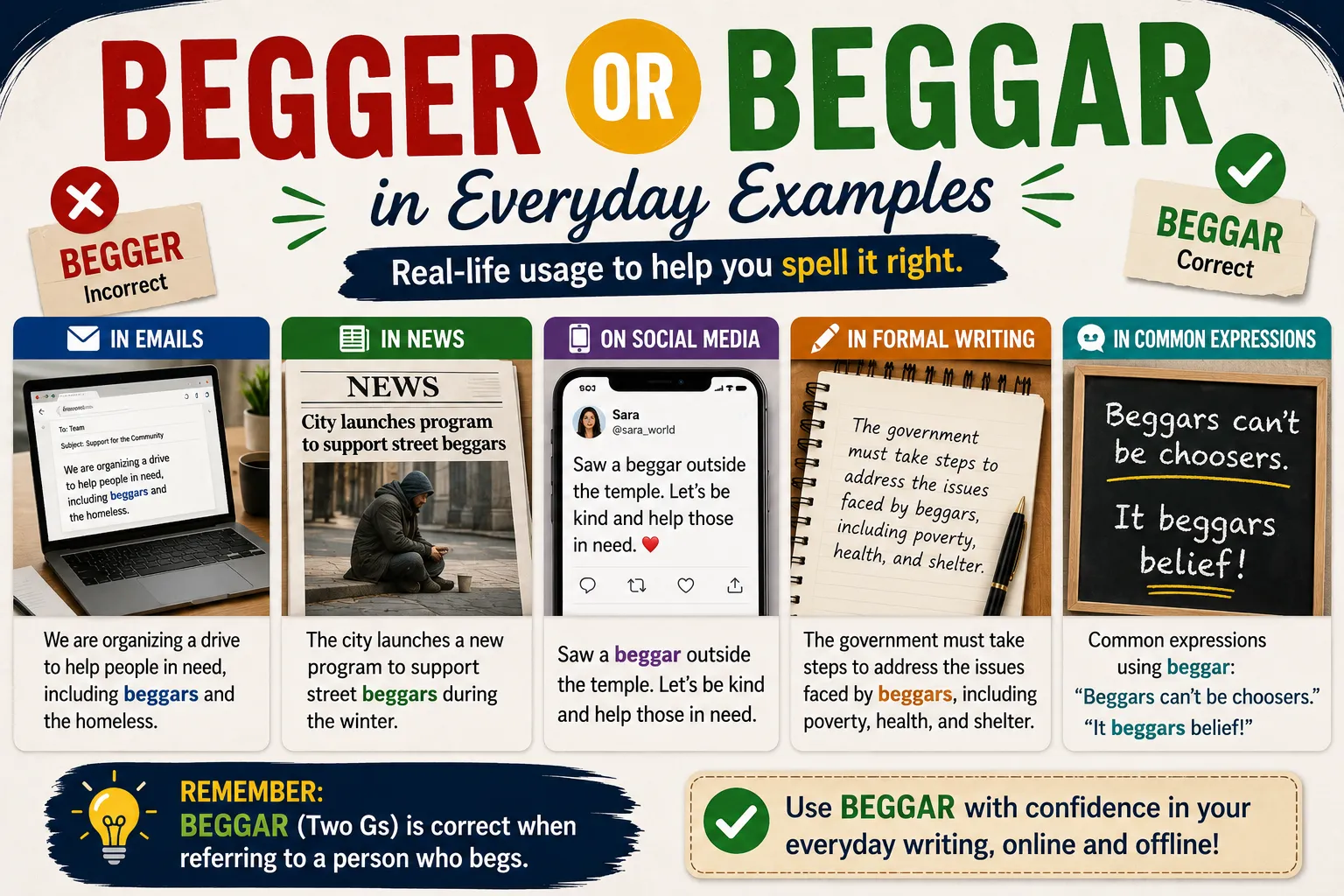
Have you ever typed “begger” and wondered if it should be “beggar”? You are not alone. This is a common spelling question because both forms look almost the same. The good news is that the answer is simple: beggar is the correct spelling when you mean a person who asks for money, food, or help.
Begger is generally a misspelling of beggar in this context. The correct word has two g’s followed by a-r: beggar.
The word beggar has been part of English for centuries. Today, it can mean a person who begs, a poor person, or, in some contexts, a person or thing that causes someone to become extremely poor. It also appears in common phrases such as “beggars can’t be choosers” and “beggar belief.”
People search for “begger or beggar” because the spelling is easy to confuse. This guide gives you the quick answer, explains the word’s history, compares British and American English, and shows how to use beggar correctly.
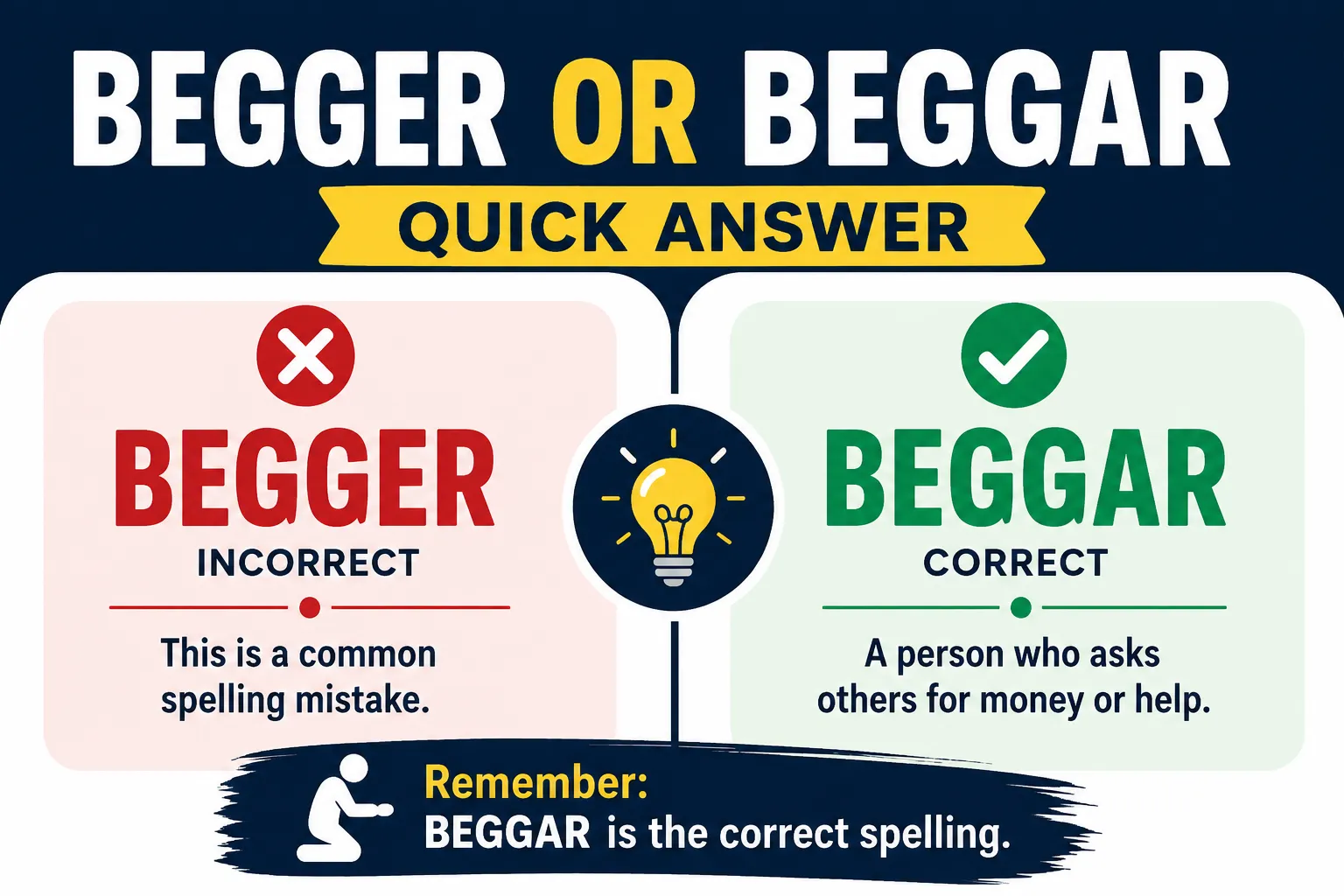
- ✅ Beggar — correct
- ❌ Begger — incorrect when you mean a person who begs
A beggar is a person who asks others for money, food, or other help, often because they are poor. Cambridge gives this as the main meaning of the noun.
Examples
The beggar asked for food.
We saw a beggar near the station.
The charity helps people who are homeless or in need.
The spelling begger is not the standard spelling of this noun.
Easy rule
Remember:
beg + gar = beggar
Not:
beg + ger = begger
So if you mean a person who begs, always use beggar.
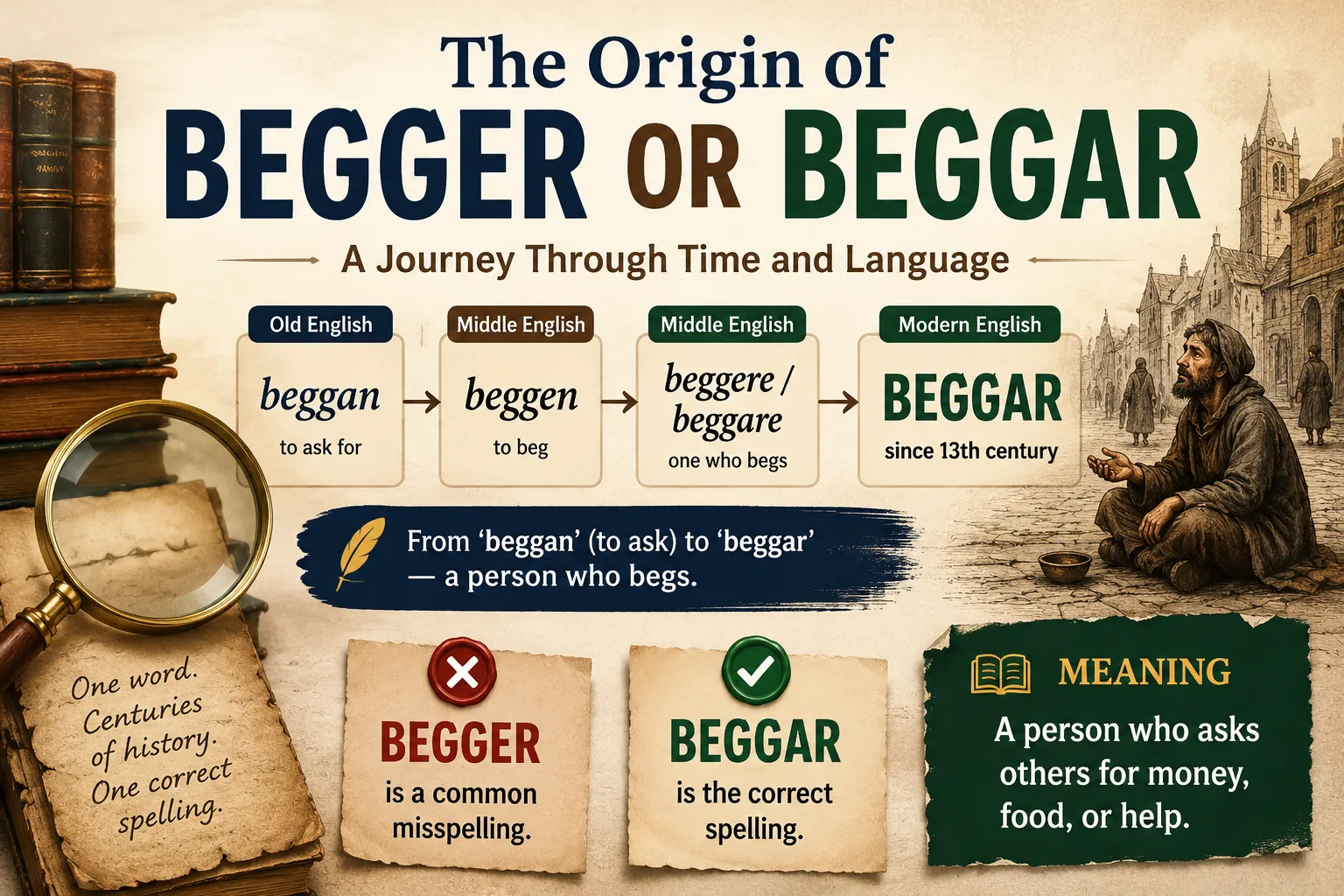
The word beggar has a long history in English.
Merriam-Webster traces beggar to Middle English forms such as beggere and beggare. These came from beggen, meaning “to beg,” combined with an ending related to -er, which can form a noun for a person who performs an action.
The noun beggar was first known in English in the 13th century. The related verb beggar appeared later, in the 15th century.
The basic idea is easy to understand:
beg → beggar
A person who begs can be called a beggar.
The spelling may look unusual to modern English learners because English has many words ending in -er, and people may naturally write begger. But the established spelling is beggar.
The word beg itself also comes from Middle English beggen and has been used in English since the 13th century.
Why is “begger” confusing?
The confusion often comes from pronunciation and spelling patterns.
English has many words where a short vowel is followed by a doubled consonant:
- bigger
- bigger
- runner
- swimmer
This can make begger look natural.
However, the standard spelling is:
beggar
The pronunciation is similar in British and American English, although the final vowel sound differs slightly between the two varieties. Cambridge lists the UK pronunciation as /ˈbeɡ.ər/ and the US pronunciation as /ˈbeɡ.ɚ/.
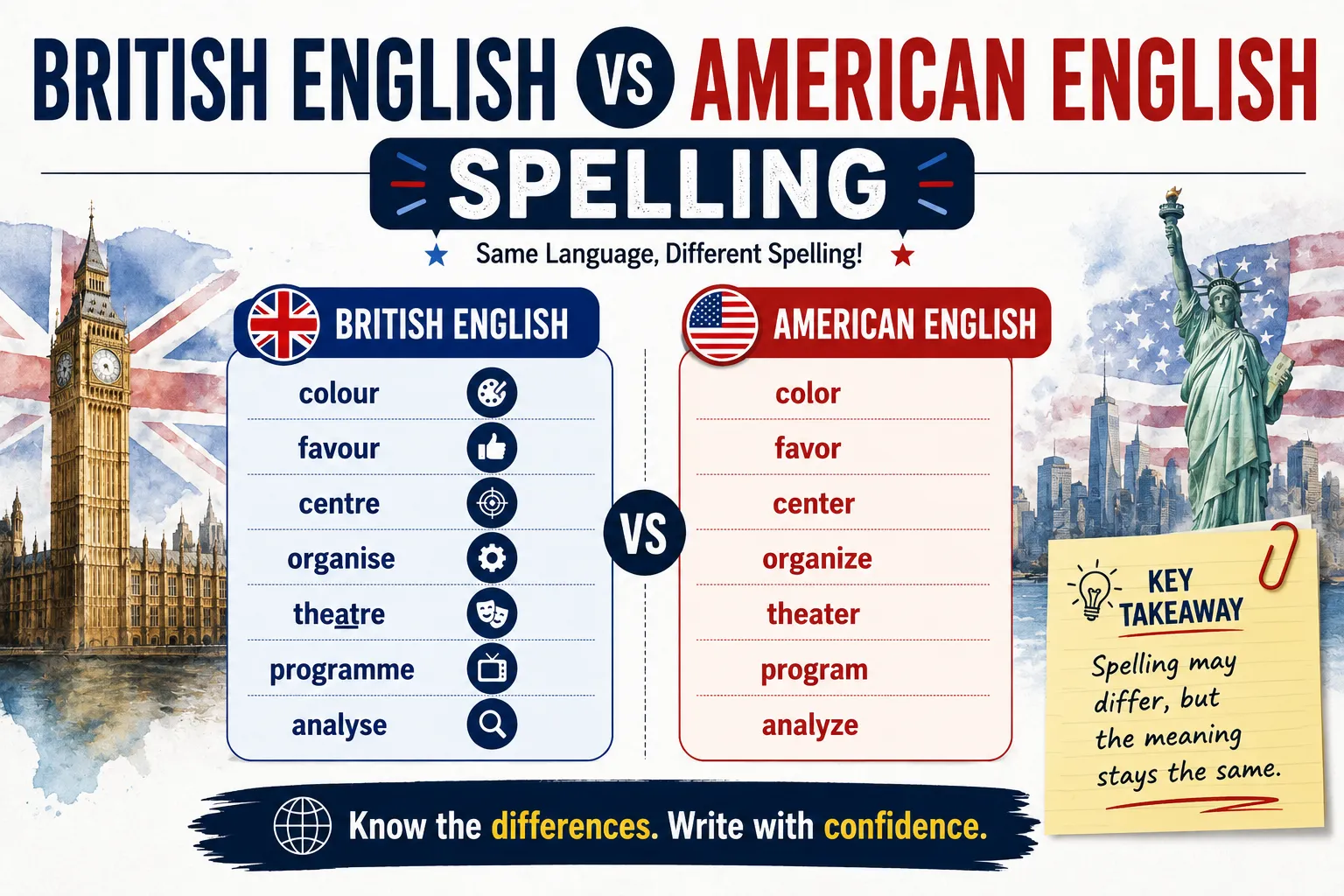
There is no British-American spelling difference between beggar and begger.
Both British English and American English use:
beggar
For example:
| Meaning | British English | American English |
|---|---|---|
| Person who begs | beggar | beggar |
| Person asking for money | beggar | beggar |
| Very poor person | beggar | beggar |
| Verb meaning to make poor | beggar | beggar |
| Common misspelling | begger | begger |
Cambridge lists beggar in both its UK and US dictionaries.
So, unlike words such as colour/color or centre/center, beggar does not change spelling between British and American English.
Comparison table
| Word | British English | American English | Correct? |
|---|---|---|---|
| beggar | Yes | Yes | ✅ |
| begger | No | No | ❌ |
| beg | Yes | Yes | ✅ |
| begging | Yes | Yes | ✅ |
| begged | Yes | Yes | ✅ |
| beggary | Yes | Yes | ✅ |
Which Spelling Should You Use?
Use beggar in almost every situation where you mean a person who begs.
For US English
Use:
The beggar asked for help.
American dictionaries use beggar as the standard spelling.
For UK English
Use:
The beggar stood outside the station.
British English also uses beggar.
For Commonwealth English
Countries that use forms of British English also use beggar as the standard spelling.
For global English
If you are writing for an international audience, choose beggar.
This applies to:
- school assignments
- blog posts
- websites
- business writing
- news articles
- emails
- social media
- academic writing
A useful writing tip
If you are unsure, remember:
Beggar is the standard spelling. Begger is a spelling mistake.
One exception is that begar can appear as a separate word in Indian English contexts. Merriam-Webster lists begar as a noun meaning forced labor, derived from Hindi begār and Persian. It is a different word and should not be confused with beggar.
Common Mistakes with Begger or Beggar
Here are some common errors.
Mistake 1: Writing “begger”
❌ The begger asked for money.
✅ The beggar asked for money.
Mistake 2: Using “begger” in formal writing
❌ The report discussed the problems faced by beggers.
✅ The report discussed the problems faced by beggars.
The plural of beggar is beggars.
Mistake 3: Confusing “beg” and “beggar”
These words have different grammatical roles.
Beg is usually a verb:
I beg you to reconsider.
Beggar is usually a noun:
The beggar asked for help.
Mistake 4: Forgetting the second “g”
❌ begar
✅ beggar
Be careful here because begar can also be a separate word with a different meaning in some contexts.
Mistake 5: Adding an extra “e”
❌ begger
✅ beggar
The correct sequence is:
b-e-g-g-a-r
Understanding the word in context makes the spelling easier to remember.
In emails
If you are writing about a person in need, you might write:
The organization provides food and shelter to people experiencing homelessness.
In modern professional writing, it is often better to use respectful and specific language rather than labeling someone simply as a beggar.
In news writing
A news article might use the word:
The city introduced a new program to support people who beg for money on the streets.
If the noun is needed:
Local officials met with several beggars and community groups.
In social media
A casual post might say:
We saw a beggar asking for help outside the market.
However, social media writers should consider the tone of the word. Depending on the context, phrases such as person experiencing homelessness, person asking for help, or person in need may sound more respectful.
In formal writing
The word can also appear in older or literary expressions.
For example:
The crisis left thousands of people as beggars.
The verb beggar has another meaning: to make someone or something extremely poor. Cambridge lists this as a literary use.
Common expressions
You may also see beggar in expressions such as:
- Beggars can’t be choosers.
- It beggars belief.
- It beggars description.
These expressions have meanings beyond the simple noun “a person who begs.” Cambridge lists beggar belief and beggar description among its idiomatic uses.
Begger or Beggar – Google Trends & Usage Data
People often use Google to check spelling when two words look or sound similar. “Begger or beggar” fits this type of search because users want a quick spelling decision.
Google Trends can be used to compare search interest over time and by location. Google describes Trends as a tool for exploring what people search for and how search interest changes.
However, there is an important point: Google Trends shows relative search interest, not the exact number of people who use or search for a word.
For a spelling keyword such as “begger or beggar,” search intent is usually more important than raw search volume.
People may search because they want to know:
| Search query | Likely intent |
|---|---|
| begger or beggar | Correct spelling |
| beggar meaning | Definition |
| begger meaning | Possible misspelling or definition search |
| beggar spelling | Spelling check |
| beggar plural | Grammar help |
| beggar in a sentence | Usage example |
| beggars can’t be choosers meaning | Idiom explanation |
The word beggar is well established in both British and American English dictionaries, while begger is not the standard spelling for the person who begs.
For SEO content, this means the keyword “begger or beggar” has clear informational intent. A strong article should answer the spelling question immediately before giving more detail.
Begger vs Beggar: Comparison Table
| Variation | Correct? | Meaning |
|---|---|---|
| beggar | ✅ | Person who begs |
| beggers | ❌ | Incorrect plural |
| beggars | ✅ | More than one beggar |
| begger | ❌ | Common misspelling |
| begging | ✅ | Asking for money, help, or something |
| begged | ✅ | Past tense of beg |
| beggary | ✅ | The state or condition of being a beggar |
| begar | ⚠️ | Separate word in some Indian English contexts |
The key difference is simple:
beggar = correct
begger = incorrect for this meaning
FAQs About Begger or Beggar
1. Is it begger or beggar?
The correct spelling is beggar.
2. Is “begger” a word?
Begger is not the standard spelling of the English noun meaning a person who begs. The correct spelling is beggar.
3. How do you spell beggar?
Spell it:
B-E-G-G-A-R
4. What does beggar mean?
A beggar is a person who asks others for money, food, or help, usually because they are poor.
5. Is beggar British or American English?
Beggar is used in both British and American English. There is no spelling difference between the two varieties.
6. What is the plural of beggar?
The plural is beggars.
Example:
Several beggars were sitting near the market.
7. Why do people spell beggar as begger?
The spelling is easy to confuse because begger looks natural based on other English words such as bigger. However, the established spelling is beggar.
Conclusion
When choosing between begger or beggar, always use beggar when you mean a person who asks for money, food, or help. Begger is a common spelling mistake, not an alternative British or American spelling.
The word beggar has been used in English since the Middle English period. Merriam-Webster traces it to Middle English beggere and beggare, from beggen, meaning “to beg.” Its first known English use dates to the 13th century.
The spelling stays the same in British and American English. The correct forms include beggar, beggars, begging, and begged. The word can also appear in expressions such as “beggars can’t be choosers” and “beggar belief.”
For school, work, websites, emails, and professional writing, remember the simple rule: beggar is correct; begger is not when referring to someone who begs. If you see “begger” in your draft, replace it with beggar.
you can also read about faze or phase by clicking this link

I’m an experienced article writer who creates clear, engaging, and SEO-friendly content that helps readers find the information they need. I specialize in writing well-researched articles, blog posts, guides, and informative content on a wide range of topics.
My writing focuses on simple language, strong structure, accurate information, and search intent. I aim to make every article easy to read while also helping websites improve their visibility on search engines.
I enjoy turning complex topics into useful, reader-friendly content that informs, answers questions, and keeps readers engaged. Whether you need an SEO article, blog post, educational guide, or website content, I can create content tailored to your audience and goals.