Have you ever written “office stationary” when you meant pens, paper, and notebooks? You’re not alone. Many English learners and even native speakers confuse stationary and stationery because the words look almost identical and sound exactly the same.
The difference is simple once you know it. Stationary is an adjective that means not moving, while stationery is a noun that refers to writing materials, such as paper, envelopes, pens, notebooks, and office supplies. Because these words are homophones, spellcheck may not always catch mistakes, making them a common source of writing errors.
In this guide, you’ll learn the meaning of each word, where they came from, how to remember the difference, and when to use each one. You’ll also find practical examples, comparison tables, common mistakes, FAQs, and usage tips to help you write with confidence in school, business, and everyday communication.
Stationary vs Stationery: Quick Answer
The difference is easy:
- Stationary = Not moving or staying in one place.
- Stationery = Writing materials like paper, envelopes, notebooks, and pens.
Examples
✅ The train remained stationary for ten minutes.
✅ Please buy some stationery for the office.
❌ I need new stationary for school.
✅ I need new stationery for school.
Quick Memory Trick
- Stationery has “e” for envelope.
- Stationary has “a” for at rest.
Remember this simple trick, and you’ll rarely confuse them again.
The Origin of Stationary vs Stationery
Although these words look alike today, they developed different meanings over time.
Origin of Stationary
The word stationary comes from the Latin word stationarius, meaning standing still or remaining in one place. It entered English in the 15th century and has always referred to something that does not move.
Examples include:
- a stationary bicycle
- a stationary vehicle
- a stationary object
The meaning has remained almost unchanged for centuries.
Origin of Stationery
The word stationery has a different history. It comes from stationer, a bookseller or publisher who worked from a fixed shop or “station” in medieval Europe. Over time, these sellers became known for providing paper, writing supplies, and books.
Eventually, stationery became the name for writing materials themselves.
Today, the word includes:
- Paper
- Envelopes
- Pens
- Pencils
- Notebooks
- Letterheads
- Greeting cards
- Office supplies
Although both words share the same historical root, they evolved into two completely different meanings.
British English vs American English Spelling
Unlike many English words (such as colour/color or organise/organize), stationary and stationery are not examples of British vs American spelling differences.
Both British English and American English use the same spellings:
- Stationary = not moving
- Stationery = writing materials
The confusion comes from their similar spelling and identical pronunciation, not from regional English differences.
Examples in British English
- The bus remained stationary during the road closure.
- The company ordered new stationery with its updated logo.
- Please place the stationery in the supply cupboard.
Examples in American English
- The car stayed stationary at the traffic light.
- She bought colorful stationery for her office.
- Our business needs custom stationery for client letters.
As you can see, the spelling remains exactly the same in both versions of English.
British vs American Usage Comparison
| Meaning | British English | American English | Correct? |
| Not moving | Stationary | Stationary | ✅ Yes |
| Writing supplies | Stationery | Stationery | ✅ Yes |
| Office paper | Stationery | Stationery | ✅ Yes |
| A parked vehicle | Stationary | Stationary | ✅ Yes |
Key Point: There is no British or American spelling variation for these words. The only difference is their meaning.
Stationary vs Stationery Comparison Table
| Feature | Stationary | Stationery |
| Part of Speech | Adjective | Noun |
| Meaning | Not moving | Writing materials |
| Used For | Objects, vehicles, people, machines | Paper, pens, notebooks, envelopes |
| Example | The bicycle remained stationary. | I bought new stationery today. |
| Memory Trick | A = At rest | E = Envelope |
Which Spelling Should You Use?
The correct spelling depends on what you mean, not where your readers live.
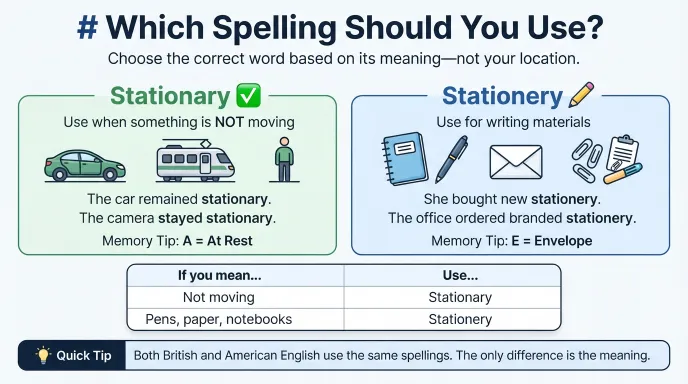
Use stationary when talking about something that is not moving.
Examples
- The truck remained stationary.
- The elevator became stationary during maintenance.
- Keep the camera stationary while recording.
Use stationery when talking about paper products or office supplies.
Examples
- Our office ordered branded stationery.
- She enjoys collecting beautiful stationery.
- The teacher handed out new stationery.
Advice for Different Audiences
| Audience | Recommended Word |
| US readers | Use stationary for “not moving” and stationery for writing supplies. |
| UK readers | Use the same spellings and meanings. |
| Australia & New Zealand | Follow the same standard English usage. |
| Canada | Use the same spellings. |
| Global audience | Use the correct word based on its meaning. |
Professional Writing Tip
Before publishing your writing, ask yourself:
- Is it describing something that isn’t moving? → Stationary
- Is it talking about pens, paper, notebooks, or office supplies? → Stationery
This quick check will help you avoid one of the most common English spelling mistakes.

Common Mistakes with Stationary vs Stationery
Because stationary and stationery sound exactly alike, many writers accidentally use the wrong one. These mistakes appear in emails, school assignments, business documents, and even online articles.
Here are the most common errors and how to fix them.
| Incorrect | Correct | Why? |
| I bought new stationary. | I bought new stationery. | Writing supplies require stationery. |
| The car was stationery. | The car was stationary. | A car that isn’t moving is stationary. |
| We ordered office stationary. | We ordered office stationery. | Office supplies are stationery. |
| The bicycle remained stationery. | The bicycle remained stationary. | The bicycle is not moving. |
| Please print this on company stationary. | Please print this on company stationery. | Company paper is stationery. |
Why People Mix Them Up
People confuse these words because:
- They sound exactly the same.
- Only one letter is different.
- Spellcheck may not notice the mistake.
- Both words are common in business writing.
Easy Memory Tricks
Remember these simple tips:
- Stationery → E for Envelope.
- Stationary → A for At rest.
These two memory tricks make choosing the correct word much easier.
Stationary vs Stationery in Everyday Examples
Learning through real-life examples is one of the easiest ways to remember the difference.
In Emails
✅ Please order new stationery for the office.
✅ Our company stationery includes letterheads and envelopes
In Business Writing
✅ The company designed professional stationery for its new brand.
✅ The delivery truck remained stationary outside the warehouse
In News Reports
✅ Traffic was stationary for nearly an hour after the accident.
✅ The school received donated stationery for students
On Social Media
✅ I can’t resist buying cute stationery!
✅ The train has been stationary for twenty minutes
In School Writing
✅ Every student should bring basic stationery on the first day.

✅ The science experiment required the camera to remain stationary
In Formal Writing
✅ Applicants should use official company stationery when submitting printed documents.
✅ The machine must remain stationary during maintenance.
Stationary vs Stationery :Google Trends & Usage Data
Although these words are often searched together, people usually search them because they want to know which spelling is correct.
Search Interest
The keyword “Stationary vs Stationery” receives steady search traffic throughout the year because:
- Students learn the difference in school.
- Job seekers write professional emails.
- Businesses order branded stationery.
- Writers want to avoid spelling mistakes.
Popular Countries
Searches are especially common in:
- United States
- United Kingdom
- Canada
- Australia
- India
- Pakistan
- New Zealand
English learners around the world frequently search for this pair because they are perfect examples of homophones if words that sound the same but have different meanings.
When Each Word Is Used
| Word | Most Common Context |
| Stationary | Traffic, vehicles, trains, machines, cameras, objects that are not moving |
| Stationery | Office supplies, school supplies, business branding, invitations, notebooks, paper products |
Key Insight
Neither word is more “correct” than the other. Each serves a different purpose:
- Use stationary when something does not move.
- Use stationery when referring to writing materials or office supplies.
Understanding this distinction will help you write accurately and professionally.
Frequently Asked Questions
1. What is the difference between stationary and stationery?
Stationary means not moving or staying in one place. Stationery refers to writing materials, such as paper, pens, notebooks, envelopes, and other office supplies
2. Is stationary ever used to mean office supplies?
No. Stationary is never the correct word for office supplies. The correct noun is stationery.
✅ Correct: I bought new stationery for school.
❌ Incorrect: I bought new stationary for school
3. How can I remember the difference?
A simple memory trick is:
- Stationery has an E for Envelope.
- Stationary has an A for At rest.
This is one of the easiest ways to remember which spelling to use
4. Are stationary and stationery pronounced differently?
No. They are homophones, meaning they are pronounced the same but have different meanings and spellings
5. Is there a British and American spelling difference?
No. Both British English and American English use the same spellings:
- Stationary = not moving
- Stationery = writing materials
The difference is based on meaning, not regional spelling
6. What are examples of stationery?
Examples include:
7. Can stationary describe people?
Yes. It can describe a person who is standing still or not moving.
Example:
The security guard remained stationary throughout the ceremony.
Conclusion:
Although stationary and stationery look and sound alike, they have completely different meanings. Stationary is an adjective that describes something that is not moving, while stationery is a noun that refers to writing materials and office supplies. Knowing this simple distinction can help you avoid one of the most common spelling mistakes in English.
A useful way to remember the difference is the memory trick: “E for Envelope” in stationery and “A for At rest” in stationary. if you’re writing an email, preparing a business document, completing schoolwork, or creating professional content, choosing the correct word improves clarity and credibility.
There is no British or American spelling variation for these words if the spellings remain the same worldwide. The only thing that changes is the meaning. By practicing with real-life examples and keeping the memory trick in mind, you’ll quickly build confidence in using stationary and stationery correctly. The next time you write about office supplies or something that isn’t moving, you’ll know exactly which word to choose
Related articles: Mathew or Matthew: Which Spelling Is Correct?, Hardy or Hearty: Which Word Is Correct and How to Use It?, Emphasises or Emphasizes: Which Spelling Is Correct?.
See the dictionary definitions for stationary and stationery.

Daniel R. Foster is an experienced English language writer and editor who specializes in explaining commonly confused words and grammar nuances. With a strong passion for clarity in communication, he creates easy-to-understand comparisons that help learners, students, and professionals use English more confidently. His articles focus on accuracy, real-world examples, and practical usage.