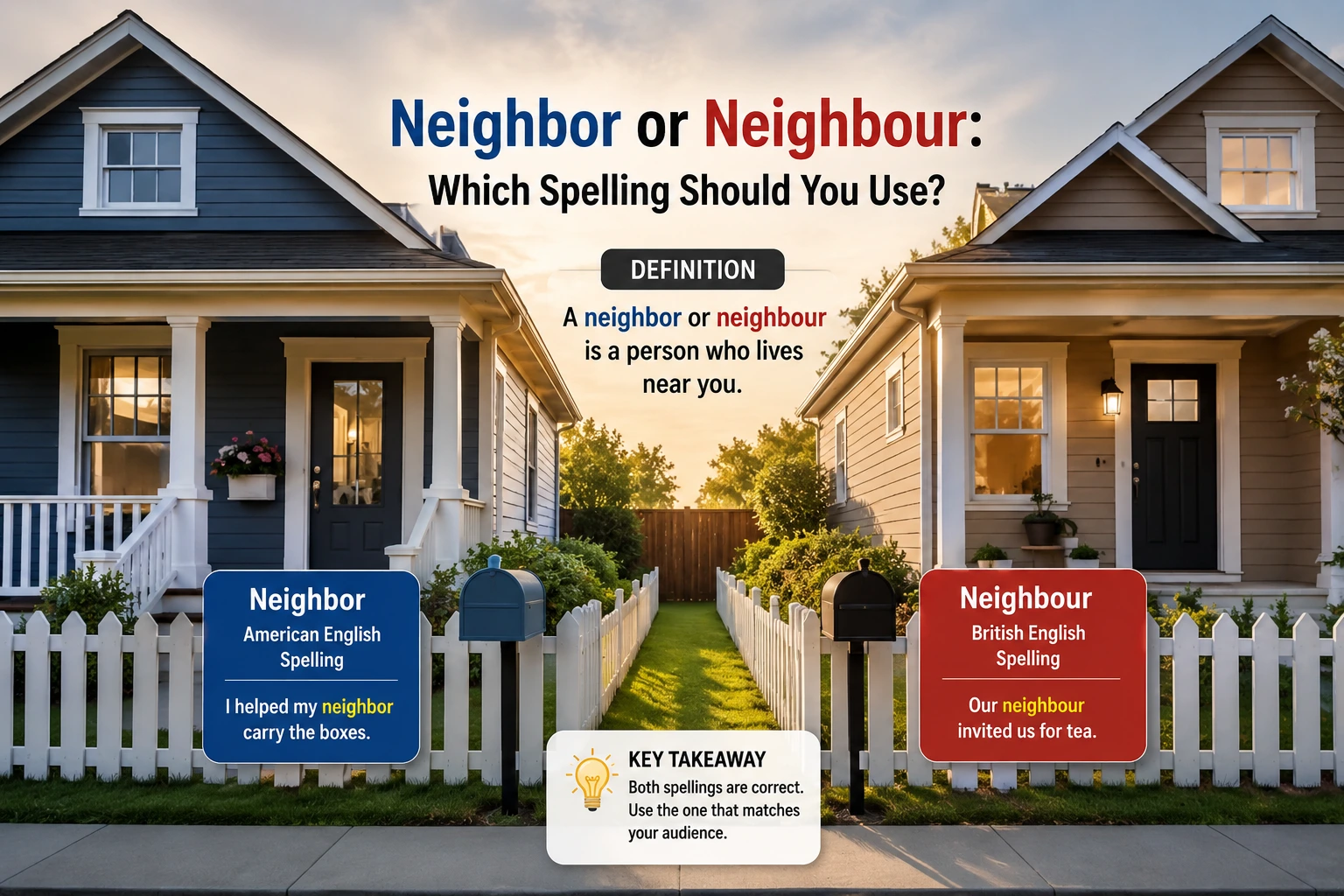
Neighbor and neighbour have the same meaning. The only difference is spelling. Neighbor is the American English form, while neighbour is the British English form.
A few years ago, I was proofreading a student’s essay when I noticed something interesting. The student had written neighbor in one paragraph and neighbour in the next. Neither spelling was wrong, but using both in the same piece made the writing look inconsistent. It reminded me how often even careful writers get confused by English spelling differences.
If you’ve ever paused before typing neighbor or neighbour, you’re not alone. Many students, bloggers, teachers, and professionals wonder which spelling is correct. The answer depends on the type of English you are using rather than the meaning of the word.
The confusion comes from the differences between American and British English. Similar spelling pairs, such as color/colour, favor/favour, and labor/labour, follow the same pattern. Once you understand the rule, choosing the correct version becomes easy.
By the end of this guide, you’ll know the difference between neighbor and neighbour, learn when to use each spelling, see real examples, and avoid common mistakes.
Neighbor or Neighbour: Quick Answer
Both neighbor and neighbour refer to a person who lives near you or someone located close to another place or thing. They share the same pronunciation and meaning.
The only difference is the variety of English you are writing.
- Neighbor → American English
- Neighbour → British English, Australian English, Canadian English, and most other Commonwealth countries
Examples
- My neighbor helped me carry the groceries. (American English)
- Our neighbour invited us over for dinner. (British English)
Both sentences are correct. The spelling simply matches a different regional writing style.
The Origin of Neighbor and Neighbour
The word has a long and fascinating history. It comes from the Old English word nēahgebūr, which combines two parts:
- nēah meaning near
- gebūr meaning dweller, farmer, or resident
Together, the original word described someone who lived nearby. Over time, pronunciation changed, and the word evolved into the modern English forms we use today.
The spelling difference appeared much later.
During the nineteenth century, American dictionaries, especially those influenced by lexicographer Noah Webster, encouraged simpler spellings. Webster believed many English words contained unnecessary letters. As a result, American English gradually dropped the “u” from words such as:
| American English | British English |
| Neighbor | Neighbour |
| Color | Colour |
| Favor | Favour |
| Labor | Labour |
| Harbor | Harbour |
Meanwhile, Britain and many Commonwealth countries continued using the traditional spellings with “ou.”
Today, both spellings are officially accepted. The key is to stay consistent throughout your writing.
Neighbor or Neighbour Explained
Although the spellings differ, the meaning never changes.
| Term | Meaning | When to Use | Region |
| Neighbor | A person living nearby | American English writing | United States |
| Neighbour | A person living nearby | British English writing | United Kingdom, Australia, Canada, New Zealand, and others |
The word can also describe countries, cities, businesses, or objects located close to one another.
Examples
- Mexico is a neighbor of the United States.
- France is a neighbour of Germany.
- We became good neighbors after moving into the apartment building.
- The new family are friendly neighbours.
In every example, the meaning stays exactly the same. Only the spelling reflects the regional style of English.
Read more: Openned or Opened: The Correct Spelling Explained
Which Version Should You Use?
The best spelling depends entirely on your audience.
If you’re writing for American readers
Choose neighbor.
This spelling matches American dictionaries, schools, newspapers, and business communication.
Example:
Please introduce yourself to your new neighbor.
If you’re writing for British readers
Choose neighbour.
It follows British spelling conventions and appears in UK publications and educational materials.
Example:
Every neighbour was invited to the community meeting.
If your audience is international
Either spelling is acceptable. However, avoid mixing both versions within the same document.
Consistency makes your writing appear polished and professional.
Common Mistakes with Neighbor and Neighbour
Even though the difference is only one letter, writers still make a few common mistakes. Most happen because people switch between American and British English without noticing.
| Mistake | Correct Form | Why It’s Wrong |
| My neighbor lives next door. Our neighbour has a dog. | Choose one spelling and use it throughout. | Mixing spelling styles looks inconsistent. |
| She is my neigbour. | She is my neighbour. | The letters are in the wrong order. |
| He is my neibor. | He is my neighbor. | A letter is missing. |
| The neighbours are coming over. (American document) | The neighbors are coming over. | Match the spelling to the variety of English you are using. |
| Our neighbors invited us for tea. (British report) | Our neighbours invited us for tea. | Use British spelling in British English writing. |
Tips to Avoid Mistakes
- Pick one variety of English before you start writing.
- Use your spell checker to catch accidental changes.
- Stay consistent in essays, blogs, emails, and reports.
- If you write for international audiences, follow the style guide your organization or publisher recommends.
Neighbor and Neighbour in Real-World Writing
Seeing the word in context makes the difference easier to remember.
Professional Email
Dear Sarah,
Our new neighbor has offered to collect deliveries while we are away. Please let me know if you’d like me to thank them on behalf of the team.
(American English)
News Headline
Local Neighbour Saves Family During House Fire
(British English)
Social Media Post
We finally met our new neighbors today. They even brought homemade cookies. What a warm welcome!
Formal Report
Residents reported that every neighbour received a printed copy of the community safety guidelines before the meeting.
Neighbor or Neighbour: Data, Trends & Usage
Search interest in neighbor and neighbour remains steady because people often want to know which spelling is correct.
Here are a few interesting facts:
- Search Intent: Informational
- Most searches for “neighbor”: United States
- Most searches for “neighbour”: United Kingdom, Australia, Canada, New Zealand, and other Commonwealth countries
- Who searches this topic?
- Students
- English learners
- Teachers
- Writers and bloggers
- Editors and proofreaders
Why This Matters
English is used around the world. A small spelling choice can make your writing feel more natural to your audience. Using the correct regional spelling also helps maintain consistency in academic papers, business documents, and online content.
Neighbor vs. Neighbour at a Glance
| Term/Variant | Meaning | Region/Context | Best Used When |
| Neighbor | A person living nearby | American English | Writing for readers in the United States |
| Neighbour | A person living nearby | British and Commonwealth English | Writing for readers in the UK, Canada, Australia, New Zealand, and similar regions |
Frequently Asked Questions
What does neighbor or neighbour mean?
Both words mean a person who lives near you. They can also describe places or countries that are close to one another.
How do you use neighbor or neighbour correctly?
Choose the spelling that matches your audience. Use neighbor in American English and neighbour in British English. Keep the same spelling throughout your writing.
Is there a difference between neighbor and neighbour?
No. They have the same pronunciation and meaning. The only difference is the regional spelling.
Is neighbour acceptable in formal writing?
Yes. Neighbour is the standard spelling in British English and is perfectly suitable for formal documents, academic writing, and professional communication.
Which spelling is correct: neighbor or neighbour?
Both are correct. The right choice depends on whether you are following American or British English conventions.
Where did the word come from?
The word comes from the Old English nēahgebūr, meaning someone who lives nearby. Over time, American and British English adopted different spellings.
Can I use both spellings in the same article?
It is best not to. Mixing neighbor and neighbour in one piece can distract readers and make your writing appear inconsistent.
Conclusion
Choosing between neighbor and neighbour is much simpler than it first appears. Both words have the same meaning, same pronunciation, and same purpose. The only difference is the spelling, which depends on the variety of English you are using.
If your audience is in the United States, use neighbor. If you’re writing for readers in the United Kingdom, Australia, Canada, New Zealand, or other Commonwealth countries, neighbour is the better choice. No matter which version you choose, the most important rule is to stay consistent throughout your writing.
Understanding regional spelling differences can make your writing look more polished and professional. It also helps you connect with readers by using the language style they expect. Whether you’re writing an email, a school assignment, a blog post, or a business document, selecting the correct spelling shows attention to detail.
Now that you know the difference between neighbor and neighbour, you can write with confidence. Bookmark this guide for future reference, and share it with anyone who has ever wondered which spelling is correct.
Read more: Believe or Belive: 5 Mistakes to Avoid

Passionate about language and clear communication, I explore the subtle differences between words and expressions through well-researched, practical content. My goal is to help readers write with greater clarity, confidence, and precision by making complex language concepts easy to understand.