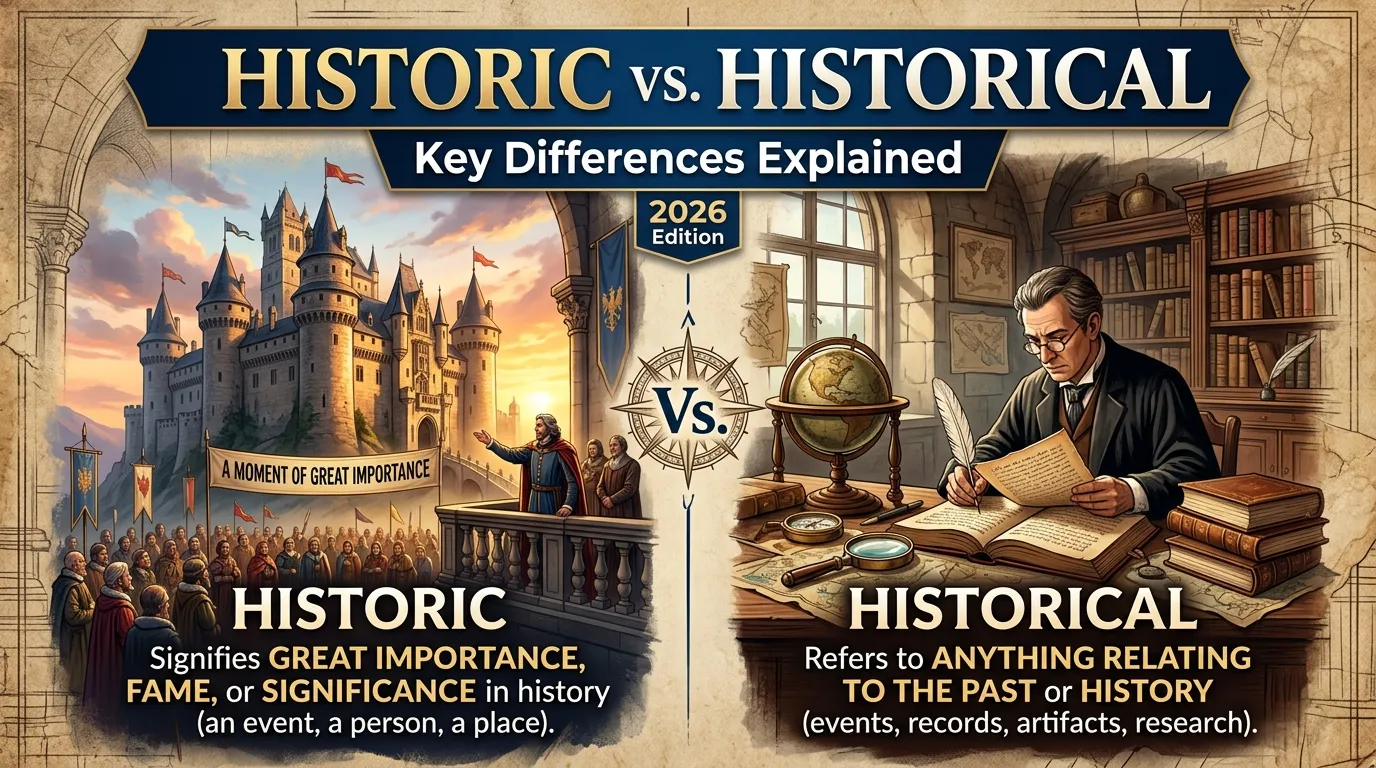
Use historic for something important or significant in history, and historical for anything related to history in general.
Imagine reading a news headline that says, “A historic agreement was signed today.” Later, you visit a museum and see a sign describing “historical documents from the 18th century.” Why is one called historic and the other historical?
Because these words look similar and both relate to history, many people use them interchangeably. However, they have different meanings and are used in different situations. Choosing the wrong one can make your writing sound awkward or less precise.
People search for “historic or historical” because they want to know:
- what the difference is
- which word is correct in a sentence
- whether they can be used interchangeably
- when to use historic
- when to use historical
The good news is that the distinction is straightforward. Historic describes something that is important, influential, or likely to be remembered in history. Historical simply means related to history, whether significant or not.
In this guide, you’ll learn the meanings, origins, examples, common mistakes, usage trends, comparison tables, and practical tips for using historic and historical correctly.
Historic or Historical – Quick Answer
👉 Historic = Important or significant in history.
👉 Historical = Related to history in general.
Examples
- The country signed a historic peace treaty. ✅
- The museum contains historical artifacts. ✅
Simple Rule
👉 Historically important = Historic
👉 Connected to history = Historical
The Origin of Historic or Historical
Both words come from the Greek word meaning:
- inquiry
- knowledge gained through investigation
Over time, English developed two related adjectives:
Historic
Used to describe events, places, or moments that have major historical importance.
Historical
Used to describe anything connected with history, regardless of importance.
Although they share the same root, their meanings gradually became more specialized.
Historic vs Historical – Meaning Explained
What Does “Historic” Mean?
“Historic” means:
- important in history
- influential
- memorable
- likely to be remembered
Example 1
- The moon landing was a historic achievement.
Example 2
- The election produced a historic result.
Example 3
- Leaders reached a historic agreement.
In each example, the event has major significance.
What Does “Historical” Mean?
“Historical” means:
- related to history
- connected with past events
- concerning historical records
Example 1
- She studies historical documents.
Example 2
- The novel is based on historical events.
Example 3
- Researchers examined historical records.
The items are connected to history but are not necessarily historically important themselves.
British English vs American English Usage
There is no spelling difference between British and American English.
Comparison Table
| Word | British English | American English |
|---|---|---|
| Historic | Standard | Standard |
| Historical | Standard | Standard |
Key Point
The meanings are the same worldwide.
Which Word Should You Use?
The correct choice depends on what you want to communicate.
Use “Historic” When:
- something is important
- an event changes history
- a moment is memorable
- significance is being emphasized
Examples
- A historic victory
- A historic speech
- A historic discovery
- A historic election
Use “Historical” When:
- discussing history generally
- referring to records or facts
- describing things from the past
- studying historical subjects
Examples
- Historical research
- Historical documents
- Historical evidence
- Historical fiction
Common Mistakes with Historic or Historical
Mistake 1
❌ Historical victory
✔ Historic victory
A victory is important, so historic is preferred.
Mistake 2
❌ Historic records
✔ Historical records
Records relate to history but are not necessarily important themselves.
Mistake 3
❌ Using the words interchangeably.
✔ Consider whether significance is being emphasized.
Mistake 4
❌ Assuming historical means important.
✔ Historical simply means related to history.
Historic or Historical in Everyday Examples
News
- The nation celebrated a historic achievement.
- Journalists reviewed historical records.
Education
- Students learned about historical events.
- Teachers discussed a historic battle.
Museums
- The museum displays historical artifacts.
- Visitors toured a historic building.
Literature
- Historical fiction combines facts and storytelling.
- The book describes a historic moment.
Historic or Historical – Google Trends & Usage Data
Usage patterns show a clear distinction.
Historic
Often appears in:
- news headlines
- politics
- major achievements
- sports milestones
Examples:
- historic win
- historic agreement
- historic decision
Historical
Often appears in:
- education
- museums
- research
- books
- documentaries
Examples:
- historical records
- historical research
- historical evidence
Key Insight
Historic emphasizes importance, while historical emphasizes connection to the past.
Comparison Table: Historic vs Historical
| Feature | Historic | Historical |
|---|---|---|
| Means important | Yes | No |
| Related to history | Yes | Yes |
| Used for major events | Yes | Sometimes |
| Used for research | No | Yes |
| Used for records | No | Yes |
| Indicates significance | Yes | No |
Historic in Modern Usage
The word “historic” often appears in major news stories.
Common Examples
- historic election
- historic peace deal
- historic achievement
- historic breakthrough
These events are viewed as especially important.
Example 1
- Scientists announced a historic discovery.
Example 2
- The team achieved a historic victory.
Historical in Academic and Educational Writing
“Historical” is widely used when discussing the past.
Common Examples
- historical documents
- historical analysis
- historical evidence
- historical context
Example 1
- Historians examined historical records.
Example 2
- The documentary presented historical facts.
Why People Confuse Historic and Historical
The confusion happens because:
- both relate to history
- both share the same root word
- both can describe past events
- the difference is subtle
The key question is:
👉 Is the subject important in history?
If yes, use historic.
If it simply relates to history, use historical.
Similar Word Pairs That Cause Confusion
English contains many related words with different meanings.
| Word Pair |
|---|
| Historic / Historical |
| Economic / Economical |
| Classic / Classical |
| Continual / Continuous |
| Personal / Personnel |
Understanding context helps you choose correctly.
Simple Trick to Remember the Difference
Easy Memory Rule
👉 Historic = History-making
👉 Historical = History-related
Quick Reminder
Important event?
✔ Historic
Related to history?
✔ Historical
FAQs
1. What is the difference between historic and historical?
Historic means important in history, while historical means related to history.
2. Is a historic event the same as a historical event?
Not exactly. A historic event is historically significant, while a historical event is simply part of history.
3. What are historical documents?
They are records, papers, or materials related to past events.
4. What is a historic achievement?
An achievement considered important enough to be remembered in history.
5. Can a building be historic?
Yes. A building can be historic if it has historical significance.
6. Is historical fiction correct?
Yes. Historical fiction is fiction set in the past.
7. What is the easiest way to remember the difference?
Think:
👉 Historic = history-making
👉 Historical = history-related
Conclusion
The difference between historic or historical comes down to significance.
Use historic when describing something important, influential, or likely to be remembered in history. Historic events, achievements, speeches, and discoveries have lasting significance.
Use historical when referring to anything connected with history, such as records, documents, facts, artifacts, or research. Historical does not automatically imply importance—it simply indicates a relationship to the past.
The simplest rule is:
👉 Historic = important in history
👉 Historical = related to history
Keeping this distinction in mind will help your writing sound clearer, more accurate, and more professional in academic, business, and everyday communication.

Miles Thornton is a seasoned author and content specialist with a knack for simplifying complex topics. Passionate about clear, engaging writing, creates articles that inform and inspire readers. With years of experience in digital publishing, Miles combines professionalism with creativity, delivering insightful content for diverse audiences