Have you ever typed “trully” and wondered if it is correct? You are not alone. Many English learners and writers confuse “trully” and “truly” because both spellings look almost the same. This small spelling difference can cause problems in school assignments, emails, websites, social media posts, and professional writing.
The correct spelling is “truly.” The spelling “trully” is incorrect in modern standard English. The word truly means sincerely, genuinely, honestly, or really. For example, you can say, “I truly appreciate your help.”
People search for “trully or truly” because they want to check the correct spelling before using the word. Some also wonder if British English and American English use different spellings. In this case, there is no difference. Both British and American English use truly.
This guide explains the difference between trully and truly, the origin of the word, common spelling mistakes, everyday examples, and the best spelling to use in professional writing.
Trully or Truly : Quick Answer
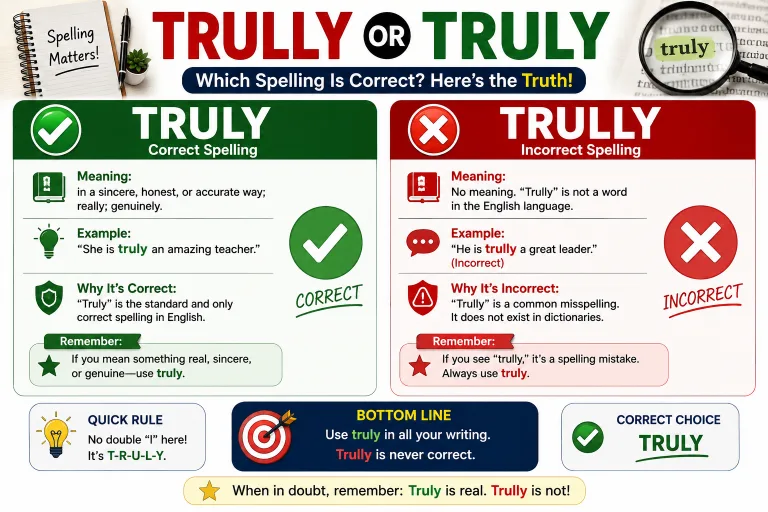
Truly is the correct spelling.
Trully is incorrect in modern standard English.
The correct form is:
Truly ✅
The incorrect form is:
Trully ❌
Examples
- ✅ I truly appreciate your help.
- ❌ I trully appreciate your help.
- ✅ She is truly talented.
- ❌ She is trully talented.
- ✅ We are truly grateful.
- ❌ We are trully grateful.
Truly is an adverb. It can mean really, sincerely, genuinely, or honestly.
For example:
I truly believe you.
This means:
I sincerely believe you.
So, if you are choosing between trully or truly, always choose truly.
The Origin of Trully or Truly
The word truly comes from the adjective true. The word has a long history in English and is related to older English words connected with ideas such as truth, faithfulness, and honesty.
Over time, true developed into the adverb truly.
The spelling may seem confusing because many people expect:
true + ly = truely
But standard English uses:
true → truly
The final e is removed before adding ly.
Another common mistake is adding an extra l:
truly → trully
This happens because English spelling patterns can sometimes make writers expect a doubled consonant. However, there is only one L in the standard spelling.
Why Is Trully Incorrect?
Trully is generally considered a misspelling of truly in modern English.
The correct word is:
TRU + LY = TRULY
It is important to remember that trully should not be used in normal modern English writing.
British English vs American English Spelling
Unlike words such as colour/color and centre/center, truly has the same spelling in British and American English.

| English Variety | Correct Spelling | Incorrect Spelling |
| American English | truly | trully |
| British English | truly | trully |
| Canadian English | truly | trully |
| Australian English | truly | trully |
| International English | truly | trully |
British English Example
I truly enjoyed the experience.
American English Example
I truly enjoyed the experience.
Both sentences use exactly the same spelling.
Therefore, you do not need to change truly based on if your audience is American or British.
Which Spelling Should You Use?
You should use truly regardless of your audience.
For a US Audience
Use:
I truly appreciate your support.
Truly is the standard American English spelling.
For a UK or Commonwealth Audience
Use:
She truly understands the situation.
British English also uses truly.
For a Global Audience
Use truly.
It is widely understood and accepted in standard English.
For Professional Writing
Use truly in:
- Emails
- School assignments
- Essays
- Reports
- Business documents
- Websites
- Blog posts
- Applications
- Formal letters
Avoid trully because it can make your writing look careless or unprofessional.
Common Mistakes with Trully or Truly
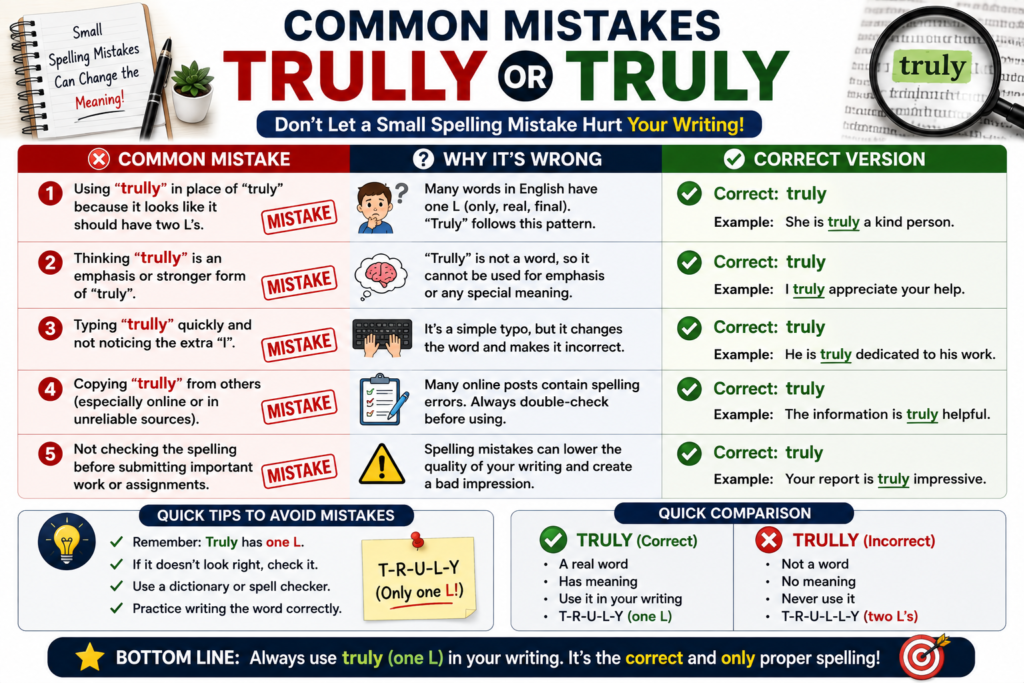
There are several common spelling mistakes related to truly.
1. Trully
❌ I trully understand.
✅ I truly understand.
The problem is the extra l.
2. Truely
❌ I am truely sorry.
✅ I am truly sorry.
The letter e should not remain after u.
3. Truelly
❌ This is truelly amazing.
✅ This is truly amazing.
This spelling contains both an unnecessary e and an extra l.
4. Truley
❌ She is truley happy.
✅ She is truly happy.
The letters are in the wrong order.
Quick Correction Table
| Incorrect Spelling | Correct Spelling |
| trully | truly |
| truely | truly |
| truelly | truly |
| truley | truly |
| truly | truly |
The easiest rule is simple:
One L, no E: truly.
Trully or Truly in Everyday Examples
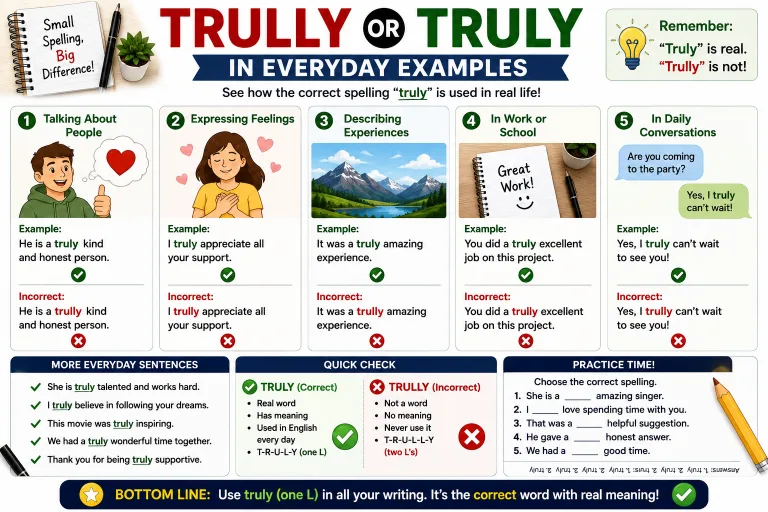
The word truly is common in everyday English.
In Emails
I truly appreciate your quick response.
We truly value your feedback.
I am truly sorry for the delay.
In News
The event was truly historic.
The player gave a truly impressive performance.
On Social Media
Truly grateful for everyone who supported me!
Today was truly unforgettable.
In Formal Writing
The results truly show the importance of education.
This research provides a truly useful explanation.
In Personal Messages
I truly miss my friends.
You are truly special to me.
In all these examples, the correct spelling is truly.
Trully or Truly : Google Trends & Usage Data
People often search for “trully or truly” because they are unsure which spelling is correct. Search engines receive many queries about confusing words, spelling variations, and grammar questions.
Google Trends can help show how often people search for different terms. However, Google Trends uses relative search interest, not exact search volume. A higher Trends score means a term has more search interest compared with other searches in the selected time and location.
For trully vs truly, search behavior can come from several groups:
- English learners
- Students
- Bloggers
- Content writers
- Social media users
- People checking professional emails
- Writers using English as a second language
The important point is that search popularity does not determine if
a spelling is correct. A misspelled word can receive many searches because people are checking if it is correct.
In standard English, truly is the accepted spelling. Trully is mainly used as a spelling mistake or as a search query from people trying to confirm the correct form.
Trully vs Truly: Comparison Table
| Feature | Trully | Truly |
| Standard spelling | ❌ No | ✅ Yes |
| Correct modern English | ❌ No | ✅ Yes |
| British English | ❌ No | ✅ Yes |
| American English | ❌ No | ✅ Yes |
| Number of Ls | Two | One |
| Contains final E | No | No |
| Part of speech | Incorrect form | Adverb |
| Meaning | No standard modern meaning | Really, sincerely, genuinely |
| Professional writing | Avoid | Recommended |
| Academic writing | Avoid | Recommended |
| Email writing | Avoid | Correct |
| Social media | Avoid | Correct |
How to Remember Truly
A simple trick can help you remember the correct spelling.
Start with:
TRUE
Remove the final E:
TRU
Add LY:
TRU + LY = TRULY
So remember:
TRUE → TRULY
You can also remember that truly has only one L.
Correct
T R U L Y
Incorrect
T R U L L Y
If you see two Ls, remove one.

This simple trick can help you avoid the most common spelling mistake.
FAQs
1. Is trully or truly correct?
Truly is correct. Trully is an incorrect spelling in modern standard English.
2. How do you spell truly?
The correct spelling is T R U L Y.
It has one L and no extra E.
3. Is trully a word?
Trully is not the standard modern spelling of this word. In normal English writing, use truly.
4. Is truly British or American?
Truly is both British and American English. There is no spelling difference between these varieties.
5. Why is truly not spelled truely?
The standard spelling is truly, not truely. The final e in true is removed when forming truly.
6. Why do people spell truly as trully?
People may add another l because they are unsure about the spelling pattern. The pronunciation can also make the incorrect spelling seem natural.
7. Is “I truly appreciate it” correct?
Yes.
I truly appreciate it.
This is a correct and natural sentence.
8. Is “Yours truly” correct?
Yes. Yours truly is a traditional closing used in letters and other written communication.
Example:
Yours truly,
Ali
9. What does truly mean?
Truly can mean really, sincerely, genuinely, or honestly.
Example:
I truly care about you.
10. Is truly an adverb?
Yes. Truly is an adverb.
Example:
She truly understands the problem.
Conclusion
The answer to “trully or truly” is simple: truly is the correct spelling. It has one L, no extra E, and five letters: T R U L Y.
The word truly comes from true and is used as an adverb. It can mean really, sincerely, genuinely, or honestly. For example, “I truly appreciate your help” means that you sincerely appreciate the help.
There is no British and American spelling difference for this word. Writers in the United States, United Kingdom, Canada, Australia, and other English speaking countries should use truly.
Common mistakes include trully, truely, truelly, and truley. These forms should be avoided in professional emails, school assignments, websites, blogs, and formal documents.
The easiest way to remember the spelling is:
TRUE → TRU + LY → TRULY
So, whenever you are unsure between trully or truly, choose truly. It is the correct and professional spelling.
Related articles: Nap or Nothing: What Do These Words Mean?, One’s or Ones: Which Is Correct and How to Use It?, Devide or Divide: Which Spelling Is Correct?.
See the dictionary definitions for trully and truly.

Hi, I’m Sehrish Iqbal, and I enjoy writing about the English language and the little differences between words that often cause confusion. I create simple and easy-to-understand articles about grammar, spelling, commonly confused words, and correct word usage. My goal is to make English easier to understand and help students, writers, and English learners use the right words with confidence.