Introduction
Have you ever stopped while writing and wondered whether you should write recognize or recognise? You are not alone. Here’s an easier-to-read version of your sentence:
Here’s a simpler version of your sentence:
“Thousands of people look up this spelling question every month because both words appear everywhere online and in print.”
Would you like it even simpler?
Let me know if you’d like it simplified further!.
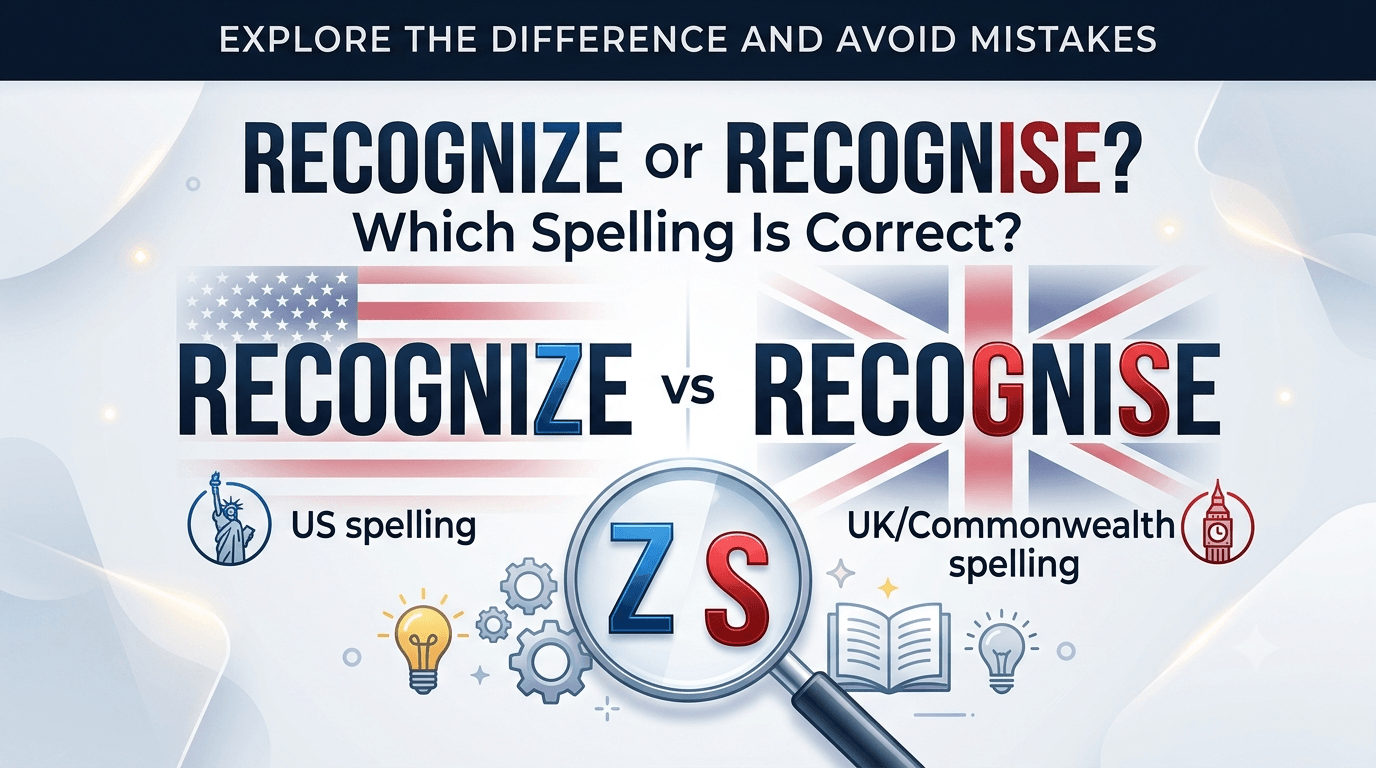
The good news is simple: both “recognize” and “recognise” are correct. The difference depends on the type of English you are using. American English prefers recognize, while British English often uses recognise. This small spelling difference confuses students, writers, businesses, and professionals who communicate with international audiences.
This guide explains the difference between recognize and recognise, their origins, which one to use, and how to avoid common mistakes. You’ll also find practical examples, comparisons, and quick answers to help you pick the right spelling every time.
Recognize or Recognise – Quick Answer

Recognize and recognise have the same meaning.
Both mean:
- To identify someone or something.
- To admit or accept something as true.
- To give praise or credit.
The only difference is spelling.
- Recognize → American English
- Recognise → British English
Examples
American English:
- I recognize your voice.
- She was recognized for her hard work.
British English:
- I recognise your voice.
- She was recognised for her hard work.
The meaning never changes.
The Origin of Recognize or Recognise

The word comes from the Latin word recognoscere, meaning “to know again.”
It later entered French before becoming part of English.
The spelling difference developed over time because English evolved differently in Britain and America.
In Britain, many words ending in -ise became common.
Examples include:
- organise
- realise
- recognise
In America, dictionary editor Noah Webster preferred simpler spellings ending in -ize.
Examples include:
- organize
- realize
- recognize
Interestingly, -ize is actually closer to the original Greek and Latin roots. Even many British publishers, including Oxford University Press, accept recognize.
British English vs American English Spelling
The biggest difference is the regional spelling preference.
American English
British English
Meaning
recognize
recognise
Same
recognized
recognised
Same
recognizing
recognising

Same
recognizes
recognises
Same
More Examples
American
British
organize
organise
realize
realise
apologize
apologise
analyze
analyse*
*Note: analyse is standard British English, while analyze is standard American English.
Key Rule
- Use -ize for American English.
- Use -ise for most British English writing.
Which Spelling Should You Use?
Choose your spelling based on your audience.
If You Write for Americans
Use recognize.
Examples include:
- US schools
- American companies
- US websites
- American newspapers
If You Write for the UK
Use recognise.
It is the spelling most British readers expect.
If You Write for Australia, New Zealand, or South Africa
Most publishers prefer recognise, although some style guides also accept recognize.
If You Write for an International Audience
Either spelling is correct.
The most important rule is consistency.
Do not switch between recognize and recognise in the same document.
Common Mistakes with Recognize or Recognise
Here are mistakes people often make.
Mistake 1
❌ recognice
✅ recognize
Mistake 2
❌ recognisze
✅ recognise
Mistake 3
Mixing spellings.
❌ We recognise the problem and recognize the solution.
✅ We recognise the problem and recognise the solution.
OR
✅ We recognize the problem and recognize the solution.
Mistake 4
Thinking one spelling is wrong.
This is incorrect.
Both spellings are accepted in standard English.
Recognize or Recognise in Everyday Examples
American:
We recognize your contribution to the project.
British:
We recognise your contribution to the project.
News
American:
The city recognized local volunteers.
British:
The city recognised local volunteers.
Social Media
- I finally recognize this place!
- I finally recognise this place!
Both are correct depending on your audience.
Formal Writing
- The committee recognizes outstanding achievement.
- The committee recognises outstanding achievement.
Again, choose one spelling style and stay consistent.
Recognize or Recognise – Google Trends & Usage Data
Search data and writing trends show clear regional preferences.
Country
Preferred Spelling
United States
Recognize
Canada
Mostly Recognize
United Kingdom
Recognise
Australia
Recognise
New Zealand
Recognise
Ireland
Recognise
General Usage
- American websites mostly use recognize.
- British newspapers usually use recognise.
- International companies often follow their chosen style guide.
- Academic writing depends on the required citation or publication style.
Comparison Table
Feature
Recognize
Recognise
Meaning
Same

Same
American English
✔ Preferred
Rare
British English
Accepted by some publishers
✔ Common
Australian English
Less common
Preferred
Canadian English
Common
Less common
Formal Writing
Correct
Correct
Informal Writing
Correct
Correct
Frequently Asked Questions
Is recognize correct?
Yes. It is the standard American English spelling and is also accepted by some British publishers.
Is recognise correct?
Yes. It is the standard British English spelling.
Which spelling is more common?
Globally, recognize appears frequently because of American English. In the UK and many Commonwealth countries, recognise is more common.
Does the meaning change?
No. Both words have exactly the same meaning.
Can I use both spellings in one article?
No. Pick one spelling and use it consistently.
Why do Americans use recognize?
American English follows spelling reforms popularized by Noah Webster, which favored -ize endings.
Why does British English use recognise?
British English traditionally prefers -ise endings for many verbs, although some publishers also use -ize.
Conclusion
Choosing between recognize and recognise is easier than it first appears. Both spellings are correct, both have the same pronunciation, and both carry exactly the same meaning. The only real difference is the version of English you are writing.
If your audience is in the United States, use recognize because it matches American spelling standards. If your readers are in the United Kingdom or many Commonwealth countries, recognise is usually the better choice. For international writing, either spelling works as long as you remain consistent throughout your document.
Understanding this difference helps you write with confidence and professionalism. Whether you are creating business emails, academic papers, blog posts, marketing content, or social media updates, using the correct regional spelling makes your writing feel natural to your audience. Remember the simple rule: recognize for American English, recognise for British English, and never mix both spellings in the same piece of writing.
Related articles: Recur or Reoccur: Which Is Correct?, Nineth or Ninth? The Correct Spelling Explained, Congratulations or Congradulations? Get It Right.
See the dictionary definitions for recognize and recognise.

Hi, I’m Sehrish Iqbal, and I enjoy writing about the English language and the little differences between words that often cause confusion. I create simple and easy-to-understand articles about grammar, spelling, commonly confused words, and correct word usage. My goal is to make English easier to understand and help students, writers, and English learners use the right words with confidence.