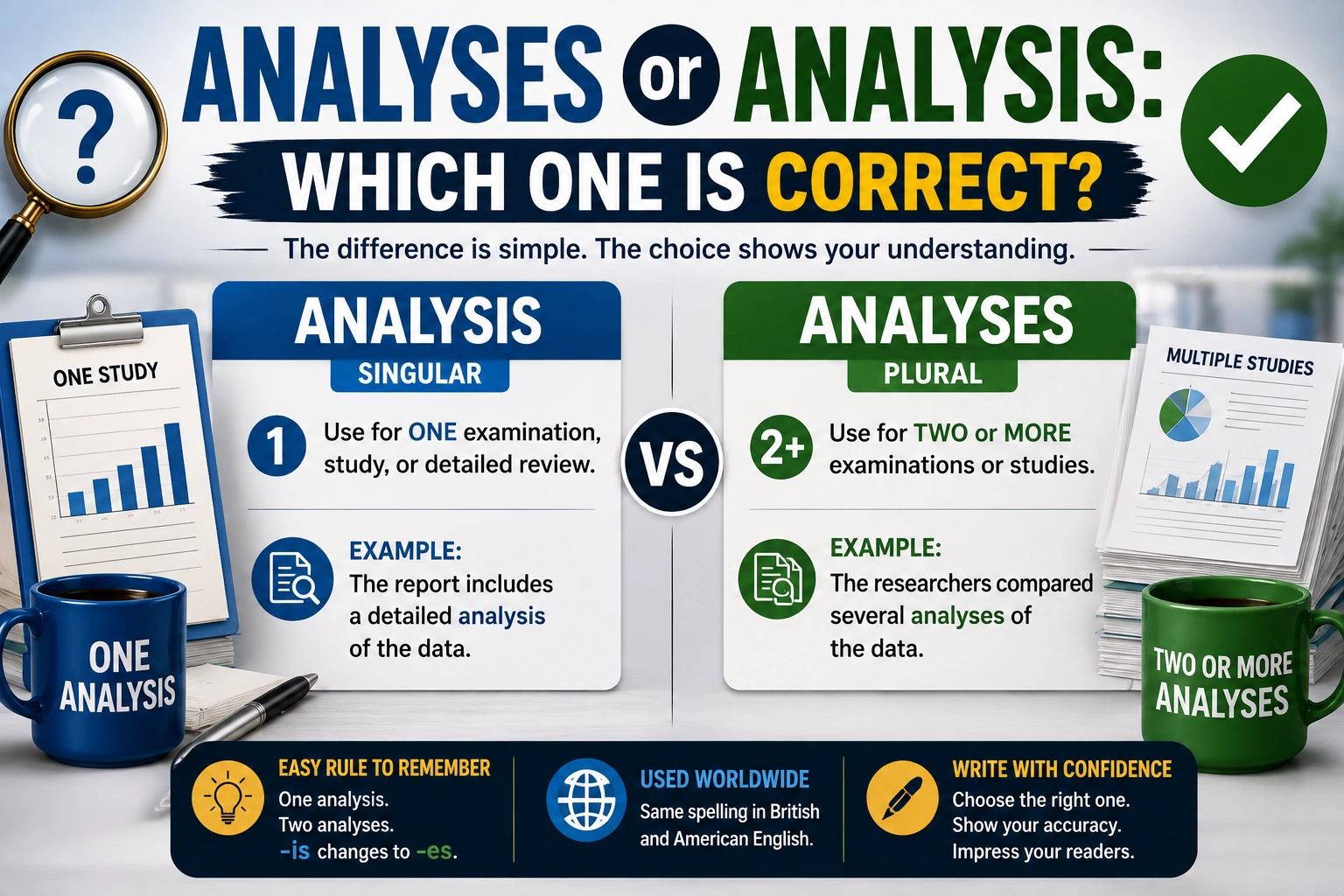
Have you ever written “analyses or analysis” and wondered which word you should use? You are not alone. These two forms are easy to confuse because they look almost the same, but they have different grammatical roles. The main difference is simple: analysis is usually singular, while analyses is the plural form.
For example, you can say, “The report contains one detailed analysis.” If you are talking about several separate examinations, use analyses: “The researchers compared three different analyses.”
The confusion often comes from the unusual plural spelling. Many English nouns form plurals by adding -s or -es, but analysis follows a Greek-derived pattern. The ending changes from -is to -es: analysis → analyses. (Merriam-Webster)
People search for “analyses or analysis” when writing essays, research papers, business reports, articles, emails, and academic work. This guide explains the difference, pronunciation, history, British and American usage, common mistakes, and easy ways to remember the correct form.
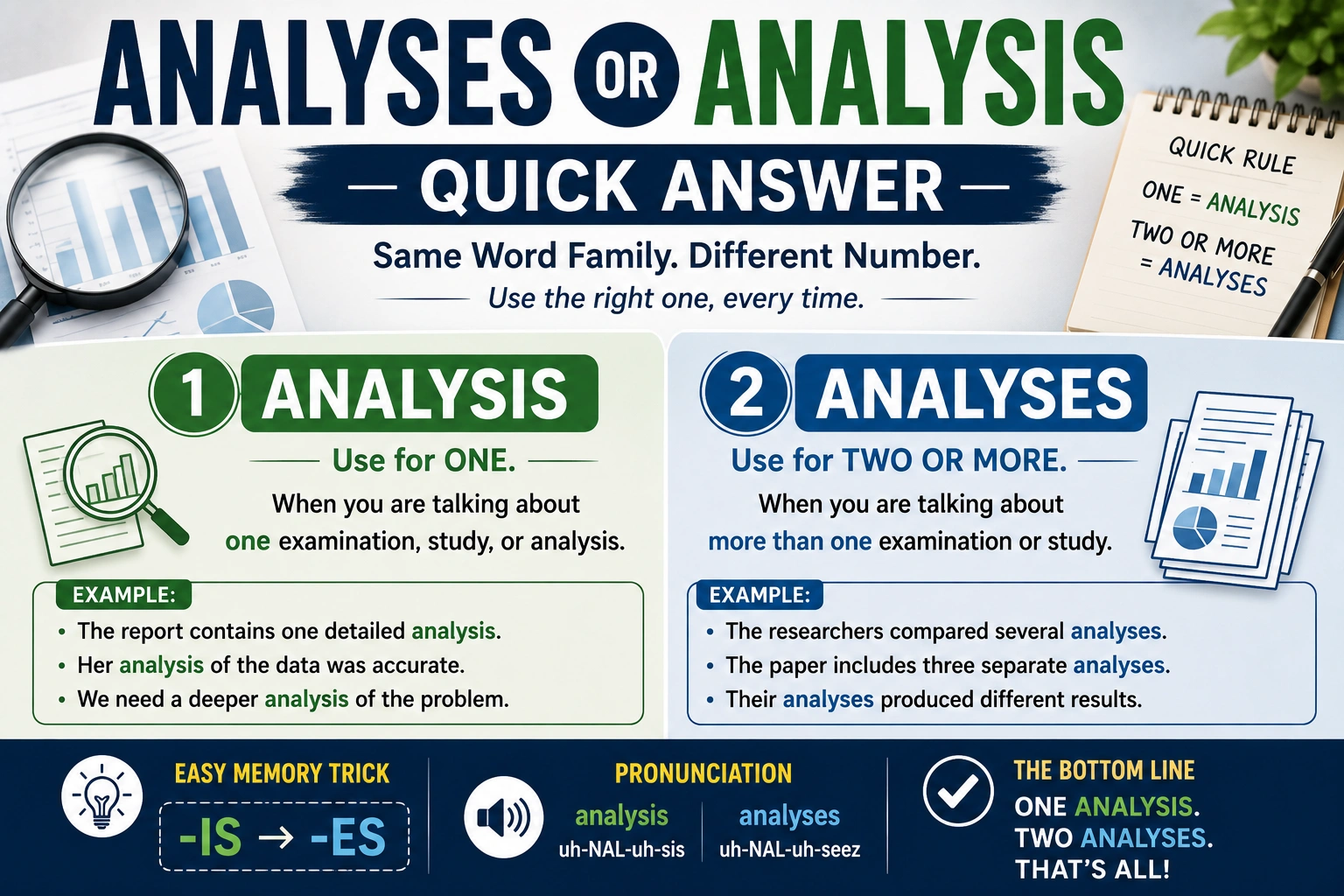
The quick answer is:
- Analysis = singular
- Analyses = plural
Use “Analysis” for One
The report contains one detailed analysis.
Her analysis of the problem was helpful.
We need a deeper analysis of the data.
Use “Analyses” for More Than One
The researchers compared several analyses.
The paper includes three separate analyses.
Their analyses produced different results.
Oxford lists analyses as the plural of analysis. (Oxford Learner’s Dictionaries)
Easy Memory Trick
Remember:
One analysis → Two analyses
Think of the ending:
-is → -es
So:
analysis → analyses
Pronunciation
The two words also sound different:
- analysis → uh-NAL-uh-sis
- analyses → uh-NAL-uh-seez
The plural has a “zeez” sound at the end. Oxford gives the plural pronunciation as /əˈnæləsiːz/. (Oxford Learner’s Dictionaries)
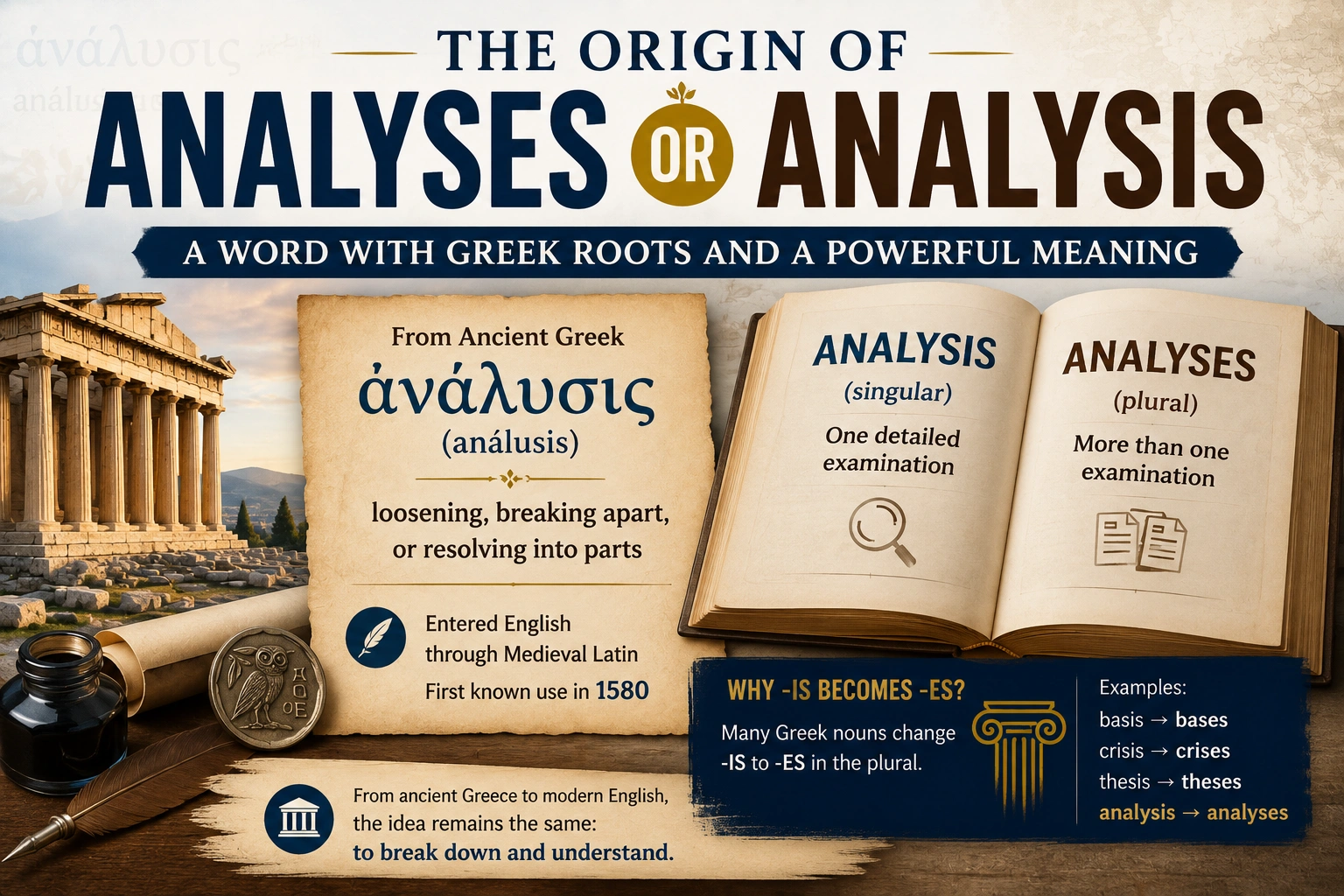
The word analysis has an ancient Greek origin. It comes from Greek análysis, meaning something like loosening, breaking apart, or resolving into parts. It is related to the Greek verb analýein, meaning “to loosen,” “undo,” or “break down.” (Merriam-Webster)
The word later entered English through Medieval Latin. Merriam-Webster records the first known English use of analysis in 1580. (Merriam-Webster)
The basic idea behind the word has remained similar. When you analyze something, you break it down into smaller parts so you can understand it better.
For example:
The scientist performed an analysis of the sample.
The scientist examines the sample and studies its parts.
Why Does Analysis Become Analyses?
The plural analyses follows a pattern inherited from Greek.
Instead of simply adding -s:
analysis → analysises ❌
English uses:
analysis → analyses ✅
This happens because many Greek-derived nouns ending in -is have plural forms ending in -es.
Examples include:
- analysis → analyses
- basis → bases
- crisis → crises
- thesis → theses
- diagnosis → diagnoses
- hypothesis → hypotheses
This is why analyses may look unusual, but it is the standard plural form. (Scribbr)
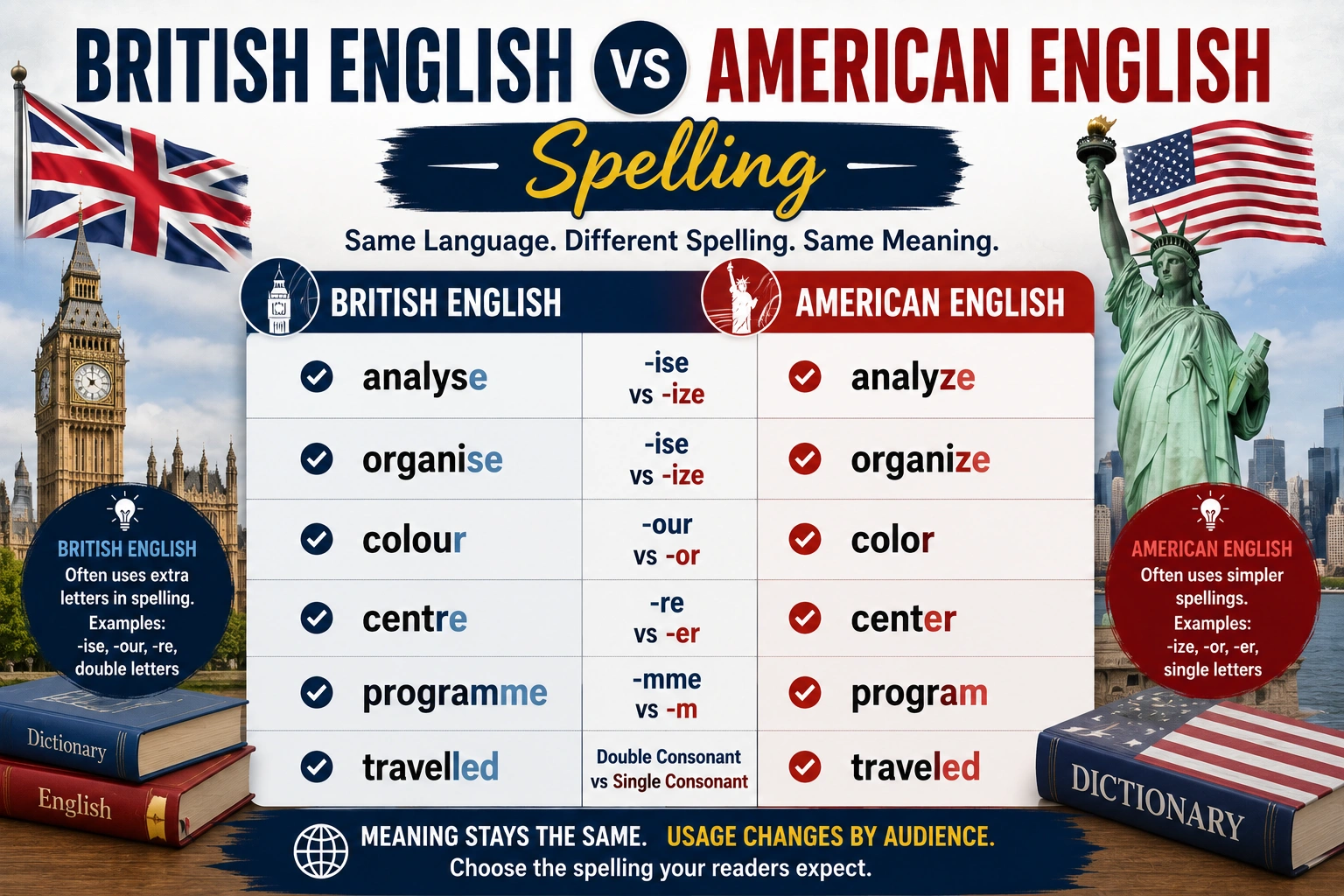
There is no difference between British and American English for the spelling of the noun forms:
- analysis = singular
- analyses = plural
Both varieties use the same spellings.
| Meaning | British English | American English |
|---|---|---|
| One examination | analysis | analysis |
| More than one | analyses | analyses |
| One analysis of data | analysis | analysis |
| Several analyses | analyses | analyses |
So you can write:
The researcher completed an analysis of the results.
or:
The researchers completed several analyses of the results.
Both British and American readers will understand the forms in exactly the same way.
A Related Spelling Difference
The related verb analyze does have a British-American spelling difference.
American English:
analyze
analyzed
analyzing
British English:
analyse
analysed
analysing
Merriam-Webster identifies analyse as the British variant of analyze. (Merriam-Webster)
Notice that this difference applies to the verb, not to the noun:
analysis ✅
analyses ✅
These noun spellings stay the same.
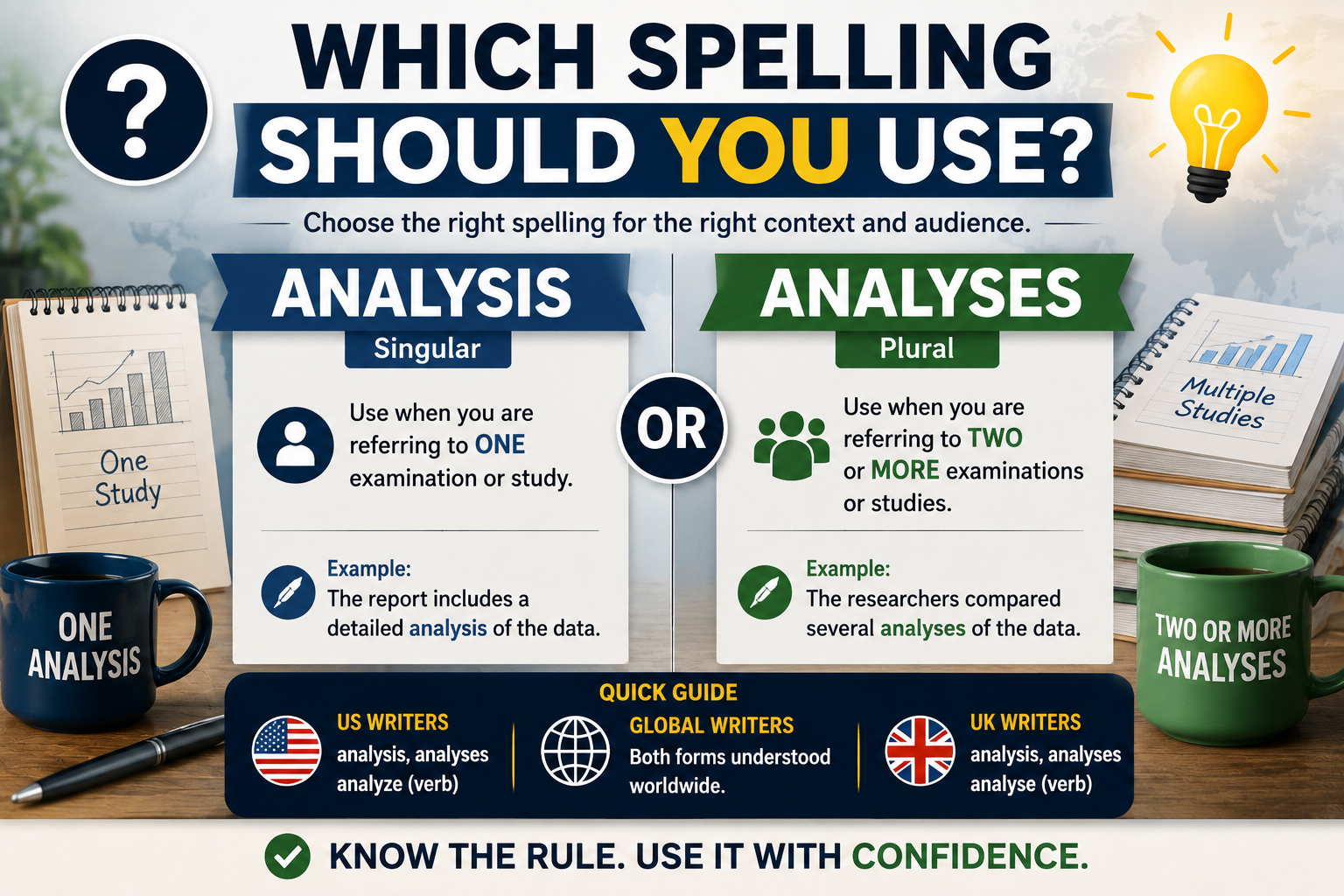
Choose the word based on number, not country.
Use “Analysis” for One
Use analysis when you are talking about one examination, study, or detailed investigation.
This analysis explains the main problem.
The report includes a detailed analysis of sales.
Use “Analyses” for More Than One
Use analyses when you mean two or more separate examinations.
The researchers conducted several analyses.
We compared the analyses from different teams.
For American Writers
Use:
analysis
analyses
analyze
analyzed
For British Writers
Use:
analysis
analyses
analyse
analysed
The key point is that analysis and analyses do not change between British and American English.
For Global Writers
If you write for an international audience, analysis and analyses are safe choices. Just keep your related verb spelling consistent with the English variety you are using.
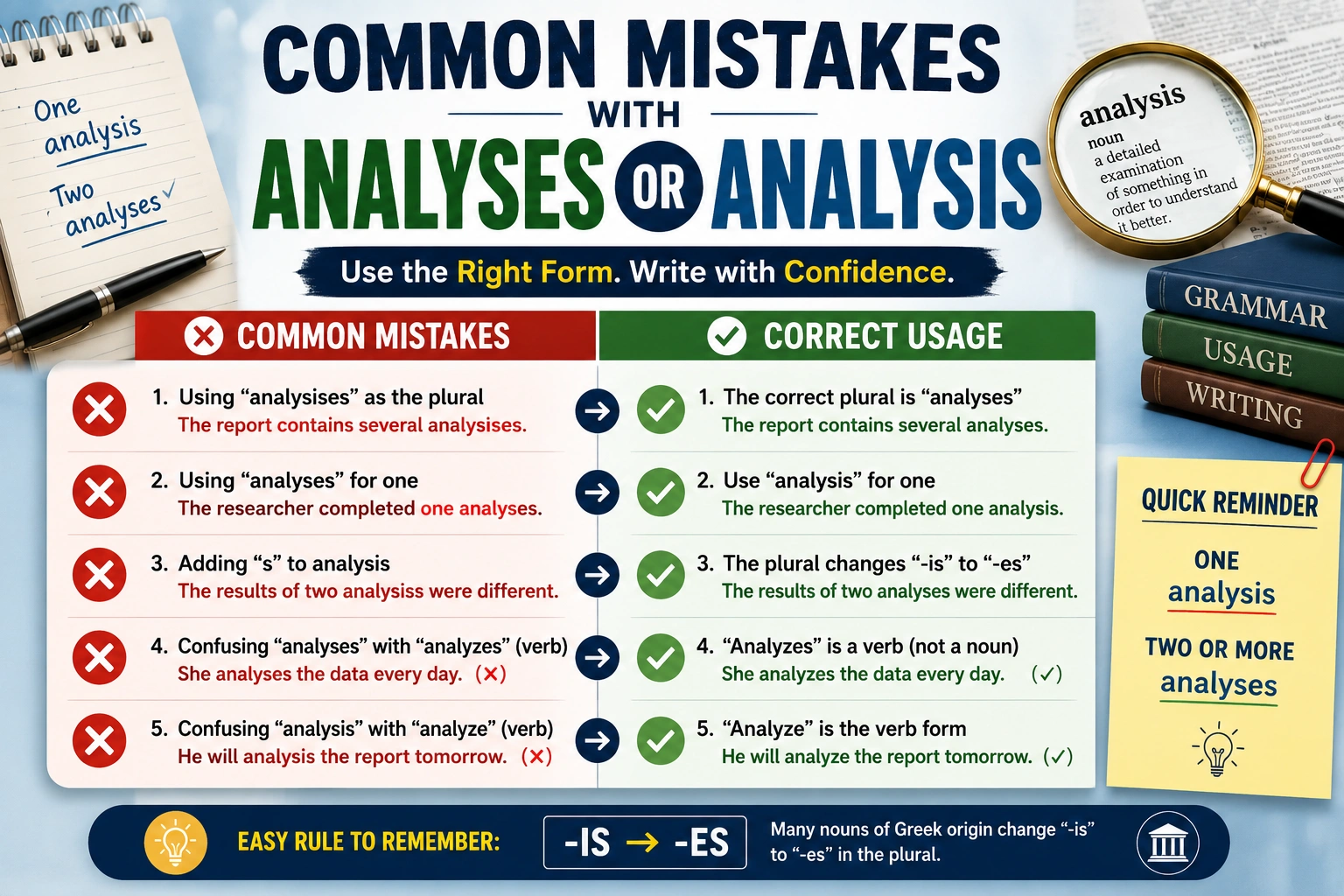
Mistake 1: Using “analysises”
❌ The report contains several analysises.
✅ The report contains several analyses.
Analysises is not the standard plural.
Mistake 2: Using “analyses” for one
❌ The researcher completed one analyses.
✅ The researcher completed one analysis.
Use analysis when the noun is singular.
Mistake 3: Adding “s” to analysis
❌ analysis → analysiss
✅ analysis → analyses
The plural does not simply add another s.
Mistake 4: Confusing analyses with analyzes
These words have different grammatical roles.
Analyses = plural noun
The report contains two analyses.
Analyzes = verb
She analyzes the data every week.
This is one of the most common sources of confusion.
Mistake 5: Confusing “analysis” with “analyze”
Analysis is a noun:
His analysis was detailed.
Analyze is a verb:
He will analyze the results.
Quick Correction Table
| Incorrect | Correct |
|---|---|
| one analyses | one analysis |
| several analysises | several analyses |
| two analysis | two analyses |
| She analyses the data (US style) | She analyzes the data |
| She analyze the report | She analyzes the report |
Analyses or Analysis in Everyday Examples
In Emails
Singular:
Please review my analysis of the sales figures.
Plural:
I have attached two analyses for your review.
In News
Singular:
The newspaper published an analysis of the election results.
Plural:
Experts provided several analyses of the economic situation.
On Social Media
Here is my analysis of yesterday’s game.
If several people provide different examinations:
I read three different analyses of the match.
In Formal Writing
This study provides an analysis of consumer behavior.
For multiple studies:
The researchers compared several analyses of consumer behavior.
In Academic Writing
Academic writing often uses both forms:
Our analysis found a clear pattern.
Previous analyses reached different conclusions.
In Business
The manager requested an analysis of monthly sales.
The team reviewed several analyses before making a decision.
In Science
The laboratory completed an analysis of the sample.
The scientists compared chemical analyses from different samples.
Analyses or Analysis – Google Trends & Usage Data
Search interest in “analyses or analysis” is mainly connected with grammar, spelling, academic writing, and understanding the plural form of analysis.
Related searches include:
- analyses or analysis
- plural of analysis
- analysis plural
- analyses meaning
- analysis vs analyses
- how to spell analyses
- analyses pronunciation
Google Trends can show how interest in search terms changes over time and across locations. However, its figures are relative, not raw search counts. Google explains that Trends normalizes results by time and location and scales them from 0 to 100. (Google Support)
This means you should be careful with claims such as “this word gets exactly X searches per month” based only on Google Trends.
The word analysis has broad use in education, science, business, journalism, medicine, statistics, and technology. Oxford lists common combinations such as statistical analysis, data analysis, and detailed analysis. (Oxford Learner’s Dictionaries)
The plural analyses is naturally less common because it is only used when writers need to discuss multiple separate examinations or studies.
For SEO content, searches such as “analyses or analysis” are useful because they often show clear user intent: the reader wants to know which form is grammatically correct.
Analyses vs Analysis Comparison Table
| Feature | Analysis | Analyses |
|---|---|---|
| Number | Singular | Plural |
| Meaning | One examination | Two or more examinations |
| Part of speech | Noun | Noun |
| Example | an analysis | several analyses |
| British spelling | analysis | analyses |
| American spelling | analysis | analyses |
| Pronunciation ending | “sis” | “seez” |
| Example sentence | This analysis is useful. | These analyses are useful. |
Analysis vs Analyses vs Analyze vs Analyzes
| Word | Type | Meaning | Example |
|---|---|---|---|
| analysis | Noun | One detailed examination | The analysis was useful. |
| analyses | Noun | More than one examination | The analyses were useful. |
| analyze | Verb | To examine something | We analyze the data. |
| analyzes | Verb | Examines something | She analyzes the data. |
This distinction is very useful when proofreading articles, essays, and reports.
FAQs About Analyses or Analysis
1. Is it analysis or analyses?
Both are correct, but they have different uses. Analysis is singular, while analyses is plural.
2. What is the plural of analysis?
The plural of analysis is analyses.
One analysis → several analyses.
Oxford and Merriam-Webster both list analyses as the plural form. (Merriam-Webster)
3. Is “analysises” correct?
No. Analysises is not the standard plural form. The correct plural is analyses.
4. How do you pronounce analyses?
Analyses is commonly pronounced approximately uh-NAL-uh-seez.
The singular analysis ends with a “sis” sound, while the plural ends with a “seez” sound. (Oxford Learner’s Dictionaries)
5. Is analyses British or American English?
Analyses is used in both British and American English. There is no spelling difference for this noun.
6. What is the difference between analyses and analyzes?
Analyses is a plural noun:
The scientists compared several analyses.
Analyzes is a verb:
She analyzes the data.
7. Is “analysis” countable or uncountable?
Analysis can be both countable and uncountable depending on the meaning and context. Oxford lists it as both countable and uncountable. (Oxford Learner’s Dictionaries)
For example:
We need further analysis.
Here, it is uncountable.
The report contains three analyses.
Here, it is countable.
Conclusion
The difference between analyses or analysis is mainly about singular and plural forms. Use analysis when you are talking about one detailed examination, study, or interpretation. Use analyses when you are talking about two or more.
For example, write “The report includes an analysis of the data” when there is one examination. If there are several, write “The report includes several analyses of the data.”
The unusual spelling comes from the word’s Greek roots. Unlike many English nouns, analysis does not form its plural by simply adding -s. Instead, -is changes to -es, giving us analysis → analyses. (Merriam-Webster)
British and American English use the same noun forms: analysis and analyses. However, the related verb can differ. American English generally uses analyze, while British English commonly uses analyse. (Merriam-Webster)
The easiest rule to remember is:
One analysis, two analyses.
Once you learn this pattern, you can use both words confidently in essays, research papers, business reports, articles, emails, and everyday writing.
you can also read about recur or reoccur by clicking this link
https://versuswords.com/recur-or-reoccur/

I’m an experienced article writer who creates clear, engaging, and SEO-friendly content that helps readers find the information they need. I specialize in writing well-researched articles, blog posts, guides, and informative content on a wide range of topics.
My writing focuses on simple language, strong structure, accurate information, and search intent. I aim to make every article easy to read while also helping websites improve their visibility on search engines.
I enjoy turning complex topics into useful, reader-friendly content that informs, answers questions, and keeps readers engaged. Whether you need an SEO article, blog post, educational guide, or website content, I can create content tailored to your audience and goals.