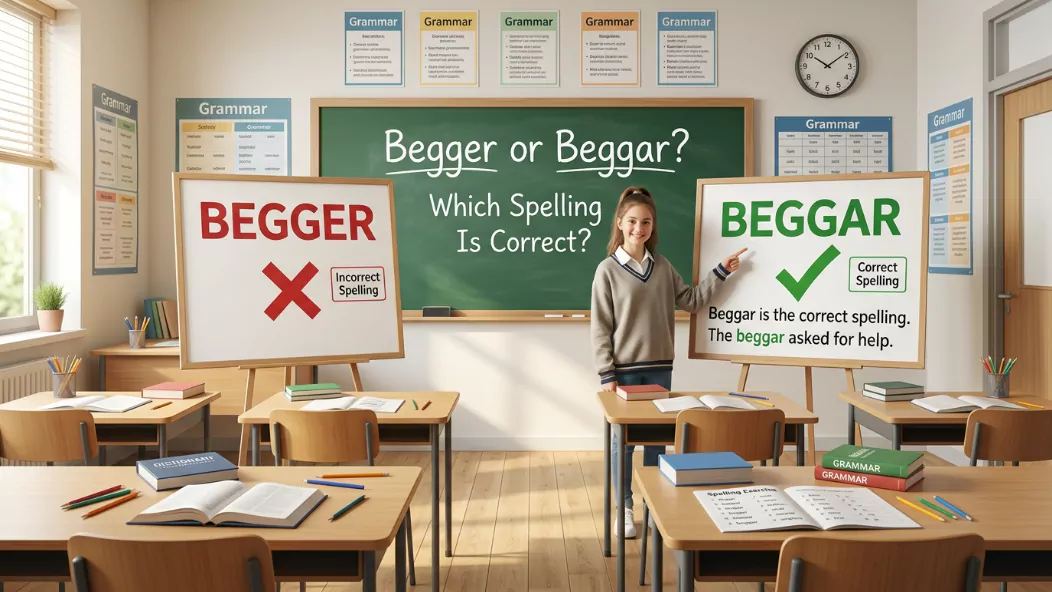
Many people search for “begger or beggar” because they are unsure which spelling is correct. It is a common spelling mistake.
Especially for English learners, students, writers, and professionals. Many people wonder if the two words have different meanings or if one is incorrect.
The confusion usually happens because English spelling does not always match pronunciation. When people hear the word, they may naturally type “begger” instead of “beggar.” Thousands search spelling questions before writing emails, essays, blogs, or social posts.
This guide explains everything you need to know about begger or beggar. Learn the correct spelling, meaning, usage, common mistakes, and examples. By the end, you will know exactly which spelling to use in every situation.
Begger or Beggar – Quick Answer
The correct spelling is beggar.
Begger is an incorrect spelling and is not recognised in standard English dictionaries.
Correct Examples
- The beggar asked for food.
- A beggar sat outside the station.
- She donated money to a homeless beggar.
Incorrect Examples
- ❌ The begger asked for help.
- ❌ A begger waited outside the shop.
Quick Comparison
| Spelling | Correct? | Meaning |
| Beggar | ✅ Yes | A person who asks others for money or food |
| Begger | ❌ No | Incorrect spelling |
The Origin of Beggar
The word beggar has been part of English for hundreds of years.
It comes from the Old French word begart, meaning people who lived by asking for charity.
Over time, the word came to mean anyone who asks others for money or food.
The spelling became standard as beggar, and dictionaries have used this form for centuries.
The misspelling begger appears because many English words ending in the “-er” sound have different spellings. People often write words the way they hear them, leading to this common mistake.
Today, every major English dictionary lists only beggar as the correct spelling.
British English vs American English Spelling
Unlike many English words, beggar has exactly the same spelling in both British and American English.
There is no regional difference.
Comparison Table
| Feature | British English | American English |
| Correct spelling | Beggar | Beggar |
| Incorrect spelling | Begger | Begger |
| Pronunciation | Similar | Similar |
| Dictionary spelling | Beggar | Beggar |
Unlike words such as:
| British | American |
| Colour | Color |
| Favourite | Favorite |
| Centre | Center |
Beggar stays the same in every major English-speaking country.
Which Spelling Should You Use?
You should always use beggar.
If your audience is American
Use beggar.
Example:
The city introduced programmes to help homeless beggars.
If your audience is British
Use beggar.
Example:
The charity supports beggars across the country.
If your audience is international
Use beggar because it is the accepted spelling worldwide.
There is no situation where begger is considered correct.
Common Mistakes with Begger or Beggar
Many writers make simple spelling mistakes.
Mistake 1
❌ Begger
✅ Beggar
Mistake 2
❌ The begger needed food.
✅ The beggar needed food.
Mistake 3
Confusing beggar with begging.
Correct examples:
- The beggar asked for help.
- He was begging outside the station.
Mistake 4
Using spell check incorrectly.
Some devices may not immediately flag begger, especially when custom dictionaries are enabled. Always double-check your spelling.

Beggar in Everyday Examples
The charity helps every beggar with food and clothing.
News
Police offered support to homeless beggars during the winter.
Social Media
Please donate to organisations that help beggars rebuild their lives.
Formal Writing
The report examined the growing number of beggars in urban areas.
Everyday Conversation
I gave the beggar some food.
Begger or Beggar – Google Trends & Usage Data
Search data shows that many people type begger into Google because they are unsure about the correct spelling.
Most searches come from:
- United States
- United Kingdom
- India
- Pakistan
- Australia
- Canada
The incorrect spelling appears mainly in search engines because users want confirmation.
In books, newspapers, academic writing, and professional websites, beggar is overwhelmingly more common.
Google usually recognises the mistake and suggests:
“Did you mean: beggar?”
This demonstrates that beggar is the accepted spelling across modern English.
Read Also: Rode or Ridden: What’s the Difference and Which One Should You Use?
Comparison Table
| Word | Correct | Used in Dictionaries | Professional Writing |
| Beggar | ✅ Yes | Yes | Yes |
| Begger | ❌ No | No | No |
Frequently Asked Questions
Is begger a real word?
No. Begger is a misspelling of beggar.
Which is correct, begger or beggar?
Beggar is always the correct spelling.
Do British people spell it begger?
No. British English also uses beggar.
Does American English use begger?
No. American English uses beggar.
Why do people write begger?

People often spell the word based on how it sounds instead of following the correct spelling.
Can I use begger in school or business writing?
No. Always use beggar in formal writing.
Does Google recognise begger?
Yes. Google usually suggests the correct spelling, beggar.
Conclusion
The answer to begger or beggar is simple. Beggar is the only correct spelling in modern English. It is accepted in British, American, Canadian, Australian, and other English varieties. Begger is a common misspelling and should not be used in writing.
If you are writing for any audience, always choose beggar. This ensures your writing looks accurate and professional. Spell check tools and dictionaries also recognise only beggar, making it the safest and most reliable choice. Whenever you are unsure, remember that there is no regional spelling difference for this word. Beggar is the correct spelling in all types of writing.
Related articles: Blankey or Blankie: Which Spelling Is Correct?, Peel or Peal: What’s the Difference and When to Use Each?, Bellies or Bellys: Y to IES Rule Explained.
See the dictionary definitions for begger and beggar.

Hi, I’m Sehrish Iqbal, and I enjoy writing about the English language and the little differences between words that often cause confusion. I create simple and easy-to-understand articles about grammar, spelling, commonly confused words, and correct word usage. My goal is to make English easier to understand and help students, writers, and English learners use the right words with confidence.