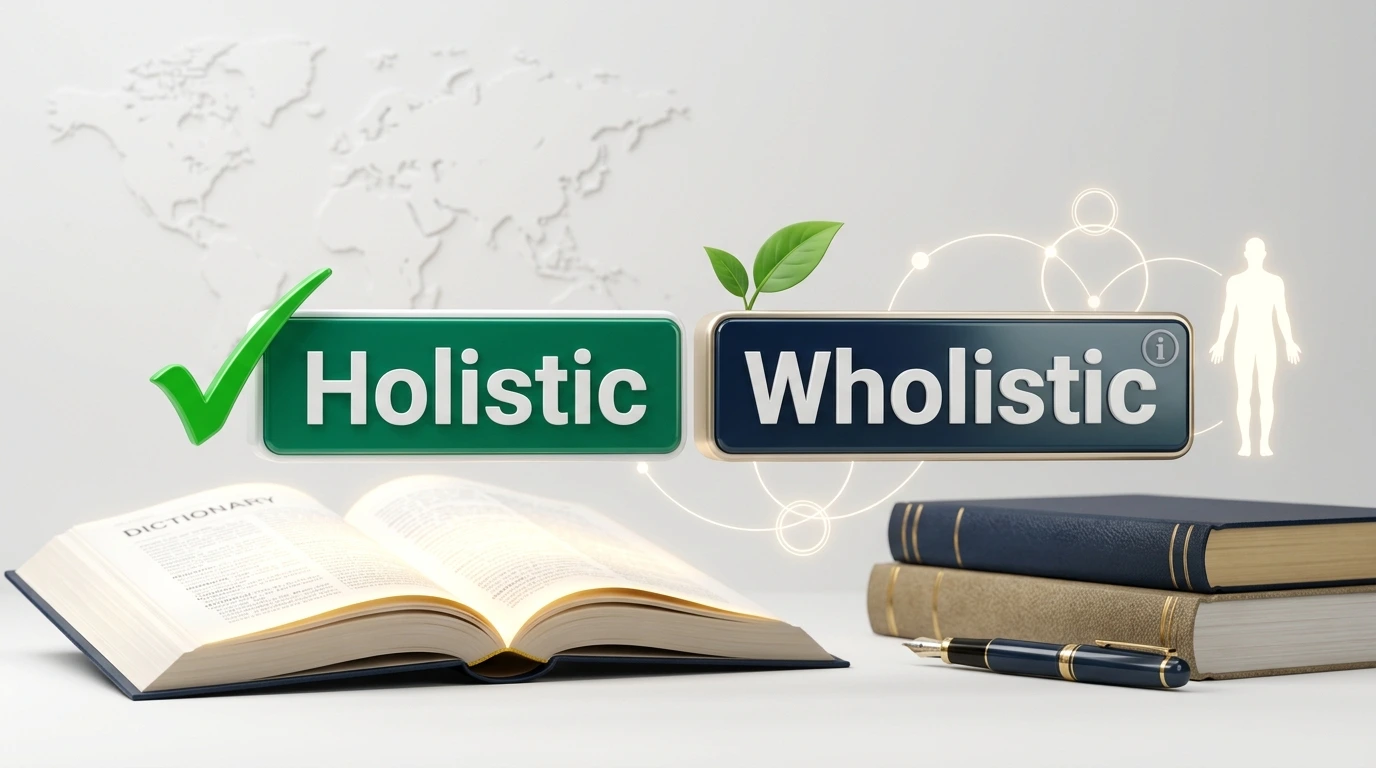
Holistic or wholistic means considering the whole person or system rather than focusing on just one part.
Have you seen both holistic and wholistic and wondered which one is correct? You are not alone. Many English learners, writers, and professionals search for this question because both words appear online, in books, and in health-related articles.
The confusion comes from the fact that holistic and wholistic have the same meaning, but one spelling is much more common than the other. If you are writing a blog post, academic paper, email, or website content, choosing the right spelling can make your writing look more natural and professional.
In this guide, you’ll learn the difference between holistic or wholistic, where each spelling comes from, and which one you should use in different situations. We’ll also look at British and American English, common mistakes, real-life examples, and answers to frequently asked questions. By the end, you’ll know exactly which spelling fits your audience and writing style.
Holistic or Wholistic: Quick Answer
Holistic is the standard and widely accepted spelling in modern English.
Wholistic is a less common alternative spelling that some people use to emphasize the idea of treating or understanding something as a whole.
Examples
- A holistic approach considers both physical and mental health.
- The school follows a holistic method of education.
- Some wellness centers describe their services as wholistic, but holistic is more common.
The Origin of Holistic or Wholistic
The word holistic comes from the Greek word holos, meaning whole or complete.
The term was introduced in the 1920s by South African statesman and philosopher Jan Smuts. He used holism to describe the idea that systems should be understood as complete wholes rather than separate parts.
Later, some writers began using wholistic because it looks more closely related to the English word whole. However, dictionaries and style guides still recognize holistic as the standard spelling.
Today, both spellings carry the same meaning, but holistic is preferred in most forms of writing.
Holistic vs Wholistic: Is There Any Difference?

The short answer is no. Holistic and wholistic have the same meaning. Both describe an approach that considers the whole person, system, or situation instead of focusing on individual parts.
The main difference is how often each spelling is used. Holistic is the standard spelling found in dictionaries, academic writing, healthcare, education, and business. Wholistic is an alternative spelling that some wellness organizations and individuals prefer because it visually highlights the word whole.
For most writing, especially online content, holistic is the better choice.
| Feature | Holistic | Wholistic |
|---|---|---|
| Meaning | Considers the whole | Considers the whole |
| Standard spelling | ✔ Yes | Alternative |
| Common in writing | Very common | Less common |
| Academic use | Preferred | Rare |
| SEO-friendly | Better | Less common |
British English vs American English Spelling
Unlike many spelling differences, this is not a British vs American English issue.
Both British and American English strongly prefer holistic.
| Version | Spelling | Region | Example Sentence |
|---|---|---|---|
| Standard English | holistic | UK | The doctor recommended a holistic treatment plan. |
| Standard English | holistic | US | She believes in holistic wellness. |
| Alternative Spelling | wholistic | Limited use worldwide | The clinic offers wholistic care. |
What Do Major Dictionaries Say?
Major English dictionaries recognize holistic as the standard spelling. Some dictionaries also list wholistic as a variant, but it is much less common.
Here’s how leading dictionaries generally treat the two spellings:
| Dictionary | Preferred Spelling | Notes |
|---|---|---|
| Merriam-Webster | Holistic | Lists wholistic as a variant spelling. |
| Cambridge Dictionary | Holistic | Uses holistic as the standard entry. |
| Collins Dictionary | Holistic | Recognizes holistic as the preferred form. |
| Oxford Dictionary | Holistic | Treats holistic as the standard spelling. |
If you are writing for a broad audience, following the dictionary-preferred spelling holistic is the safest choice.
Which Spelling Should You Use?
For a US Audience
Use holistic. It is the spelling readers expect in American English.

For a UK or Commonwealth Audience
Use holistic. It is also the preferred spelling in British English, Australia, Canada, and New Zealand.
For a Global or SEO Audience
Choose holistic because:
- It is the standard dictionary spelling.
- It appears far more often in books and articles.
- It is easier for readers to recognize.
- It matches most online searches.
Use wholistic only if it is part of a brand name or if you intentionally want to stress the idea of “whole-person” care.
Why Is “Wholistic” Less Common?
Although wholistic is a valid alternative spelling, it has never become the standard form.
One reason is that the word holistic comes from the Greek word holos, meaning “whole.” Because of this origin, dictionaries and language experts have continued to prefer holistic.
The spelling wholistic became popular later, mainly among some health practitioners, wellness brands, and alternative medicine communities. They often choose it because it makes the connection with the English word whole more obvious.
Today, holistic remains the preferred spelling in education, healthcare, journalism, business, and most professional writing.
Hung or Hanged: The Complete Guide to Correct Usage✅
Common Mistakes with Holistic or Wholistic
| Incorrect | Correct |
|---|---|
| Holistic is wrong. | Holistic is the standard spelling. |
| Wholistic is the only correct form. | Both exist, but holistic is preferred. |
| British English uses wholistic. | British English mainly uses holistic. |
| The meanings are different. | Both words have the same meaning. |
Common Collocations with Holistic
The word holistic often appears with certain nouns. Learning these common combinations can help you use the word more naturally.
| Common Collocation | Example Sentence |
|---|---|
| Holistic approach | We use a holistic approach to problem-solving. |
| Holistic health | She believes in holistic health practices. |
| Holistic care | The hospital provides holistic care for patients. |
| Holistic education | The school promotes holistic education for every child. |
| Holistic development | Sports support a child’s holistic development. |
| Holistic treatment | Doctors recommended a holistic treatment plan. |
| Holistic learning | The course encourages holistic learning through practical activities. |
| Holistic assessment | Teachers use holistic assessment to evaluate overall progress. |
These collocations are widely used in healthcare, education, business, psychology, and personal development, making holistic the preferred spelling in almost every context.
Holistic or Wholistic in Everyday Examples
Emails
We take a holistic approach to employee well-being.
News Headlines
Experts recommend a holistic strategy for climate action.
Social Media
Small daily habits create a holistic healthy lifestyle.
Formal Writing
Researchers recommend a holistic framework for improving education outcomes.
Holistic or Wholistic: Google Trends & Usage
In general, holistic is much more popular than wholistic around the world.
It is commonly used in:
- Healthcare
- Education
- Psychology
- Business
- Personal development
The spelling wholistic appears mostly in alternative medicine, wellness communities, and some organization names. Because holistic is recognized by nearly all dictionaries and style guides, it remains the preferred spelling for most readers and search engines.
Holistic vs Wholistic Comparison Table
| Feature | Holistic | Wholistic |
|---|---|---|
| Meaning | Looking at the whole | Looking at the whole |
| Standard spelling | ✅ Yes | No |
| Dictionary preference | ✅ Yes | Limited |
| Common in US | ✅ Yes | Rare |
| Common in UK | ✅ Yes | Rare |
| Best for SEO | ✅ Yes | Less common |
| Formal writing | ✅ Recommended | Usually avoided |
FAQs
Q: Is holistic or wholistic correct?
A: Both are correct, but holistic is the standard and more widely accepted spelling.
Q: Why do some people write wholistic?
A: Some writers prefer wholistic because it visually connects to the word whole, even though the meaning is the same.
Q: Is wholistic wrong?
A: No. It is a recognized alternative spelling, but it is much less common.
Q: Does British English use wholistic?
No. British English mainly uses holistic, just like American English.
Q: Which spelling is better for SEO?
A: Holistic is better because it is searched more often and recognized by readers worldwide.
Q: Do holistic and wholistic have different meanings?
A: No. They both describe an approach that considers the complete person or system rather than individual parts.
👉🏻Quick Tip: If you’re unsure which spelling to use, choose holistic. It is the standard form recognized by major dictionaries, widely accepted in both British and American English, and the best choice for professional writing and SEO.
Conclusion
The choice between holistic or wholistic is easier than many people think. Both spellings refer to the same idea of looking at something as a complete whole instead of focusing only on individual parts. However, holistic is the standard spelling used by major dictionaries, educational institutions, businesses, and professional writers around the world.
If you are writing for a general audience, publishing online, creating academic content, or improving your SEO, holistic is the best choice. It is familiar to readers, widely accepted in both British and American English, and fits almost every writing situation.
The spelling wholistic is not incorrect, but it is uncommon. It is mainly found in certain wellness communities, alternative health practices, or brand names that intentionally highlight the word whole.
When in doubt, choose holistic. It is the safest, clearest, and most professional spelling for almost every purpose.
Mallorca or Majorca: Which Spelling Should You Use in 2026?

Passionate about language and clear communication, I explore the subtle differences between words and expressions through well-researched, practical content. My goal is to help readers write with greater clarity, confidence, and precision by making complex language concepts easy to understand.