
Honour or honor means showing respect, honesty, or high regard for someone or something. The only real difference is spelling: honour is used mainly in British English, while honor is used in American English.
A few years ago, I was editing an article for an international website. I thought the job would take ten minutes. Then I saw something strange. One paragraph said honour, and the next one said honor.
I stopped.
Was one wrong? Should I fix it? Would readers notice?
That tiny missing “u” caused more confusion than I expected. I later found out that many students, writers, bloggers, and even professionals face the same problem. You may write an email, school paper, social media post, or website article and suddenly wonder, “Wait… is it honour or honor?”
The confusing part is simple. Both words are correct. Yet using the wrong one for your audience can make writing look inconsistent.
You probably searched because you want a clear answer. You want to know which spelling to use and when.
Let’s clear up the confusion once and for all.
Honour or Honor: Quick Answer
Honour and honor have the same meaning. They differ only in spelling.
- Honour → British English
- Honor → American English
Simple examples:
British English:
“It was an honour to meet you.”
American English:
“It was an honor to meet you.”
The meaning stays exactly the same.
The Origin; Background of Honour or Honor
The word has a long journey.
It came from the Latin word honor, which meant dignity, respect, and reputation.
Later, French influenced English spelling. The French form added extra letters. British English kept many of these older spellings.
That is why British English often keeps “u” in words like:
- Honour
- Colour
- Favourite
- Labour
American English later simplified many spellings.
So the words became:
- Honor
- Color
- Favorite
- Labor
This change became popular through dictionary writer Noah Webster, who wanted simpler American spelling.
That is why the spelling split still exists today.
Honour or Honor Explained: Key Differences
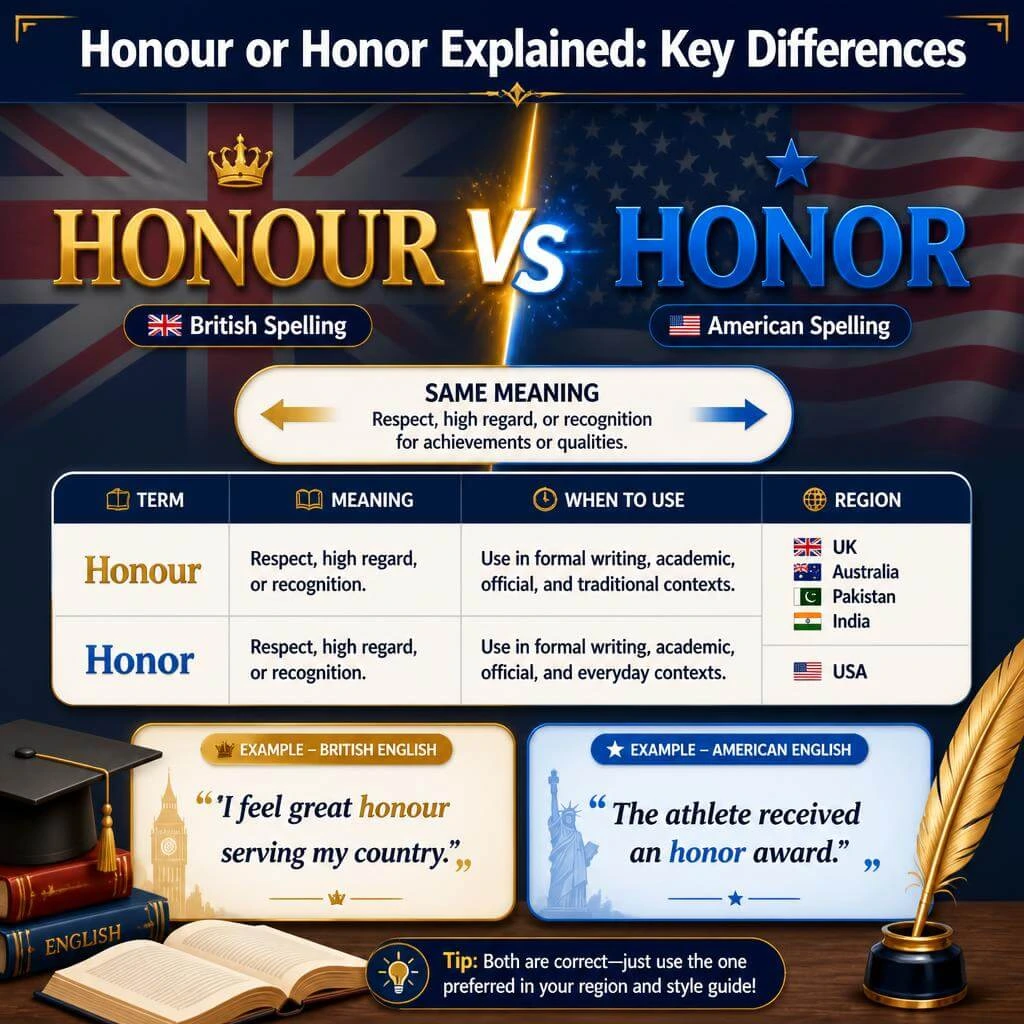
The meaning never changes.
Only the spelling changes based on region.
| Term | Meaning | When to Use | Region/Context |
| Honour | Respect, recognition, dignity | British writing | UK, Australia, Pakistan, India, Canada (often) |
| Honor | Respect, recognition, dignity | American writing | United States |
Examples
British:
“I feel great honour serving my country.”
American:
“The athlete received an honor award.”
Academic British writing:
“Students graduated with honours.”
American style:
“Students graduated with honors.”
Which Version Should You Use?
Choosing the right version is easy once you know your audience.
For students in British-based education systems
Use honour because schools often follow British English rules.
For students in American schools
Use honor because American style guides expect it.
For bloggers and content writers
Match your audience.
- US readers → honor
- UK readers → honour
For international or mixed audiences
Pick one style and stay consistent.
Do not switch between them in the same piece.
Consistency matters more than the spelling itself.
Common Mistakes with Honour or Honor
People often make small errors.
Here are common examples.
| Mistake | Correction |
| It is an honor to meet you. (British article) | It is an honour to meet you. |
| He graduated with honours. (American article) | He graduated with honors. |
| Mixing honor and honour in one article | Choose one style |
| Assuming one spelling is wrong | Both are correct |
| Changing spelling in quoted text | Keep the original |
Why this happens
- People read websites from different countries.
- Spell-check tools use different language settings.
- Writers mix styles without noticing.
Honour or Honor in Real-World Examples
Professional email
“It was an honour to speak with your team yesterday.”
American version:
“It was an honor to speak with your team yesterday.”
News headline
“Local teacher receives community honour award.”
American version:
“Local teacher receives community honor award.”
Social media post
“Such an honor to work with amazing people today!”
Formal report
“The organization presented an honour certificate to volunteers.”
Plow or Plough: The Complete Guide to Correct Usage
Honour or Honor : Data, Trends & Usage
Search behavior shows interesting patterns.
Search intent
Primary intent: Informational
People usually want to know:
- Which spelling is correct
- Which country uses which version
- Which spelling fits formal writing
- Whether one spelling is wrong
Regions with higher interest
Honour:
- United Kingdom
- Pakistan
- India
- Australia
Honor:
- United States
Why this matters now
People write for global audiences more than before.
Students submit international assignments. Businesses reach readers worldwide. Content creators publish for many countries at once.
One spelling choice can affect consistency and reader trust.
Standalone Comparison Table
| Term/Variant | Meaning | Region/Context | Best Used When |
| Honour | Respect, dignity, recognition | British English | Writing for UK-style audiences |
| Honor | Respect, dignity, recognition | American English | Writing for US readers |
| Honours | Academic distinction or recognition | British English | UK education systems |
| Honors | Academic distinction or recognition | American English | US education systems |
Frequently Asked Questions
Q: What does honour or honor mean?
A: It means respect, dignity, admiration, or recognition. The meaning is identical in both spellings.
Q: How do you use honour or honor correctly?
A: Choose the spelling based on your audience. Use honour for British English and honor for American English.
Q: Honour vs respect : what is the difference?
A: Respect is a feeling or attitude toward someone. Honour often includes recognition, values, or public appreciation.
Q: Is honour acceptable in formal writing?
A: Yes. It is completely correct in formal British English writing.
Q: Which version is correct : honour or honor?
A: Both are correct. The right choice depends on the English style you use.
Q: Where does honour come from?
A: The word came from Latin and later moved into English through French influence.
Q: Can honour or honor be used in academic writing?
A: Yes. Academic writing uses both forms depending on the style guide and country.
Conclusion
You now have a simple answer.
Honour and honor mean the same thing. The difference is not meaning. It is location and writing style.
Remember these points:
- Honour = British English
- Honor = American English
- Both are correct
- Stay consistent throughout your writing
Many people worry they are making a grammar mistake when they see these spellings. You do not need to worry anymore. The key is choosing the version that fits your readers.
Now you know exactly how to use honour or honor. Use it in your next email, article, assignment, or post with confidence.
Bookmark this guide so you never second-guess honour or honor again. Share it with someone who still gets stuck on that missing little “u.”
Honour or honor explained:meaning, spelling, correct usage, and examples. Learn which version to use and avoid mistakes.
Fulfillment or Fulfilment? Which Spelling Is Correct? (2026)