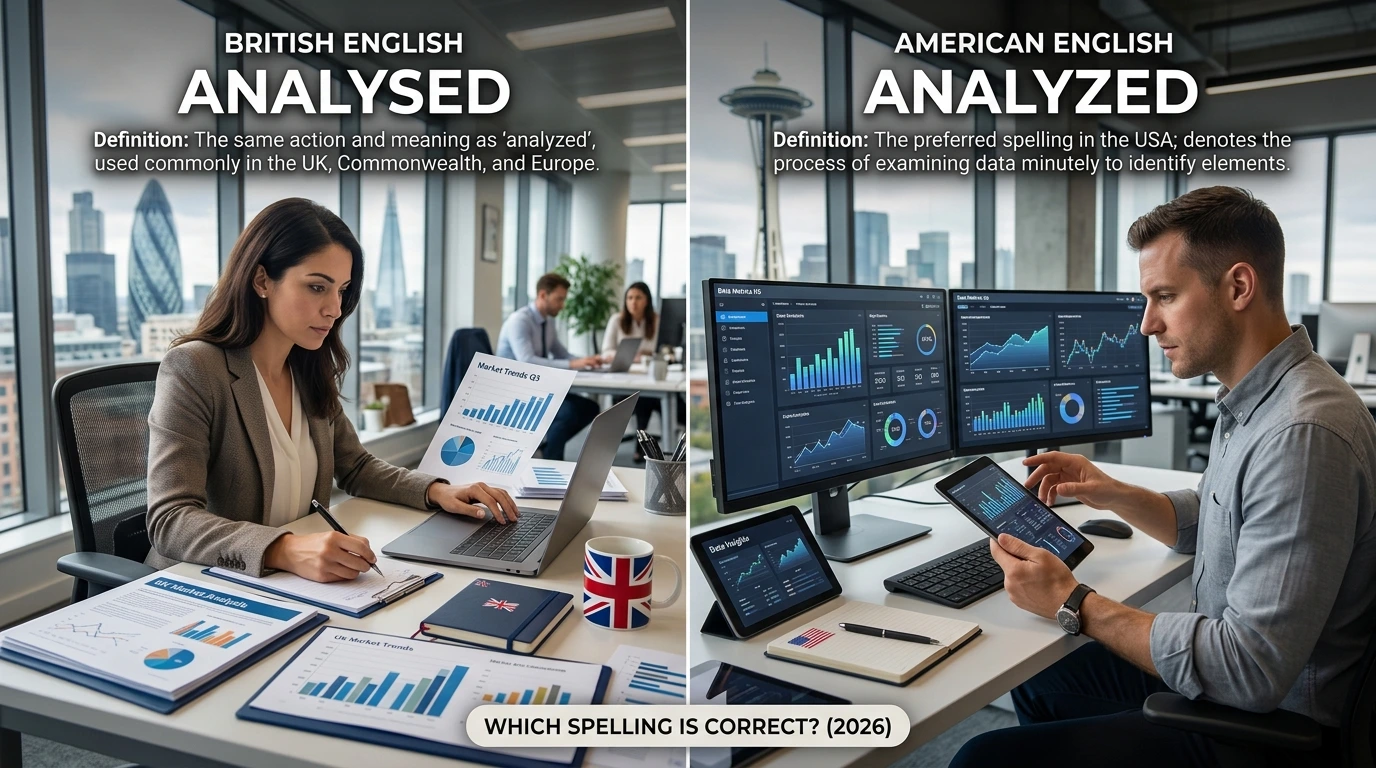
Analysed and analyzed mean the same thing. The only difference is spelling. Analysed is used in British English, while analyzed is used in American English.
A few years ago, I was checking a student’s assignment before submission. Everything looked good until I noticed one small thing. In the first paragraph, the student wrote analyzed, and two paragraphs later they used analysed. Then came the question I hear all the time:
“Which one is actually correct?”
That small spelling choice creates a lot of confusion. Many people think one version is wrong. Others believe one is more formal than the other. Some writers even switch between both versions without noticing.
The confusion becomes bigger when you write emails, blog posts, school papers, or work reports. Spell-check tools can also make things worse. One program marks a word as incorrect, while another accepts it.
The good news is simple. You do not need to memorize difficult grammar rules. You only need to understand where each spelling belongs.
By the end of this guide, you will know exactly when to use analysed and when to use analyzed without second-guessing yourself again.
Analysed or Analyzed: Quick Answer
Both words are the past tense of analyze/analyse.
- Analyzed → American English
- Analysed → British English
Examples:
American English:
“The scientist analyzed the data.”
British English:
“The scientist analysed the data.”
The meaning stays exactly the same.
Organizing vs Organising: British or American?
The Origin: Background of Analysed or Analyzed
The word comes from the Greek word analysis, which means breaking something into parts to understand it better.
Over time, the word entered English and developed two spelling styles.
British English often uses:
- analyse
- organised
- realise
American English usually changed these spellings to:

- analyze
- organized
- realize
This happened because spelling reforms in the United States aimed to make some words simpler and more consistent.
That is why today’s confusion exists. Both versions survived.
Neither is wrong.
Plow or Plough: The Complete Guide to Correct Usage
Analysed or Analyzed Explained: Key Differences
The meaning does not change.
Only the spelling and regional use change.
| Term | Meaning | When to Use | Region/Context |
| Analysed | Examined carefully | British writing | UK, Australia, New Zealand |
| Analyzed | Examined carefully | American writing | United States |
Examples
British style:
“Researchers analysed the survey results.”
American style:
“Researchers analyzed the survey results.”
Business example:
UK company report:
“We analysed customer feedback.”
US company report:
“We analyzed customer feedback.”
Which Version Should You Use?
Your audience matters.
For students in the United States
Use analyzed because schools and universities expect American spelling.
For students in the United Kingdom
Use analysed because it follows British writing standards.

For bloggers and content writers
Match your target audience.
If your readers are mostly American, use analyzed.
If your readers are mostly British, use analysed.
For international or global use
Pick one style and stay consistent.
Mixing both versions can look careless.
Common Mistakes with Analysed or Analyzed
People often make small mistakes because both spellings look correct.
Mistake 1
❌ The team analysed the data and later analyzed customer reviews.
✅ Choose one spelling style and keep it consistent.
Why this happens:
People copy information from different sources.
Mistake 2
❌ I analyse the results yesterday.
✅ I analysed the results yesterday.
✅ I analyzed the results yesterday.
Why this happens:
People confuse present tense with past tense.
Mistake 3
❌ Analyzed is always more correct.
✅ Both versions are correct.
Why this happens:
Many people learn only one English style.
Mistake 4
❌ British English uses analyzed.
✅ British English usually uses analysed.
Why this happens:
Regional spelling rules can be confusing.
Analysed or Analyzed in Real-World Examples
Professional Email
“We analyzed last month’s sales figures and found several growth opportunities.”
British version:
“We analysed last month’s sales figures and found several growth opportunities.”
News Headline
“Experts analyzed economic data after market changes.”
Social Media Post
“Just analyzed my workout progress and realized I improved a lot this month.”
Formal Report
“The research team analysed responses from 5,000 participants.”
Analysed or Analyzed: Data, Trends & Usage
People usually search this keyword because they want a direct answer.
Search intent
Informational
People want to know:
- Which spelling is correct
- Which regions use each version
- Which version they should write
Regions with high interest
Analyzed
- United States
Analysed
- United Kingdom
- Australia
- New Zealand
Why this matters today
More people work and study online now. Writers often create content for global audiences. Because of that, spelling consistency matters more than ever.
Comparison Table
| Term/Variant | Meaning | Region/Context | Best Used When |
| Analysed | Examined carefully | British English | Writing for UK readers |
| Analyzed | Examined carefully | American English | Writing for US readers |
| Analyse | Present form | British English | Present tense writing |
| Analyze | Present form | American English | Present tense writing |
Frequently Asked Questions
Q: What does analysed or analyzed mean?
A: Both mean to examine something carefully in order to understand it better.
Q: How do you use analysed or analyzed correctly?
A: Choose the version that matches your English style. Use British spelling for UK audiences and American spelling for US audiences.
Q: Analysed vs analyzed: what is the difference?
A: The only difference is spelling and regional preference. The meaning stays the same.
Q: Is analysed acceptable in formal writing?
A: Yes. It is fully correct in British English and is commonly used in schools, reports, and business writing.
Q: Which version is correct: analysed or analyzed?
A: Both are correct. Your audience decides which one works best.
Q: Where does the word come from?
A: It comes from the Greek root connected to the idea of breaking something into parts for understanding.
Q: Can analyzed or analysed be used in research papers?
A: Yes. Research papers often use these words. Just stay consistent throughout the document.
Conclusion
The good news is that there is no hidden grammar mystery here. analyzed and Analysed have the same meaning. They both describe the act of examining something carefully.
Remember these simple points:
- Analyzed = American English
- Analysed = British English
- Both are correct
- Stay consistent in your writing
Small spelling choices may seem unimportant, but they affect how polished your work looks. Using one style from beginning to end creates cleaner and stronger writing.
Now you know exactly how to use analysed or analyzed. Bookmark this guide so you never second-guess the spelling again, and share it with someone who still gets confused.
Analysed or analyzed explained: meaning, correct usage, spelling differences, examples, and guidance on choosing the right version.
Fulfillment or Fulfilment? Which Spelling Is Correct? (2026)
Related in this set: Analyzed or Analysed: US Academic Examples (US spelling guide: US academic examples only). Each guide in this set covers a different angle, so use the one that matches your question.