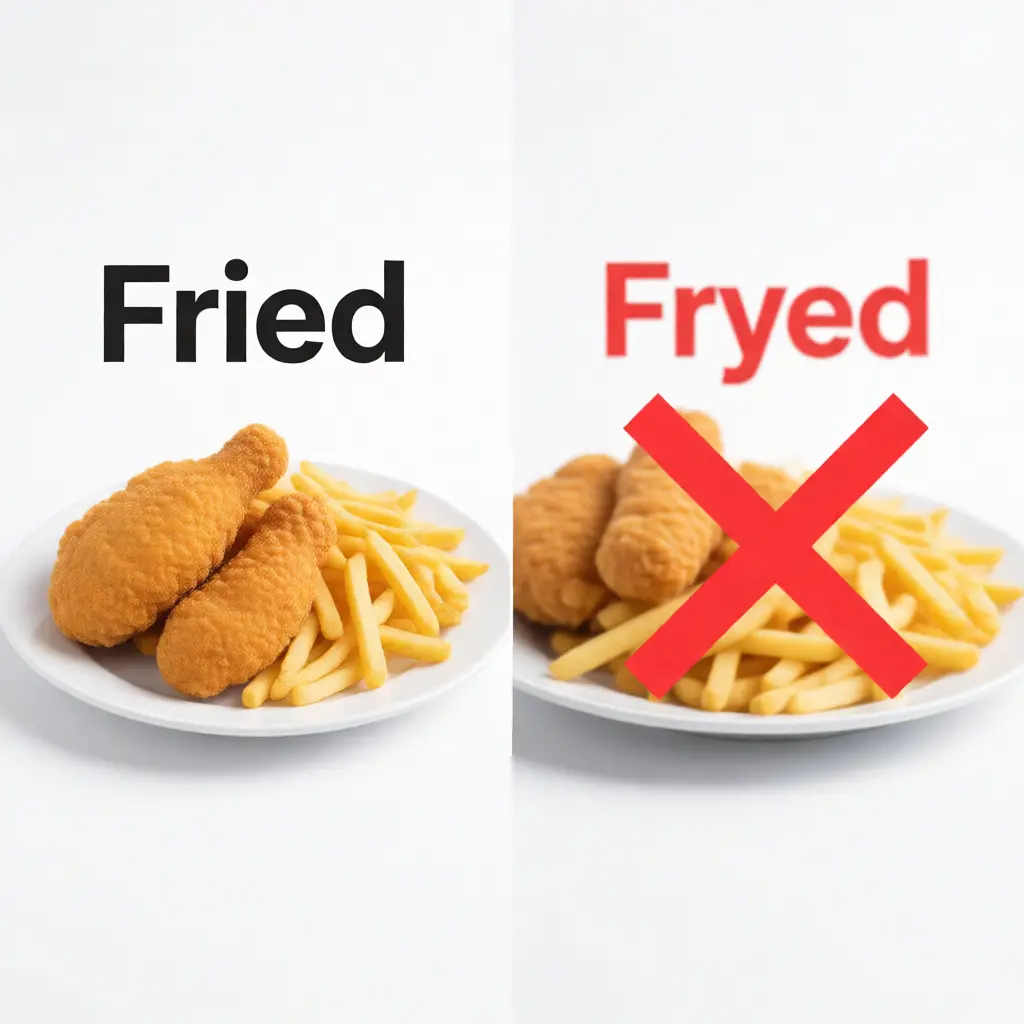
Fryed or Fried: Quick Answer
- fried is the past tense of fry, fryed is not standard.
- The menu listed fried chicken with a side salad.
- The recipe said to fry the onions until golden, then serve.
- Fried is used on menus, fryed is not used in standard recipes.
- This guide is about cooking.
The points above give the quick answer for cooking. The sections below explain how to use the forms in that context only.
How to use this in cooking
This guide narrows the question to cooking. That narrower focus matters, because a general guide has to cover every context at once, while this guide can give advice that fits one situation well. Start by checking which form your audience expects, then check the examples below, then apply the same form in your own sentences.

The meaning does not change in this context: fried is the past tense of fry, fryed is not standard. What changes is which examples are most useful, which mistakes are most likely, and which style choice is most natural for readers in this situation.
Examples in this context
- The menu listed fried chicken with a side salad.
- The recipe said to fry the onions until golden, then serve.
- Fried is used on menus, fryed is not used in standard recipes.
Read each example aloud and check whether the form fits the sentence. If the sentence sounds formal, informal, technical or everyday, the choice should match that tone, not just the dictionary entry.

The Spelling Rule Behind Fried
Fry ends in a consonant plus y, so the y changes to i before ed, and fry becomes fried. The same rule gives carry to carried and study to studied. When a vowel comes before the y, the y stays, so play becomes played. Fried works as both the past tense and the past participle: she fried the onions, and the onions are fried. The ing form keeps the y too, so we write frying, not friing. In cooking, the word appears in everyday dishes such as fried eggs and fried rice. She fries the onions first, then adds the rice, and the result is a plate of fried rice.
Mistakes to avoid in this context
- Using both forms in the same document without a reason.
- Copying a form from a different context, such as a US example into a UK document, without checking the style guide.
- Choosing a form because it looks familiar, rather than because it matches the audience.
- Repeating the same example in every paragraph, instead of testing the form in new sentences.
Frequently asked questions
Which form should I use here? Use the form that matches cooking, and keep it consistent in the document.
Is the other form wrong? No. The other form is correct in its own context. This guide does not claim that the other form is always wrong, it only explains the choice for this angle.
What if my style guide differs? Follow your style guide first. A style guide for a school, journal or employer overrides a general rule.
Conclusion
For cooking, the safest approach is to pick one form, use it consistently, and test it in real sentences from that context. That approach keeps your writing clear, and it keeps this guide distinct from the general guide, which covers the wider question.
Related in this set: Fryed vs Fried: Which One Is Actually Correct? (Main comprehensive guide: actually correct). Each guide in this set covers a different angle, so use the one that matches your question.

Michael A. Turner is a senior content writer specializing in well-researched, easy-to-understand articles. Helps readers make informed decisions through reliable content.