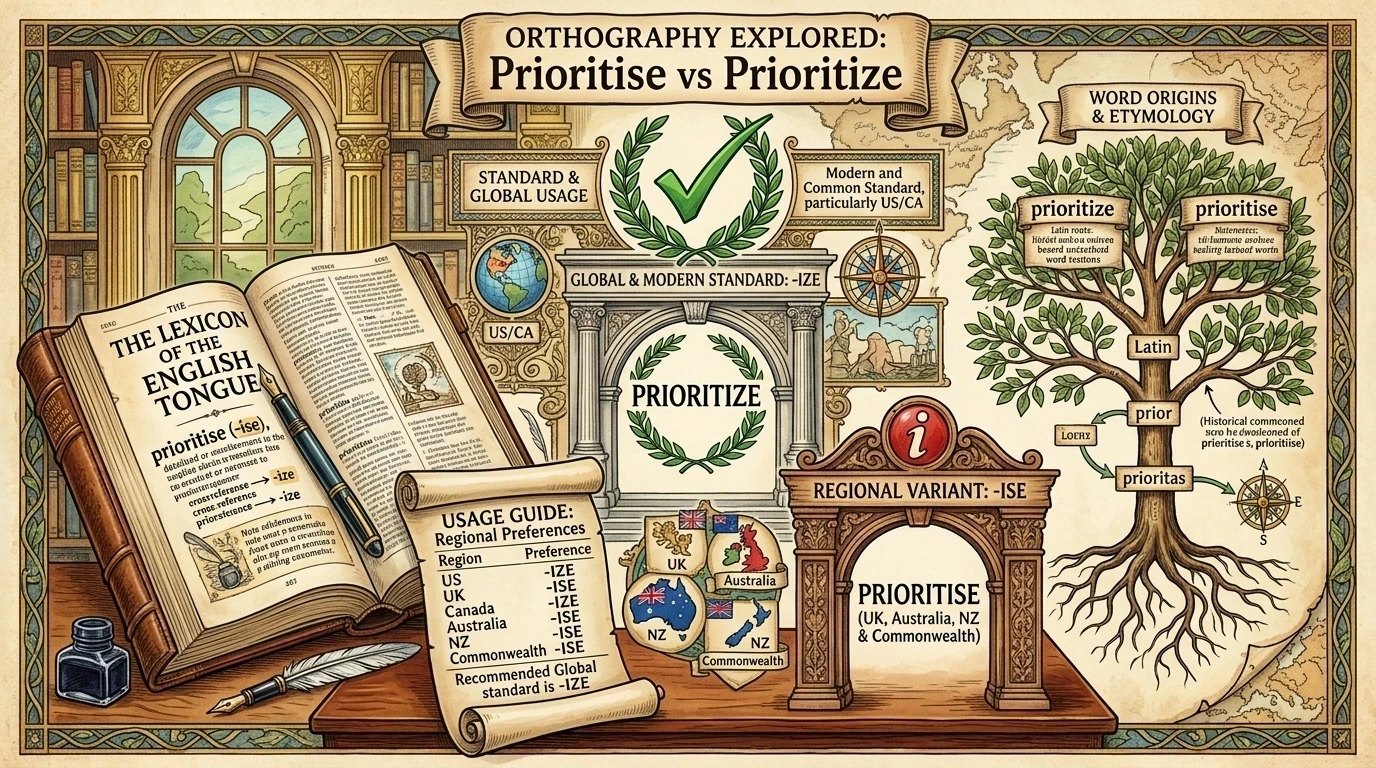
Prioritise and prioritize mean the same thing: to decide what is most important and deal with it first.Prioritise is the preferred spelling in British English, while prioritize is the standard spelling in American English.
I still remember the first time a client sent back my report marked up in red. “You used ‘prioritise’ everywhere,” he wrote. “We’re an American company.” That small spelling choice cost me an hour of fixes and a bit of embarrassment. As an English teacher with over 12 years of experience helping writers, students, and professionals communicate clearly, I’ve seen this confusion trip up thousands of people.
You search for this because you want to get it right. Maybe you’re writing an email to an international team, a school essay, or a business proposal. One wrong letter can make your work look less professional or spark unnecessary debate in comments. This guide fixes that for good. You’ll learn the clear rules, real examples, and exactly when to pick one spelling over the other so you never second-guess yourself again.
Prioritise: Quick Answer
Prioritise (or prioritize) is a verb that means to decide which tasks, goals, or items matter most and handle them first.
Think of it like packing for a trip. You don’t stuff everything into your bag at once. You choose the most important clothes and essentials first. That’s prioritizing.
Simple examples:
- “I need to prioritise my homework before playing video games.”
- “The manager will prioritize safety upgrades this quarter.”
Both spellings do the exact same job. The only difference is where you (or your readers) are from.
📚The Origin and Background of Prioritise: Prioritize
The root comes from Latin “prior,” meaning “first” or “earlier.” The word “priority” entered English in the 1400s. The verb form “prioritize” appeared much later, around the mid-20th century, especially in business and management speak.
British English traditionally prefers the “s” spelling (prioritise) following patterns from French influence. American English simplified many verbs to use “z” (prioritize), part of Noah Webster’s push for clearer American spelling in the 1800s.
Today, both are correct in their regions. Global English, especially online, mixes them more than ever. This creates the confusion you probably feel when tools like spell-checkers flag one version but not the other.
Prioritise Explained: Key Differences and Variations

The core meaning never changes. Only the spelling does.
| Term | Meaning | When to Use | Region/Context |
| Prioritise | To rank by importance | Formal writing, UK audiences | British English, Commonwealth |
| Prioritize | To rank by importance | US companies, global tech | American English |
| Prioritise / Prioritize | Same verb | International teams (be consistent) | Mixed or neutral |
Real-world use:
- British newspaper: “The government must prioritise healthcare funding.”
- American blog: “Successful founders prioritize customer feedback.”
Both sentences are perfect , as long as you stay consistent in one document.
British vs American English
British and American English often split on spelling choices like this one. British English keeps the s in many verbs that come from French or Latin roots (prioritise, organise, realise). American English streamlined these to z (prioritize, organize, realize) for simpler, more phonetic spelling. This pattern appears in dozens of words: colour/color, centre/center, and defence/defense.
Understanding this bigger picture helps you spot and fix similar issues quickly. When writing for a mixed audience, many experts recommend American spelling because it dominates online content, business software, and global platforms , but always check your specific readers first.
Which Version Should You Use?
For UK, Australia, Canada, India, or other Commonwealth countries → Use prioritise. It matches local expectations and looks natural.
For the United States or American clients → Use prioritize. American readers notice the “s” version and may see it as a typo.
For global or international audiences → Pick one and stick with it throughout your piece. Many organizations follow their main office’s style (e.g., “We use American English here”). If unsure, prioritize is slightly more common in global business and tech right now.
My rule as a teacher: Match your audience. When in doubt, check the company’s website or previous documents for consistency.
Common Mistakes with Prioritise: Prioritize

Here are the traps I see students and professionals fall into most often:
- Mixing spellings in one document Mistake: “We must prioritize tasks and then prioritise the budget.” Fix: Choose one spelling and use it everywhere.
- Using the verb when you need the noun Mistake: “My top prioritize is family time.” Fix: “My top priority is family time.” (Noun is always “priority” or “priorities.”)
- Overusing the word Mistake: “Prioritize this, prioritize that, let’s prioritize everything.” Fix: Sometimes say “focus on,” “rank,” or “tackle first” for variety.
- Forgetting consistency in team writing Mistake: One person writes “prioritise” while another uses “prioritize.” Fix: Set a style guide at the start of projects.
- Trusting spell-check blindly Mistake: Accepting the first suggestion without checking audience. Fix: Know your audience first.
Prioritise in Real,World Examples
Professional email:
“Hi team, let’s prioritise the Q3 launch features this week. I’ll prioritize the customer survey results in our meeting.”
News headline:
“UK Government Pledges to Prioritise Climate Action”
Social media post:
“Feeling overwhelmed? Try this: prioritize your top 3 tasks each morning. What’s number one for you today? 👇”
Formal report:
“This study recommends that organizations prioritize employee well-being to improve long-term productivity.”
Notice how the word fits naturally without feeling forced.
Read more: Analysed or Analyzed: Which Spelling is Correct? (2026)
Prioritise: Data, Trends & Usage📉
Searches for “prioritise vs prioritize” spike among students, writers, and non-native English speakers. The topic sits firmly in the informational search intent , people want quick clarity so they can write confidently.
In 2026, global business leans toward American spellings in tech and international trade, but British English remains strong in government, academia, and publishing across the Commonwealth. The rise of remote work means more people now write for mixed audiences than ever before.
This matters now because clear communication separates good professionals from great ones. One small spelling choice can affect how seriously people take your ideas.
Standalone Comparison Table
| Term/Variant | Meaning | Region/Context | Best Used When |
| prioritise | Rank by importance | UK, Australia, India, etc. | Writing for British/Commonwealth readers |
| Prioritize | Rank by importance | USA, global tech/business | American audiences or mixed teams |
| Priority | The thing that matters most | Everywhere | Noun form , always the same |
FAQ Section
Q: What does prioritise mean?
A: It means to decide what is most important and deal with it first. Both “prioritise” and “prioritize” share this exact meaning.
Q: How do you use prioritise correctly?
A: Use it as a verb. Stay consistent with one spelling in your whole document. Match the spelling to your main audience.
Q: Prioritise vs prioritize, what’s the difference?
A: Only the spelling. “Prioritise” (s) is British. “Prioritize” (z) is American. The meaning is identical.
Q: Is prioritise acceptable in formal writing?
A: Yes, especially in British English contexts. In American English, switch to “prioritize” for best results.
Q: Which version is correct , prioritise or prioritize?
A: Both are correct. Choose based on your audience or company style guide.
Q: Where does the word prioritise come from?
A: It comes from the Latin “prior” meaning first. The verb form grew popular in the 20th century for business and management.
Q: Can prioritise be used in American English?
A: Yes, people will understand it. But “prioritize” will look more natural to American readers and avoid questions.
🎯Conclusion
You now know that prioritise and prioritize are two correct spellings of the same useful verb. The British version uses “s,” the American uses “z,” and consistency is king. Match your spelling to your audience, avoid mixing them, and remember the noun form stays “priority.”
The best writers don’t just know rules , they use them to make their ideas shine without distraction. Now you can focus on what really matters: sharing strong thoughts clearly.
Bookmark this guide so you never second-guess the spelling again. Try using the right version in your next email or report today. And if you found this helpful, share it with a friend who’s still confused about English spellings. Your future documents will thank you.
Read more:Tire or Tyre: Which Spelling Should Use in (2026)

Passionate about language and clear communication, I explore the subtle differences between words and expressions through well-researched, practical content. My goal is to help readers write with greater clarity, confidence, and precision by making complex language concepts easy to understand.