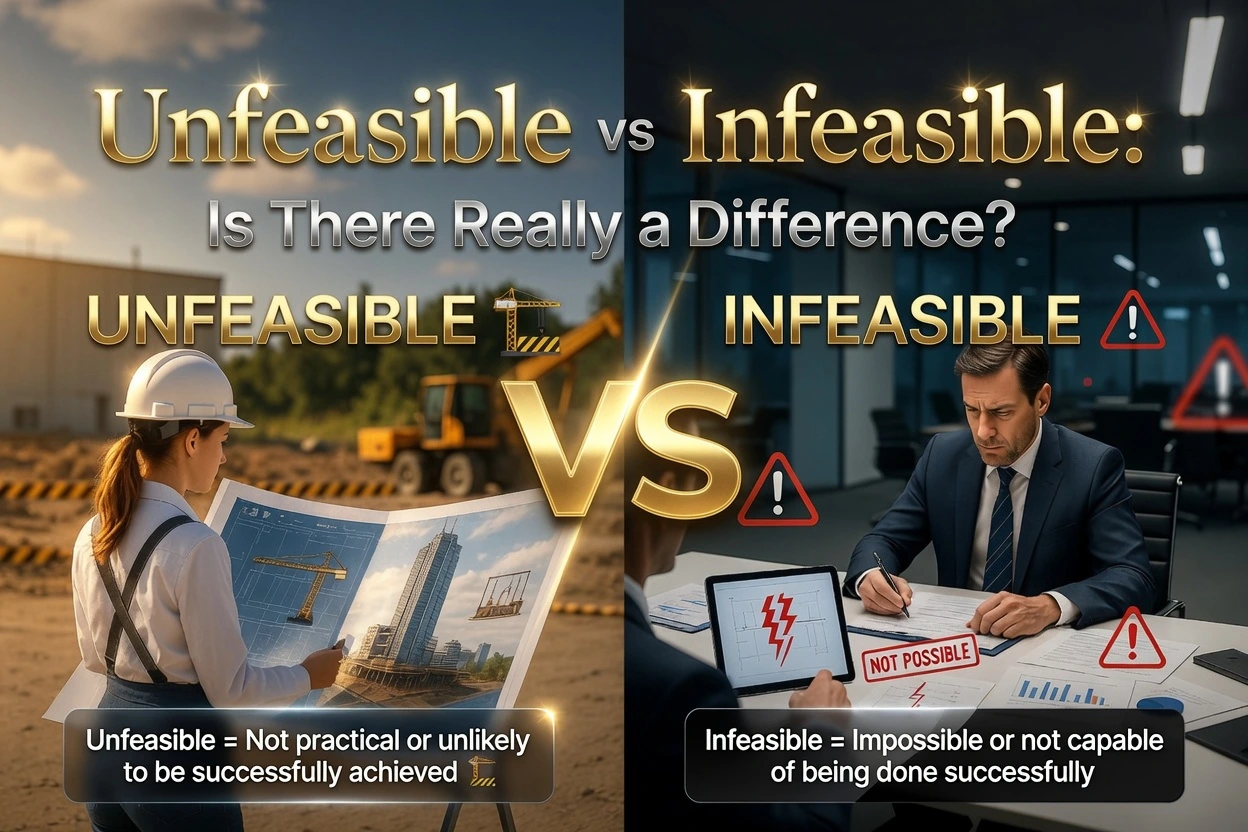
Unfeasible and infeasible both mean not practical or impossible to do. Infeasible is the more common choice in formal writing. _______________________________________________________________________________________________
I once reviewed a business proposal from a student team. The idea sounded exciting. They wanted to build a delivery service that could send products anywhere in the world within ten minutes. Then I reached one sentence: “The current plan seems unfeasible.”
I paused.
Not because the idea was impossible. I stopped because I started thinking about the word itself.
Should it be unfeasible? Or should it be infeasible?
Many people face the same question. You may see one version in a report and another in an article. Then confusion starts. You wonder if one word is wrong, if both are correct, or if they mean different things.
The interesting part is that both words are accepted in English. Yet they are not used equally.
Knowing the right choice can make your writing feel cleaner and more professional. By the end of this guide, you will understand the meanings, differences, examples, and the best option for different situations.
Let’s solve the confusion.
Unfeasible or Infeasible: Quick Answer
Both unfeasible and infeasible mean not practical, not workable, or impossible to carry out successfully.
Examples:
- Building a bridge without support may be infeasible.
- Finishing six months of work in one day seems unfeasible.
Most professional writers prefer infeasible.
The Origin of Unfeasible or Infeasible
To understand the difference, it helps to look at the roots.
The word feasible comes from older language roots connected to something that can be done easily.
English often creates opposite meanings using prefixes.
Examples:
- Possible → Impossible
- Legal → Illegal
- Accurate → Inaccurate
The prefix in- became the common choice for feasible, creating infeasible.
Later, unfeasible also appeared because English sometimes uses un- to create opposites.
Examples:
- Happy → Unhappy
- Fair → Unfair
That created two acceptable versions.
Still, one became much more popular.
Unfeasible or Infeasible Explained: Key Differences or Variations
The meanings are nearly identical.
The difference is mostly about frequency and style.
| Term | Meaning | When to Use | Region/Context |
| Infeasible | Not practical or impossible to complete | Formal writing | Business, legal, academic, technical |
| Unfeasible | Not practical or difficult to complete | Casual or less common use | General writing |
Examples:
Formal:
“The project became infeasible because of cost limits.”
General:
“Their travel plan looked unfeasible after the weather changed.”
Which Version Should You Use?
The best choice depends on your audience.
- For students → use infeasible because teachers often expect standard academic wording.
- For business writers → use infeasible because it sounds professional.
- For legal or technical documents → use infeasible because it is widely accepted.
- For casual writing → either can work, but infeasible still feels stronger.
- For global audiences → choose infeasible.
Simple recommendation:
Use infeasible most of the time.
Common Mistakes with Unfeasible or Infeasible
People often make these mistakes.
| Mistake | Correction |
| This plan is unpossible | This plan is infeasible |
| The idea became not feasible | The idea became infeasible |
| Mixing both words in one document | Choose one version |
| Using infeasible for emotional meaning | Use impossible if needed |
Why do these mistakes happen?
Prefix confusion
People see un- and in- creating opposite meanings in many words.
Writing habits
Writers often use whichever version sounds familiar.
Reading mixed content
Different websites use different styles.
Unfeasible or Infeasible in Real-World Examples
Professional Email
Subject: Project Review
“After reviewing costs, the proposed timeline appears infeasible.”
News Headline
“Experts say the transportation plan may be infeasible.”
Social Media Post
“Trying to finish ten assignments tonight feels unfeasible.”
Formal Report
“The study concluded that the current design was economically infeasible.”
Unfeasible or Infeasible: Data, Trends & Usage
People search this topic because they want:
- Correct word choice
- Writing help
- Professional wording
- Grammar guidance
Search intent:
Informational
Common audiences include:
- Students
- Business professionals
- Researchers
- Content writers
- English learners
Interesting insight:
Professional writing increasingly favors infeasible because readers expect clearer and more standard language.
Comparison Table
| Term/Variant | Meaning | Region/Context | Best Used When |
| Feasible | Practical and possible | General English | Describing workable ideas |
| Infeasible | Not practical | Professional and formal writing | Reports, business, academics |
| Unfeasible | Not practical | Less common general use | Casual situations |
Frequently Asked Questions
Q: What does unfeasible or infeasible mean?
A: Both words mean something cannot realistically be completed or carried out successfully.
Q: How do you use unfeasible or infeasible correctly?
A: Use infeasible in professional and formal writing. Unfeasible can appear in casual writing.
Q: Unfeasible vs infeasible: what is the difference?
A: The meaning is nearly identical. The main difference is frequency and style.
Q: Is infeasible acceptable in formal writing?
A: Yes. It is commonly used in academic, legal, and business writing.
Q: Which version is correct: unfeasible or infeasible?
A: Both are correct, but infeasible is generally preferred.
Q: Where do these words come from?
A: They developed from the word feasible, with opposite prefixes added later.
Q: Can these words be used in business reports?
A: Yes. Infeasible is especially common in business and project documents.
Conclusion
The confusion between unfeasible and infeasible becomes much easier once you know one important fact.
Remember these points:
- Both words are correct
- Both have almost the same meaning
- Infeasible is more common in formal writing
- Unfeasible appears less often
If you want safer and stronger wording, choose infeasible.
Readers expect it. Businesses use it. Academic writers prefer it.
Now you know exactly how to use unfeasible or infeasible. Bookmark this guide so you never second-guess these words again, and share it with someone who gets confused by them.
Yep or Yup: The Complete Guide to the Correct Usage✅