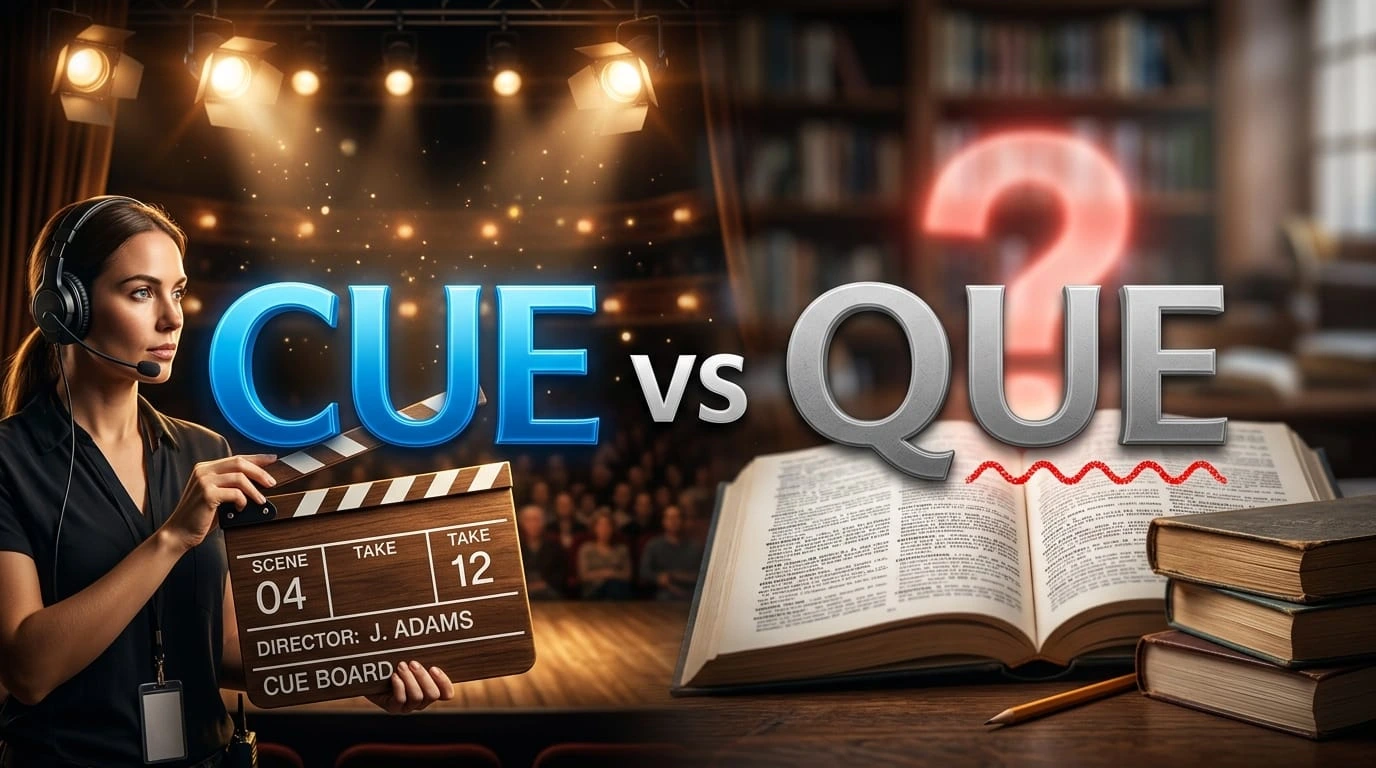
Cue is a real English word that means a signal, prompt, or hint. Que is usually incorrect in English and is often confused with queue or appears in Spanish.
I still remember checking a student’s script for a presentation. Everything looked fine until I saw a line that said, “That was my que to start speaking.” I read it twice. The sentence sounded right in my head, but the spelling was wrong.
This mistake happens a lot.
Maybe you typed que in a text message. Maybe your phone suggested it. Then you stopped and wondered if cue and que mean the same thing.
The confusion makes sense. These words sound almost identical in everyday speech. Your brain hears one sound and tries to match it with a spelling. That is where problems begin.
The good news is that the difference becomes simple once you understand it.
By the end of this guide, you will know the correct meaning, understand the differences, avoid common mistakes, and feel confident using the right word.
Let’s clear things up.
Cue or Que: Quick Answer
Cue is a proper English word that means a signal, reminder, prompt, or indication to do something.
Examples:
- That was my cue to enter the room.
- The music was her cue to begin dancing.
Que is usually not correct in English writing.
The Origin / Background of Cue or Que
The word cue has an interesting history.
It came from older theater and performance language. Actors needed signals to know when to speak or move on stage.
Those signals became known as cues.

The confusion started because que appears in other languages, especially Spanish, where it often means what or that.
People also mix it with queue, another English word that means a line of people waiting.
Three words.
Very similar sounds.
Very different meanings.
Cue or Que Explained: Key Differences or Variations
These words are not interchangeable.
| Term | Meaning | When to Use | Region/Context |
| Cue | Signal or prompt | Standard English | Worldwide |
| Que | Usually not English usage | Spanish or name usage | Language-specific |
| Queue | A waiting line | Standard English | Worldwide |
Examples:
Correct:
“The bell was my cue to leave.”
Incorrect:
“The bell was my que to leave.”
Another example:
“People stood in a queue outside the store.”
Which Version Should You Use?

The answer depends on context.
- For students → use cue when talking about signals or reminders.
- For writers → use cue because it is standard English.
- For Spanish writing → que may be correct depending on meaning.
- For general English use → choose cue.
Simple rule:
If you mean a signal or prompt, use cue.
Common Mistakes with Cue or Que
Many people make the same errors.
| Mistake | Correction |
| That was my que | That was my cue |
| Wait in the cue | Wait in the queue |
| The song was my que to dance | The song was my cue to dance |
| Standing in a cue | Standing in a queue |
Why does this happen?
Similar pronunciation
The words sound close to each other.
Auto-correct issues
Phones sometimes suggest different words.
Language overlap
People who read different languages may confuse spellings.
Cue or Que in Real-World Examples
Professional Email
Subject: Meeting Update
“The manager’s message will be our cue to begin.”
News Headline
“Weather warnings give residents a cue to prepare.”
Social Media Post
“That song was my cue to start dancing.”
Formal Report
“The alarm served as a cue for evacuation procedures.”
Cue or Que: Data, Trends & Usage
People search this topic because they want:
- Correct spelling
- Grammar help
- Word differences
- Writing support
Search intent:
Informational
Common audiences include:
- Students
- English learners
- Writers
- Bloggers
- Teachers
Interesting insight:
Searches continue growing because people often confuse cue, que, and queue during everyday writing.
Comparison Table
| Term/Variant | Meaning | Region/Context | Best Used When |
| Cue | Signal or prompt | Standard English | Talking about reminders or signals |
| Que | Foreign language usage | Spanish contexts | Spanish writing |
| Queue | Waiting line | Standard English | Talking about lines of people |
Frequently Asked Questions
Q: What does cue mean?
A: Cue means a signal, prompt, or indication that tells someone when to do something.
Q: How do you use cue correctly?
A: Use cue when referring to a signal or reminder. Example: The music was my cue.
Q: Cue vs que: what is the difference?
A: Cue is an English word. Que is generally not used in English and often appears in Spanish.
Q: Is cue acceptable in formal writing?
A: Yes. Cue is widely accepted in formal and informal writing.
Q: Which version is correct: cue or que?
A: Cue is correct for English when you mean a signal or prompt.
Q: Where does cue come from?
A: The word developed from older theater language used for stage signals.
Q: Can cue be used in business communication?
A: Yes. It is commonly used in meetings, presentations, and professional communication.
Conclusion
The confusion around cue or que is easier to solve than it first appears.
Remember these important points:
- Cue means a signal or prompt
- Que is generally not correct in English
- Queue means a waiting line
- Similar sounds create most of the confusion
Small spelling mistakes can change the meaning of a sentence quickly.
Now you know exactly how to use cue or que. Bookmark this guide so you never second-guess these words again, and share it with someone who still mixes them up.
Okey or Okay: The Complete Guide to the Correct Spelling✅
Related in this set: Cue or Que on Stage: Theatre and Music Cues (Theatre, music and performance focus: cues on stage and in rehearsal). Each guide in this set covers a different angle, so use the one that matches your question.