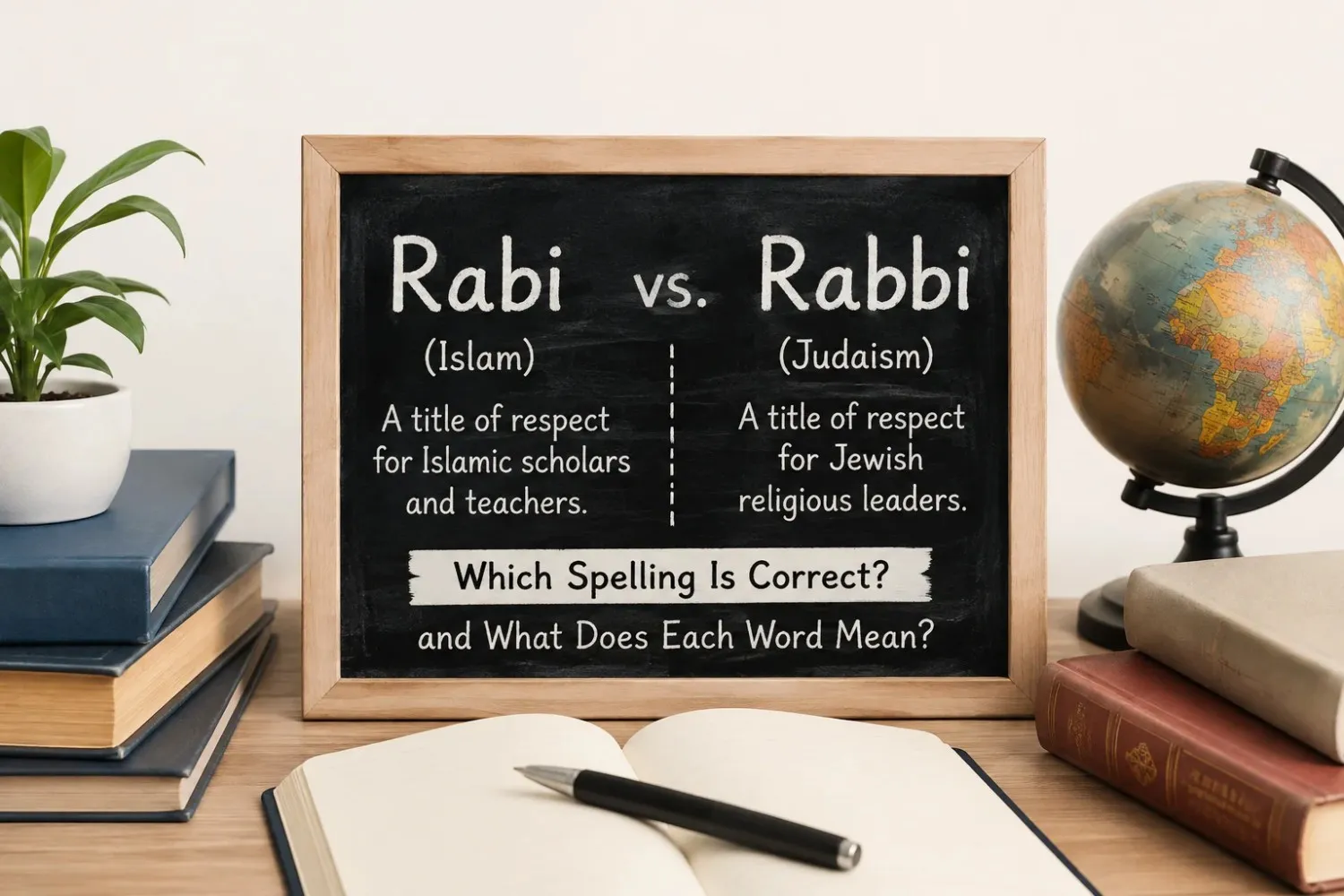
Rabi or Rabbi? Learn the difference in spelling, meaning, and correct usage with simple examples.
One missing letter can change the whole meaning of a sentence. That is why many writers search for “rabi or rabbi” before they send an email, publish an article, or write a school answer. The two words look close, but they are not British and American spellings of the same word.
Rabbi, with two b’s, is the correct English word for a Jewish religious leader, teacher, or scholar of Jewish law. Rabi, with one b, has other uses. It can name the winter crop season in India, Pakistan, and Bangladesh. It also appears in the names Rabi al-Awwal and Rabi al-Thani in the Islamic calendar. Rabi may also be a person’s name.
This guide gives a fast answer first. It then explains the origin, spelling, meaning, and everyday use of each word. You will also see simple examples, comparison tables, common mistakes, and guidance for US, UK, Commonwealth, and global readers. By the end, you will know which form fits your sentence and why.
Rabi or Rabbi – Quick Answer
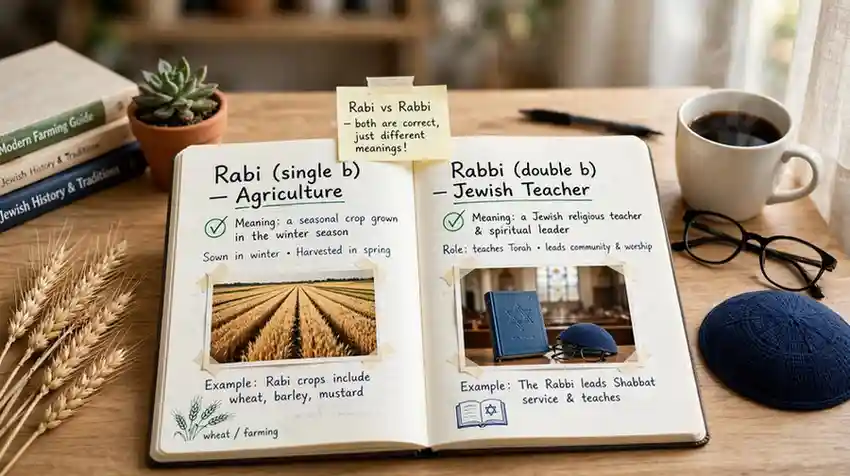
The correct spelling depends on the meaning.
Use rabbi when you mean a Jewish religious leader, teacher, or expert in Jewish law.
Example:
- The rabbi spoke at the synagogue.
- Rabbi Cohen led the service.
- We asked the rabbi for advice.
Use rabi when you mean the winter crop season used in South Asian farming.
Example:
- Wheat is a major rabi crop.
- Farmers are preparing for the rabi season.
- The rabi harvest begins in spring.
Use Rabi in Islamic month names such as:
- Rabi al-Awwal
- Rabi al-Thani
You may also use Rabi when it is someone’s official name.
The simplest rule is:
Jewish leader = rabbi
Crop season, Islamic month, or personal name = rabi
Rabi or Rabbi: Side-by-Side Comparison
| Word | Main meaning | Common context | Example |
| rabbi | A Jewish religious leader or teacher | Judaism, religion, synagogue services | The rabbi gave a short speech. |
| Rabbi | A title placed before a person’s name | Formal titles | Rabbi David welcomed the guests. |
| rabi | A South Asian winter crop season | Farming and agriculture | Wheat is grown during the rabi season. |
| Rabi | Part of an Islamic month name | Islamic calendar | The event took place in Rabi al-Awwal. |
| Rabi | A personal name | Names and identity | Rabi submitted the report. |
| rabbis | Plural of rabbi | More than one Jewish leader | Several rabbis attended the meeting. |
| rabis | Usually incorrect as the plural of rabbi | Common spelling mistake | Write “rabbis,” not “rabis.” |
The Origin of Rabi or Rabbi
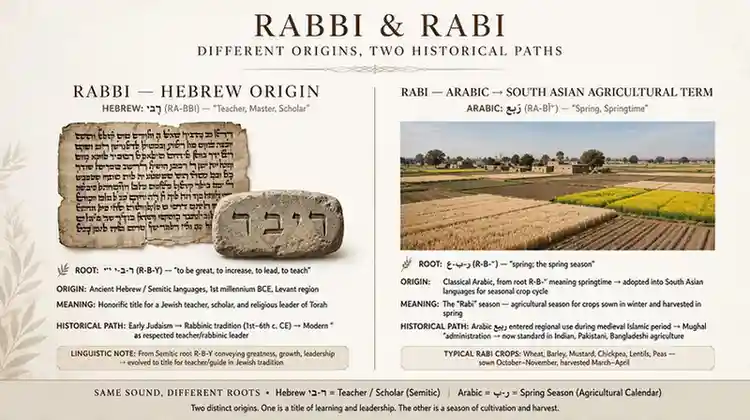
The two words have different roots, even though they look similar.
Origin of Rabbi
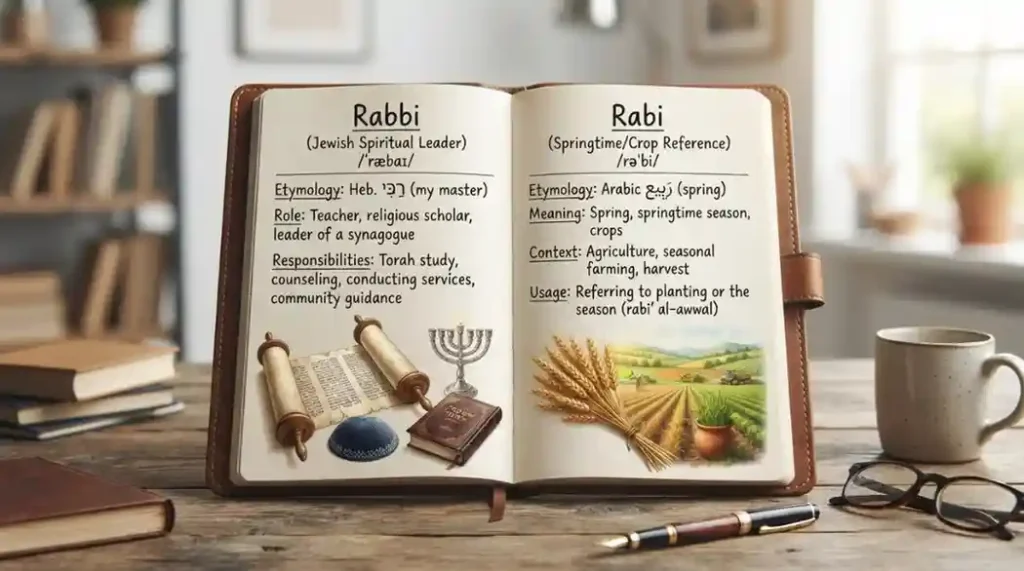
The English word rabbi comes from the Hebrew word rabbī, which means “my master” or “my teacher.” It entered English through Greek and Latin forms. The word has been used in English for hundreds of years as a title for a Jewish teacher or religious leader.
The double b is part of the accepted English spelling. It is not an optional letter.
The pronunciation is usually:
Rabbi: “RAB-eye”
Origin of Rabi
The agricultural word rabi comes from an Arabic word linked with spring. In South Asian farming, it describes crops planted during the cooler months and harvested in spring. India, Pakistan, and Bangladesh all use the term for an important farming season.
Common rabi crops include:
- Wheat
- Barley
- Chickpeas
- Mustard
- Lentils
- Rapeseed
The pronunciation is often close to:
Rabi: “ruh-BEE”
The word Rabi also appears in Islamic month names. Merriam-Webster lists Rabi al-Awwal and Rabi al-Thani as months in the Islamic year.
The spelling difference exists because rabi and rabbi developed from different language uses. They are not two spellings of one English word.
British English vs American English Spelling
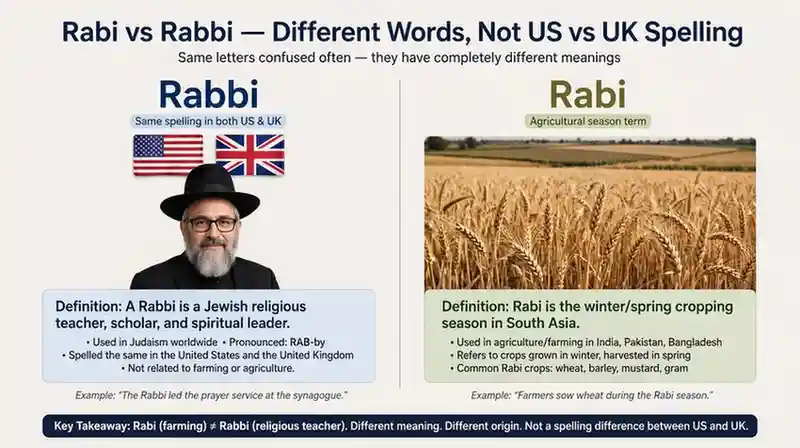
There is no major British and American spelling difference for rabi or rabbi.
Both British English and American English use rabbi for a Jewish religious leader or teacher. Cambridge Dictionary shows the same spelling in its British and American definitions.
Both also use rabi when discussing the South Asian farming season.
British and American Comparison
| Meaning | British English | American English | Correct example |
| Jewish religious leader | rabbi | rabbi | The rabbi led the service. |
| Title before a name | Rabbi | Rabbi | Rabbi Lewis spoke first. |
| South Asian crop season | rabi | rabi | The rabi crop needs irrigation. |
| Islamic month name | Rabi | Rabi | Rabi al-Awwal is an Islamic month. |
| Plural of rabbi | rabbis | rabbis | Two rabbis joined the event. |
This is unlike words such as:
- Colour and color
- Centre and center
- Travelling and traveling
- Defence and defense
With rabbi, the spelling stays the same in standard UK and US English.
Which Spelling Should You Use?
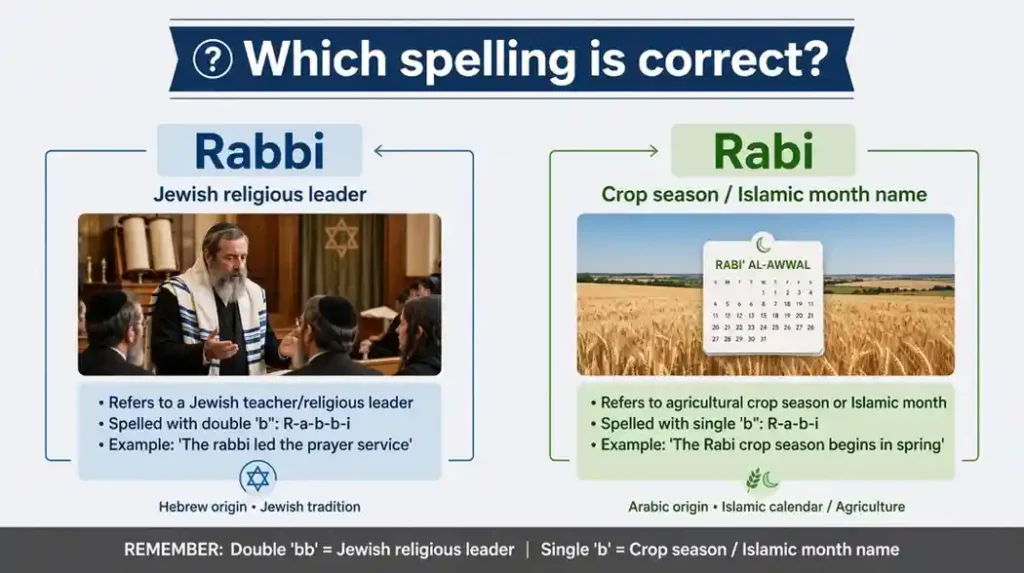
Your audience does not decide the spelling. The meaning of your sentence decides it.
For a US Audience
Use rabbi for a Jewish leader or teacher.
Correct:
- The rabbi met with community members.
- Rabbi Stein gave the opening prayer.
Do not write rabi for this meaning.
For a UK or Commonwealth Audience
The same rule applies.
Use rabbi when writing about Judaism. Use rabi when writing about farming in India, Pakistan, Bangladesh, or another South Asian setting.
Correct:
- The chief rabbi attended the ceremony.
- Farmers expect a strong rabi wheat harvest.
For an Indian or Pakistani Audience
Both words may appear often, but they still have separate meanings.
Use rabi for agriculture:
- Rabi crops are planted in the cooler season.
- Wheat is an important rabi crop.
Use rabbi for Judaism:
- The rabbi addressed the group.
- She spoke with a local rabbi.
For a Global Audience
Add enough context to make the meaning clear.
Instead of writing:
- The rabi season has started.
You can write:
- The South Asian rabi crop season has started.
Instead of writing:
- He met the rabbi.
You can write:
- He met the Jewish community’s rabbi.
Clear context helps international readers understand the word at once.
Common Mistakes with Rabi or Rabbi
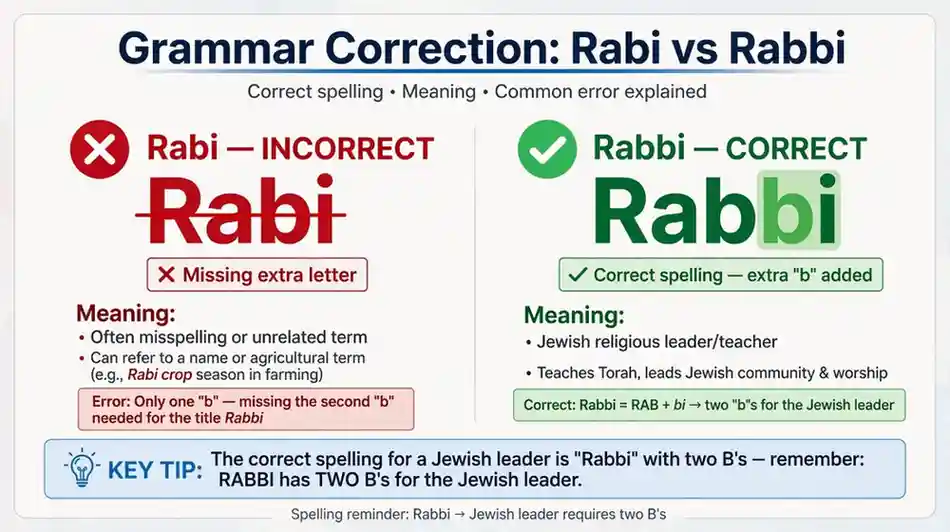
Mistake 1: Using Rabi for a Jewish Leader
Incorrect:
- The rabi led the synagogue service.
Correct:
- The rabbi led the synagogue service.
The English word for a Jewish leader has two b’s.
Mistake 2: Using Rabbi for the Crop Season
Incorrect:
- Farmers planted the rabbi wheat crop.
Correct:
- Farmers planted the rabi wheat crop.
A crop season uses one b.
Mistake 3: Writing the Wrong Plural
The plural of rabbi is rabbis.
Incorrect:
- Three rabis attended the meeting.
Correct:
- Three rabbis attended the meeting.
Mistake 4: Treating the Words as UK and US Variants
Incorrect idea:
- Rabi is British, while rabbi is American.
Correct rule:
- Both UK and US English use rabbi for the Jewish title.
- Rabi has separate agricultural, calendar, and name uses.
Mistake 5: Using the Wrong Capital Letter
Use a capital letter when the word is part of a title before a name.
Correct:
- Rabbi Aaron spoke to the class.
Use lowercase when the word is a common noun.
Correct:
- The rabbi spoke to the class.
Use capitals in formal Islamic month names.
Correct:
- Rabi al-Awwal
Mistake 6: Confusing Pronunciation
The words are usually said differently.
- Rabbi: RAB-eye
- Rabi: ruh-BEE
Reading the full sentence can help you choose the right word.
Rabi or Rabbi in Everyday Examples
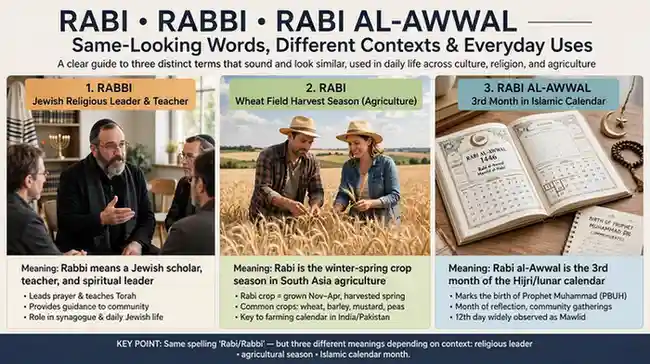
The following examples show how both words may appear in common writing.
In Emails
Rabbi:
Dear Rabbi Cohen,
Thank you for speaking at our community event.
Rabi:
The farming team has completed its plan for the coming rabi season.
In News Writing
Rabbi:
A local rabbi joined other faith leaders at the peace event.
Rabi:
Farmers expect wheat output to rise during the next rabi harvest.
On Social Media
Rabbi:
We enjoyed an inspiring talk from our guest rabbi today.
Rabi:
Rabi crop planting has started across the region.
In Formal Reports
Rabbi:
The committee consulted a rabbi about Jewish religious practices.
Rabi:
The report reviews water use during the rabi cropping season.
In School Work
Rabbi:
A rabbi is a teacher and leader in the Jewish religion.
Rabi:
Wheat and mustard are common rabi crops in South Asia.
In Invitations
Rabbi:
Rabbi Daniel Green will deliver the opening address.
Rabi:
The programme will take place during Rabi al-Awwal.
In Personal Names
When Rabi is a person’s name, copy the spelling that the person uses.
Example:
- Rabi Ahmed sent the final document.
- Please contact Rabi for more details.
Never change a person’s name from Rabi to Rabbi unless the person confirms that correction.
Read More: Misspelt or Misspelled: Which Spelling Is Correct?(2026)
Rabi or Rabbi – Google Trends & Usage Data
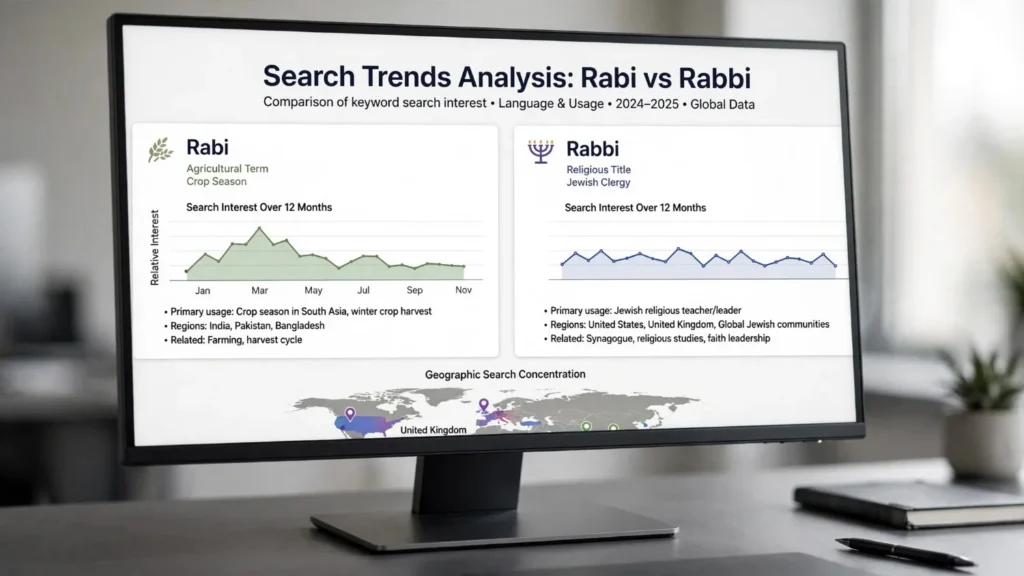
Google Trends does not provide one permanent search number. Its results change with the selected country, date range, category, and search type.
Google explains that Trends uses a sample of Google searches. It then normalizes the information by location and time. Scores are shown on a scale from 0 to 100. These scores show relative interest, not the exact number of searches. A score of zero may also mean that there was not enough data.
The search context for rabi or rabbi often changes by country.
| Country or region | Term likely to have stronger relevance | Main reason |
| United States | rabbi | Common searches about Judaism, synagogues, leaders, and Jewish events |
| United Kingdom | rabbi | Religious, cultural, educational, and news use |
| Israel | rabbi | Strong connection with Jewish religious life |
| India | rabi | Farming, crop plans, exams, weather, and harvest reports |
| Pakistan | rabi | Wheat production, agriculture, crop seasons, and Islamic month searches |
| Bangladesh | rabi | Agricultural and seasonal crop use |
| Global searches | Both | Meaning depends on religion, farming, names, or Islamic dates |
This table shows expected search context, not fixed monthly search volume. Agriculture sources confirm that rabi is widely used for a major crop season in India, Pakistan, and Bangladesh. Dictionary sources show that rabbi is the standard English term for a Jewish religious teacher or leader.
Search interest for rabi may rise around:
- Crop planting dates
- Wheat production reports
- Agricultural exams
- Harvest forecasts
- Rabi al-Awwal
- Islamic calendar dates
Search interest for rabbi may rise around:
- Jewish holidays
- Religious news
- Community events
- Public speeches
- Synagogue searches
- Questions about Judaism
For accurate research, compare both terms in Google Trends using the same country, time range, and search category.
FAQs About Rabi or Rabbi
1. Is rabi or rabbi the correct spelling?
Both spellings can be correct, but they have different meanings. Use rabbi for a Jewish religious leader. Use rabi for the South Asian crop season, an Islamic month name, or a personal name.
2. How do you spell rabbi for a Jewish leader?
The correct spelling is rabbi, with two b’s.
Example:
- She spoke with the rabbi.
3. Is rabi the British spelling of rabbi?
No. British and American English both use rabbi for a Jewish religious leader or teacher.
4. What does rabi mean in agriculture?
In agriculture, rabi is a major South Asian crop season. The crops are often planted during the cooler months and harvested in spring.
5. What are common rabi crops?
Common rabi crops include wheat, barley, mustard, chickpeas, lentils, oats, and rapeseed.
6. Is Rabi a person’s name?
Yes. Rabi can be a personal name. When writing someone’s name, always follow the spelling that person uses.
7. What is the plural of rabbi?
The plural is rabbis.
Example:
- Several rabbis attended the conference.
8. Should rabbi begin with a capital letter?
Capitalize it when it comes before a person’s name.
- Rabbi Gold
- Rabbi Sarah Cohen
Use lowercase when speaking about the role in general.
- The rabbi welcomed the guests.
9. Are Rabi al-Awwal and Rabi al-Thani spelled with one b?
Yes. These Islamic month names normally use Rabi with one b.
10. How can I remember rabi or rabbi?
Use this simple memory tip:
- Rabbi has two b’s and refers to a Jewish teacher.
- Rabi has one b and can refer to farming, an Islamic month, or a name.
Conclusion
The choice between rabi or rabbi becomes easy once you focus on meaning. Use rabbi, with two b’s, for a Jewish religious leader, teacher, or scholar. Use rabi, with one b, for the South Asian crop season, for Islamic month names such as Rabi al-Awwal, or when it is a person’s official name.
Do not treat the two forms as British and American variants. Standard English uses rabbi in both regions. The spelling rabi does not replace rabbi in UK, US, Canadian, Australian, or other global writing. Context is the key.
Before you publish, ask one simple question: Am I writing about Judaism, farming, an Islamic month, or a person’s name? That check will prevent most errors. In formal work, keep proper titles and names capitalized. In general sentences, use lowercase for common nouns unless a style guide says otherwise.
The safest rule is clear: Jewish leader equals rabbi; crop season or Islamic month element equals rabi. This small spelling check will make your writing more accurate, respectful, and easy to understand.

Hi, I’m Shafqat Rehman. With several years of experience in English grammar, spelling, word usage, and professional writing, I create simple and practical guides. My goal is to make confusing language rules easy to understand and help readers write with greater confidence and accuracy.