In the United States, a resume is usually a short, targeted summary of your qualifications for a specific job, while a CV (curriculum vitae) is a more comprehensive record of academic and professional accomplishments. Most nonacademic U.S. jobs require a resume, while academic, research, and some medical positions may require a CV.
Key Takeaways
- A U.S. resume focuses on experience, skills, and achievements relevant to a particular job.
- A CV provides a broader record of academic and professional accomplishments.
- Most U.S. employers outside academia and research expect a resume.
- CVs are common for academic, research, scientific, medical, fellowship, and grant-related applications.
- Outside the U.S., “CV” may simply mean the standard job application document Americans call a resume.
What Is the Difference Between a CV and a Resume?
The biggest difference between a CV and a resume is not just length. Purpose, audience, content, and context all matter.
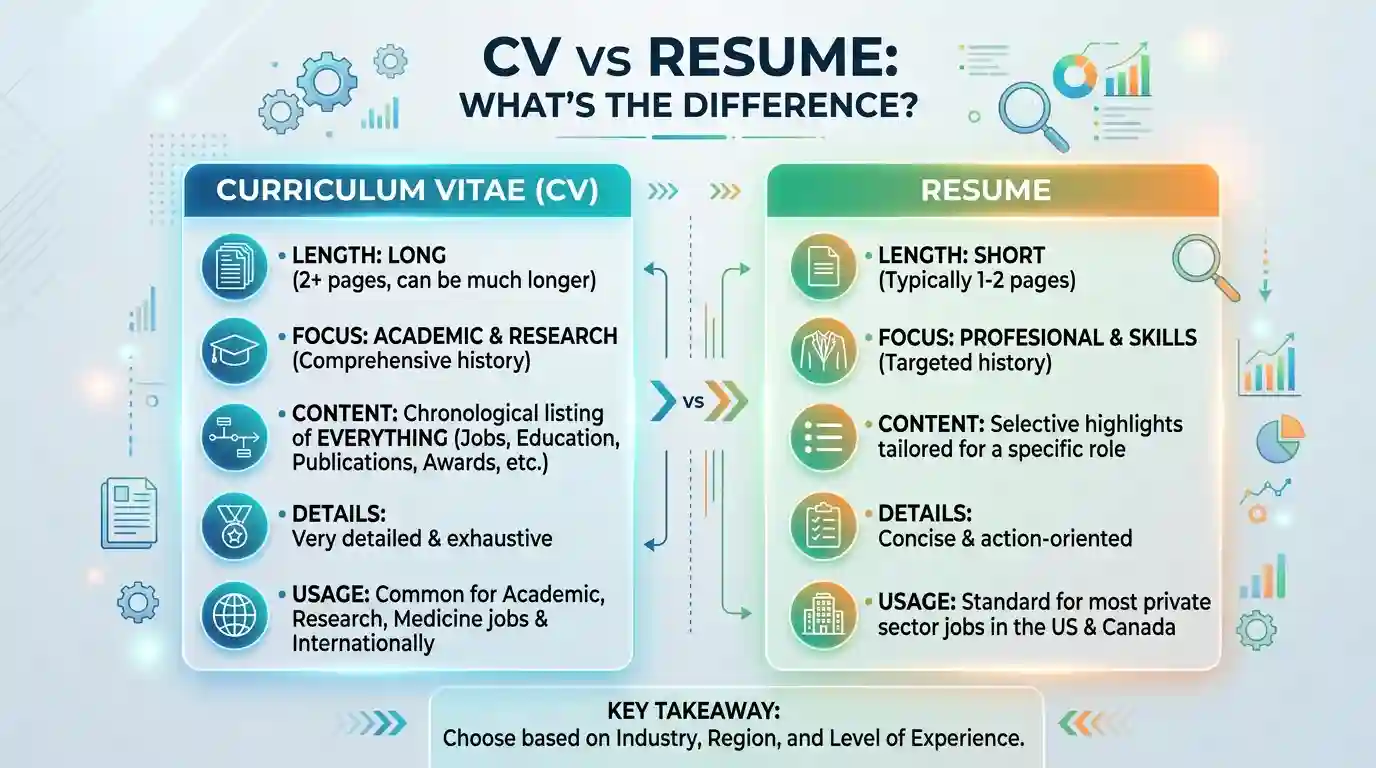
A resume is designed to quickly show an employer why you are a strong candidate for a particular position. It usually highlights your most relevant work experience, education, skills, and accomplishments. Harvard describes a resume as a concise summary of abilities, education, and experience that should be tailored to the position.
A CV, short for curriculum vitae, provides a more detailed record of your academic and professional career. It may include research, teaching experience, publications, presentations, grants, awards, professional memberships, and other scholarly accomplishments.
So, if you are applying for a marketing manager position at a company, you will normally want a resume. If you are applying for a university faculty position, a research role, or certain academic opportunities, a CV may be expected.
CV vs Resume: Side-by-Side Comparison
| Feature | Resume | CV |
|---|---|---|
| Main purpose | Show relevant qualifications for a job | Document academic and professional history |
| Typical U.S. use | Most nonacademic jobs | Academia, research, science, medicine, fellowships |
| Length | Usually 1–2 pages, depending on experience | Often several pages |
| Focus | Relevant skills, experience, and achievements | Comprehensive academic and professional record |
| Publications | Usually omitted unless relevant | Commonly included |
| Research | Briefly summarized when relevant | Often described in detail |
| Teaching | Included when relevant | Commonly included for academic careers |
| Awards | Selected relevant awards | Academic and professional awards may be listed more fully |
| Tailoring | Strongly tailored to each job | Often maintained as a comprehensive record |
| Audience | Recruiters and hiring managers | Faculty committees, researchers, academic institutions, and specialized employers |
The page-count distinction is useful, but it should not be treated as an absolute rule. Harvard and UC Davis both emphasize the difference in purpose and content, not simply the number of pages.
When Should You Use a Resume in the U.S.?
For most U.S. job applications outside academia and research, use a resume.
This includes many roles in:
- Marketing
- Sales
- Business
- Customer service
- Information technology
- Finance
- Administration
- Retail
- Operations
- Engineering
- Communications
- Human resources
A strong resume does not attempt to document everything you have ever done. Instead, it selects information that helps demonstrate your fit for the position.
For example, suppose you are applying for an SEO specialist position. Your resume might emphasize:
- SEO campaigns
- Keyword research
- Technical SEO
- Content strategy
- Organic traffic improvements
- Analytics tools
- Relevant certifications
- Previous SEO or marketing experience
You probably would not need several pages describing every course, conference, presentation, or academic activity you have completed.
Harvard specifically recommends a resume for most non-research-oriented and nonacademic jobs.
When Should You Use a CV in the U.S.?
A CV is more appropriate when the application depends heavily on your academic, research, scientific, or scholarly record.
Common situations include:
Academic and Research Careers
Universities and research institutions may request a CV for positions such as:
- Professor
- Lecturer
- Researcher
- Postdoctoral researcher
- Research scientist
- Academic administrator
An academic CV can document your publications, research projects, teaching experience, conference presentations, grants, awards, and other contributions to your field.
Harvard’s graduate-school guidance notes that CVs are used for faculty positions, fellowships, grants, publications, conference papers, and some research positions outside traditional academia.
Medical and Scientific Careers
Certain medical, scientific, and healthcare applications may also require a CV, particularly when academic credentials, research, publications, certifications, or professional contributions are important.
However, you should not assume that every healthcare job requires a CV. Read the job or application instructions. The employer or institution’s stated requirement matters more than a general rule.
Fellowships, Grants, and Academic Opportunities
Students and researchers may also need a CV when applying for:
- Fellowships
- Research grants
- Academic programs
- Conference opportunities
- Scholarly publications
- Research funding
- Academic leadership opportunities
In these situations, the reviewer may need to understand your broader academic record rather than only your most recent employment.
What Goes on a Resume vs. a CV?
The information can overlap, but the amount of detail and emphasis are different.
A typical resume may include:
- Contact information
- Professional summary or objective, when useful
- Work experience
- Education
- Skills
- Certifications
- Selected achievements
- Relevant projects
A CV may include many of those same sections but can expand considerably with:
- Contact information
- Education
- Research experience
- Teaching experience
- Publications
- Conference presentations
- Grants and funding
- Academic awards
- Professional memberships
- Certifications
- Research interests
- Academic service
- References, when appropriate
The exact sections depend on the discipline. An academic CV for a historian, medical researcher, and engineering professor will not necessarily look the same.
Are CV and Resume the Same in Other Countries?
This is where the terminology becomes confusing.
In the United States, CV and resume generally have different meanings, particularly in academic and professional settings.
In many other countries, however, “CV” is commonly used for the document Americans would call a resume. Indeed notes that internationally, the term CV can refer to a standard job-application document similar to a U.S. resume.
For example, an employer outside the U.S. might ask for your “CV” and expect a short document containing your work experience, education, and skills.
Therefore, do not assume that an overseas employer wants an American-style academic CV simply because the application says “CV.”
Location and the employer’s instructions both matter.
Can You Have Both a CV and a Resume?
Yes. In fact, maintaining both can be useful if your career includes academic and nonacademic work.
Imagine that you are a university researcher who also wants to apply for a private-sector data science position.
Your CV might contain your complete:
- Research history
- Publications
- Conference presentations
- Teaching experience
- Academic awards
- Grants
Your resume for the private-sector position could instead emphasize:
- Data analysis
- Programming
- Business projects
- Measurable results
- Technical skills
- Industry experience
You would not need to rebuild your career history from scratch each time. Your CV can act as a detailed master record, while your resume can be adapted to individual opportunities.
UC Davis similarly notes that applicants pursuing both academic and industry positions may need both documents.
How to Choose Between a CV and Resume
Use this simple decision process:
Step 1: Check the application instructions.
If the employer specifically requests a CV, follow that instruction. If it asks for a resume, send a resume.
Step 2: Look at the type of position.
A typical corporate job usually calls for a resume. An academic or research position may call for a CV.
Step 3: Consider what the employer needs to evaluate.
If publications, research, teaching, grants, or academic achievements are central to the decision, a CV may make more sense.
Step 4: Check the country.
The word “CV” may mean something different outside the United States.
Step 5: Ask if the instructions are unclear.
If an application uses CV and resume inconsistently, contact the organization rather than guessing.
Common CV and Resume Mistakes
One common mistake is assuming that longer means better. A five-page document is not automatically stronger than a one-page resume.
Another mistake is sending the same document to every employer. A resume should normally highlight the qualifications that matter for the particular position.
A third mistake is confusing an academic CV with an international job-market CV. The word “CV” does not have one universal meaning.
Finally, do not choose a document based only on what your friends, classmates, or previous employer used. The application instructions and the expectations of your field should guide your choice.
Frequently Asked Questions
Is a CV better than a resume?
Neither is automatically better. A resume is usually better for most nonacademic U.S. jobs because it focuses on the qualifications relevant to a specific position. A CV is better when an employer or institution needs a detailed academic or research record. The right document depends on the role, field, and application instructions.
Do Americans use CV or resume?
Americans use both terms, but they usually have different meanings in professional contexts. A resume is the standard document for most U.S. jobs. A CV generally refers to a more comprehensive academic or research record. Some organizations may use the terms differently, so always check the specific application requirements.
Is a CV longer than a resume?
Usually, yes. A U.S. academic CV can be several pages because it may include publications, research, teaching, presentations, grants, and awards. A resume is normally much shorter and focuses on the experience and skills most relevant to the job. There is no universal maximum length for every CV or resume.
Can I use my CV as a resume?
You can use information from your CV to create a resume, but simply submitting the entire CV as a resume is usually not the best approach. A resume should be more selective and targeted. Remove information that does not help demonstrate your qualifications for the specific position.
Should I send a CV or resume for a U.S. job?
For most nonacademic U.S. jobs, send a resume. For academic, research, and certain scientific or medical positions, check whether the employer requests a CV. If the application explicitly asks for one document, follow its instructions rather than relying on a general rule.
Conclusion
The CV vs resume question becomes much easier once you focus on purpose rather than page count.
For most jobs in the United States, a resume is the right choice because it gives employers a concise, targeted view of your relevant experience and skills. A CV is more appropriate when your academic, research, scientific, or scholarly record is central to the application.
The most important rule is simple: read the application instructions, consider the field and location, and send the document the employer actually expects.