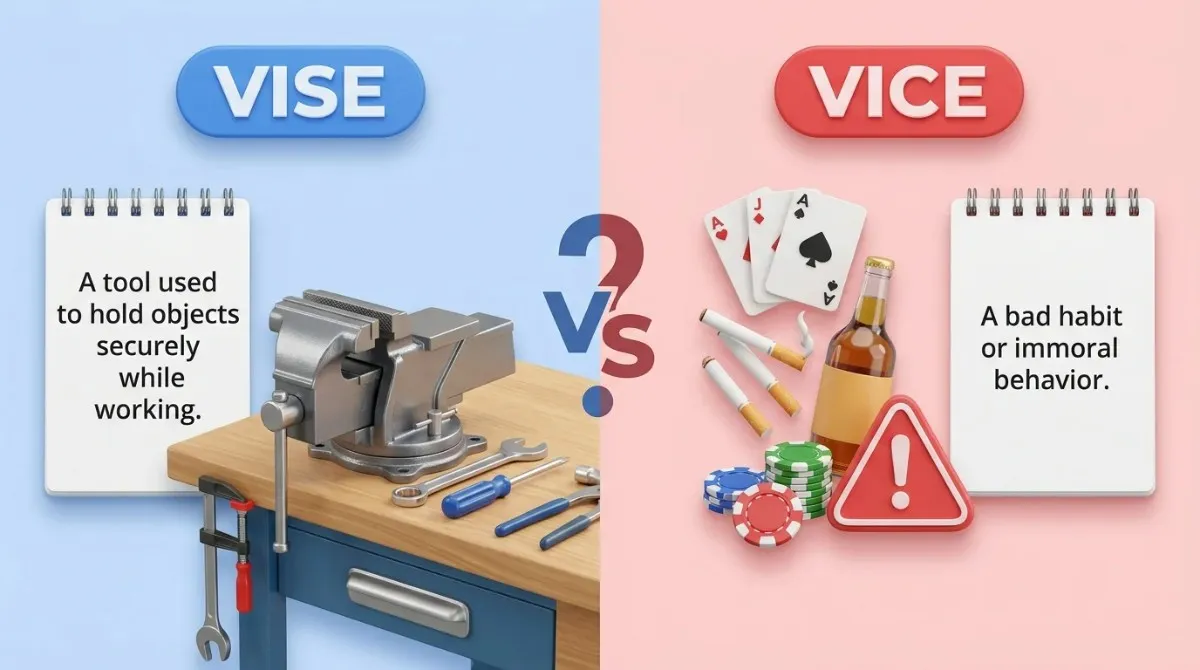
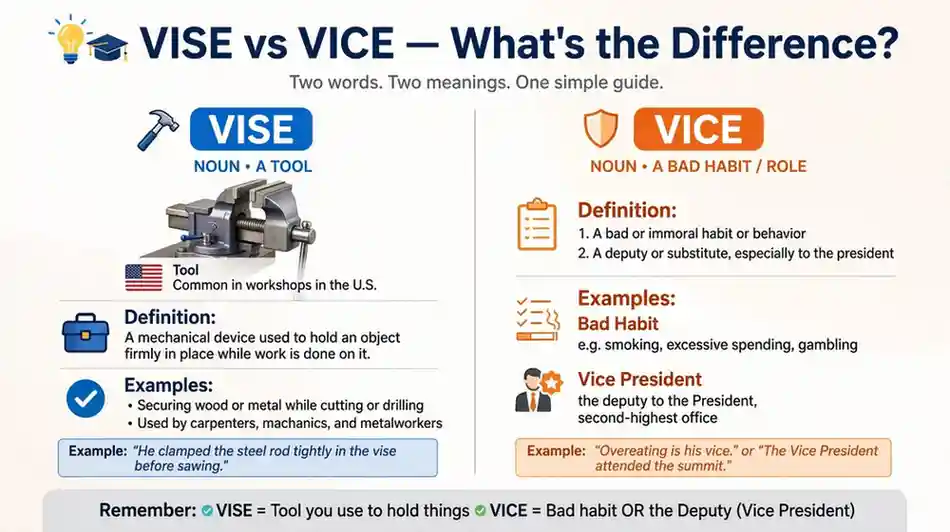
“Vise” is the correct spelling for the gripping tool, while “vice” refers to a bad habit or immoral behavior.
Should you write vise or vice? The answer depends on what you mean and where your readers live.
These two words sound the same. Yet they do not always have the same meaning. In American English, a vise is a tool that holds an object in place. A vice is a bad habit, moral fault, or illegal act. British English makes things more confusing because vice can also be the spelling for the holding tool.
People often search for vise or vice when writing about tools, tight pressure, bad habits, job titles, or the phrase “vice versa.” A single wrong letter can change the meaning of a sentence.
For example, an American worker may place wood in a vise. A British worker may place the same wood in a vice. However, both would call greed a vice.
This guide gives you a quick answer, simple rules, examples, spelling history, and advice for US, UK, and global readers.
Vise or Vice – Quick Answer
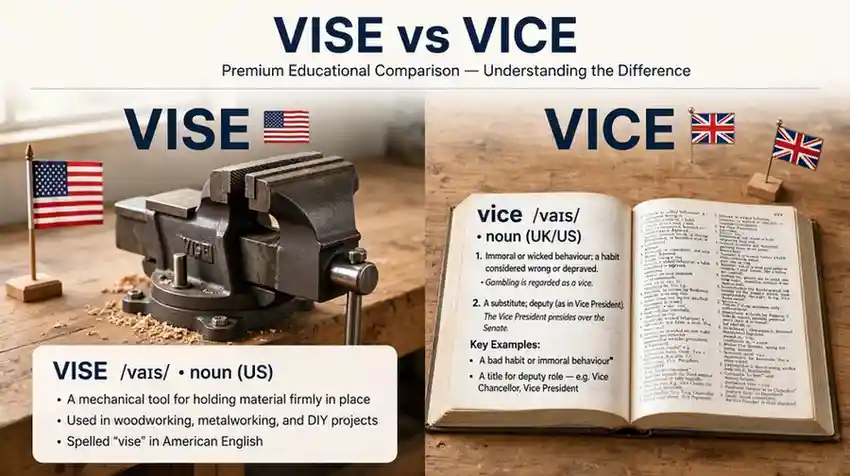
In American English:
- Vise means a tool that holds something tight.
- Vice means a bad habit, moral fault, or harmful act.
- Vice is also used in titles such as “vice president.”
In British English:
- Vice can mean the tool.
- Vice also means a bad habit or moral fault.
Cambridge lists vise as the US spelling and vice as the main UK spelling for the tool. Merriam-Webster also advises American writers to use vise for the tool and vice for a bad habit.
Simple Examples
American English:
- Put the metal part in the vise.
- Smoking was his worst vice.
- She is the vice president.
British English:
- Put the metal part in the vice.
- Smoking was his worst vice.
- She is the vice president.
A simple memory trick is:
A vise with an “s” is the US spelling for the tool. A vice with a “c” may describe a character fault.
The Origin of Vise or Vice

The words vise and vice sound alike, but they came from different roots.
The word vice, meaning a moral fault, comes from the Latin word vitium. It meant a fault, flaw, or defect. The word entered English through Anglo-French during the 14th century.
The tool word vise is younger. It appeared in English during the early 16th century. It can be traced to the Latin word vitis, meaning a vine. The idea may relate to twisting or gripping.
The vice- in “vice president” has a different history. It comes from a Latin word linked with change, place, or acting in place of another person. It does not come from the word for a bad habit or the word for a tool.
English spelling changed over time. British English kept vice for both the tool and the moral fault. American English later formed a clearer split:
- Vise for the tool
- Vice for the fault
This difference is why both spellings still appear in books, product pages, news reports, and online searches.
British English vs American English Spelling
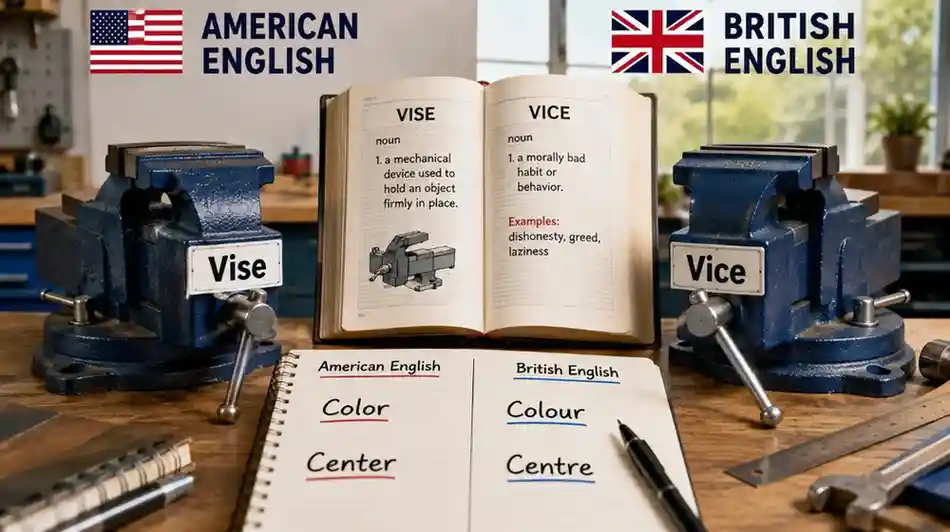
The main difference appears when the word describes a tool. Other uses of vice remain much the same.
Meaning or Use
American English
British English
Example
Tool that holds an object
Vise
Vice
Secure the wood in the vise/vice.
Bad habit
Vice
Vice
Chocolate is his only vice.
Moral fault
Vice
Vice
Greed is often seen as a vice.
Illegal or immoral activity
Vice
Vice
The police formed a vice unit.
Second-in-command title
Vice
Vice
She became vice president.
“The other way around”
Vice versa
Vice versa
Parents teach children and vice versa.
Plural of the holding tool
Vises
Vices
The workshop has two vises/vices.
Plural of moral fault
Vices
Vices
Everyone has a few vices.
Oxford describes vise as the North American form and vice as the main British form for the tool. Cambridge gives the same regional difference.
Other spelling differences between US and UK English include:
American English
British English
Color
Colour
Center
Centre
Organize
Organise
Defense
Defence
Vise
Vice
The vise or vice difference is unusual because the spelling may also change the meaning in American English.
Which Spelling Should You Use?
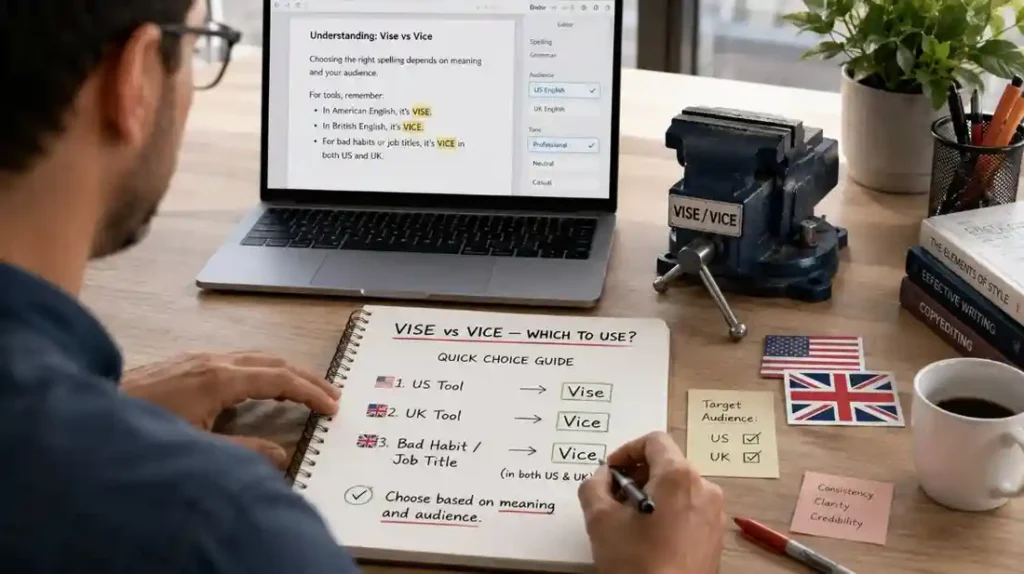
Your audience should guide your choice.
For a US Audience
Use vise when writing about the tool.
- Bench vise
- Woodworking vise
- Machine vise
- Pipe vise
- Vise grip
Use vice for a bad habit, moral fault, illegal activity, or job title.
- A costly vice
- Vice squad
- Vice president
- Vice chair
- Vice principal
For a UK Audience
Use vice for the tool and for moral faults.
- Bench vice
- Woodworking vice
- His main vice
- Vice-chair
- Vice president
The meaning will come from the rest of the sentence.
For a Commonwealth Audience
Many readers in Australia, New Zealand, and other regions follow British spelling. In such cases, vice is often used for the tool.
Canadian English may follow American or British rules, depending on the publisher. Check the company style guide when writing formal content.
For a Global Audience
Choose one English style and keep it the same throughout your content.
For a global product page, you can also use clamp when the exact type of tool is not important. This removes regional spelling confusion.
For example:
- US version: “Hold the pipe in a vise.”
- UK version: “Hold the pipe in a vice.”
- Global version: “Hold the pipe firmly with a clamp.”
Read More: Believe or Belive: 5 Mistakes to Avoid
Common Mistakes with Vise or Vice
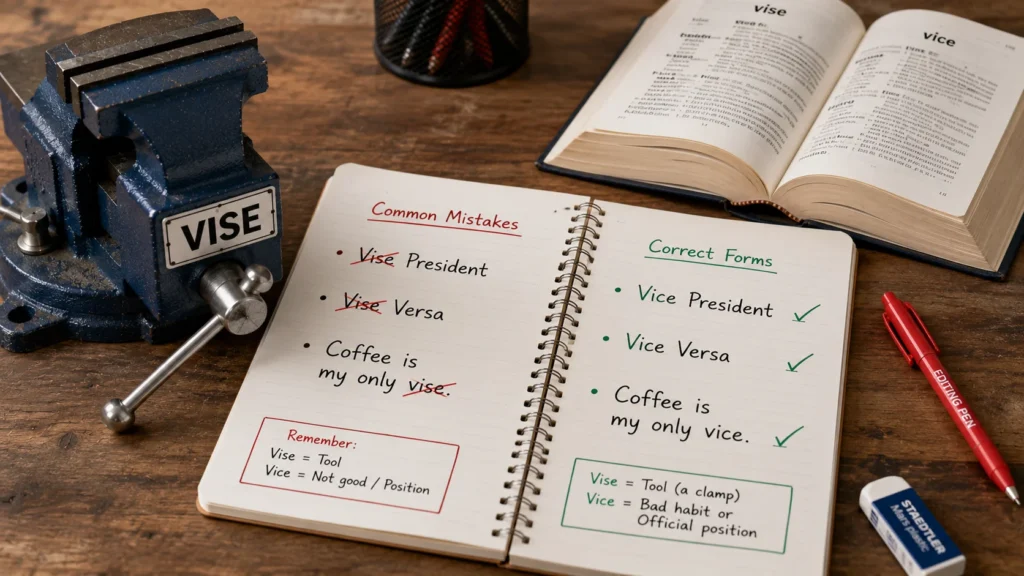
1. Writing “Vise President”
Incorrect:
He is the company’s vise president.
Correct:
He is the company’s vice president.
Job titles always use vice, not vise.
2. Writing “Vise Versa”
Incorrect:
Teachers help students and vise versa.
Correct:
Teachers help students and vice versa.
The fixed phrase is always vice versa.
3. Using “Vice” for an American Tool Name
Less suitable for US content:
Attach the bench vice to the table.
Better for US content:
Attach the bench vise to the table.
The first sentence is correct in British English. The second is better for American readers.
4. Using “Vise” for a Bad Habit
Incorrect:
Coffee is my only vise.
Correct:
Coffee is my only vice.
A bad habit is always a vice.
5. Mixing US and UK Spellings
Mixed:
The colour of the American bench vise is gray.
This sentence uses British colour with American vise. It is easy to understand, but it lacks a clear style.
US version:
The color of the bench vise is gray.
UK version:
The colour of the bench vice is grey.
6. Trusting Spellcheck Without Checking the Audience
A spelling tool may accept both words. This does not mean both are right for every sentence.
Check three things:
- What does the word mean?
- Where does the reader live?
- Which English style does the publication use?
Vise or Vice in Everyday Examples
In Emails
US workplace email:
Please place the metal plate in the vise before drilling.
UK workplace email:
Please place the metal plate in the vice before drilling.
General business email:
Maria will lead the meeting because she is our vice chair.
In News Writing
Police have started a new operation against organised vice.
Here, vice means illegal or immoral activity.
The worker’s hand became trapped near an industrial vise.
This spelling fits an American news report.
The worker’s hand became trapped near an industrial vice.
This spelling fits a British news report.
On Social Media
Buying books is my only vice.
This deadline has my mind in a vise.
In the second sentence, vise is used as an image. It means the person feels trapped or under strong pressure.
A British writer may say:
This deadline has my mind in a vice.
In Formal Writing
American technical report:
The sample was held in a steel vise during the test.
British technical report:
The sample was held in a steel vice during the test.
Formal company report:
The vice president approved the final plan.
In Product Descriptions
US product title:
Heavy-Duty Bench Vise for Woodworking and Metal Repair
UK product title:
Heavy-Duty Bench Vice for Woodworking and Metal Repair
Using the local form may help readers trust the page and understand the product faster.
Vise or Vice – Google Trends & Usage Data

Google Trends can show how often people search for vise or vice over time and by place. However, its scores are relative. They do not show exact search totals. Google normalises the data and uses a scale in which the highest point is shown as 100.
A raw comparison can also be unclear. The word vice has many meanings. Searches may relate to:
- Vice president
- Bad habits
- Crime
- Vice squad
- News and media names
- The British spelling of the tool
The word vise has a more narrow meaning. It is mainly linked to tools, workshops, repair work, woodworking, and metalwork.
For better data, compare clear phrases rather than single words:
- “Bench vise” vs “bench vice”
- “Woodworking vise” vs “woodworking vice”
- “Metal vise” vs “metal vice”
Expected Search Pattern by Country
Country or Region
Better Tool Keyword
Reason
United States
Bench vise
Standard American spelling
United Kingdom
Bench vice
Standard British spelling
Australia
Bench vice
British spelling is widely used
New Zealand
Bench vice
British spelling is widely used
Canada
Bench vise or bench vice
Usage may depend on local style
Global audience
Use both in research
Search habits differ by region
Google Trends results can change with the selected country, date range, and search category. For this reason, writers should not treat one Trends score as a fixed grammar rule.
Use dictionaries for correct spelling. Use Trends to learn how real users search.
Frequently Asked Questions
1. Is it vise or vice?
Both spellings are correct, but their use depends on meaning and region. In American English, vise is a tool and vice is a fault. British English uses vice for both.
2. Is it bench vise or bench vice?
Use bench vise for American readers. Use bench vice for British readers.
3. Is “vise versa” correct?
No. The correct phrase is vice versa. It means that the reverse is also true.
Example:
Parents learn from children and vice versa.
4. Can vice mean a tool?
Yes. In British English, a vice is a tool with two jaws that hold an object firmly. American English normally spells the tool vise.
5. What does vice mean in a person?
A vice can be a bad habit, weakness, or moral fault.
Example:
His greatest vice was gambling.
6. What is the plural of vise?
The American plural is vises.
Example:
The store sells several types of vises.
In British English, the plural of the tool is vices.
7. Is vice president spelled with a “c” or an “s”?
It is always spelled vice president with a “c.” Never write “vise president.”
8. Is “vise-like grip” correct?
Yes, in American English. It describes a grip that is very strong and tight.
British writers normally use vice-like grip.
9. Which spelling is best for SEO?
Use the spelling your target readers search for. Choose bench vise for US content and bench vice for UK content. For a global page, one spelling can be used in the title while the other appears naturally in the text.
Conclusion
The choice between vise or vice becomes easy once you check the meaning and the reader’s location.
In American English, use vise for the tool that holds an object firmly. Use vice for a bad habit, moral fault, illegal activity, or job title. In British English, vice can name both the tool and the fault. Phrases such as vice president and vice versa always use a “c” in every form of English.
For professional writing, choose one language style and stay with it. Use American spelling for a US audience and British spelling for a UK audience. For product pages or guides, target terms like “bench vise” and “bench vice.” These phrases show the user’s meaning more clearly than either single word.
The safest rule is simple: check the meaning, identify your audience, and keep your spelling consistent. This will make your content easier to read, more professional, and better matched to search intent.

Hi, I’m Shafqat Rehman. With several years of experience in English grammar, spelling, word usage, and professional writing, I create simple and practical guides. My goal is to make confusing language rules easy to understand and help readers write with greater confidence and accuracy.