Both “acknowledgements” and “acknowledgments” are correct spellings of the same word. The version with “e” (acknowledgements) is standard in British English and most Commonwealth countries. The version without “e” (acknowledgments) is standard in American English and Canadian English.
Acknowledgements and Acknowledgments Quick Answer
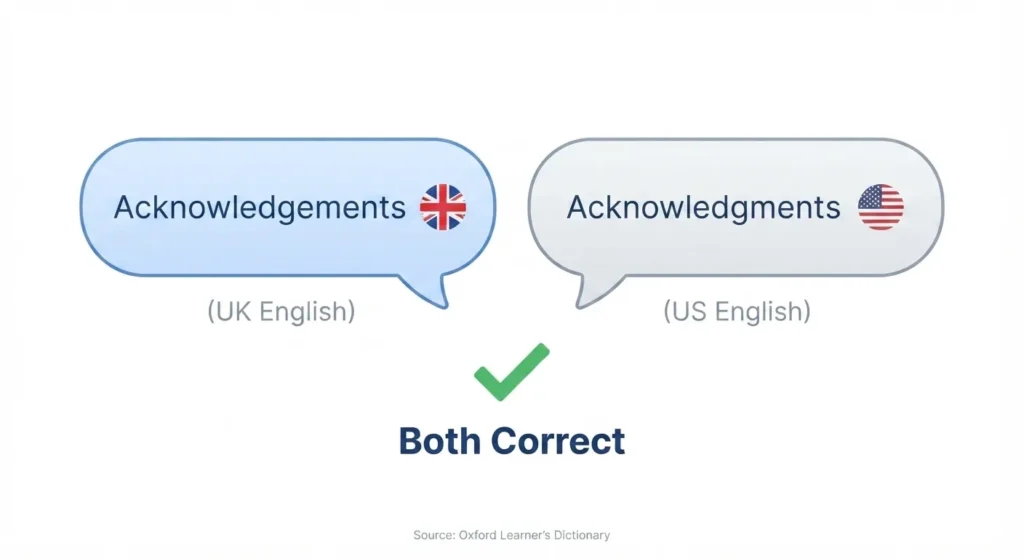
People search for this keyword because they see two spellings and want to know which one is right. The confusion comes from regional spelling rules in English. Both forms mean the same thing. They refer to the act of recognizing someone or something, or a statement of thanks in a book, report, or speech.
Use “acknowledgments” if your audience is in the United States. Use “acknowledgements” if your audience is in the United Kingdom, Australia, India, or other Commonwealth nations. In global or mixed audiences, pick one style and stay consistent.
The Origin of Acknowledgements and Acknowledgments
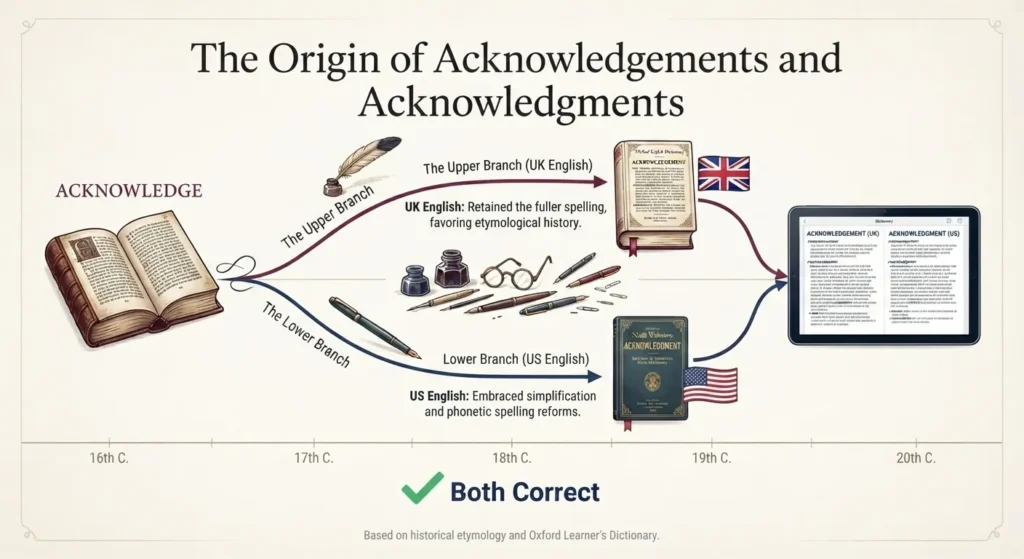
The word comes from the verb “acknowledge,” which means to admit, recognize, or show thanks. The noun form adds the suffix “-ment.” In older English, the “e” from “acknowledge” was kept when “-ment” was added, giving “acknowledgement.”
In the 1800s and 1900s, American spelling reforms led by Noah Webster favored shorter forms. Many “-our” words became “-or” (colour → color), and many silent “e” letters were dropped before suffixes. This is why American English uses “acknowledgment” while British English kept “acknowledgement.”
Both spellings have been in use for over two centuries. Modern dictionaries list both as correct. The difference is purely regional, not grammatical.
British English vs American English Spelling
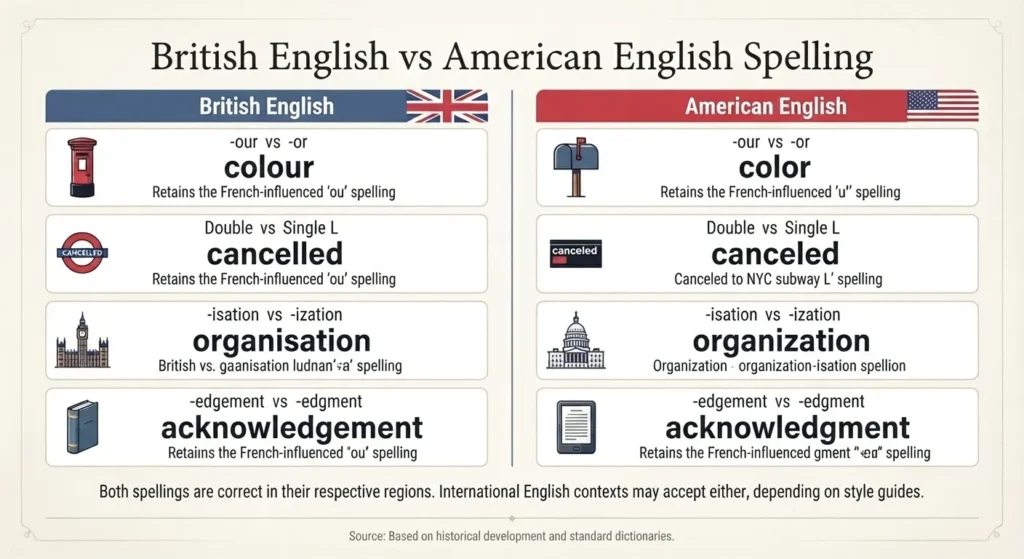
British English tends to keep extra letters from the root word. American English often removes them for simplicity. This pattern appears in many word pairs:
- colour (UK) vs color (US)
- cancelled (UK) vs canceled (US)
- organisation (UK) vs organization (US)
- acknowledgement (UK) vs acknowledgment (US)
Comparison Table Spelling Variations
| Region | Preferred Spelling | Example Sentence |
|---|---|---|
| United States | acknowledgments | The report includes acknowledgments to the research team. |
| United Kingdom | acknowledgements | Her thesis contains heartfelt acknowledgements. |
| Canada | acknowledgments | The book’s front matter lists acknowledgments. |
| Australia | acknowledgements | The conference program ends with acknowledgements. |
| India | acknowledgements | The dissertation opens with acknowledgements. |
| Global or International | either (be consistent) | Choose one form and use it throughout your document. |
Which Spelling Should You Use
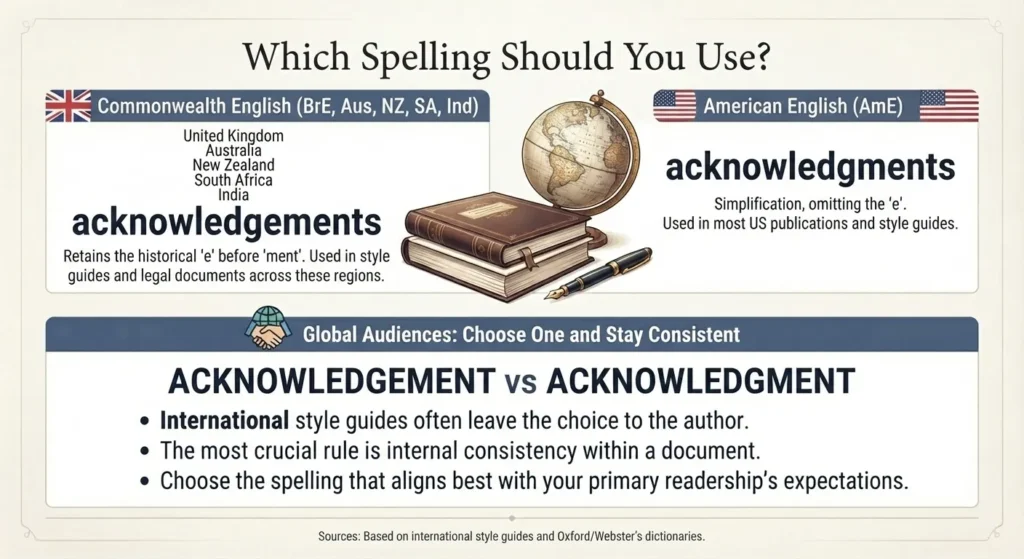
Your choice should match your audience and style guide.
- United States: Use “acknowledgments.” Major US style guides (APA, Chicago, MLA) prefer this form.
- United Kingdom, Australia, New Zealand, India, South Africa: Use “acknowledgements.” UK publishers and universities expect this spelling.
- Canada: Lean toward “acknowledgments,” following US influence, though some Canadian outlets use “acknowledgements.”
- Global or mixed audiences: Pick one spelling and use it consistently. Do not switch between forms in the same document.
If you are writing for a journal, check its author guidelines. If you are writing for a company, follow its brand style guide. Consistency matters more than which form you choose.
Read more 👉: Emphasises or Emphasizes: Which Spelling Is Correct?
Common Mistakes with Acknowledgements and Acknowledgments
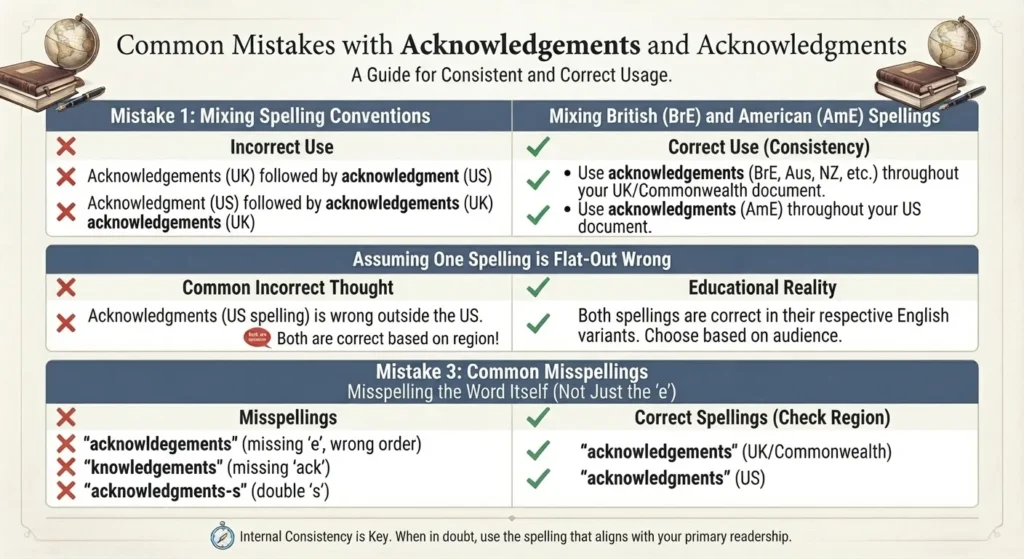
Writers often make these errors:
- Mixing spellings in one document: Using “acknowledgment” in one section and “acknowledgements” in another. This looks unprofessional.
- Assuming one form is wrong: Both are correct. Calling one “incorrect” ignores regional standards.
- Misspelling the root word: Writing “acknowlegement” or “acknowledgemnt.” Always keep the “dge” and correct vowel order.
- Using the wrong form for the audience: A US student using “acknowledgements” in a thesis submitted to an American university may be asked to revise it.
Always run a spell check set to the correct regional English (US or UK). This catches most inconsistencies.
Acknowledgements and Acknowledgments in Everyday Examples
You will see both forms across different types of writing.
- Emails: “Please find the acknowledgments section attached.” (US) vs “The acknowledgements are on page ii.” (UK)
- News articles: US outlets like The New York Times use “acknowledgments.” UK outlets like The Guardian use “acknowledgements.”
- Social media: Authors posting about their books may write “Thanks to everyone in my acknowledgements!” or “Grateful for all named in my acknowledgments.” Both appear often.
- Formal writing: Theses, dissertations, reports, and books include a dedicated section titled “Acknowledgements” (UK) or “Acknowledgments” (US). This section thanks advisors, funders, family, and others.
In all cases, the meaning is identical. Only the spelling changes.
Acknowledgements and Acknowledgments Google Trends and Usage Data
Search data shows clear regional patterns.
- In the United States, “acknowledgments” is searched and used far more than “acknowledgements.”
- In the United Kingdom, Australia, and India, “acknowledgements” dominates search volume and published usage.
- In Canada, usage is mixed but leans toward “acknowledgments,” especially in academic and corporate settings.
- In global English contexts (international journals, multinational companies), both forms appear, but consistency within a single document is the norm.
Publishing databases show that US academic papers use “acknowledgments” in over 80 percent of cases. UK and Commonwealth papers use “acknowledgements” in a similar majority.
This confirms that regional preference, not correctness, drives the choice.
Frequently Asked Questions
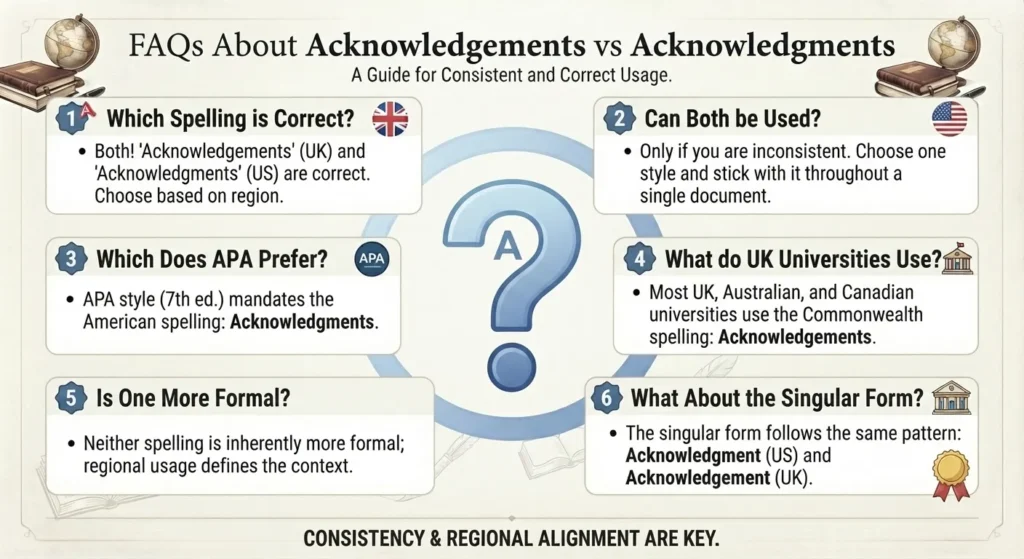
1. Is “acknowledgements” or “acknowledgments” correct?
Both are correct. “Acknowledgements” is British English. “Acknowledgments” is American English.
2. Can I use both spellings in the same document?
No. Choose one spelling and use it consistently throughout your document. Mixing them looks like an error.
3. Which spelling does APA style prefer?
APA style follows American English and prefers “acknowledgments.”
4. Do UK universities accept “acknowledgments”?
Most UK universities expect “acknowledgements.” Using the US form may be flagged by editors or examiners.
5. Is one spelling more formal than the other?
No. Both are equally formal. The choice depends on region and style guide, not tone.
6. What about “acknowledgement” vs “acknowledgment” (singular)?
The same rule applies. “Acknowledgement” is British. “Acknowledgment” is American.
7. Does spellcheck mark one as wrong?
It depends on your language setting. If your spellcheck is set to English (US), it may flag “acknowledgements.” If set to English (UK), it may flag “acknowledgments.” Adjust your settings to match your audience.
Final Thoughts
The debate between “acknowledgements” and “acknowledgments” is not about right or wrong. It is about regional spelling conventions. American English drops the middle “e.” British English and most Commonwealth varieties keep it. Both forms are accepted in major dictionaries and style guides.
When writing, always consider your audience. If you are in the US or writing for US readers, use “acknowledgments.” If you are in the UK, Australia, India, or similar regions, use “acknowledgements.” In international settings, pick one and stay consistent. Never mix the two in the same document.
By following these simple rules, you can avoid confusion and present polished, professional writing. Your readers will focus on your message, not your spelling.

Hi, I’m Sehrish Iqbal, and I enjoy writing about the English language and the little differences between words that often cause confusion. I create simple and easy-to-understand articles about grammar, spelling, commonly confused words, and correct word usage. My goal is to make English easier to understand and help students, writers, and English learners use the right words with confidence.