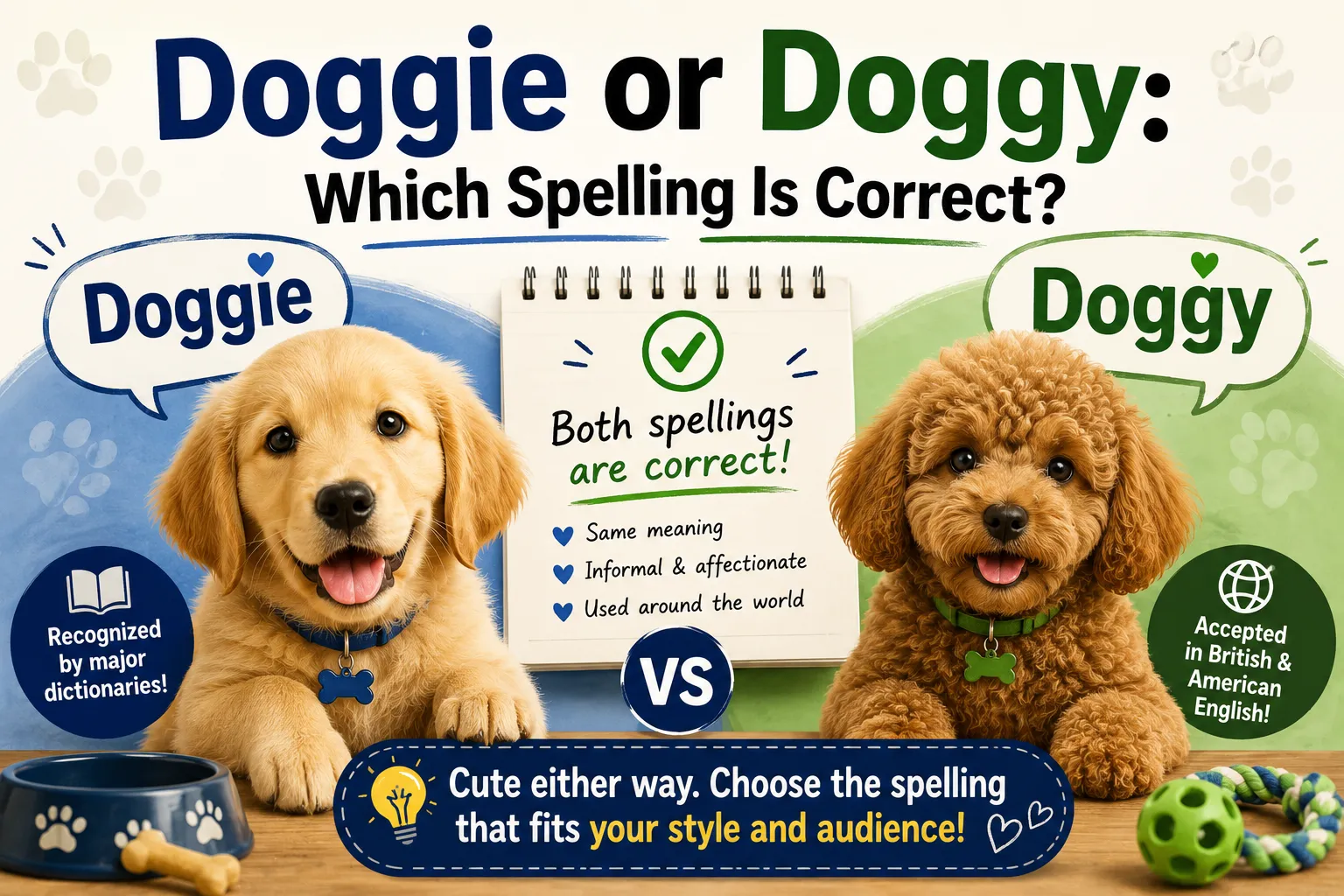
If you have ever typed “doggie or doggy” into Google, you are not alone. Both spellings appear in books, dictionaries, social media posts, pet websites, and everyday speech. That makes it easy to wonder whether one is correct and the other is a mistake.
The good news is simple: both “doggie” and “doggy” are correct spellings. They usually have the same meaning and refer to a dog in a cute, informal, or child-like way. Major dictionaries, including Oxford, Cambridge, Merriam-Webster, and Dictionary.com, recognize both forms.
People often search for “doggie or doggy” because English has two common spellings for the same word. The difference is not mainly about grammar. It is about spelling preference, style, and context.
In this guide, you will learn the difference between doggie and doggy, where the words came from, which form is more useful in different types of writing, and how to avoid common mistakes.
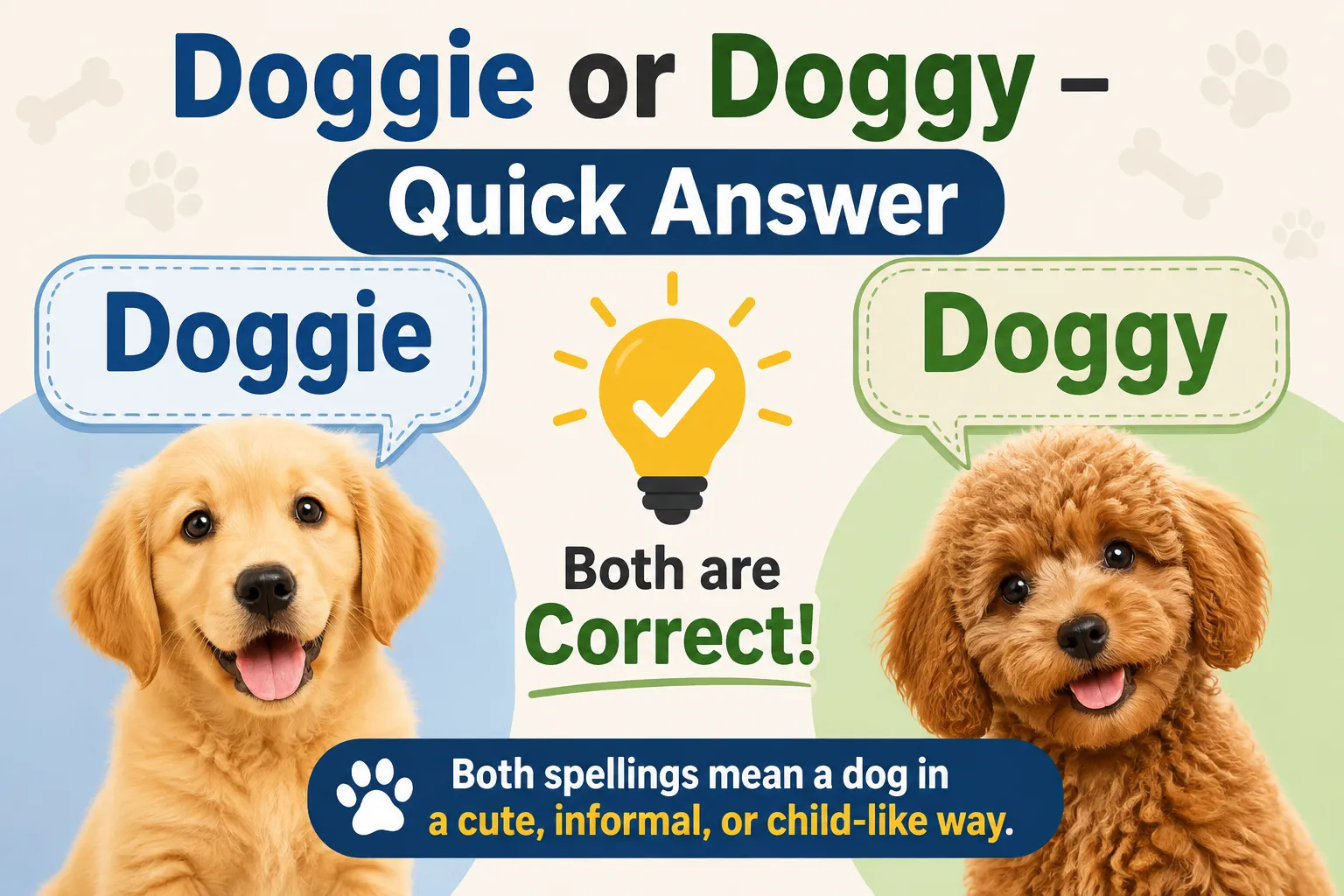
They are informal words for a dog, often used by children or when speaking affectionately about a dog. Oxford lists doggy and gives doggie as another form. Cambridge also defines doggy as a child’s word for a dog and notes doggie as an alternative.
Examples
- “Look at that cute doggy!”
- “Look at that cute doggie!”
- “The child wants to pet the doggy.”
- “The little doggie is sleeping.”
Both sentences work.
However, doggy is often the safer choice if you want a standard dictionary form. Merriam-Webster lists doggy as the main entry and doggie as a variant.
| Spelling | Correct? | Meaning | Style |
|---|---|---|---|
| doggy | Yes | A dog; an affectionate term | Informal |
| doggie | Yes | A dog; an affectionate term | Informal/cute |
| dogy | No | — | Incorrect |
| dogie | Usually not for this meaning | Different word/use | Avoid |
| doggo | Informal slang | A dog | Very casual |
So, if you are asking “Is it doggie or doggy?”, the answer is both.
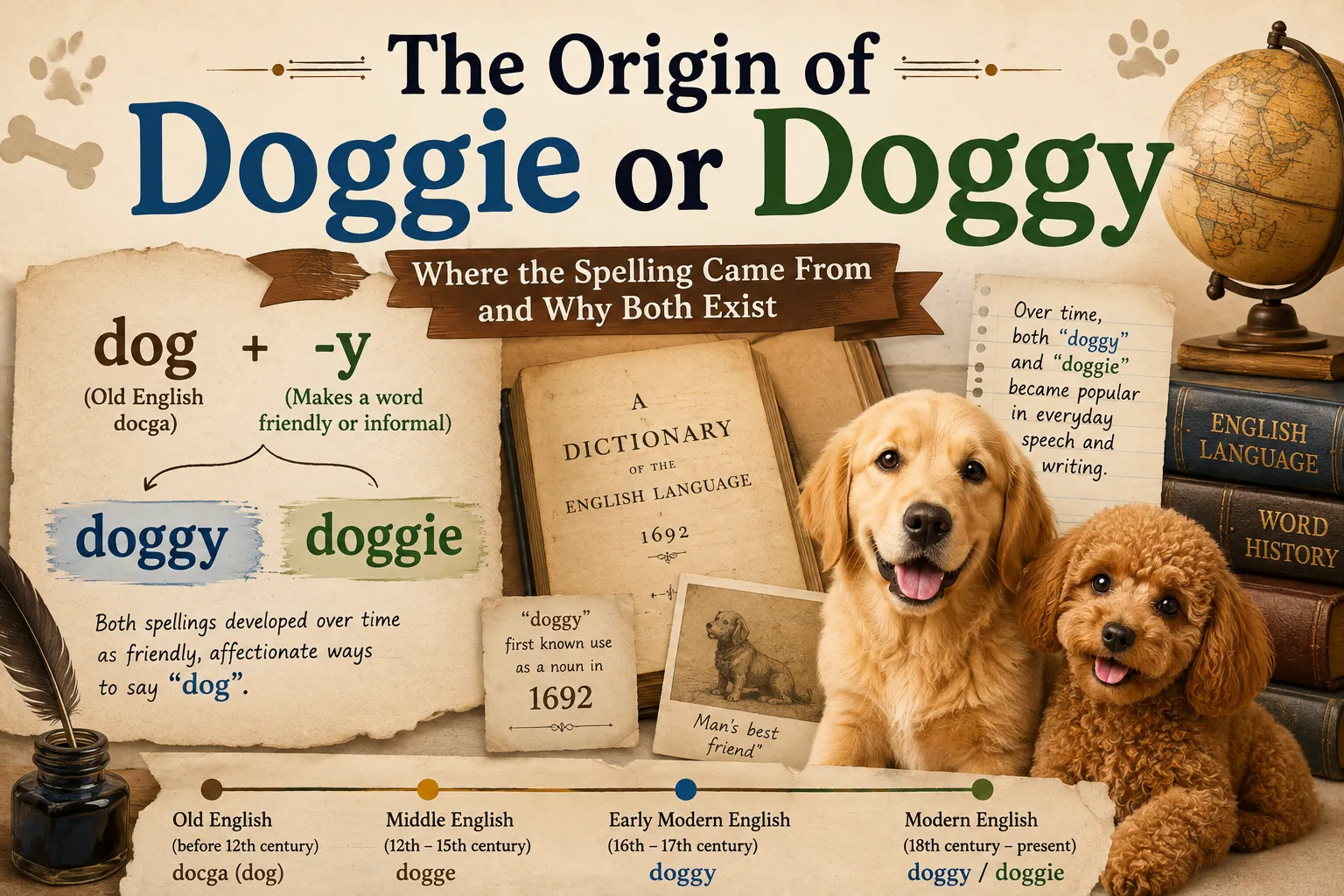
The word doggy has a long history. Merriam-Webster records its first known use as a noun in 1692. Its adjective use dates to 1852.
Dictionary.com gives a somewhat different historical picture for related uses. It traces one doggy form to dog + -y, with an early recorded use in the 19th century, while another adjective-related form has an older history.
The ending -y is important. English often uses -y to create an informal or descriptive word.
For example:
- dog → doggy
- fog → foggy
- sun → sunny
- fun → funny
In doggy, the spelling developed as a familiar form of dog.
Why Does “Doggie” Exist?
Doggie is a spelling variant of doggy. The extra i helps show the pronunciation and gives the word a more playful appearance.
This type of spelling is common in informal English. People may choose doggie because it looks softer, cuter, or more child-friendly.
Modern dictionaries recognize the spelling. Merriam-Webster lists doggie as a variant, while Oxford and Cambridge also recognize it.
Therefore, doggie is not simply a spelling mistake for doggy.
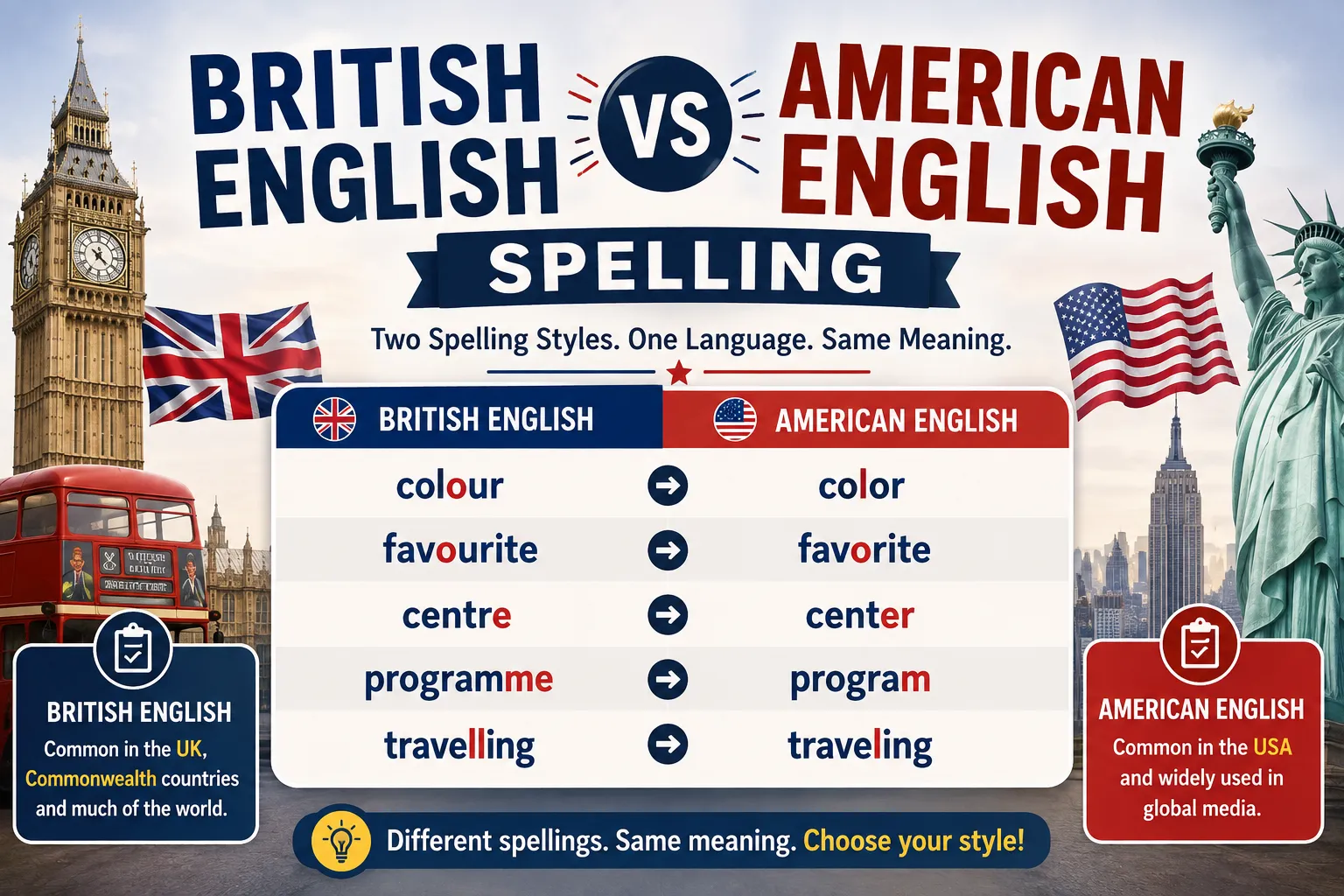
There is no strict British-versus-American rule that says one country must use doggy and the other must use doggie.
Both forms are understood in British and American English.
Cambridge lists doggy as the main form and doggie as an alternative. Its British and American pronunciation information also shows that pronunciation can vary by accent, but the spelling remains broadly the same.
Oxford likewise lists doggy and notes doggie as another form in both its learner and American dictionary resources.
Comparison Table
| Feature | British English | American English |
|---|---|---|
| Common form | doggy | doggy |
| Alternative | doggie | doggie |
| Meaning | A dog, especially in child-like speech | A dog, especially in child-like speech |
| Formality | Informal | Informal |
| “Doggie” accepted? | Yes | Yes |
| “Doggy” accepted? | Yes | Yes |
| Best formal alternative | dog | dog |
The main point is that doggie vs doggy is not like colour vs color.
With colour/color, there is a clear regional spelling difference. With doggie/doggy, both spellings are accepted in major English dictionaries.
Which Spelling Should You Use?
Your choice depends mostly on your audience and the type of writing.
For American English
Doggy is a safe choice.
For example:
“The children played with the doggy.”
You can also use doggie, especially in casual writing, children’s content, pet-related posts, and affectionate speech.
For British English
Again, doggy is a safe choice.
British readers will understand doggie without difficulty. It is also recognized by major dictionaries.
For Commonwealth English
In countries such as Australia, Canada, and other English-speaking regions, both spellings are generally understandable.
If you want a neutral choice, use doggy.
For Professional Writing
Neither doggy nor doggie is usually ideal for formal writing.
Instead, use:
- dog
- puppy
- pet
- canine
For example:
Informal:
“The doggy was waiting outside.”
More professional:
“The dog was waiting outside.”
This matters because doggy and doggie are informal terms. Oxford and Cambridge both identify the word as informal or child-like.
Common Mistakes with Doggie or Doggy
Many spelling mistakes happen because people are unsure which ending to use.
1. Writing “dogy”
❌ “Look at that dogy!”
✅ “Look at that doggy!”
The standard spelling uses double g.
2. Treating “doggie” as incorrect
❌ “Doggie is always wrong.”
✅ “Doggie is a recognized variant of doggy.”
Major dictionaries support both forms.
3. Using “doggy” in formal documents
❌ “The research examined doggy behavior.”
Better:
✅ “The research examined dog behavior.”
“Doggy” is informal and may sound too casual for academic or professional writing.
4. Confusing “doggy” with “puppy”
A puppy is specifically a young dog.
A doggy can refer to a dog in general, especially in affectionate or child-like speech.
For example:
“That doggy is very old.”
This is possible because doggy does not always mean puppy.
5. Assuming “doggie” changes the meaning
In most everyday uses, doggie and doggy have the same basic meaning.
The spelling mainly changes the look and feel of the word.
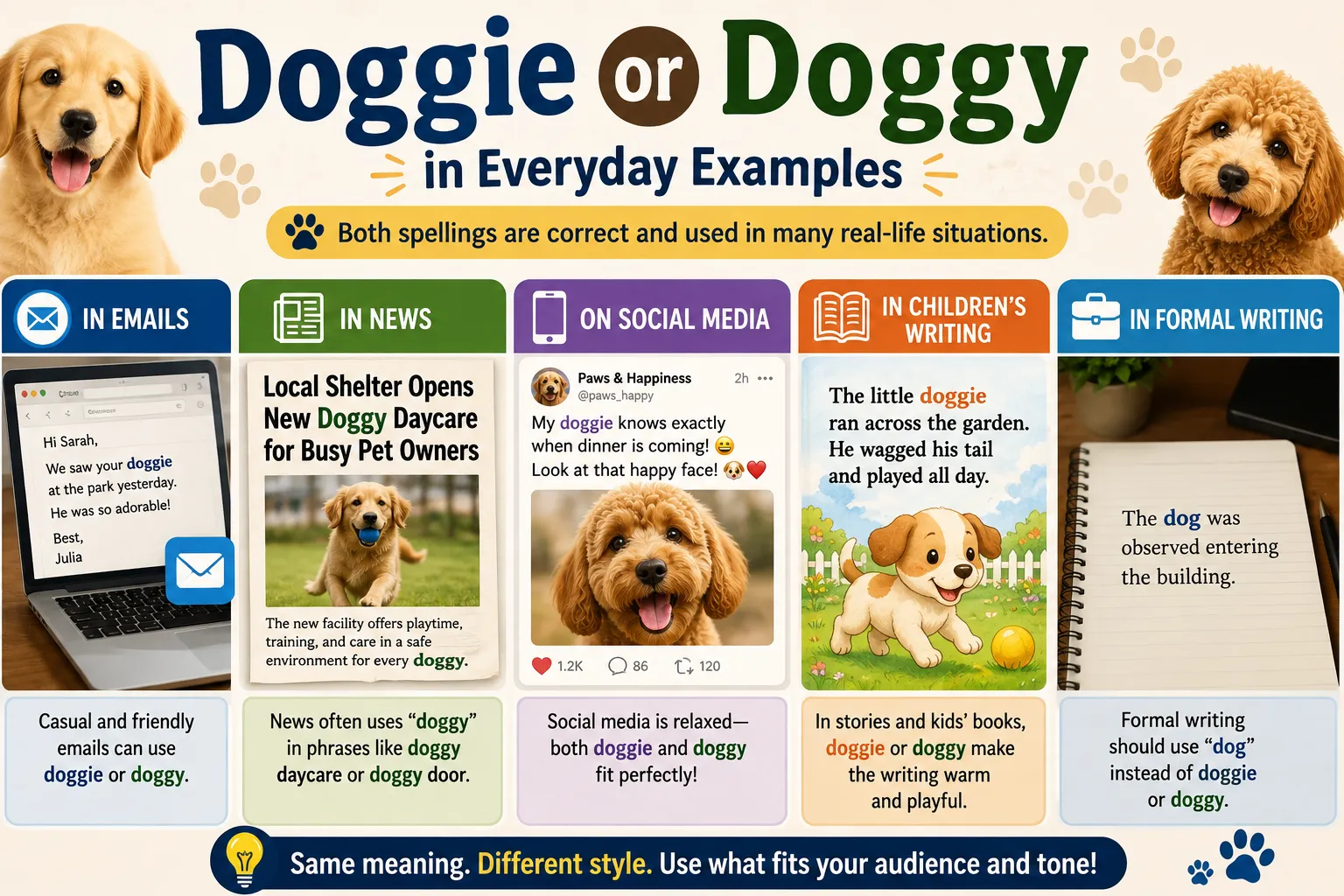
Both forms appear in casual communication and popular writing.
In Emails
Informal email:
“We saw your doggy at the park yesterday. He was adorable!”
For a professional email, it is better to write:
“We saw your dog at the park yesterday. He was adorable.”
In News
News writing generally prefers dog because it is neutral.
However, phrases such as doggie bag or doggy daycare can appear because they are established expressions.
Merriam-Webster gives examples such as doggy door and doggy bag, showing that doggy is widely used in compounds.
On Social Media
Social media is much more relaxed:
“My doggy knows exactly when dinner is coming!”
Or:
“Look at this happy doggie! 🐶”
Both work well.
In Children’s Writing
Doggy and doggie are especially natural in children’s stories.
Example:
“The little doggie ran across the garden.”
The playful spelling can make the text feel warm and child-friendly.
In Formal Writing
Use dog instead:
“The dog was observed entering the building.”
This is clearer and more professional than:
“The doggy was observed entering the building.”
Doggie or Doggy – Google Trends & Usage Data
Search interest can help show how people use competing spellings, but Google Trends should be interpreted carefully.
Google Trends does not provide a simple worldwide count of the total number of searches. Instead, it shows relative search interest, normally on a scale from 0 to 100 for the selected terms, time range, and location.
For doggie vs doggy, search behavior can also be affected by phrases rather than the basic word itself. For example:
- doggy daycare
- doggie daycare
- doggy bag
- doggie bag
- doggy door
- doggie door
This means a search comparison may reflect interest in particular phrases rather than a simple spelling preference.
Dictionary evidence shows that doggy is the primary dictionary entry in several major references, while doggie is treated as an accepted variant.
Usage also appears in modern media. For example, recent news examples use both doggy and doggie in pet-related contexts.
What This Means for SEO
If you are writing an SEO article, do not treat doggie and doggy as completely unrelated words.
Use the main keyword naturally, but include the alternative spelling where it helps readers.
For example:
Primary keyword: doggie or doggy
Related terms:
- doggy meaning
- doggie meaning
- doggy spelling
- doggie spelling
- is doggie correct?
- is doggy correct?
- doggy vs doggie
- doggie vs doggy
This approach can satisfy users who search using either spelling.
Doggie vs Doggy: Comparison Table
| Variation | Correct? | Meaning | Best Use |
|---|---|---|---|
| doggy | ✅ Yes | Informal word for a dog | General informal use |
| doggie | ✅ Yes | Informal word for a dog | Cute or playful writing |
| doggy dog | ✅ Possible | Repeated/child-like expression | Casual speech |
| doggy bag | ✅ Yes | Bag for leftover food | Common expression |
| doggie bag | ✅ Yes | Same as doggy bag | Informal expression |
| doggy door | ✅ Yes | Door for a pet | Everyday English |
| doggie door | ✅ Yes | Same meaning | Informal English |
| dogy | ❌ No | — | Spelling mistake |
| dogie | ❌ Not the usual spelling for this meaning | — | Avoid for this meaning |
FAQs About Doggie or Doggy
1. Is “doggie” or “doggy” correct?
Both are correct. Major dictionaries recognize doggie as a variant of doggy.
2. Is “doggy” a real word?
Yes. Doggy is a standard dictionary word. It can be a noun meaning a dog and an adjective relating to dogs.
3. Is “doggie” a real word?
Yes. Doggie is an accepted spelling variant of doggy. It is especially common in informal and child-like language.
4. Which is more common: doggie or doggy?
Doggy is generally the safer standard form because major dictionaries commonly use it as the main entry, while doggie is listed as a variant.
5. Is “doggy” British or American?
Doggy is used in both British and American English. There is no strict regional rule requiring one spelling.
6. Is “doggie” childish?
It can sound cute, affectionate, or child-like, but adults also use it in casual speech and writing.
7. Should I use “doggy” in formal writing?
Usually, no. Dog is better for formal, academic, business, and professional writing.
Conclusion: Doggie or Doggy?
So, doggie or doggy? The answer is that both spellings are correct. They are informal ways to refer to a dog, often with a cute, friendly, or child-like feeling. Major dictionaries such as Oxford, Cambridge, and Merriam-Webster recognize both forms.
If you want the safest general choice, use doggy. It is widely recognized and commonly appears as the main dictionary form. Doggie is also correct and can be a good choice when you want a softer or more playful tone.
The spelling does not normally change the meaning. The biggest difference is style.
For children’s stories, social media, casual messages, and affectionate speech, either form works well. For professional or academic writing, dog is usually better.
Remember these three points: doggy is correct, doggie is also correct, and neither is usually the best choice for formal writing. Choose the form that fits your audience and tone.
you can also read about assure vs ensure by clicking this link
👇👇👇
https://guideffy.com/wp-admin/post.php?post=3333&action=edit

I’m an experienced article writer who creates clear, engaging, and SEO-friendly content that helps readers find the information they need. I specialize in writing well-researched articles, blog posts, guides, and informative content on a wide range of topics.
My writing focuses on simple language, strong structure, accurate information, and search intent. I aim to make every article easy to read while also helping websites improve their visibility on search engines.
I enjoy turning complex topics into useful, reader-friendly content that informs, answers questions, and keeps readers engaged. Whether you need an SEO article, blog post, educational guide, or website content, I can create content tailored to your audience and goals.