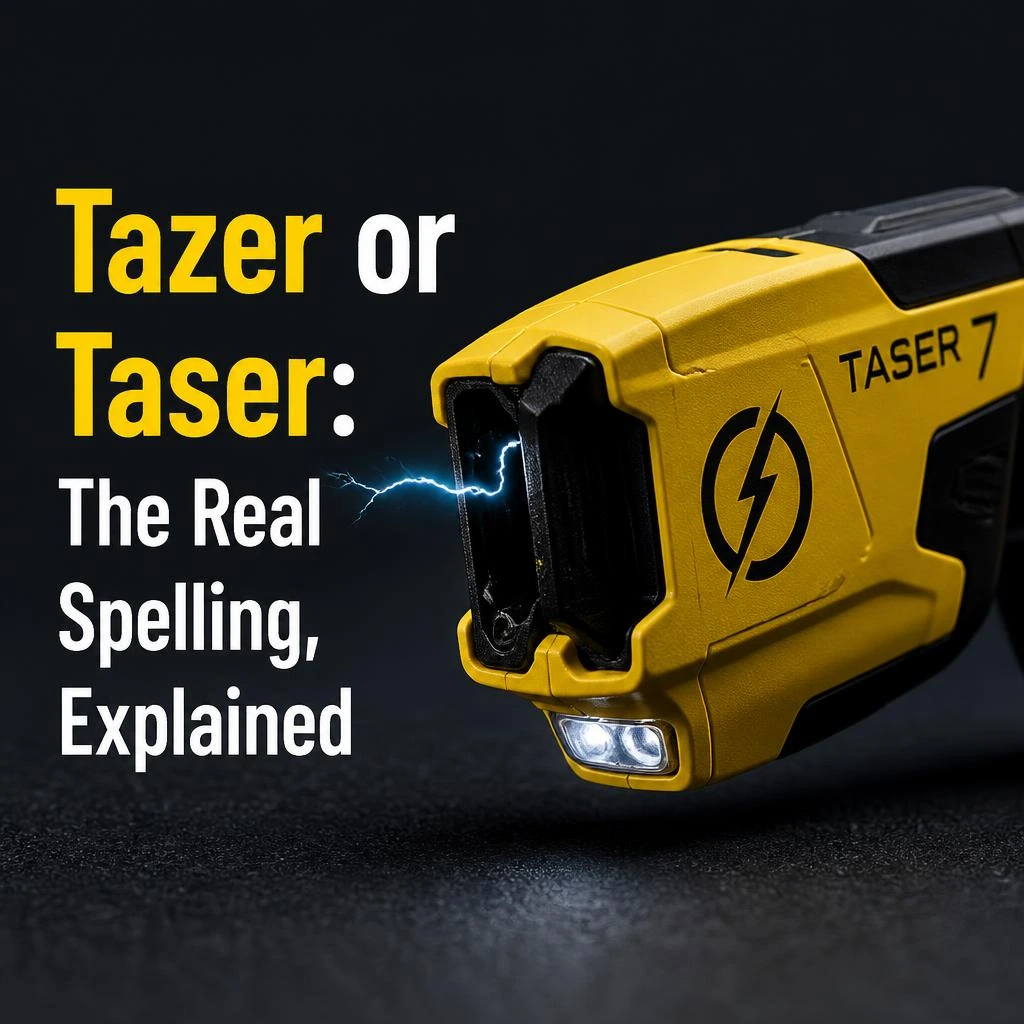
Taser is the correct spelling. “Tazer” is a common misspelling that happens because of how the word sounds when spoken aloud.
I used to write “tazer” without a second thought. Then an editor circled it in red and wrote one word next to it: “trademark.” That sent me down a rabbit hole I didn’t expect — and it turns out millions of people make the same mistake every month.
This article settles it for good. You’ll learn the correct spelling, where the word came from, why so many people get it wrong, and how to use it properly in writing — whether that’s a school paper, a news article, or a quick text to a friend.
Let’s clear up the confusion.
Tazer or Taser: Quick Answer✍🏻
Taser is the only correct spelling. It’s a registered trademark, not a generic dictionary word someone invented from scratch.
You’ll see it used like this:
- “Police carried Tasers as a less-lethal option.”
- “The officer drew her Taser instead of a firearm.”
“Tazer” shows up constantly in casual writing, social media, and even some news outlets. It’s still wrong — just widely repeated.
Read more:What or Which: Key Differences Explained with Examples (2026)
📔The Origin of the Word “Taser”
The word isn’t random. It’s actually an acronym wrapped in a tribute.
TASER stands for Thomas A. Swift’s Electric Rifle — a nod to a fictional young inventor named Tom Swift from a series of adventure novels popular in the early 1900s. The actual device was developed by NASA researcher Jack Cover in the early 1970s, and he named it after his childhood hero.
Because Cover’s company trademarked the name, “Taser” technically refers to a specific brand of conducted electrical weapon, now made by Axon Enterprise. Over time, like “Kleenex” or “Band-Aid,” the brand name became the word everyone uses for the whole category of device.
That history explains the spelling. There’s no “z” anywhere in Thomas A. Swift’s Electric Rifle — so there’s no reason for one to sneak into the word itself.
Taser vs Tazer : Where the Confusion Comes From
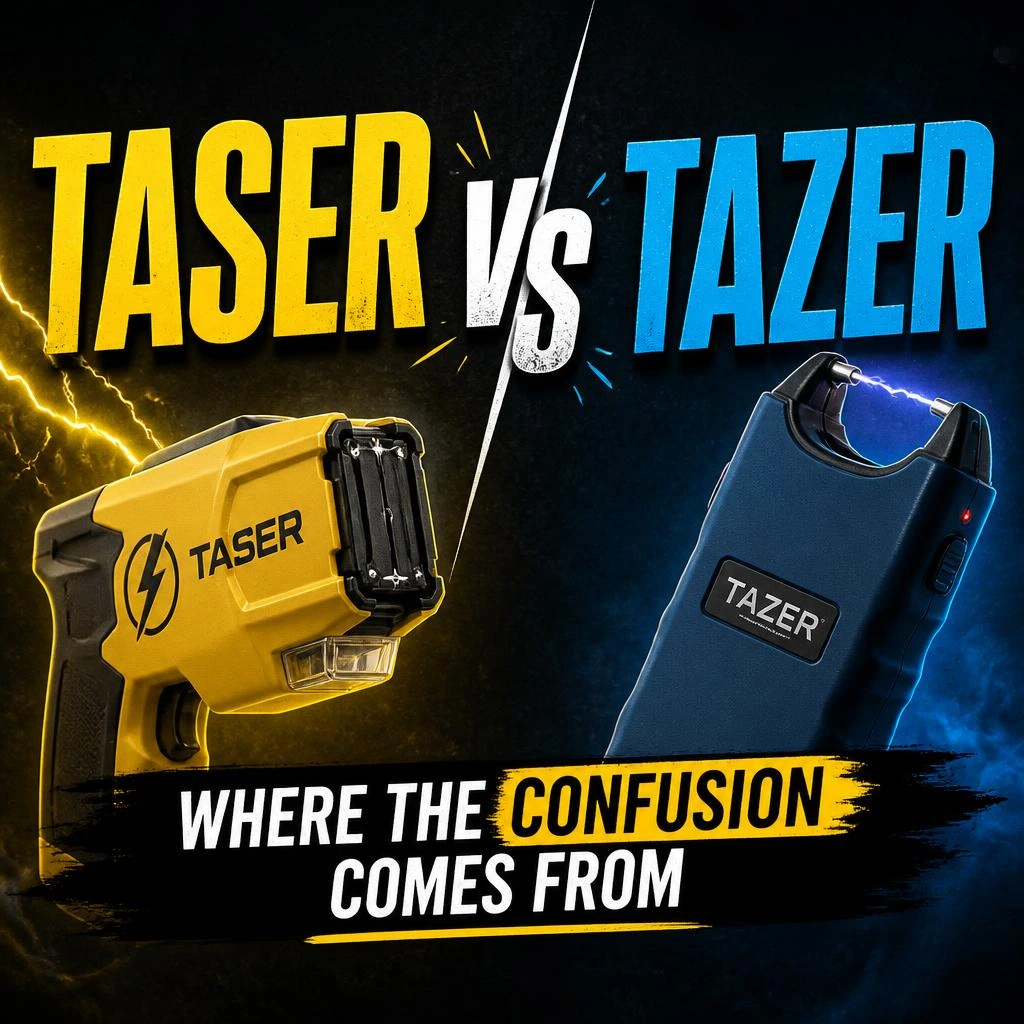
This isn’t really a “two correct spellings” situation. It’s a pronunciation trap.
English speakers naturally soften the “s” sound between two vowels into a “z” sound. Think of words like “laser” — also pronounced with a z-sound, also spelled with an “s.” Nobody writes “lazer,” yet “tazer” persists at a much higher rate.
| Term | Status | Why People Use It | Correct? |
| Taser | Official trademarked spelling | Matches the acronym origin | ✅ Yes |
| Tazer | Phonetic misspelling | Matches how it sounds when spoken | ❌ No |
| TASER (all caps) | Original acronym style | Used in early branding and patents | ✅ Acceptable in formal/brand contexts |
The takeaway: trust the spelling, not your ear.
Which Version Should You Use?✅
Your context decides the right call here.
- For journalists and formal writing → Use Taser. Style guides like the AP Stylebook recognize it, and it matches the legal trademark.
- For students and essays → Use Taser. Spellcheck and most dictionaries will flag “tazer” as incorrect.
- For casual texting or social media → “Tazer” won’t get you in trouble, but Taser still reads as more credible.
- For brand-specific or legal writing → Use TASER in full caps only when directly referencing the registered trademark or quoting official Axon materials.
When in doubt, default to Taser. It’s accurate everywhere, in every context.
Common Mistakes with “Tazer” or “Taser”
These slip-ups show up constantly, even in published content.
- Mistake: “He got tazed by police.” Correction: “He got tased by police.” Why it happens: The verb form follows the same z-sound trap as the noun.
- Mistake: “tazer gun” Correction: “Taser” (the word already implies it’s a device — “gun” is often redundant and sometimes inaccurate, since many models don’t resemble firearms) Why it happens: People associate it with traditional weapons and add a clarifying word out of habit.
- Mistake: Using “taser” as a generic term for any stun device. Correction: Reserve Taser for the actual brand; use “stun gun” or “conducted electrical weapon” for generic or non-Axon devices. Why it happens: Brand names often become catch-all terms, like “Google it” for any web search.
- Mistake: “tasered” used inconsistently with capitalization (Tasered, TASERed, tasered). Correction: Lowercase tased or tasered is standard in general writing. Why it happens: No universal style consensus exists outside formal journalism guides.
- Mistake: Treating “Taser” as a verb without acknowledging it’s a trademark. Correction: Many style guides prefer “used a Taser on” rather than “Tasered,” to avoid genericizing the trademark. Why it happens: Verbing brand names is common in everyday speech (see: “Google,” “Xerox”).
🌍Taser in Real, World Examples
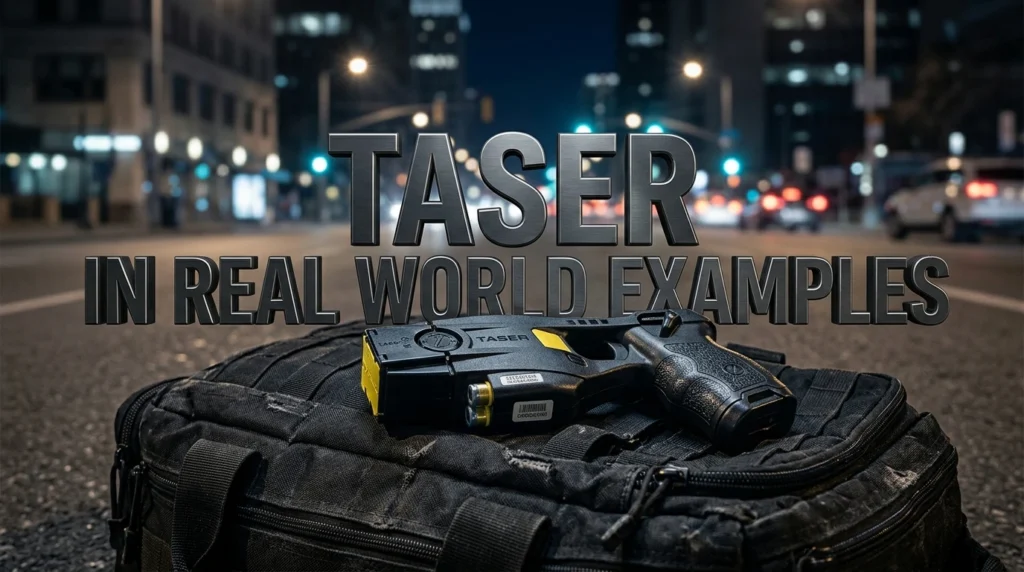
In a news headline: “Officer Used Taser During Tense Traffic Stop, Bodycam Footage Shows”
In a professional email: “Please confirm whether department policy requires logging every Taser deployment in the incident report system.”
In a social media post: “Wild night — security actually had to use a Taser to break up the parking lot fight 😳”
In a formal document: “All officers issued a Taser must complete annual recertification training per department policy.”
Notice the pattern — capital “T,” no “z,” every time.
Taser: Data, Trends & Usage📈
Search interest in “taser vs tazer” spikes consistently because the misspelling is so common in everyday speech. This is overwhelmingly an informational search — people aren’t shopping, they’re trying to settle a spelling debate, often mid-sentence while writing something else.
Interest tends to cluster around:
- Students and writers double-checking spelling for assignments or articles
- True crime and news consumers encountering the term in headlines
- General curiosity sparked by viral videos or news footage
This matters now because trademarked terms are increasingly treated as generic in casual speech — similar to how “Uber” became shorthand for rideshare. Getting the spelling right keeps your writing credible, especially in professional or published contexts.
Tazer vs Taser: Comparison Table
| Term/Variant | Meaning | Region/Context | Best Used When |
| Taser | Correct trademarked spelling | Global, all English-speaking regions | Any formal or general writing |
| TASER | Original full-caps acronym | Legal documents, brand references | Citing the trademark directly |
| Tazer | Common misspelling | Casual speech, informal social posts | Never recommended, though widely seen |
| Stun gun | Generic term for similar devices | Global | Referring to non-Taser-brand devices |
Frequently Asked Questions
Q: What does “Taser” mean? A: Taser is a trademarked brand name for a type of conducted electrical weapon, now manufactured by Axon Enterprise. It’s often used generically to refer to similar devices, much like “Kleenex” for tissues.
Q: How do you use “Taser” correctly in a sentence? A: Capitalize the “T” and spell it with an “s,” not a “z” — for example, “The officer carried a Taser.” As a verb, “tased” or “tasered” is standard in casual writing.
Q: Tazer vs Taser — what’s the actual difference? A: There’s no real difference in meaning. “Tazer” is simply an incorrect spelling caused by the word’s pronunciation. Only “Taser” is recognized as correct.
Q: Is “Taser” acceptable in formal writing? A: Yes. Major style guides, including AP style, recognize “Taser” as the correct spelling for formal and journalistic writing.
Q: Which version is correct — Taser or Tazer? A: Taser is correct. Tazer is a phonetic misspelling that doesn’t appear in dictionaries or official trademark filings.
Q: Where does the word “Taser” come from? A: It’s an acronym for “Thomas A. Swift’s Electric Rifle,” named by inventor Jack Cover after a fictional character from early 20th-century adventure novels.
Q: Can “Taser” be used as a verb? A: Yes, informally. “Tased” and “tasered” are both common, though some style guides prefer avoiding verb forms of trademarked names altogether in strict formal writing.
Final Takeaway
Three things to remember: Taser is the correct spelling, it comes from a real trademarked brand name, and “tazer” only persists because of how the word sounds out loud.
Use “Taser” with a capital T in any writing that matters — news articles, school papers, professional emails. Save “tazer” for never.
Bookmark this guide so you never second-guess the spelling again, and share it with anyone you’ve seen write “tazer” one too many times.
Read more:Fulfillment or Fulfilment? Which Spelling Is Correct? (2026)

Passionate about language and clear communication, I explore the subtle differences between words and expressions through well-researched, practical content. My goal is to help readers write with greater clarity, confidence, and precision by making complex language concepts easy to understand.