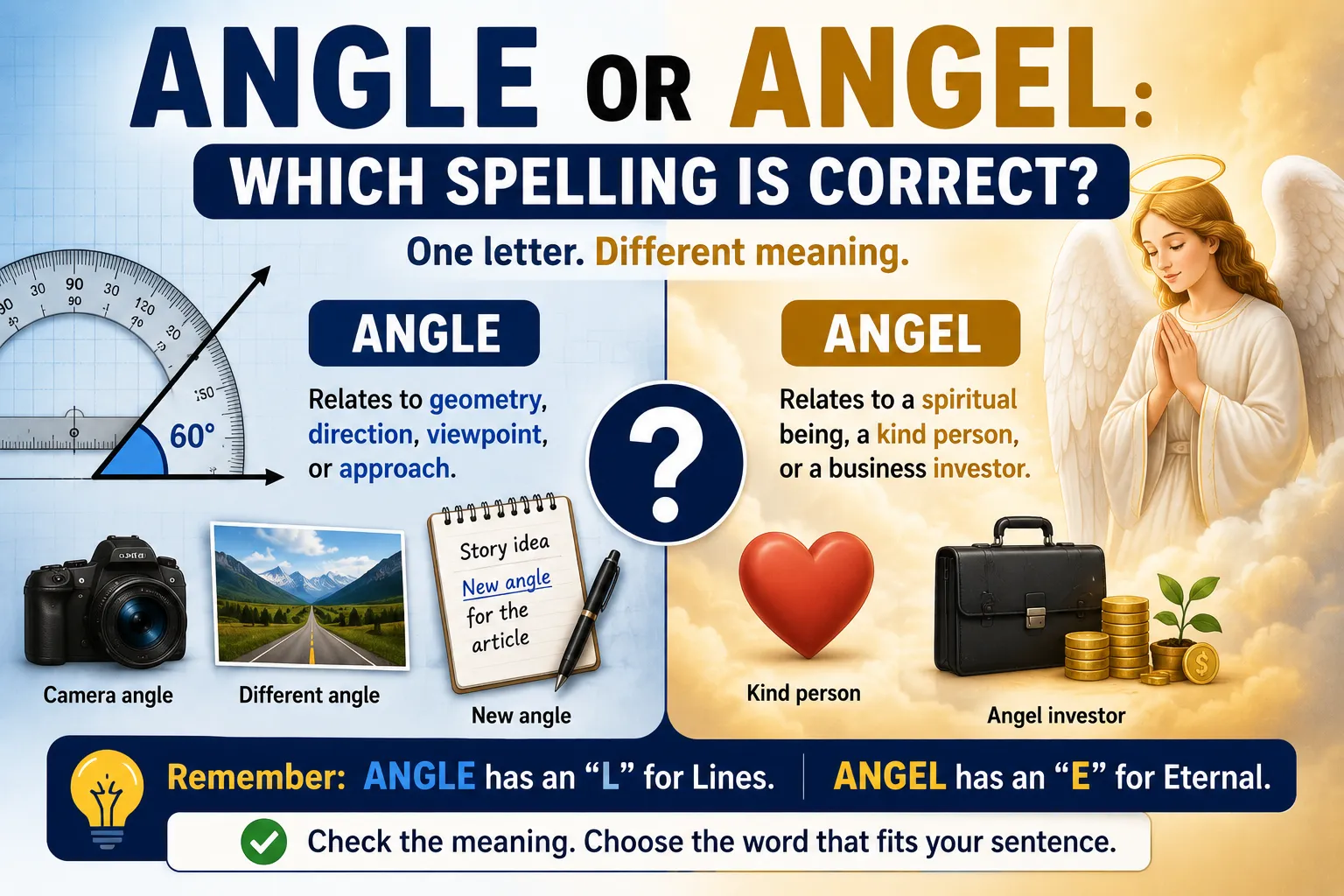
Have you ever written “angle” when you meant “angel”? These two words look almost the same, but they have completely different meanings. One belongs to geometry, photography, and points of view. The other refers to a spiritual being or a very kind person.
This is why many people search for “angle or angel.” The words differ by only one letter, and they can sound similar when spoken quickly. A small spelling mistake can change the meaning of an entire sentence.
The good news is that the difference is easy to understand. Angle relates to corners, measurements, directions, and viewpoints. Angel refers to a spiritual being, a kind person, or, in business, an investor who supports a company. Cambridge and Oxford dictionaries give these words separate meanings and origins.
In this guide, you will learn when to use angle and angel, how the words developed, common mistakes, everyday examples, and simple tricks to remember the correct spelling.
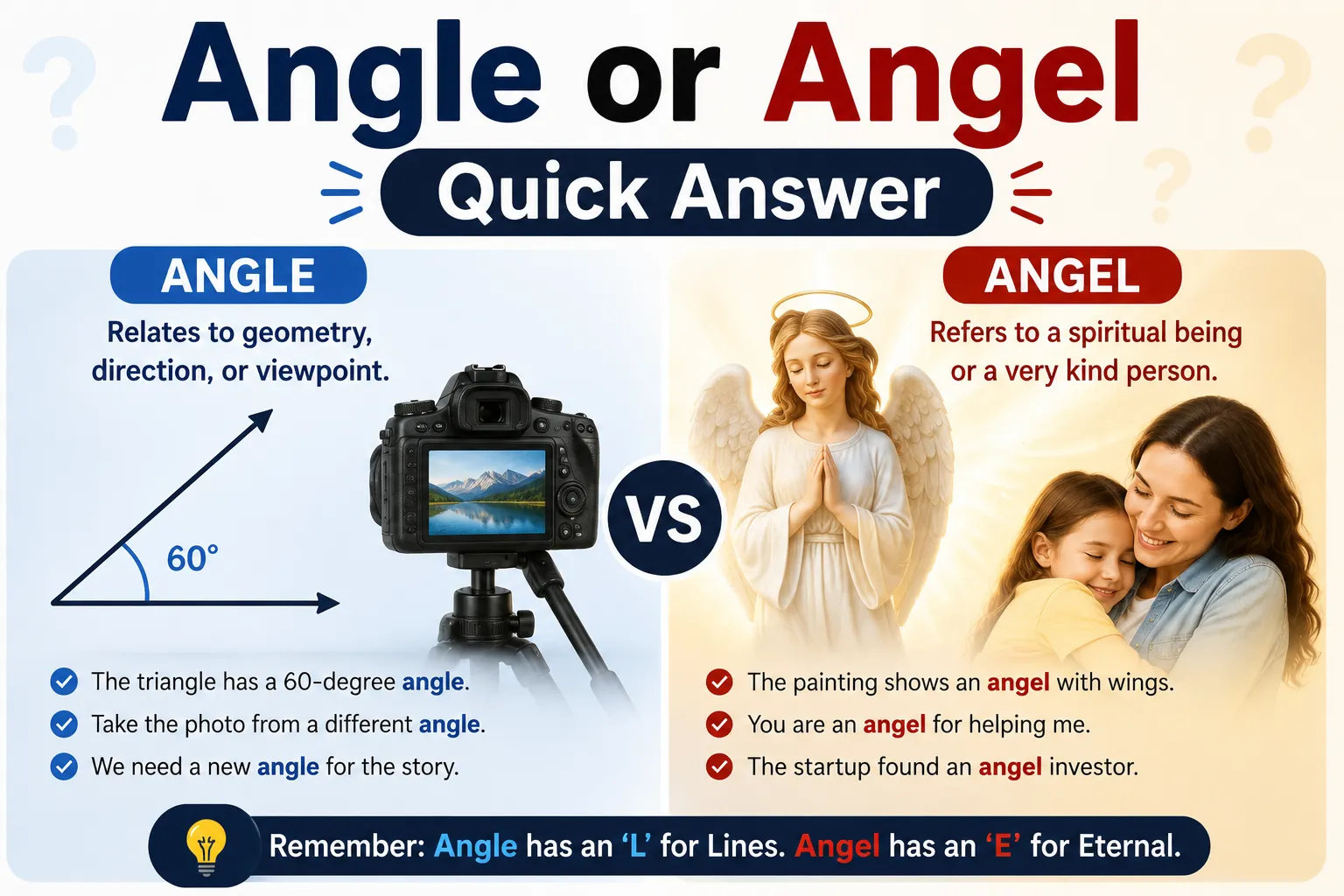
Angle and angel are both correct English words, but they mean different things.
Angle
Angle usually means the space between two lines or surfaces. It can also mean a direction, viewpoint, or way of presenting an idea.
Examples:
- “The triangle has a 60-degree angle.”
- “Take the photo from a different angle.”
- “We need a new angle for the story.”
Angel
Angel usually means a spiritual being believed to serve as a messenger of God. It can also describe a very kind or helpful person.
Examples:
- “The painting shows an angel with wings.”
- “You are an angel for helping me.”
- “The child looked like a little angel.”
The easiest difference
Think:
Angle = geometry, direction, or viewpoint.
Angel = spiritual being or kind person.
| Word | Meaning | Example |
|---|---|---|
| angle | Space between lines | “The angle is 90 degrees.” |
| angle | Viewpoint | “Look at it from another angle.” |
| angle | Approach to a story | “The journalist found a new angle.” |
| angel | Spiritual being | “An angel appeared in the painting.” |
| angel | Kind person | “Thanks. You are an angel!” |
| angel | Business investor | “The startup found an angel investor.” |
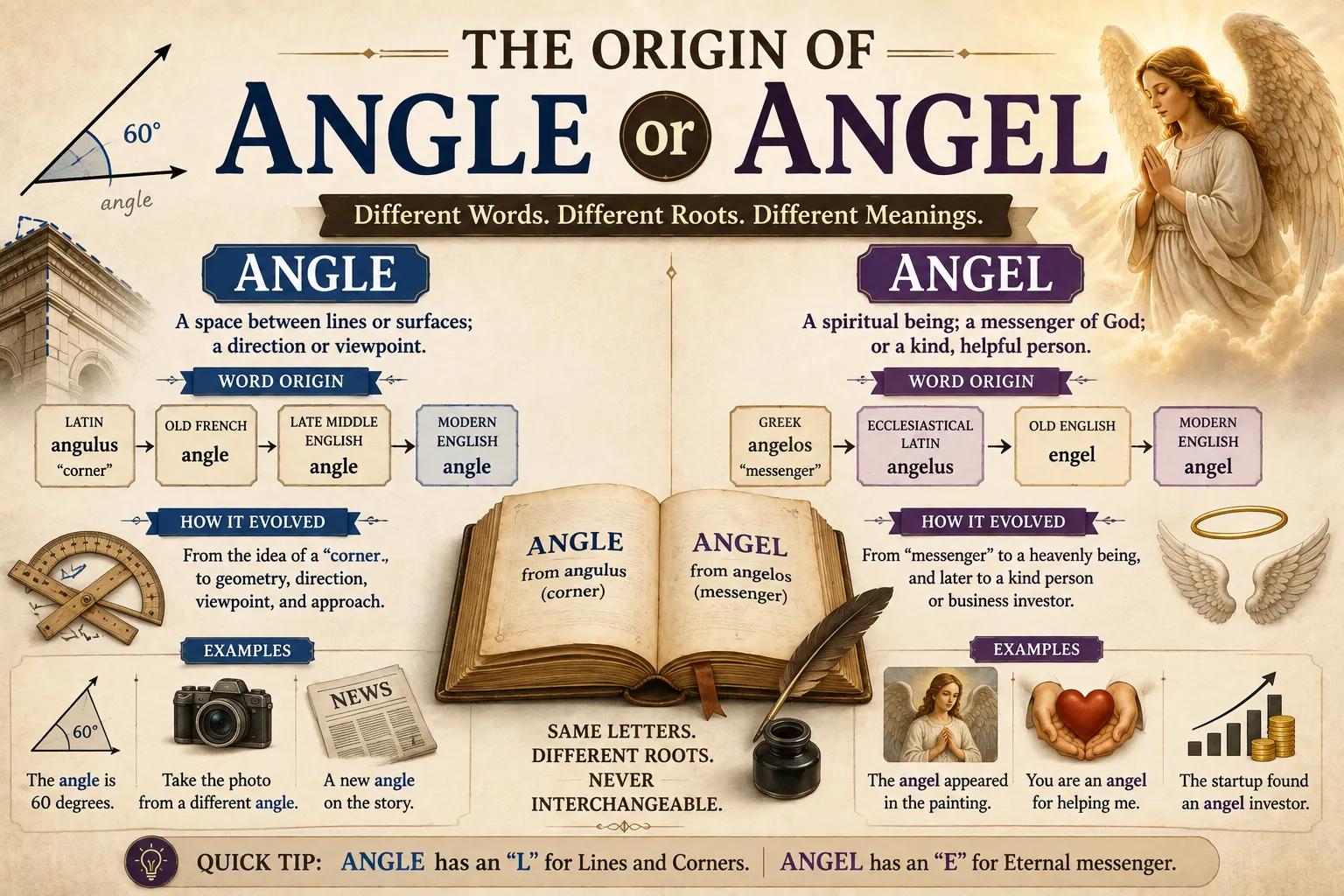
Although angle and angel look similar, they come from different historical roots.
The Origin of Angle
The noun angle comes from Late Middle English. Oxford traces it through Old French to the Latin angulus, meaning “corner.”
This history makes sense because an angle is formed where lines or surfaces meet.
The word developed from the idea of a corner into the modern meanings we use today:
- an angle in geometry
- an angle of a building
- a camera angle
- an angle of vision
- a particular angle or viewpoint
Oxford also records the modern meaning of angle as a particular way of presenting or thinking about a situation.
The Origin of Angel
Angel has a different history. Oxford traces it to Old English engel, ultimately through Ecclesiastical Latin from Greek angelos, meaning “messenger.” It later developed through forms influenced by Old French.
The original idea of a messenger is closely connected to the religious meaning of the word.
Today, angel can mean:
- a heavenly or spiritual being
- a kind person
- a person who helps someone
- an investor who provides money to a business
The business meaning appears in phrases such as angel investor and business angel.
Why Are They So Easy to Confuse?
The spelling is similar:
angle → A-N-G-L-E
angel → A-N-G-E-L
Only the final two letters change places.
The pronunciation also helps explain the confusion. In standard English, angle begins with the sound /æŋ/, while angel begins with /eɪn/. Cambridge lists these different pronunciations in both British and American English.
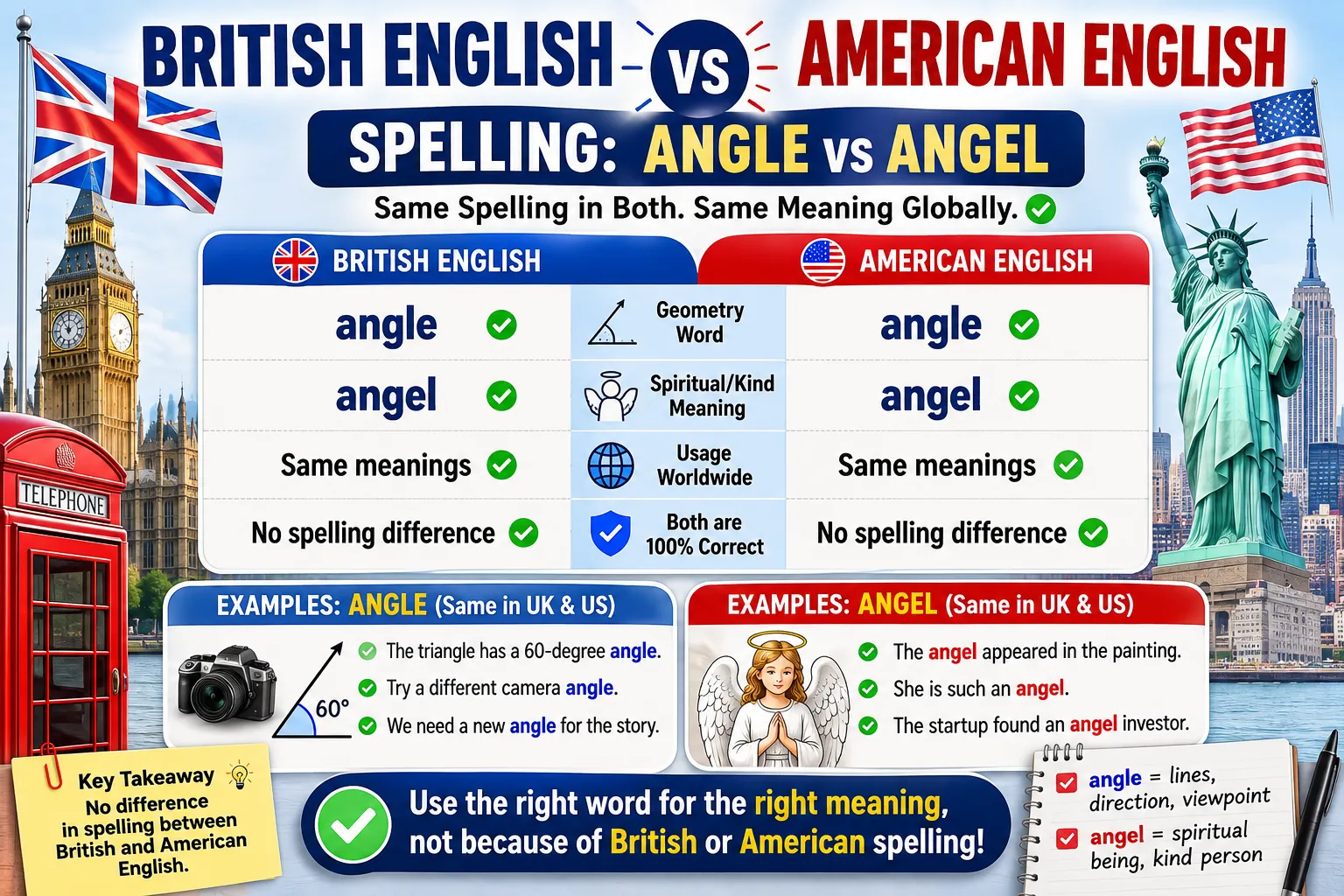
There is no British-versus-American spelling difference between angle and angel.
Both British English and American English use:
- angle
- angel
The meanings are also essentially the same.
Cambridge provides both UK and US pronunciations for each word, while Oxford has separate British and American dictionary entries without changing the spelling.
Comparison Table
| Feature | British English | American English |
|---|---|---|
| Geometry word | angle | angle |
| Spiritual word | angel | angel |
| Meaning of angle | Same | Same |
| Meaning of angel | Same | Same |
| Spelling difference | None | None |
| Pronunciation | Slight accent differences may occur | Slight accent differences may occur |
| Common mistake | Mixing the two words | Mixing the two words |
So, unlike colour/color or centre/center, this is not a British vs American spelling issue.
If you write angle or angel, the correct choice depends on your meaning, not your country.
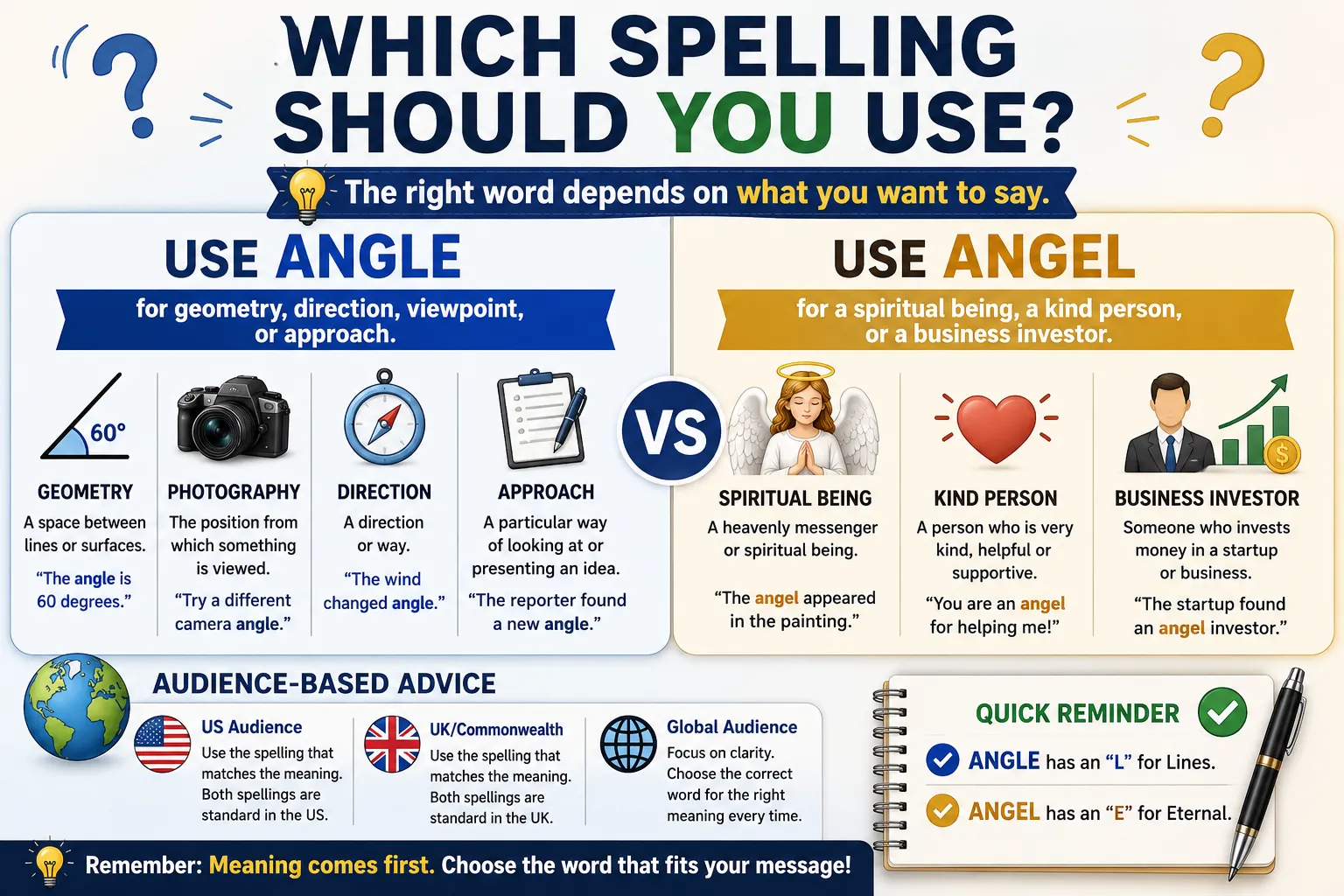
The answer depends on what you want to say.
Use “angle” for Geometry
Use angle when talking about degrees, lines, shapes, or measurements.
“The triangle has three angles.”
“The angle is 45 degrees.”
Use “angle” for Photography
Use angle when describing the position or direction from which something is viewed.
“Try taking the picture from a lower angle.”
Oxford lists angle as a position from which you look at something.
Use “angle” for Ideas or Stories
Use angle when you mean a particular approach or viewpoint.
“The reporter found an interesting angle for the article.”
“Let’s look at the problem from another angle.”
This meaning is common in journalism, advertising, business, and everyday discussion.
Use “angel” for Spiritual Beings
Use angel when referring to a spiritual being.
“The story describes an angel with wings.”
Oxford defines an angel as a spirit believed to serve God and deliver messages or perform tasks.
Use “angel” for a Kind Person
You can also call someone an angel when they are very helpful or kind.
“You brought me coffee? You are an angel!”
Cambridge gives this informal use as a way to describe someone who is very good, helpful, or kind.
Use “angel” in Business
In business, an angel investor is someone who invests money in a business, often a new or small company.
“The startup received funding from an angel investor.”
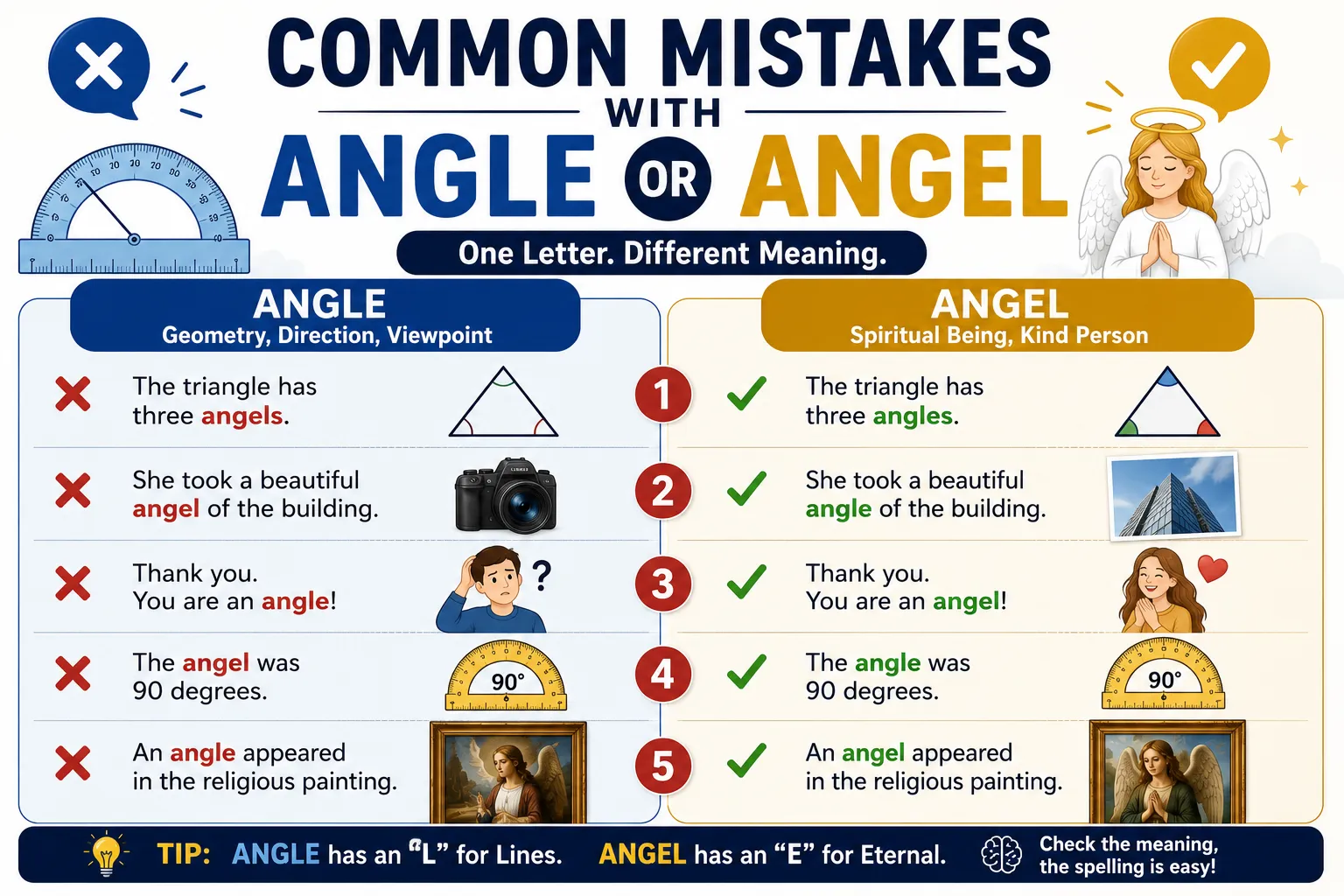
Because these words look so similar, spelling mistakes are common.
Mistake 1: “The triangle has three angels.”
❌ The triangle has three angels.
✅ The triangle has three angles.
A triangle has angles, not angels.
Mistake 2: “She took a beautiful angel of the building.”
❌ She took a beautiful angel of the building.
✅ She took a beautiful angle of the building.
A photograph can have an angle.
Mistake 3: “Thank you. You are an angle.”
❌ You are an angle.
✅ You are an angel.
If you are praising someone for being kind, use angel.
Mistake 4: “The angel was 90 degrees.”
❌ The angel was 90 degrees.
✅ The angle was 90 degrees.
Degrees measure angles.
Mistake 5: “An angle appeared in the religious painting.”
❌ An angle appeared in the religious painting.
✅ An angel appeared in the religious painting.
A winged spiritual being is an angel.
Angle or Angel in Everyday Examples
Understanding real-life examples makes the difference easier to remember.
In Emails
If you are discussing a project:
“Let’s look at this issue from another angle.”
If you are thanking someone:
“You are an angel for helping me with this.”
The first refers to a viewpoint. The second describes a kind person.
In News
Angle is common in journalism.
“The reporter explored a new angle on the story.”
Here, angle means a particular way of presenting or examining a story.
On Social Media
Both words can appear in casual posts.
“I love this camera angle!”
“My grandmother is such an angel.”
The meaning makes the correct spelling clear.
In Photography
Use angle:
“The photographer changed the camera angle.”
Never use angel when you mean a camera position.
In School and Mathematics
Use angle:
“Calculate the missing angle.”
“A right angle measures 90 degrees.”
In Religious Writing
Use angel:
“The angel delivered a message.”
In Formal Writing
Both words are correct when their meanings are correct.
For example:
“The study examined the viewing angle of the camera.”
“The painting depicts an angel.”
The key is not formality. The key is choosing the word that matches the intended meaning.
Angle or Angel – Google Trends & Usage Data
People search for “angle or angel” because the words are easy to confuse. Search behavior can also reflect different meanings of the two words.
Angle has many everyday and technical uses. People may search for it when studying geometry, taking photographs, discussing viewpoints, or reading about news and business.
Angel is also widely used, but its searches can relate to religion, names, popular culture, kindness, and business terms such as angel investor.
Google Trends measures relative search interest, not the exact number of searches. Its data can be compared by location, time, and search term, but the results can change depending on the selected period and category.
This matters when comparing angle and angel. A simple search-volume comparison may mix many different meanings.
For SEO, the best approach is to understand the searcher’s intent.
Common Search Intent
| Search | Likely Intent |
|---|---|
| angle or angel | Spelling confusion |
| angle meaning | Definition |
| angel meaning | Definition |
| angle in geometry | Mathematics |
| camera angle | Photography |
| angel meaning in English | Vocabulary |
| angel investor | Business |
| right angle | Mathematics |
| guardian angel | Religion/spirituality |
If you are writing for search engines, naturally include related phrases such as angle vs angel, angle or angel spelling, angel meaning, and angle meaning. Do not repeat them unnaturally.
Angle vs Angel: Comparison Table
| Word | Correct Spelling | Main Meaning | Example |
|---|---|---|---|
| angle | A-N-G-L-E | Space between lines | “The angle is 90 degrees.” |
| angle | A-N-G-L-E | Viewpoint | “Try a different angle.” |
| angle | A-N-G-L-E | Story approach | “That is an interesting angle.” |
| angel | A-N-G-E-L | Spiritual being | “The angel had wings.” |
| angel | A-N-G-E-L | Kind person | “You are an angel.” |
| angel | A-N-G-E-L | Business investor | “She is an angel investor.” |
A Simple Memory Trick
Here is an easy way to remember them:
Angle has an “L” for Lines.
angLe → Lines
An angle is made by lines.
Angel has an “E” for Eternal.
angEl → Eternal
An angel is often connected with heaven or spiritual life.
It is not a formal spelling rule, but it is a useful memory trick.
FAQs About Angle or Angel
1. What is the difference between angle and angel?
Angle refers to a space between lines, a direction, or a viewpoint. Angel refers to a spiritual being or a very kind person.
2. Is “angle” a correct word?
Yes. Angle is a standard English word used in geometry, photography, directions, viewpoints, and many other contexts.
3. Is “angel” a correct word?
Yes. Angel is a standard English word for a spiritual being and can also describe a very kind person.
4. Is angle British or American English?
Both British and American English use angle. There is no different American spelling.
5. Is angel British or American English?
Both British and American English use angel. The spelling is the same in both varieties.
6. How can I remember angle vs angel?
Remember angle = lines. An angle is formed by lines. For angel, think of a spiritual being with wings.
7. Which is correct: “a 90-degree angle” or “a 90-degree angel”?
The correct phrase is “a 90-degree angle.” An angle is measured in degrees.
8. Which is correct: “You are an angle” or “You are an angel”?
If you mean that someone is kind or helpful, say “You are an angel.”
Conclusion: Angle or Angel?
The difference between angle and angel is small in spelling but large in meaning. Both are correct English words, but they cannot normally replace each other.
Use angle when you mean a space between lines, a direction, a camera position, or a way of looking at an idea. For example, you can talk about a 90-degree angle, a camera angle, or a new angle on a story. Cambridge and Oxford both recognize these meanings.
Use angel when you mean a spiritual being or someone who is very kind and helpful. You may also see it in business phrases such as angel investor.
There is no British-versus-American spelling difference to worry about. The correct word depends entirely on your meaning.
The easiest memory trick is simple: angle has an L for Lines, while angel can remind you of an Eternal spiritual being.
So, before choosing between angle or angel, ask yourself one question: Am I talking about lines and viewpoints, or a spiritual being and kindness? That answer will usually give you the right spelling.
Learn the difference between angle or angel, with meanings, origins, examples, spelling tips, usage advice, and ways to remember each.
you can also read about ridden or rode by clicking this link
👇👇👇
https://guideffy.com/ridden-or-rode/

I’m an experienced article writer who creates clear, engaging, and SEO-friendly content that helps readers find the information they need. I specialize in writing well-researched articles, blog posts, guides, and informative content on a wide range of topics.
My writing focuses on simple language, strong structure, accurate information, and search intent. I aim to make every article easy to read while also helping websites improve their visibility on search engines.
I enjoy turning complex topics into useful, reader-friendly content that informs, answers questions, and keeps readers engaged. Whether you need an SEO article, blog post, educational guide, or website content, I can create content tailored to your audience and goals.