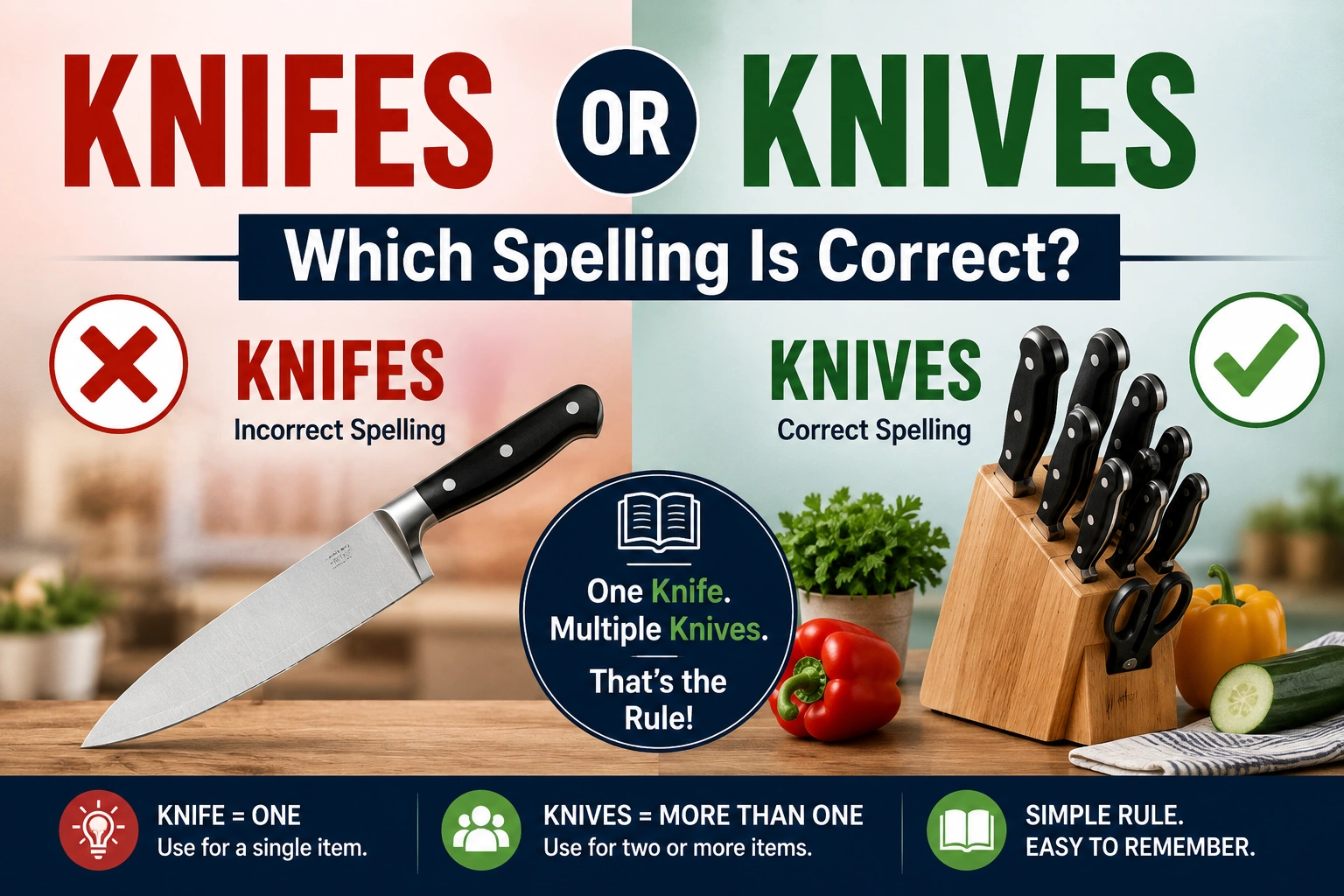
Have you ever written “knifes or knives” and wondered which spelling is correct? This is a common English spelling question because the plural form of knife does not follow the simple rule of adding -s. Instead, the word changes from knife to knives.
The correct plural spelling is knives. For example, “The chef uses several knives.” The spelling knifes is not the standard plural form of knife. However, knifes can appear as a verb in some contexts, such as “He knifes through the water,” although this use is much less common.
People search for “knifes or knives” because words ending in -fe can be confusing. English has several nouns that change -f or -fe to -ves in the plural, such as life → lives and wife → wives. But this is not true for every word ending in -f.
This guide explains the difference between knifes and knives, the history behind the spelling, British and American usage, common mistakes, everyday examples, and an easy way to remember the correct plural.
The correct plural of knife is knives. ✅
Knife → Knives
Examples:
I bought a new knife.
The chef has several knives.
Please wash the knives after dinner.
The spelling knifes is incorrect when you mean more than one knife. ❌
Why Does Knife Become Knives?
The word knife ends in -fe. When it becomes plural, the f changes to v, and -es is added:
knife → knives
This pattern also appears in some other common English words:
- life → lives
- wife → wives
- leaf → leaves
- wolf → wolves
- shelf → shelves
- half → halves
However, English has exceptions. Not every word ending in -f changes to -ves.
For example:
- roof → roofs
- chief → chiefs
- belief → beliefs
- chef → chefs
So, it is best to learn the plural form of each word.
Easy Memory Trick
Remember:
One knife, two knives.
Think of the F changing to V:
KNIFE → KNIVES
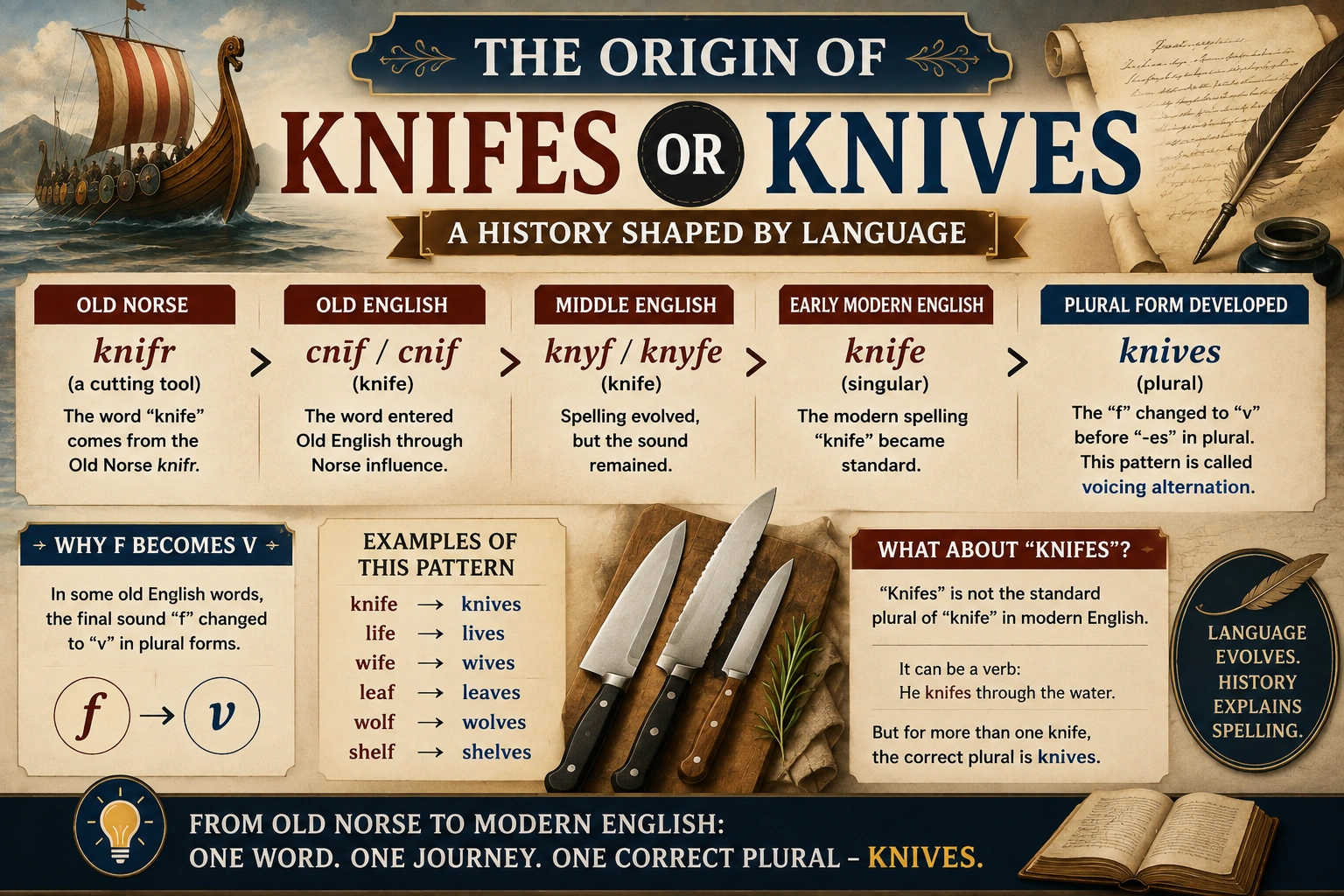
The spelling knives comes from the long history of the word knife.
The English word knife comes from Old Norse knifr, referring to a cutting tool. It entered English through the historical contact between Norse speakers and English speakers. The modern spelling developed over many centuries.
The plural form knives reflects an old English pattern of changing a consonant sound when forming certain plurals. Linguists often call this type of change voicing alternation.
In earlier stages of English, some nouns ending in sounds such as f developed plural forms with a v sound. Over time, these forms became established in everyday English.
That is why we have:
- knife → knives
- life → lives
- wife → wives
- leaf → leaves
The spelling is therefore not a random modern rule. It is the result of historical changes in English pronunciation and spelling.
Why Not “Knifes”?
If English always formed plurals by adding -s, we might expect:
knife → knifes
But English has many irregular and historical plural patterns. Knives became the standard plural form, so knifes is not used as the normal plural noun.
There is one important detail: knifes can be a verb form in certain contexts.
For example:
The fish knifes through the water.
Here, knifes is the third-person singular form of the verb knife, not the plural of the noun knife.
For normal plural writing, always use knives.
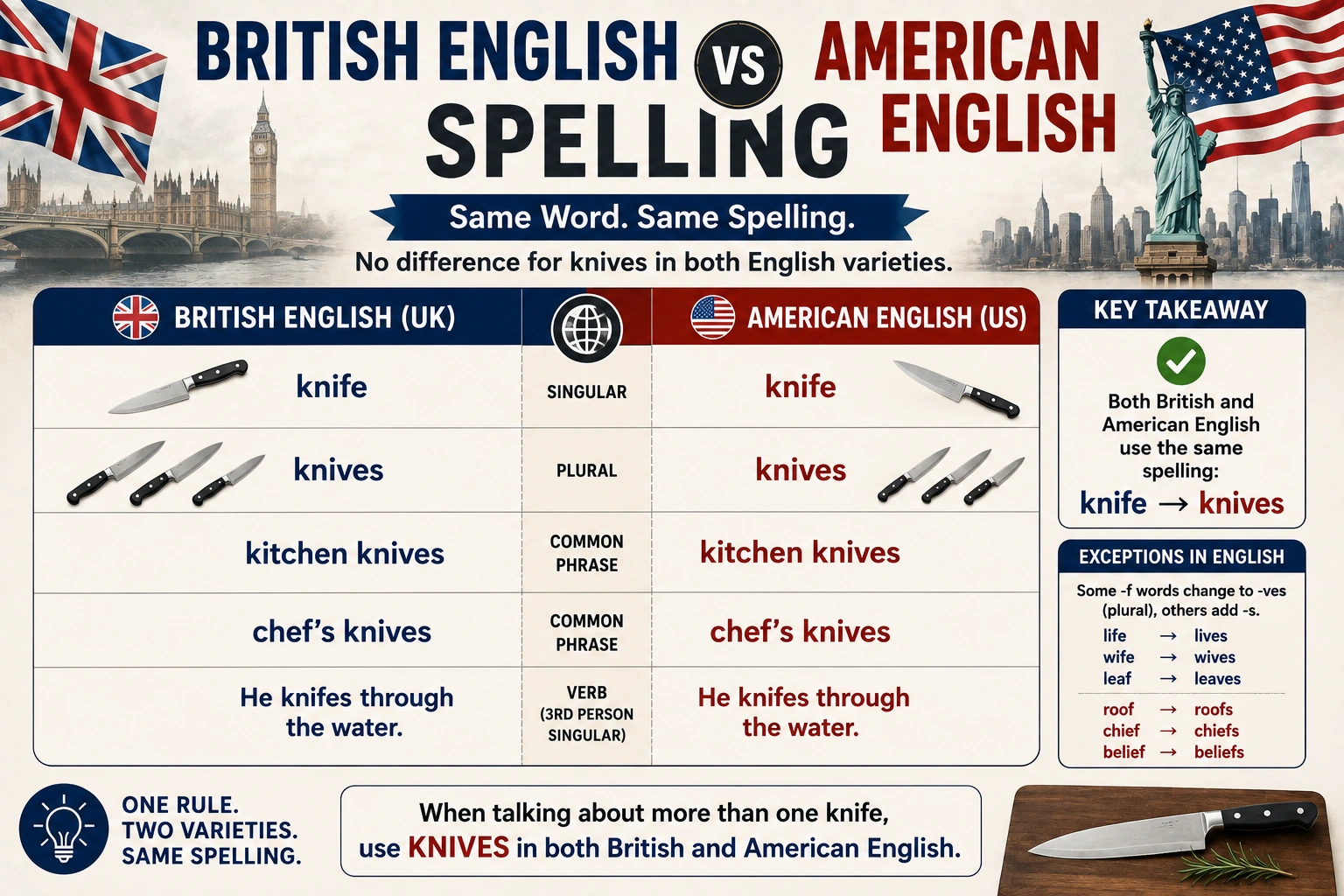
There is no spelling difference between British English and American English for the plural noun knives.
Both varieties use:
knife → knives
| Word | British English | American English |
|---|---|---|
| Singular | knife | knife |
| Plural | knives | knives |
| Incorrect plural | knifes | knifes |
| Verb | knifes | knifes |
The spelling knives is standard in both British and American English.
Comparison With Similar Words
| Singular | Plural |
|---|---|
| knife | knives |
| life | lives |
| wife | wives |
| leaf | leaves |
| wolf | wolves |
| shelf | shelves |
| roof | roofs |
| chief | chiefs |
This table shows why English spelling can be tricky. Some words ending in -f change to -ves, while others simply add -s.
Which Spelling Should You Use?
Whether you write for a US, UK, Commonwealth, or global audience, use knives when referring to more than one knife.
For American English
Use:
The kitchen has several knives.
For British English
Use:
The kitchen has several knives.
For Global English
Use:
The chef carefully arranged the knives.
There is no need to change knives based on the country.
Singular vs Plural
Use knife for one:
I need a sharp knife.
Use knives for two or more:
I need several knives.
A Useful Rule
Do not assume every word ending in -f changes to -ves.
Learn common forms individually:
knife → knives
roof → roofs
This will help you avoid many spelling errors.
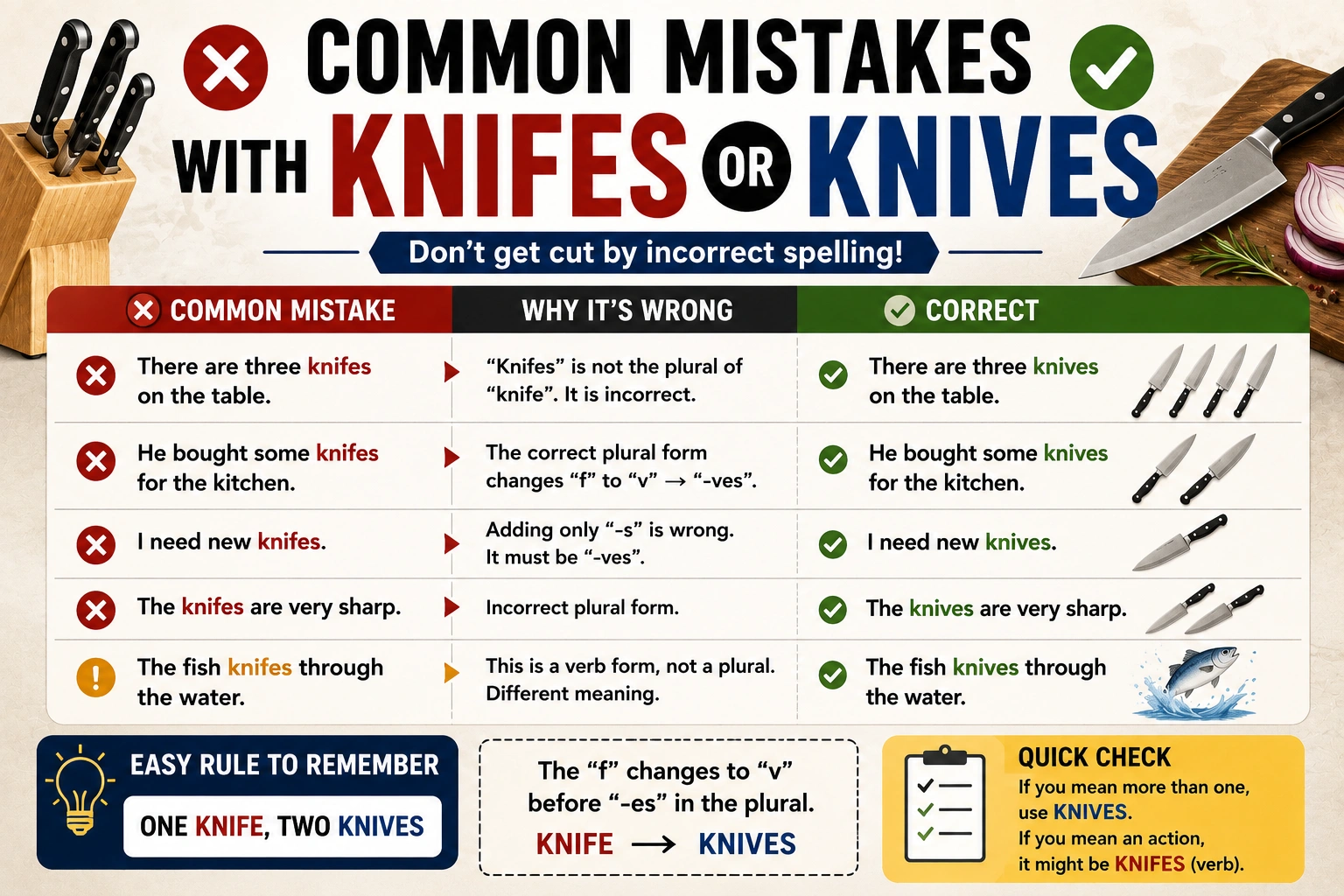
Mistake 1: Using “knifes” as the plural
❌ There are three knifes on the table.
✅ There are three knives on the table.
Mistake 2: Adding only “s”
❌ one knife → two knifes
✅ one knife → two knives
Mistake 3: Forgetting the “e” change
Some writers may create other incorrect forms such as knivs.
❌ knivs
✅ knives
The correct plural changes f → v and adds -es.
Mistake 4: Applying the rule to every -f word
It would be wrong to assume:
roof → rooves
The standard plural is:
roof → roofs
English has many exceptions, so check the specific word when you are unsure.
Mistake 5: Confusing the noun and verb
Knives is the plural noun:
The knives are clean.
Knifes can be a verb form:
The boat knifes through the waves.
These have different grammatical functions.
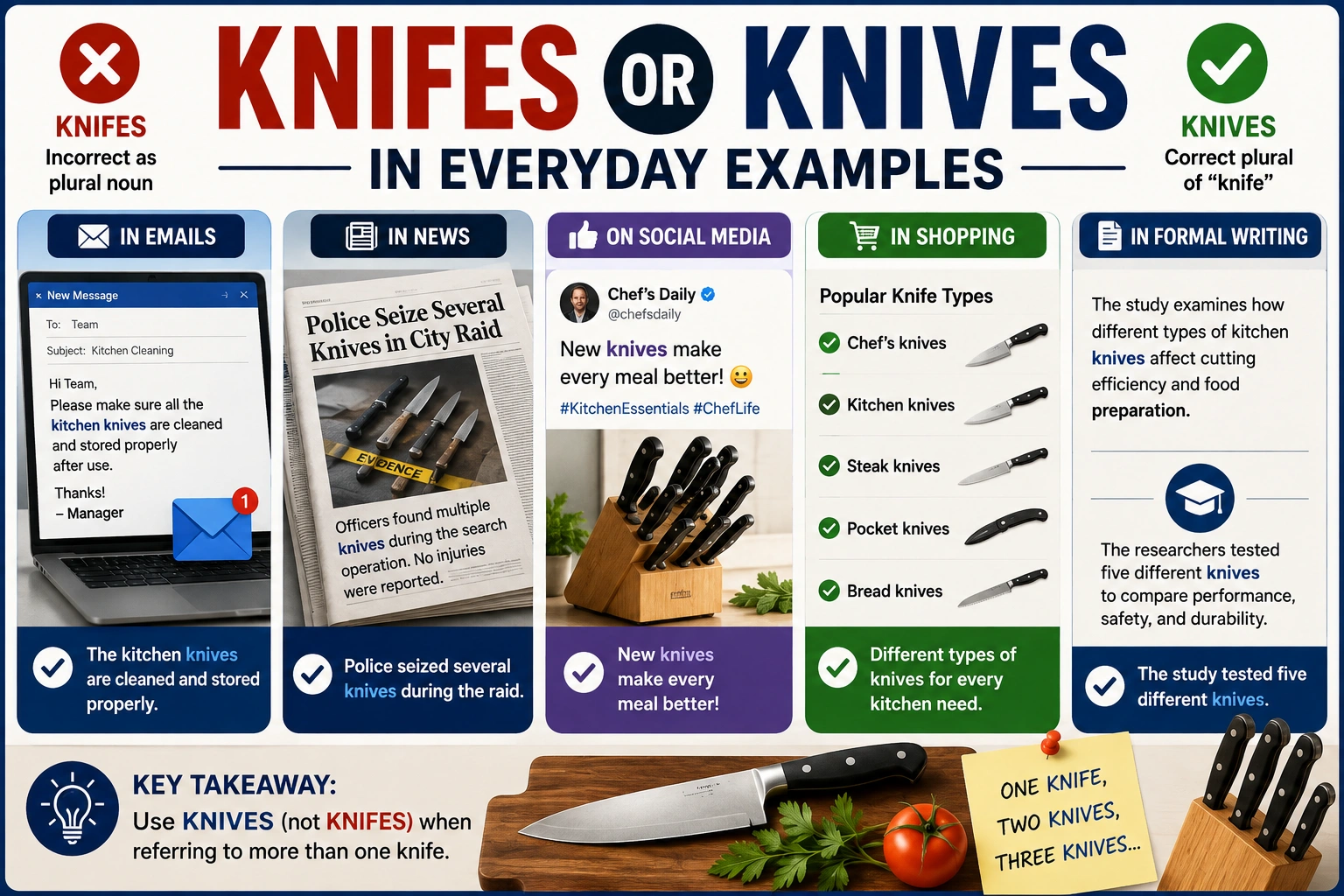
The word knives appears in many everyday situations.
In Emails
Please make sure all the kitchen knives are cleaned before closing.
Here, knives is the plural noun.
In News
Officials reported that several knives were found at the scene.
Again, knives refers to more than one knife.
On Social Media
These are my favorite kitchen knives.
The plural form is knives, not knifes.
In Formal Writing
The study examined how different types of kitchen knives perform during food preparation.
Formal writing uses the same plural spelling.
In Shopping
You might see phrases such as:
- kitchen knives
- chef’s knives
- table knives
- pocket knives
- butter knives
In all of these examples, knives is the correct plural spelling.
Singular and Plural Examples
| Singular | Plural |
|---|---|
| I bought one knife. | I bought two knives. |
| The knife is clean. | The knives are clean. |
| This knife is sharp. | These knives are sharp. |
| She needs a knife. | She needs several knives. |
Knifes or Knives – Google Trends & Usage Data
People search for “knifes or knives” mainly because the plural spelling is irregular and easy to confuse with the simple -s plural rule.
Related searches include:
- knifes or knives
- knife plural
- plural of knife
- knife or knives
- is knives correct
- knives spelling
- how to spell knives
Search interest can vary by country and time. Google Trends data is also affected by the exact search term, location, language, and selected time period. For that reason, exact popularity numbers should be checked for a specific country and date range rather than presented as permanent statistics.
The word knives is common in everyday English because it appears in many contexts, especially cooking, dining, household products, writing, and general descriptions.
The spelling question is especially useful for students, English learners, writers, and anyone checking the plural form of knife.
Knifes vs Knives Comparison Table
| Feature | Knifes | Knives |
|---|---|---|
| Standard plural of knife | ❌ No | ✅ Yes |
| Refers to multiple knives | ❌ | ✅ |
| Standard British English | ❌ | ✅ |
| Standard American English | ❌ | ✅ |
| Can be a verb? | ✅ Sometimes | ❌ |
| Example | He knifes through the water. | The knives are clean. |
The most important distinction is this:
Knives is the plural noun. Knifes can be a verb, but it is not the standard plural of knife.
FAQs About Knifes or Knives
1. Is it “knifes” or “knives”?
Knives is the correct plural of knife.
One knife → two knives.
2. Why does knife become knives?
The plural developed from historical changes in English where the f sound changed to a v sound in certain words.
3. Is “knifes” ever correct?
Yes, but not as the normal plural noun. Knifes can be the third-person singular form of the verb knife in some contexts.
4. Is “knives” correct in American English?
Yes. Knives is the standard plural spelling in American English.
5. Is “knives” correct in British English?
Yes. British English also uses knives.
6. What is the singular of knives?
The singular form is knife.
One knife → many knives.
7. What is the easiest way to remember the spelling?
Remember:
Knife → Knives
The f changes to v, and -es is added.
Conclusion
The correct answer to “knifes or knives” is simple: knives is the standard plural of knife. If you are talking about more than one knife, always write knives.
For example, you should write “The chef has three knives,” not “The chef has three knifes.” The spelling changes because knife follows a historical English pattern in which the f changes to v before the plural ending.
This spelling is the same in British English and American English, so writers around the world can use knives with confidence. The main thing to remember is that English does not use one simple rule for every word ending in -f. Some words change to -ves, while others simply take -s.
One useful memory trick is “one knife, two knives.” Once you remember this pair, the correct spelling becomes much easier. Also remember that knifes can appear as a verb in some sentences, but it is not the normal plural form.
So, whenever you mean more than one knife, choose knives.
you can also read about address or adress by clicking this link

I’m an experienced article writer who creates clear, engaging, and SEO-friendly content that helps readers find the information they need. I specialize in writing well-researched articles, blog posts, guides, and informative content on a wide range of topics.
My writing focuses on simple language, strong structure, accurate information, and search intent. I aim to make every article easy to read while also helping websites improve their visibility on search engines.
I enjoy turning complex topics into useful, reader-friendly content that informs, answers questions, and keeps readers engaged. Whether you need an SEO article, blog post, educational guide, or website content, I can create content tailored to your audience and goals.