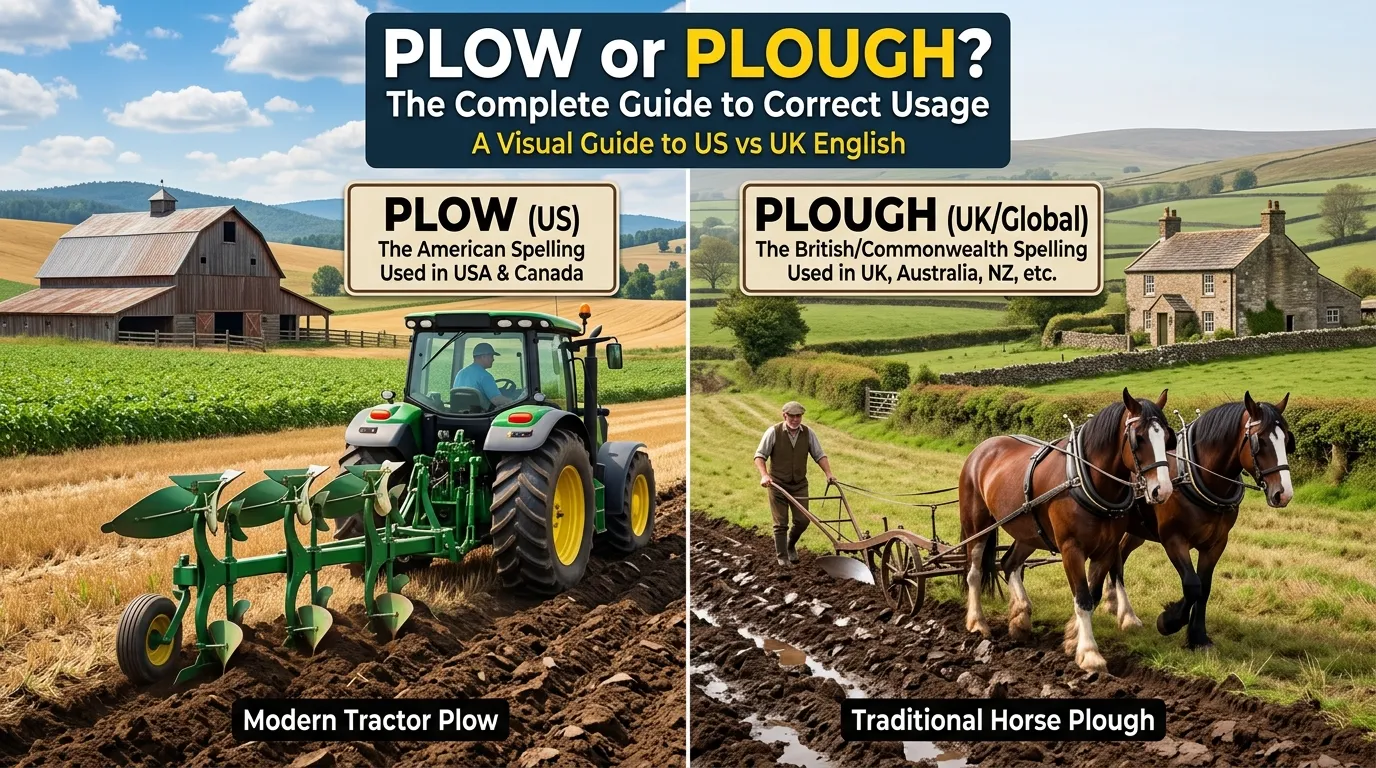
Plow and plough mean the same thing: a farming tool or the act of turning soil for planting crops. Plow is the American spelling, while plough is the British spelling.
I still remember reading an American farming magazine and seeing the word plow on nearly every page. Later, while reading a British gardening guide, I noticed the same tool was called a plough. At first, I thought they were different pieces of equipment. They were not.
Many English learners face this same confusion. You may see plow in American books, websites, and news articles. Then you come across plough in British publications. Since both words look quite different, it is easy to wonder whether one is correct and the other is a mistake.
The truth is much simpler. Both spellings refer to the same farming tool and the same action of preparing land for planting. The only real difference is the variety of English being used.
If you have ever stopped while writing and asked, “Should I use plow or plough?” this guide will give you a clear answer. You will learn the history behind both spellings, understand when to use each one, and see real-world examples that make the distinction easy to remember.
Plow or Plough – Quick Answer
Both plow and plough refer to:
A farm tool used to turn over soil before planting crops.
They can also be used as verbs meaning to prepare land by turning the soil.
- Plow = American English
- Plough = British English
Example 1
- American English: Farmers plow the fields each spring.
- British English: Farmers plough the fields each spring.
Example 2
- The tractor pulled a plow across the field.
- The tractor pulled a plough across the field.
The meaning remains exactly the same.
The Origin / Background of Plow or Plough
The word comes from Old English and has existed for hundreds of years. Early forms of the word appeared as ploh and similar spellings.
As English evolved, different spelling traditions developed.
British English kept the traditional spelling plough.
American English later simplified many words, resulting in plow.
This pattern appears in other words as well:
- Draught → Draft
- Mould → Mold
- Plough → Plow
The difference is purely a spelling preference based on region.
Plow or Plough Explained : Key Differences
There is no difference in meaning.
| Term | Meaning | When to Use | Region/Context |
|---|---|---|---|
| Plow | Tool for turning soil | American writing | United States |
| Plough | Tool for turning soil | British writing | UK, Australia, New Zealand |
| Plow | To prepare land for crops | American English | Farming and agriculture |
| Plough | To prepare land for crops | British English | Farming and agriculture |
Example Sentences
Plow
- The farmer used a plow before planting corn.
- They plow the land every season.
Plough
- The farmer repaired his plough before harvest.
- They plough the field after the rain.
Which Version Should You Use?
For American Readers
Use plow because it follows American spelling conventions.
For British Readers
Use plough because it matches British English standards.
For Farmers and Agricultural Writers
Use whichever spelling matches your audience and publication style.
For International Audiences
Either spelling is correct, but choose one and stay consistent.
Recommended Rule
- US audience → Plow
- UK audience → Plough
- Global audience → Either, but use one style throughout
Common Mistakes with Plow or Plough
| Mistake | Correction | Why It Happens |
|---|---|---|
| Mixing plow and plough in one article | Use one spelling consistently | Different English styles |
| Assuming plough is outdated | It is still widely used | Regional misunderstanding |
| Assuming plow is incorrect | It is standard American English | Lack of awareness |
| Changing spellings randomly | Follow one style guide | Consistency matters |
| Thinking they have different meanings | Both mean the same thing | Spelling confusion |
Common Error 1
❌ The farmer used a plow and later repaired his plough.
✅ The farmer used a plow and later repaired his plow.
Common Error 2
❌ Plough is wrong.
✅ Plough is the standard British spelling.
Common Error 3
❌ Plow and plough are different farming tools.
✅ They are the same tool with different spellings.
Plow or Plough in Real-World Examples
Professional Email
“The new plow equipment will arrive next week.”
“The new plough equipment will arrive next week.”
News Headline
“Farmers Use Modern Plows to Increase Productivity”
“Farmers Use Modern Ploughs to Increase Productivity”
Social Media Post
“Just watched a tractor plow an entire field in one afternoon.”
“Just watched a tractor plough an entire field in one afternoon.”
Formal Report
“The company purchased three new plows for agricultural operations.”
“The company purchased three new ploughs for agricultural operations.”
Plow or Plough : Data, Trends & Usage
Regions Where Plow Is Common
- United States
- American farming publications
- US schools and universities
Regions Where Plough Is Common
- United Kingdom
- Australia
- New Zealand
- Ireland
Search Intent
The search intent is mainly informational.
People want to know:
- Which spelling is correct
- Whether there is a difference
- Which version to use in writing
Why This Matters Today
Agricultural content is shared globally. Writers, students, and businesses often communicate across countries. Knowing the correct regional spelling helps maintain professionalism and clarity.
Standalone Comparison Table
| Term/Variant | Meaning | Region/Context | Best Used When |
|---|---|---|---|
| Plow | Farming tool or action | American English | Writing for US readers |
| Plough | Farming tool or action | British English | Writing for UK readers |
| Plow | Turn soil for planting | American agriculture | Following US style |
| Plough | Turn soil for planting | British agriculture | Following UK style |
Frequently Asked Questions
Q: What does plow or plough mean?
A: Both words refer to a farming tool used to turn soil or the action of preparing land for planting.
Q: How do you use plow or plough correctly?
A: Use plow in American English and plough in British English.
Q: Plow vs plough : what’s the difference?
A: The only difference is spelling. Their meanings and usage are identical.
Q: Is plough acceptable in formal writing?
A: Yes. It is the standard spelling in British English and is widely accepted in formal documents.
Q: Which version is correct : plow or plough?
A: Both are correct. The right choice depends on your audience and writing style.
Q: Where does the word come from?
A: It comes from Old English and has been used for centuries in agriculture.
Q: Can plow or plough be used as a verb?
A: Yes. Both can mean to turn over soil in preparation for planting crops.
Conclusion
The choice between plow and plough comes down to regional spelling preferences. Both words refer to the same farming tool and the same agricultural action.
Remember these key points:
- Plow is the American spelling.
- Plough is the British spelling.
- Both have identical meanings.
- Neither spelling is more correct than the other.
- Consistency is the most important rule.
Once you know who your audience is, choosing the right spelling becomes easy. Use plow for American readers and plough for British readers.
Now you know exactly when to use plow or plough. Bookmark this guide so you never hesitate over the spelling again, and share it with anyone who has been confused by these two words.

I am Oliver Kentwood, an English author fascinated by the quirks of language. I explore correct and incorrect spellings, helping readers navigate common confusions with clarity and style.