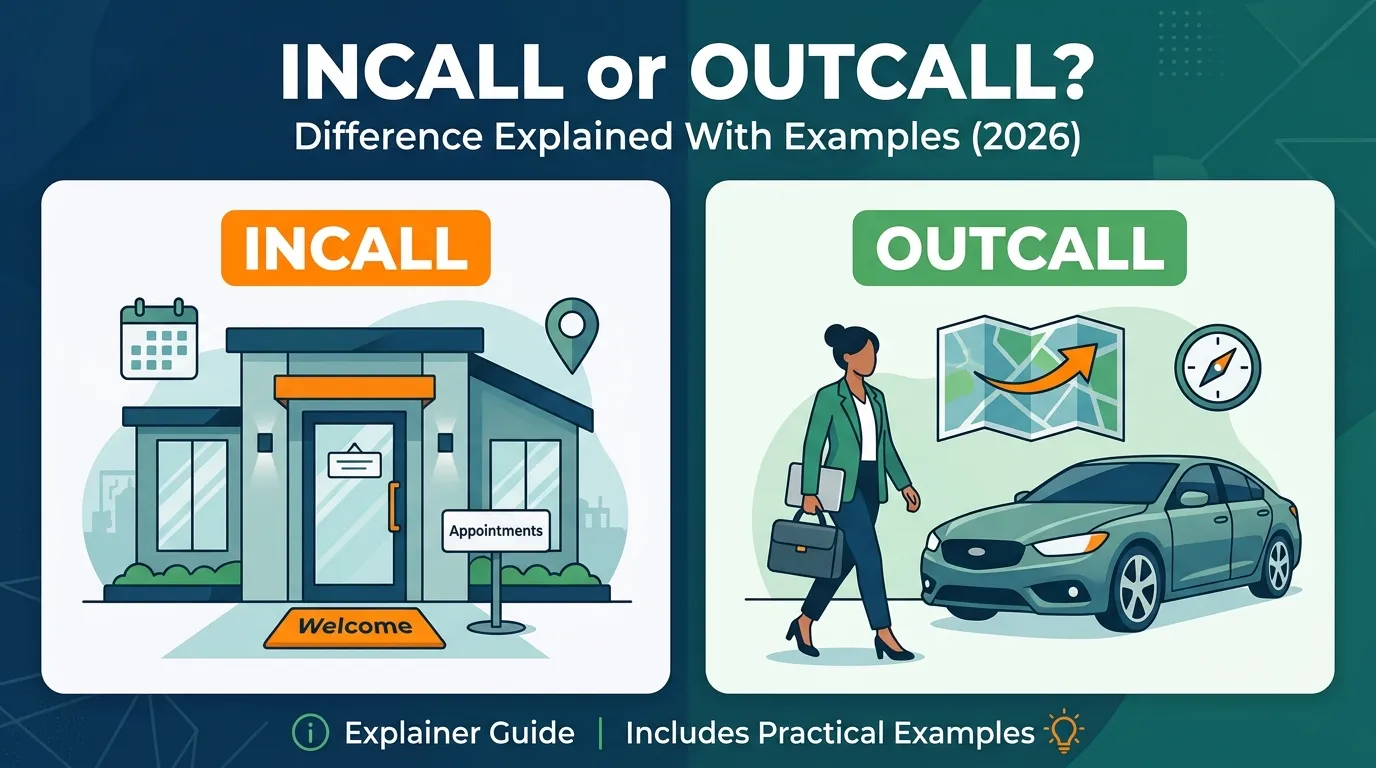
An incall service means the client goes to the provider’s location, while an outcall service means the provider travels to the client’s location.
If you’ve ever booked a mobile service such as a massage, beauty appointment, repair technician, or private consultation, you may have come across the terms incall and outcall. At first glance, they can seem confusing because both involve the same service but in different locations.
Understanding the difference is important because it affects:
- where the appointment takes place
- travel costs
- scheduling
- convenience
- pricing
People search for “incall or outcall” because they want to know:
- what each term means
- which option is better
- how they differ
- when to choose one over the other
- whether one costs more than the other
The good news is that the distinction is simple. The key difference is who travels—the client or the service provider.
In this guide, you’ll learn the meanings, examples, advantages, disadvantages, common uses, and practical tips for choosing between incall and outcall services.
Incall or Outcall – Quick Answer
👉 Incall = The client travels to the service provider.
👉 Outcall = The service provider travels to the client.
Examples
- You visit a therapist’s office. → Incall ✅
- A technician comes to your home. → Outcall ✅
Simple Rule
👉 You travel = Incall
👉 They travel = Outcall
What Does Incall Mean?
An incall appointment takes place at the provider’s location.
This could be:
- an office
- a clinic
- a studio
- a salon
- a business location
The customer travels to receive the service.
Example 1
- A client visits a massage clinic for an appointment.
Example 2
- A student attends a tutoring session at the tutor’s office.
Example 3
- A customer goes to a beauty salon.
All of these are incall services.
What Does Outcall Mean?
An outcall appointment occurs when the service provider travels to the client’s location.
This may include:
- homes
- hotels
- workplaces
- event venues
Example 1
- A plumber visits your house.
Example 2
- A mobile hairdresser comes to your home.
Example 3
- A consultant visits your office.
All of these are outcall services.
Incall vs Outcall – Main Difference
The difference comes down to travel.
| Feature | Incall | Outcall |
|---|---|---|
| Client travels | Yes | No |
| Provider travels | No | Yes |
| Location | Provider’s place | Client’s place |
| Travel fee | Usually none | Often included |
| Convenience for client | Lower | Higher |
Key Point
The service itself may be identical. Only the location changes.
Which Option Costs More?
In many industries:
👉 Outcall services often cost more.
Why?
Because the provider may need to cover:
- travel time
- transportation costs
- fuel expenses
- scheduling adjustments
Example
A mobile beauty appointment may cost more than a salon appointment because the stylist travels to you.
However, pricing varies by business and industry.
Advantages of Incall Services
Many customers choose incall appointments because they can be more affordable.
Benefits
- Lower cost
- Professional environment
- Access to specialized equipment
- More appointment availability
- Consistent service setting
Example
A physical therapist may have equipment available only at their clinic.
Advantages of Outcall Services
Outcall services focus on convenience.
Benefits
- No travel required
- Saves time
- Greater comfort
- Convenient for busy schedules
- Useful for people with mobility challenges
Example
A mobile mechanic repairs your vehicle at your location instead of requiring a shop visit.
Common Industries Using Incall and Outcall
Healthcare
- therapists
- physiotherapists
- caregivers
Beauty Services
- hairstylists
- makeup artists
- nail technicians
Home Services
- plumbers
- electricians
- cleaners
Education
- tutors
- trainers
- coaches
Many professionals offer both options.
Incall or Outcall – Which Is Better?
The answer depends on your priorities.
Choose Incall If You Want:
- lower prices
- access to equipment
- a professional setting
- maximum availability
Choose Outcall If You Want:
- convenience
- time savings
- home service
- minimal travel
Neither option is universally better.
Everyday Examples
Example 1: Hair Appointment
Salon visit:
✔ Incall
Stylist comes to your home:
✔ Outcall
Example 2: Repair Service
You visit the repair shop:
✔ Incall
Technician comes to your house:
✔ Outcall
Example 3: Tutoring
Student attends tutor’s office:
✔ Incall
Tutor visits student’s home:
✔ Outcall
Common Mistakes with Incall and Outcall
Mistake 1
❌ Assuming incall means the provider visits you.
✔ Incall means you visit the provider.
Mistake 2
❌ Assuming outcall is always more expensive.
✔ It often is, but not always.
Mistake 3
❌ Confusing location with service quality.
✔ The quality may be identical in both cases.
Mistake 4
❌ Thinking every provider offers both options.
✔ Some offer only incall or only outcall services.
Why These Terms Are Popular
Businesses use these terms because they quickly explain:
- where the service occurs
- who travels
- how appointments are arranged
They are commonly seen in:
- booking platforms
- appointment systems
- service directories
- professional websites
Simple Trick to Remember the Difference
Easy Memory Rule
👉 Incall = Into their location
👉 Outcall = Out to your location
Quick Reminder
You go there?
✔ Incall
They come to you?
✔ Outcall
FAQs
1. What is an incall service?
An incall service is one where the client visits the provider’s location.
2. What is an outcall service?
An outcall service is one where the provider travels to the client’s location.
3. Which is usually more expensive?
Outcall services often cost more because travel is involved.
4. Is incall better than outcall?
Not necessarily. It depends on whether you prioritize cost or convenience.
5. Can a business offer both?
Yes. Many businesses provide both incall and outcall options.
6. Is outcall more convenient?
Generally, yes, because the client does not need to travel.
7. What is the easiest way to remember the difference?
Think:
👉 Incall = You go in
👉 Outcall = They go out to you
Conclusion
The difference between incall or outcall is simple once you focus on who travels.
Incall means the customer visits the provider’s location. It is often less expensive and provides access to a professional environment.
Outcall means the provider travels to the customer’s location. It is typically more convenient and may involve additional travel costs.
The easiest way to remember is:
👉 Incall = You go to them
👉 Outcall = They come to you
Understanding this distinction makes it easier to book appointments, compare service options, and choose the arrangement that best fits your schedule, budget, and preferences.

I am Oliver Kentwood, an English author fascinated by the quirks of language. I explore correct and incorrect spellings, helping readers navigate common confusions with clarity and style.