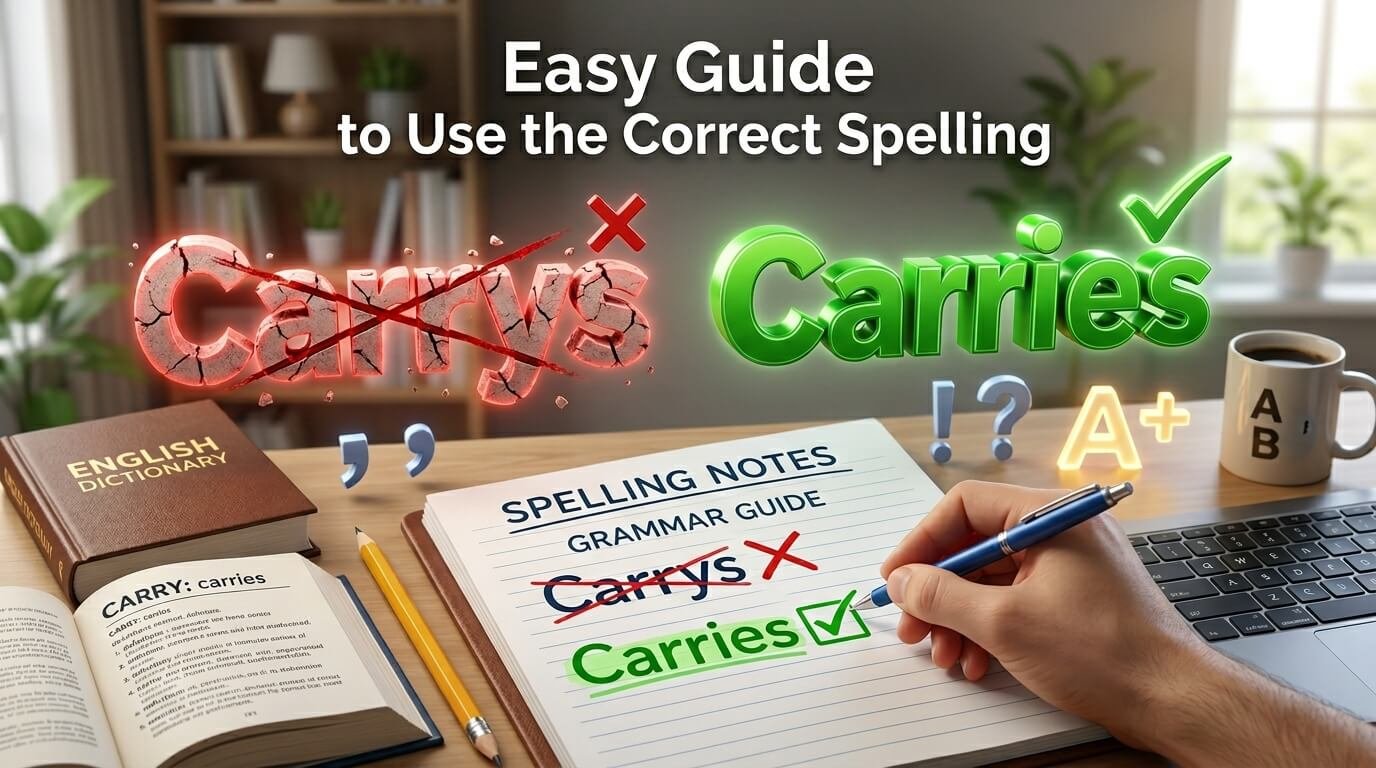
Carries is the correct spelling. Carrys is incorrect in standard English. Use carries when talking about a person, thing, or object that “carry” becomes for he, she, or it.
A few years ago, I was checking a blog article before publishing it. Everything looked fine until my eyes stopped on one sentence:
“The company carrys products across the country.”
Something felt strange right away.
I fixed it to carries, but that tiny mistake reminded me of something important. Small spelling errors happen to almost everyone. I have seen students make them. I have even seen experienced professionals pause and wonder, “Wait… is it carrys or carries?”
You may be here because you typed a sentence, looked at it again, and suddenly felt unsure. That happens because English has rules that are not always simple. Some words change in ways that people do not expect.
The good part is this: once you learn the rule behind carrys or carries, you will probably never forget it.
By the end of this guide, you will know the correct spelling, understand why people get confused, see real examples, and feel fully confident using it in your own writing.
Carrys or Carries : Quick Answer
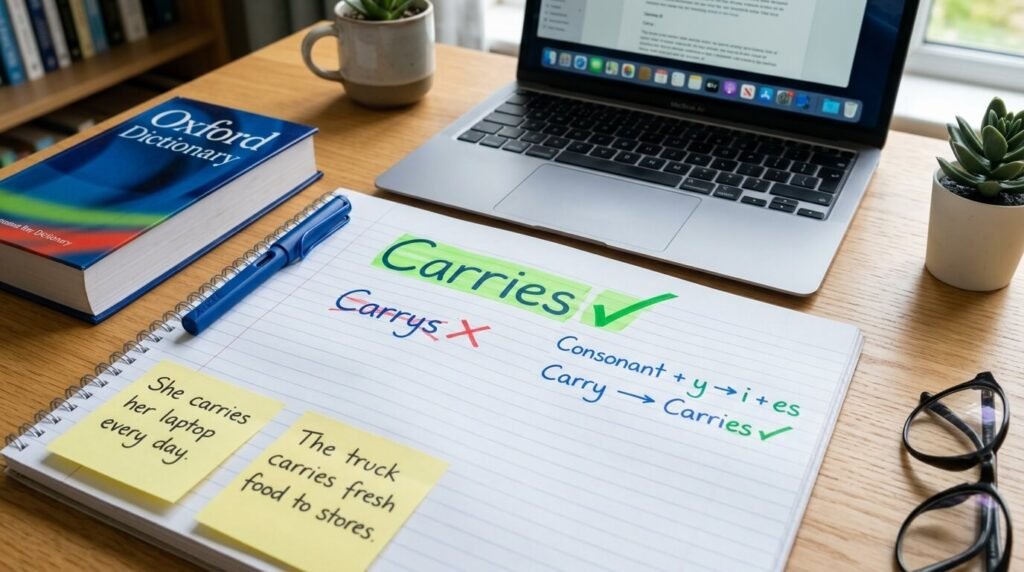
The answer is simple.
Carries is correct.
Carrys is wrong.
The word carries is the third-person singular form of carry.
Real-world examples:
- She carries her laptop every day.
- The truck carries fresh food to stores.
- He carries his keys in his pocket.
A quick memory trick:
Consonant + y = change y to i + add es
Carry → Carries ✅
Carry → Carrys ❌
The Origin / Background of Carrys or Carries
The word carry has a long history. It came from old French words and later became part of English.
The meaning stayed mostly the same. It means:
- To hold something
- To move something
- To take something from one place to another
So why does confusion happen?
People usually think adding s makes a word singular:
- Walk → Walks
- Jump → Jumps
That works for many verbs.
But words ending with a consonant and y follow another rule.
Examples:
- Study → Studies
- Try → Tries
- Fly → Flies
- Carry → Carries
Your brain often wants to simply add s, which creates carrys.
That is why so many people search for this spelling question.
Carrys or Carries Explained :Key Differences or Variations
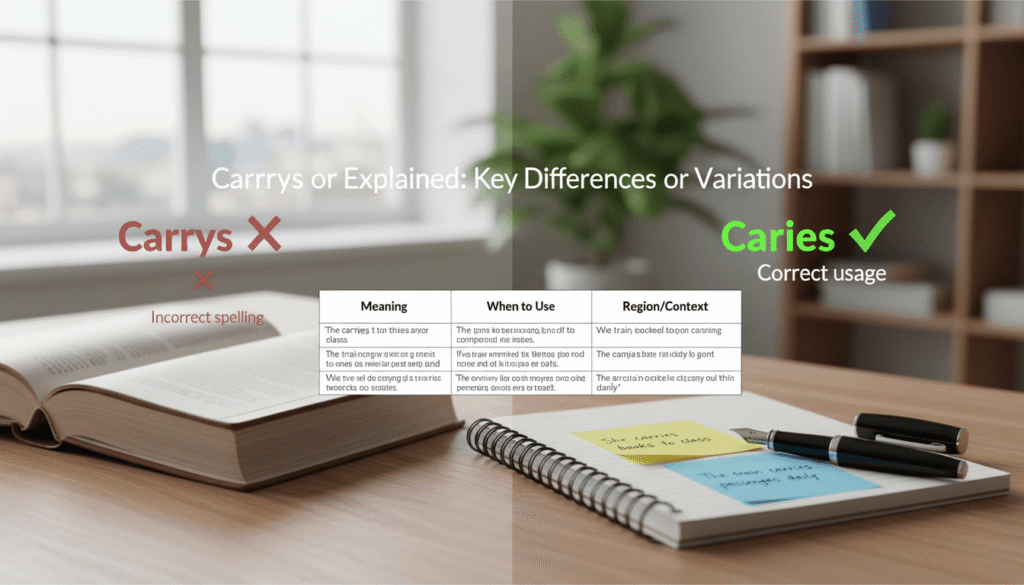
Many people think both words are accepted spellings. They are not.
Here is the difference.
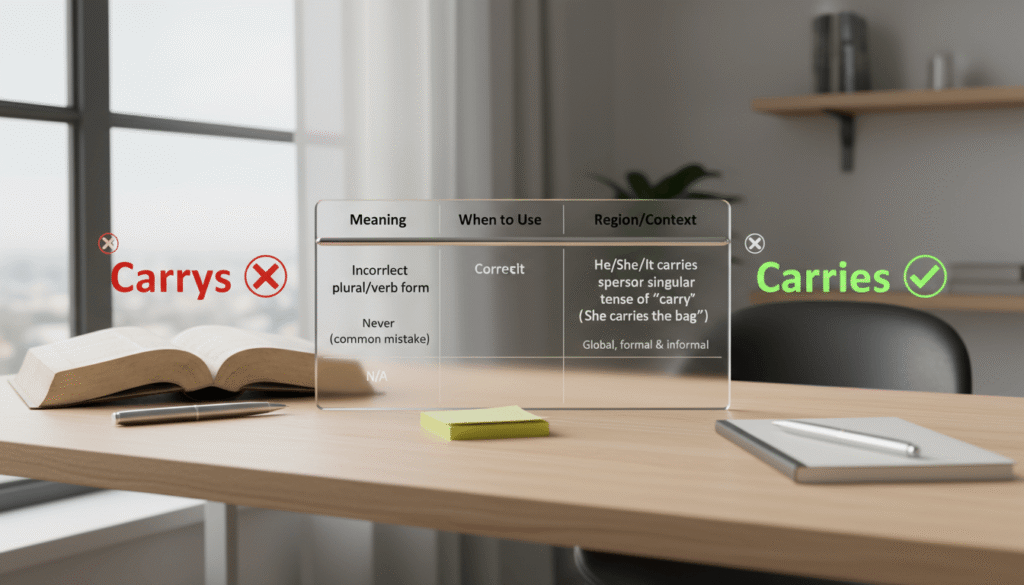
| Term | Meaning | When to Use | Region/Context |
| Carrys | Incorrect spelling | Never | Not standard English |
| Carries | Third-person singular of “carry” | Writing and speaking | Used worldwide |
Examples:
Correct:
“She carries books to class.”
Correct:
“The train carries passengers daily.”
Wrong:
“She carrys books to class.”
Wrong:
“The train carrys passengers.”
Which Version Should You Use?
Your audience matters. But this case is easy because the answer stays the same.
For students
Use carries because teachers and exams follow standard English rules.
For writers and bloggers
Use carries because spelling mistakes hurt trust.
For business and professional writing
Use carries because clean writing looks more professional.
For global use
Choose carries every time.
No major English-speaking country uses carrys.
Common Mistakes with Carrys or Carries
People usually make the same errors.
Mistake 1
❌ She carrys a bag.
✅ She carries a bag.
Why it happens:
People simply add s.
Mistake 2
❌ The company carrys supplies.
✅ The company carries supplies.
Why it happens:
The word ends with y, so the spelling changes.
Mistake 3
❌ He carrys his phone daily.
✅ He carries his phone daily.
Why it happens:
Many writers forget the grammar rule.
Mistake 4
❌ The bus carrys many people.
✅ The bus carries many people.
Why it happens:
Fast typing often causes this mistake.
Mistake 5
❌ My friend carrys snacks.
✅ My friend carries snacks.
Why it happens:
The incorrect spelling sometimes “looks right” at first glance.
Carrys or Carries in Real-World Examples
Professional Email
Subject: Delivery Update
“Hello Sarah,
Our shipping team carries customer orders to nearby locations every morning.”
News Headline
“Local Truck Company Carries Emergency Supplies”
Social Media Post
“My brother carries snacks everywhere 😂”
Formal Report
“The organization carries responsibility for project delivery.”
Weening or Weaning? Correct Spelling Explained (2026)
Carrys or Carries : Data, Trends & Usage
People usually search for carrys or carries for one reason:
They want a fast spelling answer.
Common audiences include:
- Students
- English learners
- Writers
- Bloggers
- Office workers
- Teachers
Search intent:
Informational
People are not trying to buy something. They simply want the correct spelling.
Interest often comes from:
- Homework
- Writing emails
- Blog posts
- Social media content
- School assignments
One interesting thing stands out.
People often search for the wrong spelling because spell-check tools do not always catch mistakes inside a sentence.
That makes quick grammar guides more useful than ever.
Standalone Comparison Table
| Term/Variant | Meaning | Region/Context | Best Used When |
| Carrys | Wrong spelling | None | Never |
| Carries | Correct form of carry | Global English | Every situation |
| Carry | Base verb | General use | Present tense |
Frequently Asked Questions
Q: What does carrys or carries mean?
A: The correct form is carries. It means someone or something holds or moves an object from one place to another.
Q: How do you use carries correctly?
A: Use carries with he, she, or it.
Example:
“She carries a notebook.”
Q: Carrys vs carries : what is the difference?
A: Carries is correct English. Carrys is a spelling mistake.
Q: Is carries acceptable in formal writing?
A: Yes. Carries is fully correct for business writing, reports, emails, and academic work.
Q: Which version is correct : carrys or carries?
A: Carries is the only correct version.
Q: Where does carries come from?
A: It comes from the base word carry, which entered English through older French language roots.
Q: Can carries be used in business writing?
A: Yes. You can use it in reports, emails, articles, and professional communication.
Conclusion
You now have the full answer to carrys or carries.
Remember these key points:
- Carries is correct.
- Carrys is incorrect.
- Words ending in consonant + y often change to i + es.
- The rule stays the same in American English and British English.
Small spelling mistakes can change how your writing looks. A tiny word can affect trust, grades, or even first impressions.
The good news is that this rule is easy to remember once you see it in action.
The next time you stop and wonder about carrys or carries, you will know exactly what to choose.
Bookmark this guide so you never second-guess carrys or carries again. Share it with someone who still gets confused.
Carrys or carries explained with correct spelling, examples, grammar rules, and mistakes to avoid in everyday English writing.
Racquet or Racket : Difference Explained With Examples✅